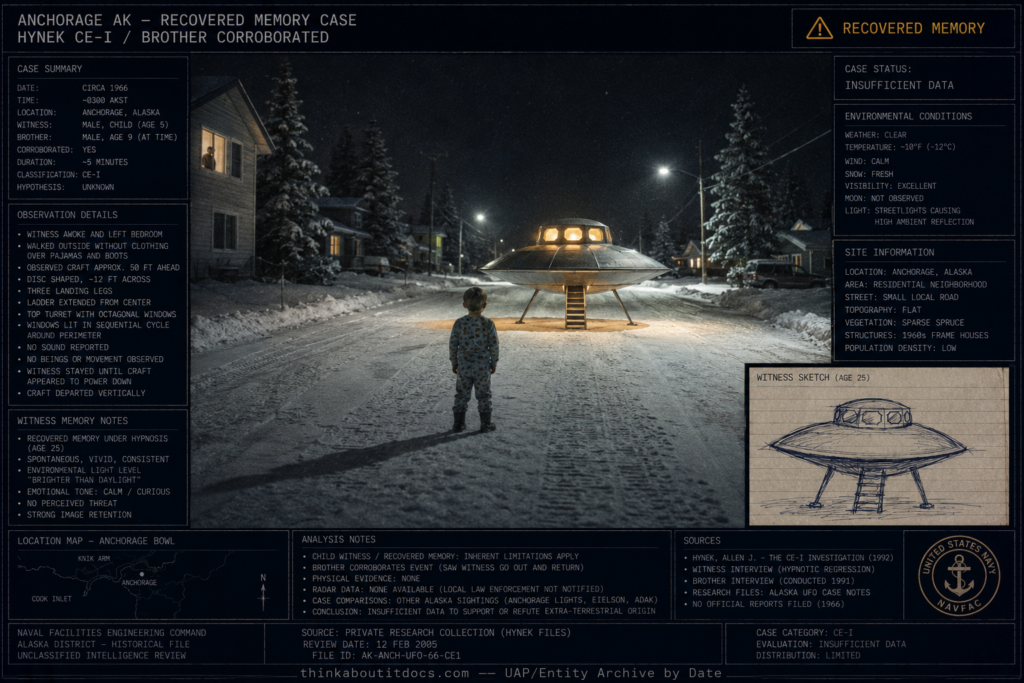
Circa 1966: A child in an Anchorage neighborhood observed a small metallic saucer-shaped craft with turret, landing legs, and ladder sitting on a snow-covered street at 3 AM. His brother independently corroborated the sighting decades later. Recovered memory case — Insufficient Data.
THINK ABOUTIT UFO|UAP SIGHTING REPORT
1966: Anchorage, Alaska UFO|UAP Sighting
Sometime in 1966, a child in a residential Anchorage neighborhood found himself standing in the middle of his snow-covered street in the early morning hours with no memory of having gone outside. Roughly fifty to sixty feet away sat a small saucer-shaped craft on landing legs, with a ladder extended to the ground and a slowly rotating turret on top. He watched it for an indeterminate period before the memory ended. He would not begin to recall any of this until he was in his late thirties — and when he finally told his older brother about it, the brother interrupted to describe the same craft in the same details, seen from his bedroom window.
⚠ RECOVERED MEMORY CASE
This report is based entirely on memories that the primary witness explicitly states he did not begin to recall until approximately 25–30 years after the event. Recovered and repressed memories, while sometimes accurate, are not considered reliable evidence in isolation. The independent corroboration by the witness’s brother strengthens the account but does not resolve the fundamental evidentiary limitations of decades-delayed recall with no contemporaneous documentation.
Date: 1966 (no specific month or day)
Sighting Time: Approximately 3:00 AM
Day/Night: Night
Location: Anchorage, Alaska (residential neighborhood, unspecified)
Urban or Rural: Urban
No. of Entity(‘s): 0
Entity Type: Not applicable
Entity Description: Not applicable
Hynek Classification: CE-I (Close Encounter of the First Kind) — visual observation of an object within 500 feet; no physical traces reported
Duration: Approximately 2 minutes (brother’s estimate from inside the house)
No. of Object(s): 1
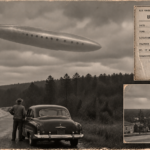
Description of the Object(s): A small metallic saucer-shaped craft sitting on landing legs on a snow-covered residential street. The main body resembled an inverted saucer or teapot lid. A small cylindrical turret approximately 3 feet across and 2–3 feet tall sat atop the craft, featuring octagonal (eight-sided) windows. The witness initially perceived the turret as rotating, but later corrected this — interior lights may have been cycling sequentially around the perimeter, creating the illusion of rotation. Three landing legs supported the craft. A ladder extended from the center of the underside approximately 4 feet to the ground. Little or no sound.
Shape of Object(s): Inverted saucer with cylindrical turret on top; supported by landing legs (possibly three)
Size of Object(s): 12–15 feet across, approximately 6–7 feet high including turret
Color of Object(s): Metallic
Distance to Object(s): 50–60 feet
Height & Speed: Stationary — sitting on landing legs on the street surface
Number of Witnesses: 2 (the reporting witness and his older brother)
Special Features/Characteristics: Octagonal windows on turret with sequentially cycling interior lights creating illusion of rotation. Ladder extended from center underside to ground. Witness has no memory of going outside and reports significant childhood memory gaps prior to seventh grade. Brother independently corroborated the sighting decades later, describing the same craft features without prompting.
Case Status: Insufficient Data
Source: Anonymous self-report filed to UFOEvidence.org on March 29, 2006, with follow-up detail submitted April 2, 2006. Secondary pickup by Phantoms and Monsters blog (January 2012).
Summary/Description: A child in a residential Anchorage neighborhood found himself standing in the middle of a snow-covered street at 3 AM with no memory of going outside, observing a small metallic saucer-shaped craft with turret, landing legs, and ladder from approximately 50–60 feet. He did not begin to recall the memory until his late thirties. His older brother independently corroborated the sighting decades later, describing the same craft details. Recovered memory case — both accounts are from decades-old recall with no contemporaneous documentation.
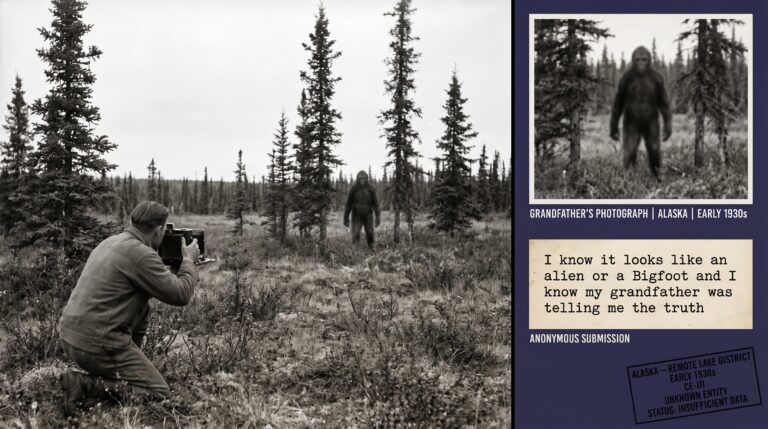
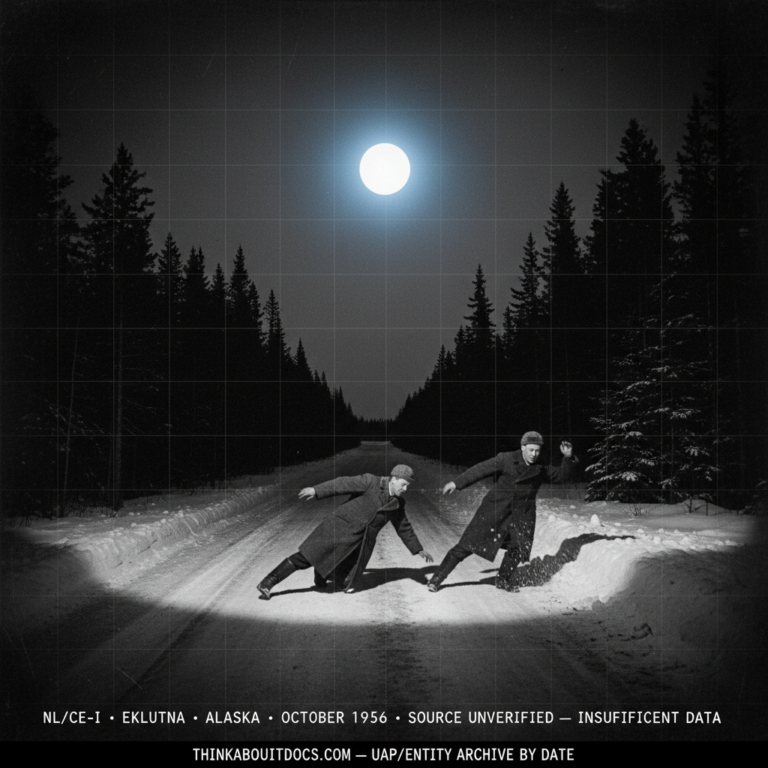
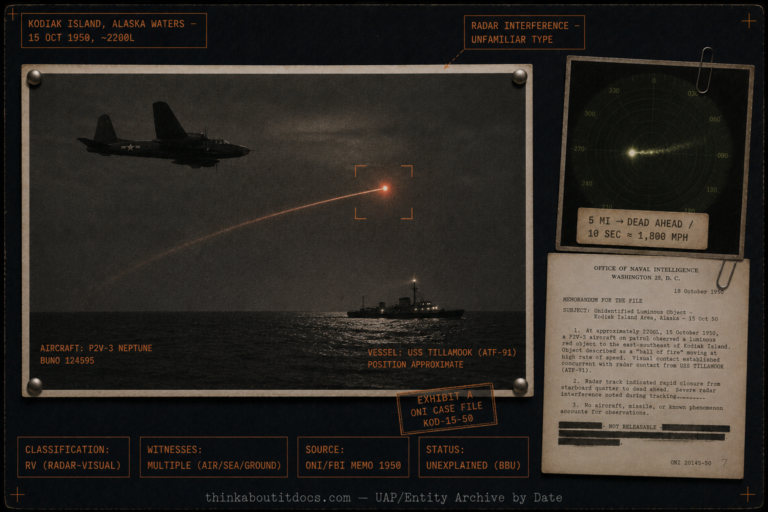
Related Cases: 1936: Sighting in Eklutna | 1950: Kodiak, Alaska — Navy Radar/Visual
Detailed Report
The witness — who has never publicly identified himself — reported in 2006 that he experienced a vivid memory of a UFO encounter that took place approximately forty years earlier in Anchorage, Alaska. He states that he did not begin to remember the event until he was in his late thirties to early forties.
In the memory, he is standing in the middle of his residential street during winter, at approximately 3:00 AM. Fresh snow covers the ground and reflects the streetlights, making the scene unusually bright. No one else is present and the neighborhood is completely quiet. He has no recollection of leaving his house or going outside.
Approximately 50 to 60 feet away, a saucer-shaped craft sits on the street. The main body resembles an inverted saucer or teapot lid, roughly 12 to 15 feet across and 6 to 7 feet high including the turret. A small cylindrical turret approximately 3 feet across and 2 to 3 feet tall sits atop the craft, featuring octagonal (eight-sided) windows that the witness initially perceived as rotating. The craft is supported by landing legs — the witness believes three — and a ladder extends from the center of the underside approximately 4 feet to the ground. The craft produces little or no sound.
In a follow-up report dated April 2, 2006, the witness corrected his description of the turret: rather than physically rotating, the lights inside may have been cycling sequentially from one window to the next around the perimeter, creating the visual effect of rotation.
The witness states that approximately four years before filing the report (circa 2002), he and his older brother were hiking in winter overlooking Anchorage. The witness decided to tell his brother about the memory, expecting to be dismissed. Instead, the brother interrupted and described the same craft — the windows, the size, the shape, the ladder — stating that he had watched it from his bedroom window for approximately two minutes. The brother had never told anyone because he assumed no one would believe him. He had purchased a telescope afterward in hopes of seeing the objects return.
The witness reports that his mother does not remember either child reporting anything at the time. He also notes that he has very limited memory of his childhood prior to seventh grade, a fact well-known to his family. A witness-drawn sketch of the craft was submitted with the original report.
Researcher’s Notes
Two Brothers, One Memory, and the Limits of Decades-Delayed Recall
- Source Chain: This case has no independent source chain whatsoever. It consists of a single anonymous self-report to a public UFO submission database in 2006, describing events from approximately 1966. No investigator interviewed the witness. No physical evidence was collected. No contemporaneous documentation exists. The witness’s mother has no memory of the event. The report was picked up by the Phantoms and Monsters blog in 2012 with no additional investigation.
- The Recovered Memory Problem: The witness explicitly states that he did not begin to remember this event until his late thirties to early forties — a gap of roughly 25 to 30 years. He also reports significant memory gaps across most of his childhood prior to seventh grade. Recovered and repressed memories are one of the most contested areas in psychology. While such memories can sometimes reflect real events, they are also highly susceptible to confabulation, reconstruction, and contamination from later cultural exposure. A child in 1966 Alaska would have had abundant exposure to UFO imagery in popular culture, and decades of additional exposure before the memory surfaced. The absence of any contemporaneous awareness — the mother’s lack of memory, no childhood discussion between the brothers — means there is no anchor point to confirm the event occurred as recalled.
- The Brother’s Corroboration: The independent corroboration by the older brother is the single strongest element of this case. The brother reportedly described the same craft features — windows, ladder, size, shape — without prompting. However, several caveats apply: both brothers grew up in the same household with the same cultural exposures; the conversation happened decades after the event with no record of the brother’s exact words; and we have only the reporting witness’s account of what the brother said. No investigator interviewed the brother independently.
- Hynek Reclassification: The original page classified this as CE-II (Close Encounter of the Second Kind), which requires physical traces such as ground impressions, burns, electromagnetic effects, or physiological impacts on the witness. No such evidence is reported anywhere in the account. The craft was observed at close range (50–60 feet) but left no documented physical trace. The correct classification is CE-I (Close Encounter of the First Kind) — close-range visual observation without physical evidence.
- Assessment: This case is classified Insufficient Data. The brother’s independent corroboration prevents dismissal, but the recovered-memory framework, the absence of any contemporaneous documentation, the anonymous reporting, and the forty-year delay between event and report make it impossible to evaluate the account with confidence. The witness’s tone is sincere and self-aware — he acknowledges the strangeness of his memory gaps and expresses frustration rather than grandiosity. But sincerity is not evidence, and the case cannot support a classification higher than Insufficient Data.
What remains is a small, vivid scene — a child standing alone on a snow-bright Anchorage street at three in the morning, watching a craft that shouldn’t exist sit quietly on its landing legs — and a brother who says he saw the same thing from his bedroom window. Whether the memory records an event or reconstructs one from the raw material of childhood and culture, no available evidence can determine. The case is preserved as a sincere witness account with notable familial corroboration, filed under Insufficient Data.