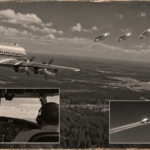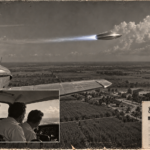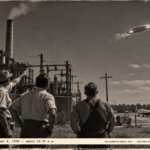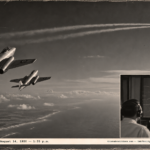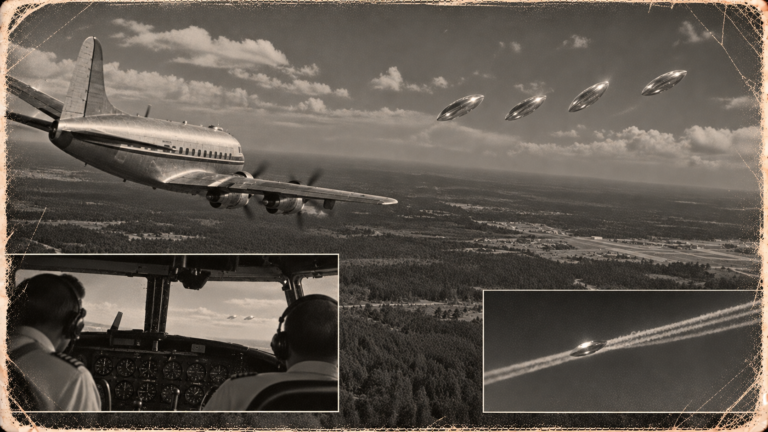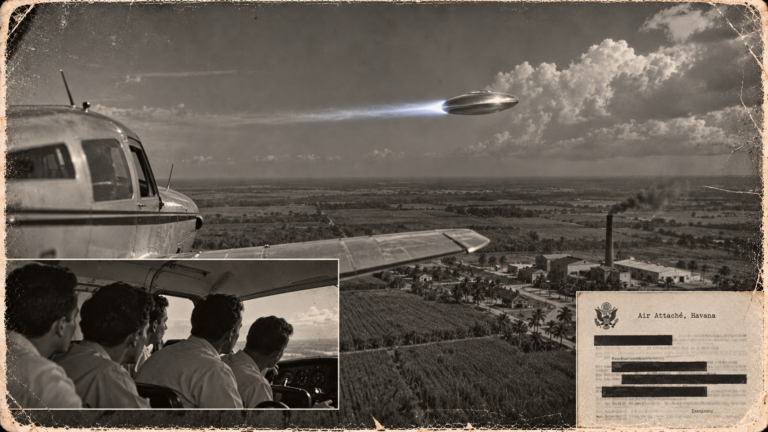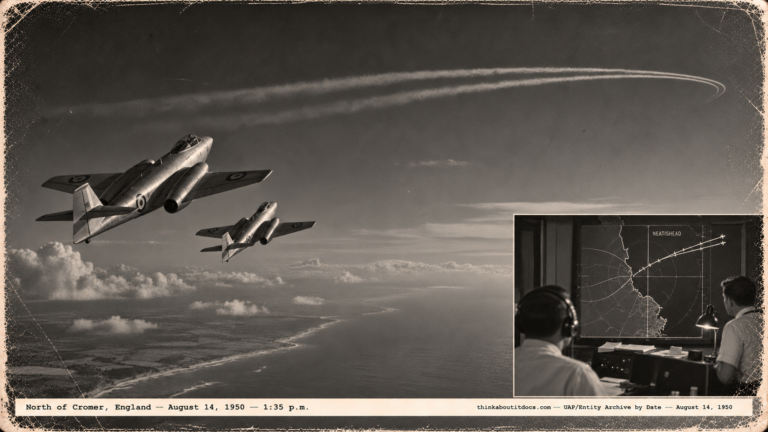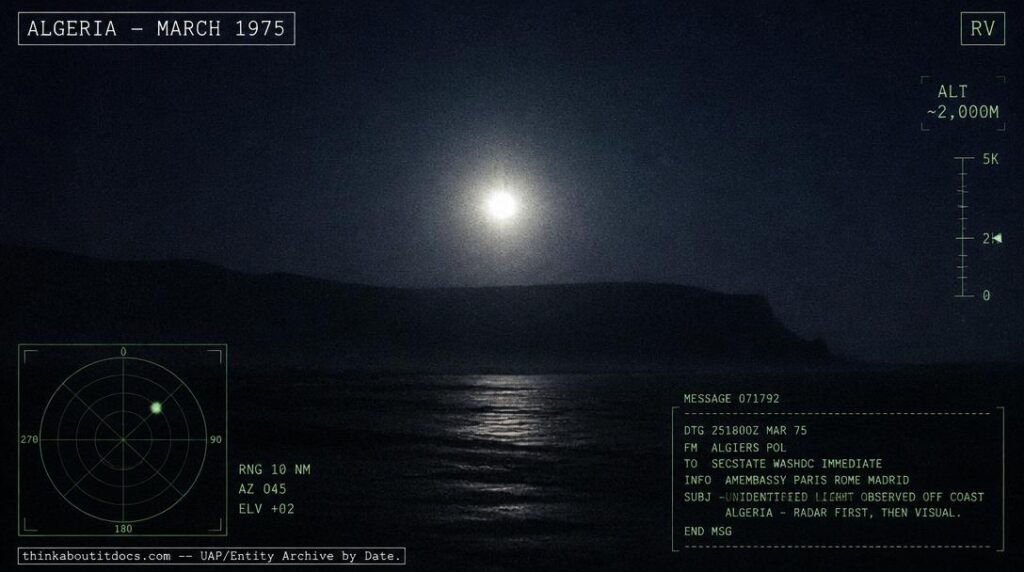
Dossier reconstruction of the radar-and-visual UFO sighting reported over the Algerian coast, March 6, 1975.
THINK ABOUTIT UFO|UAP ENCOUNTER REPORT
1975: Algeria UFO Sightings | Declassified Kissinger Cable Archive
On March 7, 1975, Algeria’s Secretary General of the Ministry of Defense summoned an American Embassy officer in Algiers and asked, in effect, whether Washington had anything to do with the “machines” that had been maneuvering over Algerian airspace for weeks — objects seen five times since January, twice tracked by radar and eyes at once, and reported, more than once, to have landed and taken off again. The next day the officer cabled the whole exchange to Secretary of State Henry Kissinger.
This case is unusual in the archive for its source: not a witness account or a magazine investigation, but a declassified U.S. State Department cable, later published in full in Fawcett and Greenwood’s The UFO Cover-Up. As a contemporaneous diplomatic document rather than a recollection, it is reproduced here close to verbatim, in the cable’s own numbered-paragraph format.
Date: January–March 1975 (cable dated March 1975; sightings began late January, most recent March 6)
Sighting Time: Usually 1900 or 1930 hours (7:00–7:30 PM)
Day/Night: Night
Location: Multiple sites across Algeria — twice near Oran, once in the center of the country, once near Béchar, and most recently off the Algerian coast
Urban or Rural: Undocumented — sightings occurred near military installations and, in the final instance, off the coast; no further terrain detail given
No. of Entity(‘s): 0 — no entities reported
Entity Type: Not applicable — no entities reported
Entity Description: Not applicable
Hynek Classification: RV (Radar/Visual) — applies most precisely to the March 6 sighting, first detected by radar and then confirmed visually; the four earlier sightings in the series are described as visual-only
Duration: Over two hours on one occasion (date within the series not specified)
No. of Object(s): Undocumented precisely — the cable’s opening line refers to plural “machines,” but every subsequent numbered paragraph describes a single “object”; this inconsistency is preserved from the source rather than resolved
Description of the Object(s): An intensely bright light, repeatedly compared by the Algerian official to a car headlight, bright enough to obscure the object’s actual shape; reported to maneuver and to have been seen landing and taking off
Shape of Object(s): Undocumented — obscured by the object’s own brightness
Size of Object(s): Undocumented
Color of Object(s): Very bright light, likened to a car’s headlight; no further color detail given
Distance to Object(s): Undocumented
Height & Speed: Estimated altitude of 2,000 meters on most occasions; the March 6 sighting was reported at approximately 15,000 meters — a figure the cable itself flags as “(SIC),” suggesting the reporting officer considered it anomalously high. No speed given.
Number of Witnesses: Unspecified number; Algerian officials emphasized the object was “always seen by more than one person” and considered hallucination ruled out on that basis
Special Features/Characteristics: Object maneuvered and was reported to land and take off; sightings clustered near military installations; the wave began almost immediately after three American journalists arrived in Béchar in January to cover Malcolm Forbes’s aborted transatlantic balloon attempt, a coincidence Algerian officials noted explicitly; the March 6 sighting was detected first by radar, then visually
Case Status: Unexplained
Source: Fawcett and Greenwood, The UFO Cover-Up (formerly titled Clear Intent), pages 79–80; reproducing declassified U.S. State Department cable no. 071792, March 1975
Summary/Description: A declassified State Department cable from the American Embassy in Algiers to Secretary of State Henry Kissinger records that Algerian defense officials asked the United States directly whether it was responsible for an unidentified object seen maneuvering, landing, and taking off over Algerian airspace on five occasions between January and March 1975 — including one instance in which the object was detected by radar and then confirmed visually.
Related Cases: The cable itself references an earlier report — “Our 2447” — describing a “mysterious balloon” sighted near Oran, Algeria, on January 25, 1975, which the cable’s author identifies as the presumed first sighting in this same sequence. That earlier cable is not separately indexed in this archive.
Detailed Report
The document at the center of this case is a State Department cable, number 071792, sent from the American Embassy in Algiers to Secretary of State Henry Kissinger in March 1975, and later published in full by Barry Greenwood and Lawrence Fawcett in The UFO Cover-Up. It is reproduced here in the cable’s own numbered-paragraph structure, condensed for readability but not altered in substance.
The cable opens by reporting that Algeria’s Secretary General of the Ministry of Defense, Col. Abdelhamid Latrache, had summoned the embassy officer to the Ministry on March 7 to ask whether the United States could shed any light on strange “machines” that had been maneuvering over Algerian airspace in recent weeks.
Latrache traced the story back to the previous January, when three American journalists arrived in Béchar to cover the anticipated arrival of a balloon launched from California — a reference the embassy officer took to mean journalists covering Malcolm Forbes’s proposed transatlantic balloon flight, which had been aborted at the last minute. Almost immediately after the journalists’ appearance, Latrache said, Algerians began seeing strange objects in the sky, observed near military installations by what he called responsible people — which was why Algerian officials had come to the Americans first.
By Latrache’s account, the object had been seen five times, usually around 1900 or 1930 hours, and on one occasion had remained visible for over two hours. Sightings had occurred twice near Oran, once in the center of the country, once near Béchar, and, most recently, off the Algerian coast the night before the meeting (March 6). The object carried a very bright light — Latrache repeatedly compared it to a car’s headlight — bright enough that it obscured the object’s actual shape. It maneuvered, and had reportedly been seen to land and take off. The March 6 sighting was detected first by radar and then confirmed visually; the object’s altitude on that occasion was recorded at roughly 15,000 meters, a figure marked “(SIC)” in the cable itself, while other sightings placed it at an estimated 2,000 meters. Latrache stressed that the object had always been seen by more than one person, which in his view ruled out hallucination; he did not appear especially alarmed, but was clearly treating the reports seriously.
The embassy officer noted that Algerian officials had previously asked about a mysterious balloon, and that American inquiries at the time had turned up nothing. Latrache replied that the balloon case was closed and this was a separate matter. He mentioned that Algeria was independently tracking the U.S. Sixth Fleet by radar and aircraft surveillance, and wondered whether the new sightings might be connected to fleet maneuvers. The officer allowed that the coastal sighting could conceivably be fleet-related, but stated categorically that no American aircraft, machines, or balloons were operating in Algerian airspace without explicit Algerian authorization — and promised to cable Washington immediately to ask whether any agency had relevant information.
In his own closing comment, the officer connected the case to an earlier cable — “Our 2447” — which had reported a mysterious balloon sighted near Oran on January 25, and which he took to be the first sighting in the same sequence. He noted that Col. Latrache was not an excitable person and that Algerian military officials were generally matter-of-fact, and offered his own working assumption that the Algerians had genuinely seen something, most likely a natural phenomenon that had since generated what he called mild hysteria and a run of repeated sightings — while adding that, given the level at which the inquiry had been raised, Washington needed to take it seriously regardless. The cable closes with a formal request for any information addressees could provide, particularly regarding the alleged radar sighting of March 6, noting that Latrache had already rejected the officer’s own suggestions that the object was a satellite or a searchlight reflecting off clouds.
RESEARCHER’S NOTES
The Kissinger Cable — Algeria 1975 and a Radar-Visual Sighting Wave
- Classification Notes: RV (Radar/Visual) applies most precisely to the March 6 sighting, in which radar detection preceded visual confirmation — matching Hynek’s own definition of the category. The four earlier sightings in the same series are described only as visual, so filing the entire case under RV is a documented simplification of a mixed-evidence sequence, not an error, but worth noting as such.
- Source Chain Assessment: This is a declassified State Department cable, a contemporaneous internal diplomatic communication rather than a later recollection, published in full in Fawcett and Greenwood’s The UFO Cover-Up. That places it among the more rigorously documented sources in this archive, though it is also, by nature, a secondhand American summary of what an Algerian official reported — not a first-hand sighting account.
- Terminology Inconsistency: The cable’s opening line refers to plural “machines,” but every numbered paragraph that follows describes a single “object.” This is preserved here as a genuine inconsistency in the primary source rather than resolved one way or the other, since doing so would require assuming information the cable doesn’t provide.
- Landing Claim vs. Classification: Paragraph 3 of the cable states the object “has been seen to land and take off” — a claim that, absent any described physical trace evidence, sits uneasily between RV and Hynek’s CE-II category (close encounters involving physical effects). No ground search or trace evidence is mentioned anywhere in the source, so the case is filed under RV as reported rather than upgraded on the strength of an unelaborated claim.
- Corroborating Context: The cable directly ties the sighting wave’s origin to the January arrival of American journalists covering Malcolm Forbes’s aborted balloon flight, and cross-references an earlier cable, “Our 2447,” reporting a “mysterious balloon” near Oran on January 25 — indicating Algerian officials at the time considered the balloon episode and the later sightings potentially connected.
- The Cable-Writer’s Own Assessment: The officer’s closing comment section explicitly offers his own working theory — that Algerians had likely seen a natural phenomenon that generated “mild hysteria” — while stressing the inquiry still had to be taken seriously given the level at which it was raised. That contemporaneous American assessment is preserved here as part of the record, not adopted as this archive’s own conclusion.
Few cases in this archive come with a paper trail this direct: a sitting Algerian defense official pressing an American embassy officer for answers, and that officer cabling the exchange to the Secretary of State within a day. What the cable does not offer is resolution — no follow-up reply, no confirmed explanation, and no indication the “alleged radar sighting” of March 6 was ever definitively accounted for. It remains filed here as Unexplained, on the strength of the document itself rather than any conclusion drawn from it.
“He kept comparing it to headlight of a car.”