July 19, 1952 — Puerto Maldonado, Peru
THINK ABOUTIT UFO|UAP SIGHTINGS REPORT
1952 Puerto Maldonado, Peru: A Customs Inspector’s Photo and a Tangle of Witnesses
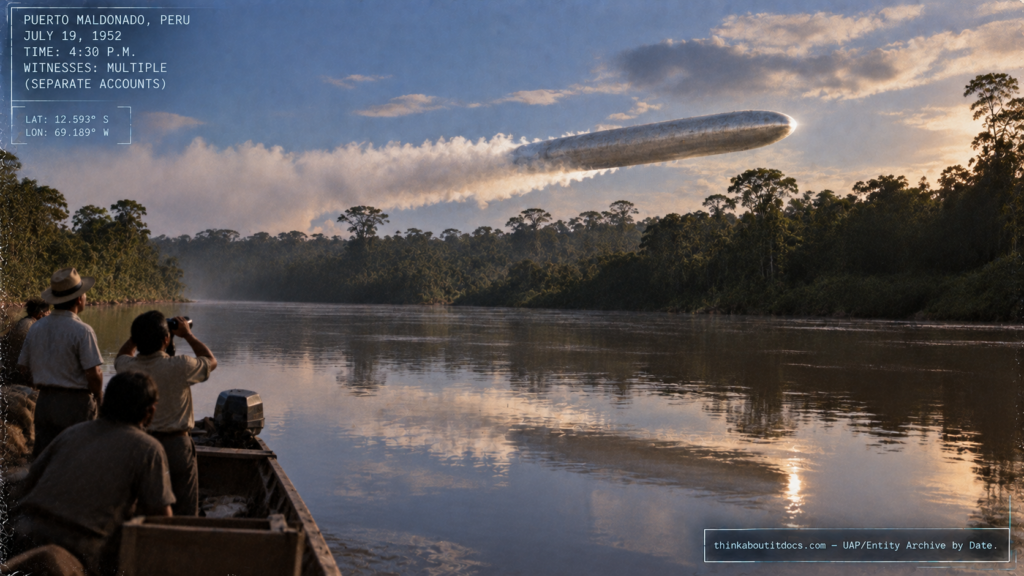
At 4:30 in the afternoon of July 19, 1952, Peruvian Customs Inspector Domingo Troncoso, stationed on the jungle frontier with Bolivia at Puerto Maldonado, watched a massive cigar-shaped object drift low over the Madre de Dios River, trailing a dense wake of thick white vapor from its tail — and had the presence of mind to grab a camera and capture it, reflection and all, in the river below. It’s a genuinely rare kind of case: multiple independent witness accounts of what may be the same object, radio blackouts reported at the time, and a tangled, honestly-preserved web of conflicting details — a disc versus a cigar, one photograph versus three, even 1951 versus 1952 — that this archive presents without trying to force into a single tidy narrative.
Date: July 19, 1952 (a Lima newspaper account of a related report gives the date as July 19, 1951 — likely a transcription/translation error, addressed below)
Sighting Time: 4:30 p.m. (16:30)
Day/Night: Afternoon
Location: Puerto Maldonado, Peru (Madre de Dios region, near the Bolivian border)
Urban or Rural: Urban (jungle frontier town)
No. of Entity(‘s): Not Applicable
Entity Type: Not Applicable
Entity Description: Not Applicable
Hynek Classification: DD (Daylight Disc — despite the primary photograph’s cigar shape, this category is retained per the site’s own established Hynek usage for large daylight-observed craft)
Duration: Object visible for 1-2 minutes per one independent account; the vapor trail it left behind reportedly remained visible for more than 15 minutes afterward
No. of Object(s): 1
Description of the Object(s): Troncoso’s photograph shows a large, cigar/dirigible-shaped object emitting a dense trail of thick whitish smoke or vapor from its aft end; a separate account from witness Pedro Bardi instead describes a round object, and a Lima newspaper account describes a “luminous disc” with an intensely orange head or nucleus
Shape/Size/Color of Object(s): Cigar-shaped in the surviving photograph, estimated over 100 ft long; intense orange coloring per the newspaper account of the separate but possibly related “luminous disc” report
Distance to Object(s); Not precisely specified for Troncoso’s sighting; the object was clearly visible above the jungle treeline along the riverbank in the photograph, with its own reflection visible in the water below
Height & Speed: Flying horizontally and fairly low; a separate account estimated altitude at 2,500-3,000 ft and calculated the object’s speed at approximately 1,117 mph based on it being independently sighted again 120 kilometers away only four minutes later
Number of Witnesses: Multiple, across what may be one or several related sightings: Domingo Troncoso (the photographer); a Peruvian school teacher who separately took a photograph; agricultural engineer Pedro Bardi and farm owner Pedro Arellano, who watched from a different location as their radio went dead; and unnamed additional observers referenced in a Lima newspaper account
Special Features/Characteristics: The object’s reflection is visible in the Madre de Dios River in Troncoso’s photograph, a detail cited as evidence the object was a real, physical, structured craft rather than a processing artifact; radio communications reportedly went dead during at least one witness’s observation; a Lima newspaper account describes possible falsification involving three different photographs taken by three different people, a detail the original American intelligence report itself found confusing and incomplete
Case Status: Unresolved and genuinely tangled — multiple witness accounts appear to describe either the same event from different vantage points or several related but distinct sightings on the same day, with inconsistent shape descriptions (cigar vs. disc), a possible one-year date discrepancy in at least one secondary source, and an unresolved reference to photograph falsification that the original 1952-era American intelligence report itself could not clarify
Source: Wendelle Stevens; B.J. Booth; Mark Cashman; Col. McHenry Hamilton, Jr., USAF (American Air Attaché, Lima, Peru); El Comercio (Lima newspaper); James Moseley/NICAP (via a letter dated August 10, 1957, relaying an account from Pedro Bardi); UFO Photographs Around the World Vol. 2 (Roberts/Stevens, 1985); Loren Gross, UFOs: A History, 1951 booklet
Summary/Description: At 4:30 p.m. on July 19, 1952, Peruvian Customs Inspector Domingo Troncoso, stationed at Puerto Maldonado near the Bolivian border, observed a large cigar-shaped object flying low and horizontally over the Madre de Dios River, trailing a dense wake of thick whitish vapor from its rear. He photographed the object, and its reflection is visible in the river beneath it, cited as evidence of its physical reality. Separately, a Lima newspaper reported a “luminous disc” with an intense orange nucleus seen in the same general area and timeframe, during which a local radio station reportedly went dead and could not transmit or receive. A school teacher in the area also took a photograph. In a 1957 letter to NICAP investigator James Moseley, witness Pedro Bardi described watching a round object pass at an estimated 100 meters altitude from a different vantage point, during which his own radio conversation with Lima was interrupted; he calculated the object’s speed at roughly 1,117 mph based on it being sighted again 120 kilometers away only four minutes later. American Air Attaché Col. McHenry Hamilton, Jr. compiled an intelligence report on the incident that referenced possible falsification involving three separate photographs from three separate people, a detail the report itself described as unclear.
Related Cases: One of several 1952 Peru/South American reports involving radio interference coinciding with a UFO sighting, a recurring detail across multiple unrelated cases and locations from this era
Detailed Report
The Puerto Maldonado case is one of the more evidentially complex reports of July 1952, built from several partially overlapping — and partially contradictory — accounts rather than a single clean narrative, and it’s preserved here with that complexity intact rather than smoothed into false clarity.
At about 4:30 p.m. on July 19, 1952, Customs Inspector Domingo Troncoso, working with the Peruvian Customs Office at Puerto Maldonado on the jungle frontier with Bolivia, noticed a very strange cigar-shaped object over the river area. The large, dirigible-shaped craft was flying horizontally and fairly low, passing from right to left across his field of view, leaving a dense trail of thick whitish smoke or vapor emitted from its aft end. Troncoso obtained a camera and captured one good photograph. That the object was a real, physical craft — rather than a processing flaw or fabrication — was argued from its clear reflection visible in the waters of the Madre de Dios River beneath it, well above the broad-leaved jungle trees along the bank in the photograph’s foreground. The object was estimated at over 100 feet in length.
A separate account, submitted through Col. McHenry Hamilton, Jr., the American Air Attaché in Lima, translated a Lima newspaper article describing a “luminous disc” that sped over the same general Puerto Maldonado area near the Bolivian border at approximately 4:50 p.m. on July 19 — sourced by the site’s original account to 1951, likely a transcription or translation error given every other detail (location, description, timing) matches the 1952 date used throughout the rest of the case. Among the witnesses to this report was a Peruvian school teacher who took a separate photograph of the object. The newspaper account described the disc’s head or nucleus as an intense orange color, moving south to north, visible for 1 to 2 minutes, leaving a thick vaporous trail that remained visible for more than 15 minutes, at an estimated altitude of 2,500 to 3,000 feet. During its passage, the local radio station of the Peruvian Corporation of the Amazon reportedly went dead and could not transmit or receive.
The Peruvian Minister of Education later held discussions with American Embassy officials about the report, and the school teacher’s photograph, along with an account of those discussions, was published in the August 15 issue of the Lima newspaper El Comercio. The American intelligence report on the case is described as incomplete, containing an unexplained reference to more than one photograph; Colonel Hamilton was told by Peruvian authorities that some falsification had occurred, involving three different photographs taken by three different people — a claim the surviving documentation doesn’t clarify further.
A third, independently sourced account comes from a 1957 letter that investigator James Moseley sent to NICAP, describing a conversation with agricultural engineer Pedro Bardi in Lima. Bardi said that on July 19, 1952, while at a farm in the Madre de Dios area owned by Pedro Arellano, he and others were talking to Lima by radio at about 4:30 p.m. when the radio suddenly went dead. Looking outside, they saw a round object passing at high speed, estimated at about 100 meters altitude, smaller than a DC-3, making a buzzing sound. Bardi determined the object’s speed from a report that it was seen again four minutes later near Puerto Maldonado, 120 kilometers away — a calculation yielding roughly 1,117 mph. The photograph obtained from Troncoso showed a cigar shape rather than the round shape Bardi described, a discrepancy Moseley suggested might be explained by an elongation effect from the object’s speed. Moseley told NICAP he found the photograph itself genuine, while adding he personally doubted the object was anything but earth-made. He further noted that when the smoke trail eventually settled to the ground, it turned out to be a mass of thin fibrous threads.
RESEARCHER’S NOTES
The Puerto Maldonado Case — Multiple Witnesses, an Honestly Unresolved Tangle
- The case’s central strength — multiple, largely independent witness accounts of possibly the same event — is also its central complication. Troncoso’s cigar-shaped photograph, Bardi’s round-object account, and the newspaper’s “luminous disc” description don’t cleanly agree on the object’s shape, even as they align reasonably well on timing, general location, and the striking detail of radio interference.
- The falling “fibrous threads” from the smoke trail is a specific, checkable physical detail rarely present in UFO literature of this era. Whatever caused it, this is the kind of concrete trace evidence that distinguishes the case from a purely visual report.
- The reference to “falsification” involving three photographs from three people is a serious unresolved thread, not a minor footnote. The original American intelligence report itself flagged this as confusing and incomplete — meaning the case’s photographic record may be more tangled than a single “the photo is genuine” verdict can capture.
- Radio interference coinciding with the sighting recurs across multiple, independently sourced accounts within this same case. Both the newspaper account and Bardi’s separate account describe radio equipment failing during observation — a consistent detail across otherwise differing witness descriptions.
- Even NICAP’s own investigator, while defending the photograph’s authenticity, explicitly doubted an extraterrestrial origin. Moseley’s 1957 assessment — genuine photo, likely earth-made object — is a useful, moderate position preserved directly from the original correspondence rather than imposed after the fact.
The Puerto Maldonado case is a genuinely complicated, multi-witness report that resists being smoothed into a single clean narrative — differing shape descriptions, an unresolved photograph-falsification claim, and at least one likely date transcription error all sit alongside consistent details like the radio interference and the object’s reflection in the river. It’s presented here with that tangle intact, since forcing it into tidier shape would misrepresent what the sources actually say.
“It seems obvious to me that the photo is genuine. Incidentally, I strongly doubt if this particular saucer was anything but earth-made.”
— James Moseley, letter to NICAP, August 10, 1957.