THINK ABOUTIT UFO | UAP SIGHTING REPORT
1947: Nine Flying Discs Encountered by B-17
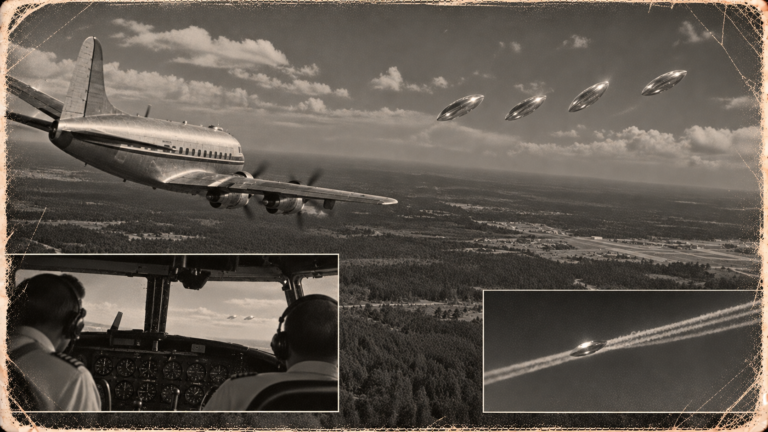
Riding in the glass nose of a B-17 over Promontory Point, Utah, at half past three on a perfectly clear afternoon in July 1947, an Air Force officer first took them for big white birds — until they closed on the bomber so fast he grew alarmed. Nine round discs, each forty to sixty feet across, rose from the Salt Flats at high speed, veered off the left wing close enough to read their color, and climbed away in a tight V of three-by-three before vanishing in seconds. The officer had a brand-new movie camera with a telephoto lens sitting right in front of him and never thought to lift it. He had been overseas for eighteen months and, by his account, knew nothing of the “flying saucer” furor then sweeping the States — yet what he described aligned, almost to the detail, with the wave breaking back home.
Date: July 16, 1947
Sighting Time: 15:30 hours
Day/Night: Day
Location: Promontory Point, Utah (over the Salt Flats), observed from a B-17 in flight
Urban or Rural: Rural
No. of Entity(‘s): None reported
Entity Type: Not applicable — no occupants or entities observed
Entity Description: Not applicable
Hynek Classification: DD (Daylight Disc) — metallic/structured objects observed in daytime flight
Duration: A few seconds
No. of Object(s): 9
Description of the Object(s): Nine round, metallic discs, approximately 40–60 feet in diameter, with sand-colored tops and light-blue underbellies. They rose from the Salt Flats at high speed and performed a climbing flight in a V-formation of three groups of three before disappearing within seconds.
Shape of Object(s): Round disc
Size of Object(s): Approximately 40–60 feet in diameter
Color of Object(s): Sand-colored tops; light-blue underbellies
Distance to Object(s): Close — the objects veered near enough to the left wing for color and shape to be identified
Height & Speed: Rose from the Salt Flats at “great speed” in a climbing flight; precise speed not measured. Initially appeared to head toward the aircraft before veering left and climbing away.
Number of Witnesses: 2 — the reporting officer (ETW, later a retired USAF Colonel; Aircraft Distribution Officer, Far East Air Materiel Command) and the flight engineer (T/Sgt “GJH,” name withheld). The pilot did not see the objects.
Special Features/Characteristics: Nine objects in a structured 3-3-3 V-formation; rose from ground level (Salt Flats) at high speed; two-tone coloration (sand-colored top / light-blue underbelly) noted from differing crew vantage points, suggesting possible counter-shading; extreme speed and climb rate; clear weather; no sound reported; witness had a telephoto movie camera at hand but did not film
Case Status: Insufficient Data
Source: UFO Casebook (eyewitness report submitted by the witness, “ETW, Col. USAF (Ret.),” California)
Summary/Description: On July 16, 1947, at 15:30, a USAF officer riding in the nose of a B-17 being ferried from Middletown Air Depot, Pennsylvania back toward Japan saw nine objects rise from the Salt Flats near Promontory Point, Utah. Initially mistaking them for white birds, he grew alarmed as they approached at high speed; they then veered off the left wing, close enough for him to identify nine round discs about 40–60 feet in diameter with light-blue undersides, climbing away in a 3-3-3 V-formation and gone within seconds. The flight engineer corroborated the sighting and added that, from his vantage, the tops appeared sand-colored; the pilot did not see them. The witness reported the sighting to the Operations Section at Travis Air Force Base as directed, kept a written record of the details in his wallet and a copy in his strongbox for decades, and related the account publicly only much later.
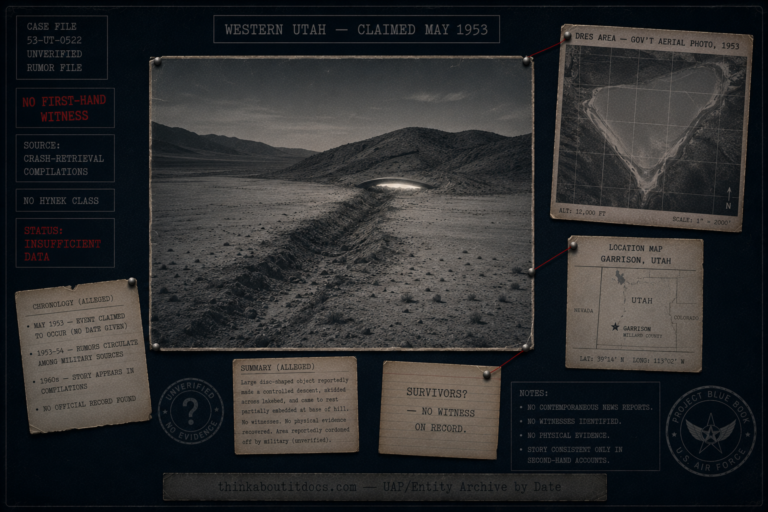
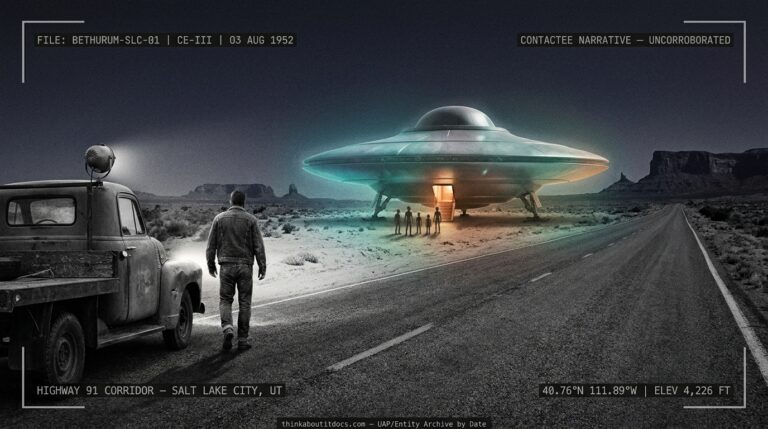
Related Cases: Kenneth Arnold sighting, June 24, 1947 (wave context, formation of nine objects); 1952 Crash in Western Utah; 1952 Encounters near Salt Lake City, Utah; broader July 1947 nationwide disc wave
DETAILED REPORT
This is a daylight aerial observation by military aircrew during the opening weeks of the modern UFO era. The reporting witness, identified only by the initials ETW and described as a retired USAF Colonel, stated that in 1947 he was the Aircraft Distribution Officer for the Far East Air Materiel Command at Fuchu, Japan, and was overseeing a project to ferry B-17 aircraft from the Pacific theater to the Middletown Air Depot in Pennsylvania for conversion into air-sea rescue aircraft. He was a passenger aboard a modified B-17 on the return leg toward Japan when, approaching Promontory Point, Utah at 15:30 on July 16, 1947, he saw objects rising from the Salt Flats.
By his account he was positioned in the aircraft’s nose with an unobstructed forward view. He first took the objects for large white birds, then became alarmed as they closed on the bomber at high speed. They veered to the left, passing close enough off the left wing for him to identify them as nine round discs roughly 40–60 feet in diameter with light-blue underbellies, climbing away in a V-formation arranged in three groups of three. The entire event lasted only a few seconds. He went immediately to the cockpit; the pilot had not seen the objects, but the flight engineer, a technical sergeant whose name he withheld, confirmed the sighting and — from his lower vantage point — added that the tops of the discs appeared sand-colored. The weather was clear. The witness noted he had reported the sighting to the Operations Section at Travis Air Force Base as directed by a senior officer, and that he had carried a written record of the date and details in his wallet for decades, with a duplicate in his strongbox, in case anyone ever asked for names and dates.
The case has genuine strengths and a clear ceiling. On the strength side: two independent military witnesses with a professional observing background, a precise date and time, clear weather, a close pass allowing color and shape resolution, and a strikingly specific configuration (nine objects, 3-3-3 V, two-tone counter-shaded coloration). The witness’s claim of having been overseas and unaware of the contemporaneous U.S. saucer excitement, if accurate, would reduce the role of cultural priming, and his decades-long record-keeping speaks to sincerity. On the limiting side: the account is a personal narrative submitted to UFO Casebook and related publicly only many years after the event, with the corroborating engineer anonymized and the reporting officer himself effectively anonymous (initials only). No contemporaneous 1947 report, no Travis AFB Operations record, and no Project Blue Book or other official file is reproduced or cited; the brand-new telephoto movie camera went unused, so no imagery exists. The phrase “United States Air Force” is itself a minor anachronism for July 16, 1947 — the service was the U.S. Army Air Forces until September 18, 1947 — which is consistent with a later retelling using the witness’s eventual service identity rather than a contemporaneous one.
RESEARCHER’S NOTES
Nine Over the Salt Flats — Promontory Point 1947 and the Limits of a Late-Reported Military Account
- Classification Assessment: DD (Daylight Disc) is correctly applied and should stand. The objects were structured, disc-shaped, observed in daytime flight, and resolved by color and form at close range, with no occupants, landing, or close-approach physical effects. No Close Encounter category applies. The two-tone coloration and tight formation are descriptive details within the DD framework rather than grounds for reclassification.
- Source Chain Assessment: This is the case’s principal limitation. The originating source is a first-person narrative submitted to UFO Casebook, a popular case-collection website, rather than a contemporaneous document or an investigation by a primary research organization. Under the archive hierarchy this sits in the Plausible-to-weak band: the witness presents as credentialed (a retired Colonel with a specific 1947 posting), and the account is internally detailed and consistent, but it is self-reported, anonymized (initials only for the primary, name withheld for the corroborating engineer), and undated as to when it was written. No Travis AFB Operations Section record, Blue Book file, or other official paper trail is reproduced. The “USAF” anachronism (the USAAF did not become the independent U.S. Air Force until September 1947) is a tell of later retelling, not necessarily of fabrication, but it underscores the temporal distance between event and account.
- Pattern Context: The case is a textbook July 1947 wave entry, occurring about three weeks after Kenneth Arnold’s June 24 sighting. The detail of nine objects is notable — Arnold’s celebrated report also involved nine objects in formation — which cuts two ways: it situates the account squarely within the wave’s dominant imagery, and it raises the possibility (which the witness’s “unaware of the excitement” claim is meant to forestall) of conformity to the period’s most famous template. The objects rising from the Salt Flats at speed and the 3-3-3 V-formation are consistent with numerous structured-formation reports of the era. The two-tone counter-shading (sand top, blue underside) is an unusual and specific observation that does not derive obviously from the stock saucer imagery of 1947.
- Physical Evidence and Evidentiary Weight: There is no physical evidence — no film (the telephoto camera went unused), no photograph, no radar, and no reproduced official report. The evidentiary weight rests on dual military-witness testimony, partially corroborated (the pilot did not see the objects; the engineer did). The strengths are the witness quality, the precision of the description, and the clear conditions; the weaknesses are the late, self-published, anonymized sourcing and the absence of any documentary corroboration. These factors place the case at Insufficient Data: it is a high-interest, high-credibility-profile account that cannot be independently verified from the record as held. Recovery of a Travis AFB Operations record or a Blue Book/early-USAF file matching the date and route would be the path to an Unexplained upgrade.
The Promontory Point B-17 case is one of the more credible-sounding aircrew reports of the 1947 wave — two military observers, a precise time and place, clear skies, a close pass, and an oddly specific two-tone, nine-object, 3-3-3 formation — carried by a witness who kept the details in his wallet for decades. But credibility of profile is not the same as verification of record. The account reached daylight late, through a self-submitted narrative on a case-collection site, with the corroborating engineer anonymized, no contemporaneous paperwork reproduced, and a service-name anachronism marking the distance between event and telling. The archive’s position is Insufficient Data: a strong, sincere, professionally-described observation that remains uncorroborated by any document on hand. It is retained as a high-merit candidate for official-record recovery — the Travis AFB report the witness says he filed would, if found, materially change its standing.