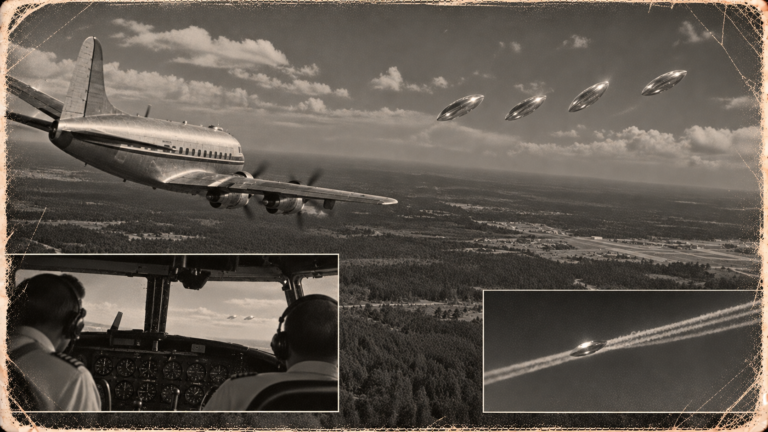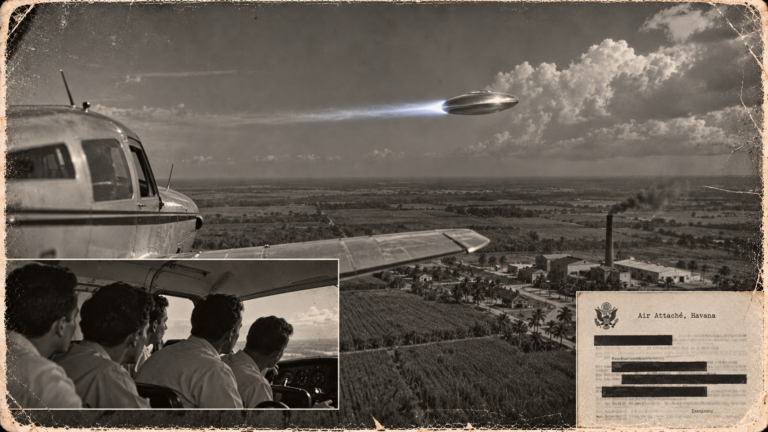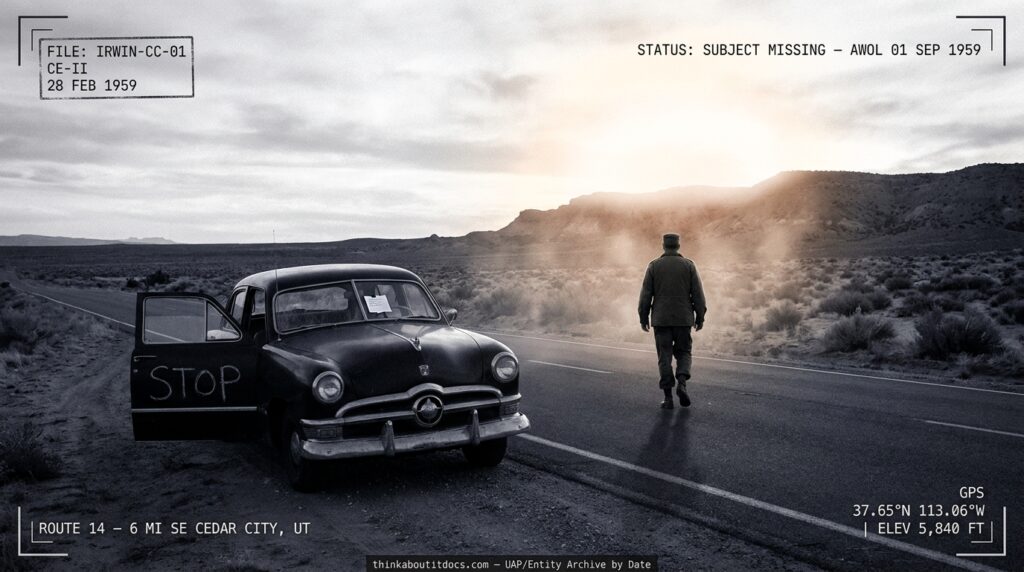
PFC Gerry Irwin left his car with a note and walked toward a glowing object behind a ridge near Cedar City on February 28, 1959. He was found unconscious ninety minutes later. He has never been seen since August 1959.
THINK ABOUTIT DISAPPEARANCE REPORT
1959: The Disappearance of Private Irwin
On a February night in 1959, a Nike missile technician named Gerry Irwin pulled his car off Route 14 near Cedar City, Utah, scrawled “STOP” in shoe polish on his vehicle, and walked into the desert to investigate what he believed was a crashing aircraft. He was found unconscious ninety minutes later. There had been no airplane crash. What followed — a cascading sequence of blackouts, fugue states, compulsive return to the encounter site, and an ultimate vanishing from which Irwin has never resurfaced — constitutes one of the most disturbing and least resolved missing-person cases in the UFO literature.
The Irwin case occupies an uncomfortable space between conventional UFO sighting report and something far stranger — a human life seemingly derailed by a single observation of an unidentified aerial phenomenon, followed by behavioral disintegration that no medical authority of the era could explain.
Date: February 28, 1959 (initial sighting); behavioral episodes through August 1, 1959; AWOL as of August 1959
Sighting Time: Afternoon/Evening
Day/Night: Afternoon transitioning to evening
Location: Route 14, approximately six miles southeast of Cedar City, Utah
Urban or Rural: Rural
No. of Entity(‘s): None observed
Entity Type: Not Applicable
Entity Description: Not Applicable
Hynek Classification: CE-II (Close Encounter of the Second Kind) — Observation of an unidentified object with associated physical or physiological effects on the witness
Duration: Initial sighting brief; witness found unconscious approximately 90 minutes after leaving his vehicle
No. of Object(s): 1
Description of the Object(s): A brightly glowing object that crossed the sky in a descending trajectory, initially resembling an aircraft making a forced landing
Shape of Object(s): Not clearly defined; described as a glowing object
Size of Object(s): Not estimated
Color of Object(s): Bright glow (specific color not recorded)
Distance to Object(s): Object appeared to descend behind a ridge; witness walked toward the estimated landing area
Height & Speed: Descended from altitude across the sky; speed consistent with a craft in controlled descent
Number of Witnesses: 1 (PFC Gerry Irwin, initial sighting); search party found him unconscious
Special Features/Characteristics: Witness rendered unconscious for approximately 23 hours following the encounter; subsequent fugue states, blackouts, and compulsive return to the encounter site over a period of months; missing jacket recovered weeks later at the original site with a paper-wrapped pencil in its buttonhole — paper was burned by the witness upon recovery; witness ultimately listed AWOL and has never been seen again
Case Status: Unexplained
Source: Jacques Vallée, Passport to Magonia (Case 482); James Lorenzen / APRO; B.J. Booth research compilation
Summary/Description: PFC Gerry Irwin, a Nike missile technician stationed at Fort Bliss, Texas, was driving from Nampa, Idaho back to his post on February 28, 1959. Near Cedar City, Utah, on Route 14, he observed a brightly glowing object crossing the sky in a descending trajectory. Believing he was witnessing an aircraft crash, Irwin left a note on his steering wheel requesting that anyone finding it call law enforcement, wrote “STOP” in shoe polish on his car, and walked toward the apparent landing site. A Fish and Game inspector found the note approximately 30 minutes later and alerted the Cedar City Sheriff. A search party located Irwin unconscious in the field with no sign of any aircraft crash. He could not be awakened for approximately 23 hours, and his jacket was missing. Over the following months, Irwin experienced recurring blackouts, fugue states, and a compulsive return to the encounter site where he recovered his jacket with a paper-wrapped pencil — he burned the paper immediately upon finding it. After multiple psychiatric evaluations that returned normal results, Irwin was listed AWOL on September 1, 1959, and has never been located.
Related Cases: 1959 February Sightings Index
Detailed Report
Private First Class Gerry Irwin was a Nike missile technician stationed at Fort Bliss in El Paso, Texas. On February 28, 1959, he was driving south from Nampa, Idaho, where he had been on leave, back to his duty station. At Cedar City, Utah, he turned southeast onto Route 14. Approximately six miles from the turnoff, the landscape was suddenly illuminated by a brightly glowing object that crossed the sky from right to left in a descending trajectory, disappearing behind a ridge to the east.
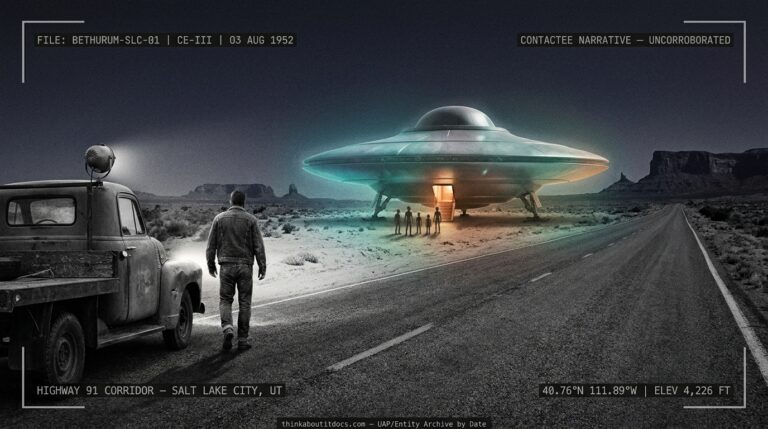
Irwin’s immediate interpretation was that he was witnessing an aircraft making a forced landing or crashing. Acting on a soldier’s instinct to render aid, he quickly wrote a note — “HAVE GONE TO INVESTIGATE POSSIBLE PLANE CRASH. PLEASE CALL LAW ENFORCEMENT OFFICERS” — and attached it to his steering wheel. He then wrote “STOP” in large letters on the side of his car using shoe polish, and set off on foot toward the ridge where the object had disappeared.
Approximately thirty minutes later, a Fish and Game inspector stopped at the car, read the note, and contacted the Cedar City Sheriff’s Office. Sheriff Otto Pfeiff organized a search party and returned to the area. About an hour and a half after Irwin had first observed the glowing object, the search party found him unconscious in the field. There was no sign of any aircraft crash. His jacket was missing.
At Cedar City Hospital, Dr. Broadbent examined Irwin and found his temperature and respiration normal, but the patient could not be awakened by any means. The diagnosis was recorded as “hysteria” — a clinical term indicating a condition with no identifiable organic cause. Irwin remained unconscious for approximately twenty-three hours. When he finally regained consciousness, his first words were: “Were there any survivors?” He felt physically well but was confused about his missing jacket and had no explanation for the glowing object he had seen.
Irwin was transferred back to Fort Bliss and placed under observation at William Beaumont Army Medical Center for four days. He was returned to duty, though his security clearance was withdrawn. Within days, he fainted while walking on the base, recovering almost immediately. On March 15, he collapsed again on an El Paso street and was taken to Southwest General Hospital. His condition mirrored the Cedar City episode: unarousable sleep followed by awakening with the question “Were there any survivors?” He believed it was still February 28 and was shocked to learn two weeks had passed.
Irwin was readmitted to William Beaumont Hospital’s psychiatric ward, where he spent a month under observation. Captain Valentine, the attending psychiatrist, evaluated him as “normal.” The very next day after his release, Irwin left the fort without authorization, caught a bus to Cedar City, and went directly to the original encounter site. There, he located his missing jacket. In one of its buttonholes was a pencil with a piece of paper tightly wound around it. Irwin took the paper, burned it, and appeared to emerge from a trance-like state — suddenly confused about where he was and how he had gotten there. He turned himself in to Sheriff Pfeiff, who reminded him of the earlier incident.
Jim and Coral Lorenzen of the Aerial Phenomena Research Organization (APRO) contacted Irwin after he returned to Fort Bliss. He underwent another psychiatric examination with the same result — normal. His case was reviewed by the Inspector General, who ordered a more comprehensive evaluation. On July 10, 1959, Irwin re-entered Beaumont Hospital. After release, he failed to report for duty on August 1. One month later, he was officially listed as AWOL. Gerry Irwin has never been seen or heard from again.
Researcher’s Notes
The Lost Soldier — Cedar City 1959 and the Boundaries of Explainable Aftermath
- Classification Rationale — CE-II: The existing page classifies this case as DD (Daylight Disc), but the sighting occurred in the afternoon-to-evening period and involved a glowing object rather than a metallic disc observed in clear daylight. More importantly, the case’s defining feature is not the aerial observation itself — which was brief and at distance — but the profound and sustained physiological and psychological effects on the witness. The reclassification to CE-II reflects the Hynek taxonomy’s recognition of encounters that produce measurable effects on the observer, even when the object itself is not observed at close range. The prolonged unconsciousness, amnesia, fugue states, and compulsive return behavior constitute a physiological impact directly linked to the sighting event.
- Source Chain and Documentation Quality: The Irwin case benefits from an unusually strong source chain for a 1959 UFO-adjacent event. The initial encounter was documented by law enforcement (Sheriff Otto Pfeiff), medical personnel (Dr. Broadbent at Cedar City Hospital), and military medical authorities at William Beaumont Army Medical Center. APRO’s James Lorenzen investigated directly. Jacques Vallée catalogued the case as Magonia 482 in Passport to Magonia. While military psychiatric records remain classified, the multiple institutional touchpoints — sheriff’s department, civilian hospital, military hospital, Inspector General review — provide independent documentation unusual for cases of this era.
- The Behavioral Sequence as Data: What makes the Irwin case exceptional is not the initial aerial observation — a glowing object descending behind a ridge is ambiguous at best — but the subsequent behavioral cascade. The pattern includes: extended unarousable unconsciousness with no organic cause; recurring fugue states with temporal disorientation; a compulsive, seemingly pre-programmed return to the encounter site; location and recovery of a hidden object (the jacket with paper-wrapped pencil); immediate destruction of the paper’s contents; emergence from the trance state only after the paper was burned; and ultimate disappearance. This sequence reads less like the aftermath of a conventional sighting and more like the execution of a post-hypnotic program — a comparison that researchers of the era noted but could not pursue.
- The Disappearance — Unresolved: Irwin’s permanent vanishing after August 1, 1959, elevates this case beyond standard UFO reporting. He was a trained military technician with a Nike missile security clearance (withdrawn after the incident), stationed at one of the most sensitive Cold War installations in the country. His disappearance from active military duty without subsequent detection — no criminal record, no death certificate, no contact with family or military authorities — has never been satisfactorily explained. Whether the disappearance is connected to the original encounter, to the psychiatric aftermath, to military intelligence interest in his case, or to personal factors entirely unrelated to the UFO event remains unknown. The absence of resolution is itself the most significant datum in the file.
- Pattern Context — Missing Time and Post-Encounter Fugue: The Irwin case predates the language and conceptual framework that would later develop around “missing time” experiences in UFO encounter literature. Barney and Betty Hill’s 1961 encounter — which introduced hypnotic regression as a tool for recovering suppressed encounter memories — occurred two years after Irwin’s disappearance. In retrospect, the Irwin case presents many of the elements that would later be associated with CE-IV abduction narratives: unexplained unconsciousness, amnesia, behavioral compulsion, and the suggestion of implanted information or programming. That these elements appeared in a well-documented case before the abduction narrative framework existed gives the Irwin file a particular evidentiary weight — it cannot be accused of conforming to a template that did not yet exist.
The case of Private Gerry Irwin remains one of the most unsettling entries in the UAP archive — a case where the phenomenon, if phenomenon it was, did not merely appear and depart, but reached into a human life and unmade it. The glowing object over Cedar City may have been anything. What happened to the man who walked toward it has never been explained.