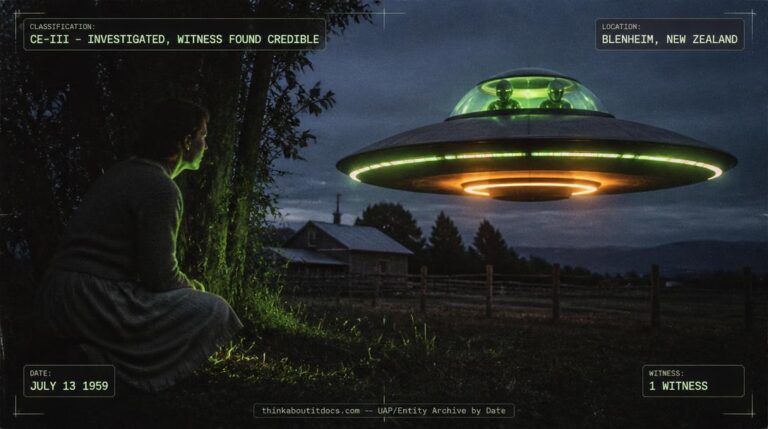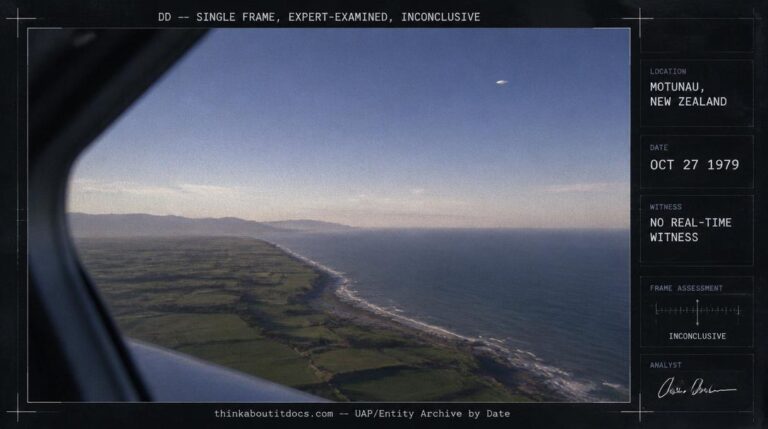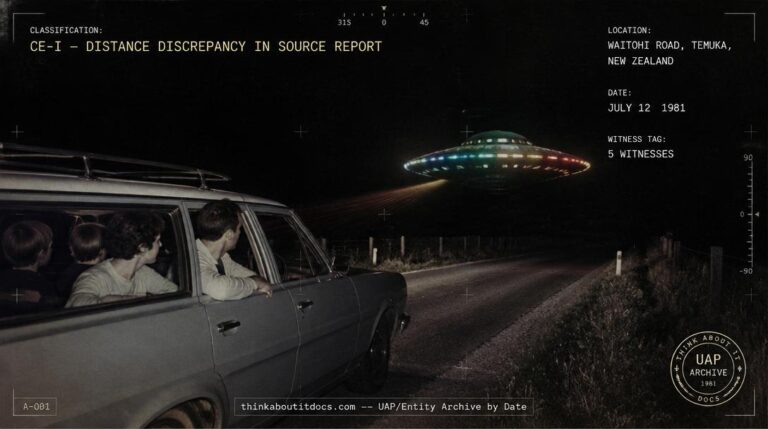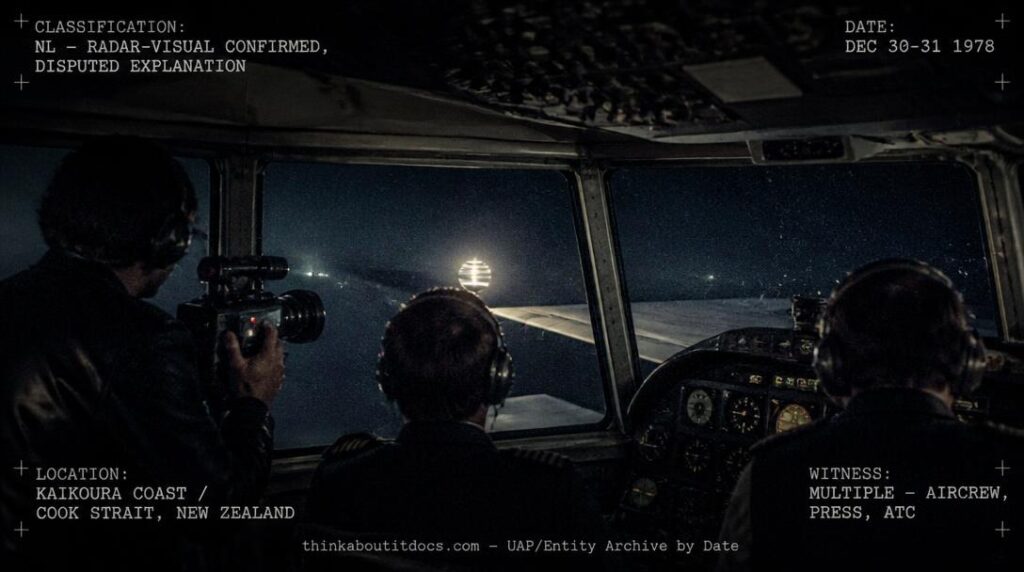
Recreation of the December 1978 Kaikoura Lights case, in which a television crew aboard an Argosy freighter filmed a bright, spinning object independently confirmed on Wellington air traffic control radar.
THINK ABOUTIT UFO|UAP SIGHTINGS REPORT
1978: The Kaikoura Lights — New Zealand’s Radar-Visual UFO Case
Over ten days in December 1978, pilots flying the Wellington-Christchurch cargo route past Kaikoura, New Zealand repeatedly reported unidentified lights pacing their aircraft — sightings independently confirmed on ground radar by Wellington Air Traffic Control — culminating on New Year’s Eve when a television news crew aboard an Argosy freighter filmed a bright, spinning, structured object that Wellington radar tracked in formation with the plane, footage that would later air on the BBC and around the world.
Date: December 20-31, 1978, with the two most significant events on December 21 and December 30-31
Sighting Time: 11:00 PM (Dec 20), 1:20 AM (Dec 21), and 11:50 PM (Dec 30) through the early morning of Dec 31
Day/Night: Night
Location: South Island, New Zealand, primarily over the Cook Strait and the Kaikoura coastline, along the Wellington-Christchurch air corridor
Urban or Rural: Coastal/maritime — sightings occurred primarily over open water and coastline rather than populated areas
No. of Entity(‘s): Not Applicable — no entity described
Entity Type: Not Applicable
Entity Description: Not Applicable
Hynek Classification: NL (Nocturnal Light) — point or extended luminous source observed at night. This is a reasonable fit for most of the individual sightings, though the RVE (Radar-Visual Event) correlation and the filmed, structured object seen on December 31 push this case toward the more evidentially significant end of that category. See Researcher’s Notes.
Duration: Multiple encounters across several days; individual radar-visual tracking episodes lasted up to roughly 40 minutes, with one filmed object tracked continuously for close to 15 minutes
No. of Object(s): Up to 3 simultaneous radar targets at a time across the various encounters
Description of the Object(s): Reports varied across the flights: pulsing lights that grew from pinpoint size to that of a “large balloon,” objects that projected a beam of light downward before disappearing, a light that doubled in size on radar while flying in formation with the aircraft, and — most notably, on the December 31 return flight — a bright, spinning sphere with visible lateral lines, filmed on camera and simultaneously tracked on radar for approximately four minutes, its movement relative to the aircraft suggesting controlled, intelligent flight rather than a fixed or drifting light source.
Shape of Object(s): Sphere (for the filmed December 31 object); most other sightings were unresolved points or extended sources of light
Size of Object(s): Described across the various sightings as ranging from a pinpoint to the size of a large balloon or a house; one radar target reportedly doubled in size while in formation with the aircraft
Color of Object(s): Bright white and blue-white flashing lights, with some objects showing a tinge of green or red
Distance to Object(s): Ranged from as far as 12 nautical miles down to approximately 1 mile when objects were reported flying in formation with the aircraft
Height & Speed: One radar target was estimated moving at speeds up to approximately 15,000 km/h before stopping abruptly; another object was observed descending suddenly by roughly 1,000 feet before ascending again in a series of jerky movements. These are witness/radar-derived estimates, not confirmed instrumented measurements independent of the systems described.
Number of Witnesses: Multiple, across several separate flights and dates: pilots Captain Vern Powell and First Officer Ian Pirie (December 21); RNZAF observer Ian Uffindel and Wellington controller John Cordy (December 20); and, on the December 30-31 flight, Captain Bill Startup, First Officer Bob Guard, television reporter Quentin Fogarty, cameraman David Crockett, sound recordist Ngaire Crockett, and later replacement crew member Dennis Grant, alongside Wellington Air Traffic Control staff including controller Geoffrey Causer and radar technician Bryan Chalmers
Special Features/Characteristics: This case is unusual for the number of separately, independently confirmed Radar-Visual Events (RVEs) — instances where a pilot’s visual sighting was matched, in real time, to a specific radar return by ground control. The December 31 filming was widely broadcast, including by the BBC. The Royal New Zealand Air Force placed a Skyhawk fighter on alert to intercept the objects if they reappeared. Radar technician Bryan Chalmers specifically tested for anomalous propagation (radar beam bending caused by atmospheric conditions) following the sightings and found the equipment functioning normally. The full government investigation file was reportedly classified and is held at Archives New Zealand.
Case Status: Unexplained (Investigated) — this remains one of the most thoroughly documented UFO cases on record, combining pilot testimony, independent ground and airborne radar correlation, and analyzed film footage, alongside a genuine, credentialed skeptical retrospective analysis that has proposed conventional explanations for at least part of the phenomena. See Researcher’s Notes.
Source: Contemporary news coverage and Wellington Air Traffic Control records; Quentin Fogarty, “Let’s Hope They’re Friendly” (Angus & Robertson, 1982); Bill Startup, “The Kaikoura UFOs” (1983); Dr. Bruce Maccabee’s technical film analysis, published in Applied Optics (1980); William Ireland’s 2000 retrospective analysis in the New Zealand Skeptics journal; Archives New Zealand file “1979 UFO Affair – Kaikoura”
Summary/Description: In late December 1978, a series of Radar-Visual encounters occurred over the Cook Strait and Kaikoura coastline of New Zealand. The most famous incident involved an Argosy freight plane carrying a television crew that captured approximately 30 seconds of footage of a bright, spinning sphere with lateral lines. These sightings were simultaneously tracked by Wellington Air Traffic Control, which reported targets following the aircraft and, in one instance, an object that doubled in size on radar while in formation with the plane.
Related Cases: This case is frequently discussed in connection with other 1977-1979 New Zealand UFO reports from the same general region, including this archive’s 1977 Waimata Valley/Gisborne case, which references it as regional context
Detailed Report
The events began on the night of December 20, 1978, when an RNZAF observer, Ian Uffindel, reported one large and two smaller lights moving together in a controlled manner near Blenheim Airbase; Wellington Air Traffic Control confirmed matching radar targets, marking the first of several Radar-Visual Events in the sequence. The following night, December 21, Captain Vern Powell and First Officer Ian Pirie, flying an Argosy cargo run, reported bright lights near Cape Campbell that behaved unlike conventional aircraft, tracked in real time by Wellington radar across a period that saw an object move roughly 60 nautical miles at high speed before stopping abruptly. Powell described the light shifting in color and remaining visible even as it passed behind cloud; Wellington confirmed multiple corresponding radar targets throughout, including one estimated moving at roughly 15,000 km/h.
The case became internationally famous ten days later. On the night of December 30, an Australian television crew — reporter Quentin Fogarty, cameraman David Crockett, and sound recordist Ngaire Crockett — boarded a Safe Air Argosy freighter piloted by Captain Bill Startup (23 years and 14,000 flying hours of experience) and First Officer Bob Guard, intending to film background footage related to the earlier sightings. Crossing the Cook Strait in clear weather, the crew began receiving real-time radar correlations from Wellington controller Geoffrey Causer, who repeatedly called out the bearing and distance of unidentified targets appearing near the aircraft — targets the crew could not always immediately see, and which appeared and disappeared from the radar scope over the following half hour. At several points the crew did see corresponding lights exactly where Wellington indicated, including a light Startup compared to an aircraft’s tail light and, later, a pair of rapidly flashing blue-white lights Startup likened to the strobes of a passenger jet, despite the Argosy being the only known aircraft in the area. At one point Wellington reported a target “in formation” with the Argosy that had “doubled in size” on the scope — an episode now referred to in ufology literature by the shorthand DST (Double Size Target). First Officer Guard visually confirmed a small, twinkling light with a faint green or red tinge from his side window at the same time.
After landing safely in Christchurch, the crew took off again just after 2:00 AM on December 31 for the return leg, with Dennis Grant replacing Ngaire Crockett, who chose not to fly back through the same airspace. Shortly after takeoff, the crew observed what became the case’s signature footage: a bright, spinning sphere marked with lateral lines, filmed by Crockett on a hand-held camera (after swapping seats with Guard to get a clear view) and simultaneously tracked on radar for about four minutes, its motion relative to the aircraft read by those aboard as evidence of controlled flight rather than a passive light. Two further pulsating lights were also observed, one of which dropped approximately 1,000 feet in a blurred, rapid descent before leveling off in a series of jerky movements. The footage, once broadcast, drew international attention, including a segment on the BBC’s main evening news, and prompted proposed conventional explanations ranging from the planet Venus to reflections from Japanese squid-fishing boats working the coastal waters — explanations that proponents of the sighting have argued do not adequately account for the radar correlation or the number and spread of simultaneous targets recorded that night.
RESEARCHER’S NOTES
The Kaikoura Lights — 1978 and a Case With Real Evidence on Both Sides
- Classification Assessment: NL fits most of the individual sightings — unresolved lights rather than a consistently structured craft — though the filmed, spinning, lateral-lined object from December 31 pushes toward a more resolved presentation for at least that portion of the case, and the sheer number of independently confirmed radar-visual correlations sets this apart from a typical single-witness NL report.
- Source Chain Assessment: This is an unusually well-documented case by any standard: named, experienced professional pilots, a professional television crew with recording equipment, named air traffic control personnel providing real-time radar correlation, and film footage that received formal technical analysis by physicist Dr. Bruce Maccabee. A previous version of this page’s Researcher’s Notes presented only the case for an anomalous origin and did not mention that a credentialed New Zealand scientist, William Ireland (a former Department of Scientific and Industrial Research researcher), published a formal retrospective analysis in the New Zealand Skeptics journal in 2000 proposing conventional explanations for at least portions of the sightings. Omitting that from a “no analysis, no opinion, just the documented record” archive was an imbalance worth correcting; it is included here as part of the record, not as a final word either way.
- Evidentiary Weight: The combination of independent radar confirmation, professional pilot testimony, and analyzed film footage gives this case genuinely unusual evidentiary weight within ufology. That said, proposed conventional explanations — misidentification of Venus, and reflections or lights from the Japanese squid-fishing fleet known to operate in the area at the time — have been seriously advanced by credentialed investigators, not only casual skeptics, and deserve to be weighed rather than dismissed outright. The squid-boat theory in particular remains disputed rather than conclusively ruled out by either side of the case’s proponents or critics.
- Pattern and Comparative Context: Radar-Visual Events, in which ground radar independently confirms a pilot’s visual sighting in real time, are considered a particularly evidentially significant category in UFO literature precisely because they reduce (though do not eliminate) the likelihood of simple visual misidentification by a single observer. This case is one of the most frequently cited RVE examples internationally for that reason.
- Geographic and Historical Context: The Kaikoura coastline and Cook Strait corridor were, at the time, a documented fishing ground for Japanese squid boats using powerful lights to attract their catch — a genuine regional detail relevant to evaluating the light-based sightings, alongside the case’s undisputed radar correlation, which a squid-boat explanation does not on its own fully address.
Few UFO cases anywhere combine professional pilot testimony, real-time independent radar confirmation, and analyzed film footage the way this one does — and few have also drawn a genuine, credentialed skeptical retrospective attempting to explain it conventionally. Both deserve a place in the record. Squid boats and Venus may explain parts of what was seen; they have a harder time accounting for the radar correlations that ran alongside the visual sightings all December. The case remains Unexplained, and rigorously investigated from more than one direction.
“It turned with us as I changed course… It was making definite movements in relation to us.”