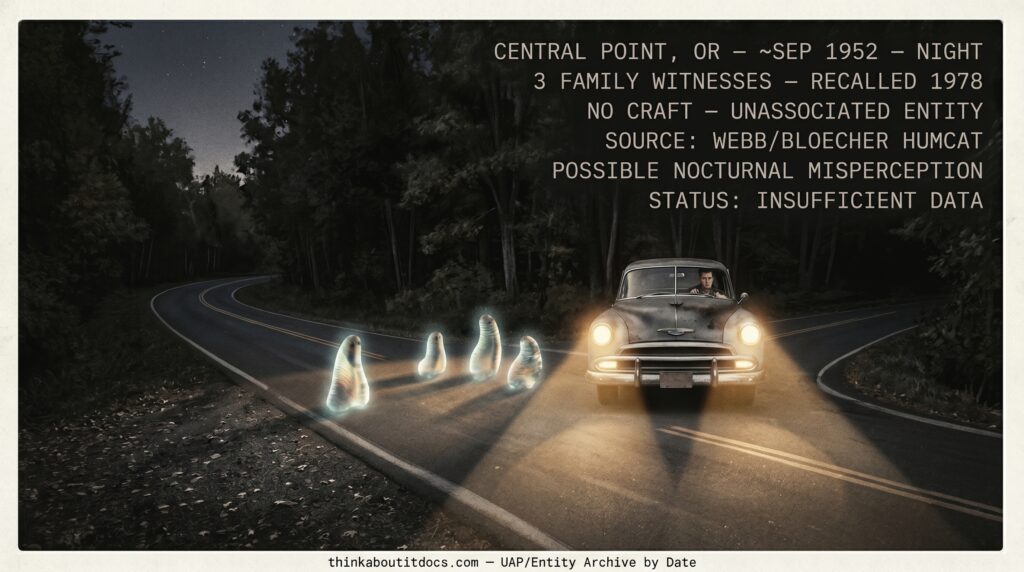
The 1952 Central Point, Oregon sighting — a family reported three white, limbless forms gliding across the road near Medford. No craft; a 1978 HUMCAT recollection; logged Insufficient Data. (thinkaboutitdocs.com — UAP/Entity Archive by Date)
THINK ABOUTIT UFO|UAP|ENTITY SIGHTINGS REPORT
1952: Three White Forms Cross a Road, Central Point, Oregon
It is a brief, vivid roadside encounter from the Rogue Valley: a family driving home one night in 1952 sees three white, limbless forms — likened to the “Shmoos” of the Li’l Abner comic strip — glide across the road in front of their car and vanish into the trees. Three family members saw it, the account was collected by serious researchers, and the closeness is striking. But two facts set its real weight. First, there is no craft anywhere in the account — nothing in the air, nothing landed, just three pale shapes crossing a dark road — so it is not a close encounter of the third kind but an unassociated entity sighting. Second, the witness’s own written account was set down in 1978, about twenty-six years after the event. And three white, featureless, gliding forms briefly caught in headlights on a rural road at night have an obvious prosaic candidate the account cannot exclude. The archive keeps the entry, corrects the classification, and files it honestly as Insufficient Data.
Date: About September 1952 (the witness’s written account dates to 1978; see Researcher’s Notes)
Sighting Time: Night (not further specified)
Day/Night: Night
Location: Corner of Old Stage Road and Scenic Avenue, near Central Point, in the Rogue Valley a few miles northwest of Medford, Oregon
Urban or Rural: Rural
No. of Entity(‘s): 3
Entity Type: White, odd-shaped, limbless forms (no craft associated)
Entity Description: Between 3 and 4 feet tall, white, with no clear features and no visible extremities; likened to the “Shmoos” of Al Capp’s Li’l Abner comic strip; the neck-and-head portion of each was about half the length of the body; two led and a slightly smaller third followed; they glided smoothly across the road
Hynek Classification: None — no craft or object is involved; this is an unassociated humanoid/entity report, not a close encounter of the third kind (the prior CE-III is incorrect, as CE-III requires beings associated with a craft)
Duration: About a minute
No. of Object(s): None — no object reported
Description of the Object(s): Not applicable
Shape of Object(s): Not applicable
Size of Object(s): Not applicable (the forms were 3 to 4 feet tall)
Color of Object(s): Not applicable (the forms were white)
Distance to Object(s): Closest approach about 8 to 15 feet
Height & Speed: Not applicable (the forms glided across the road on the ground)
Number of Witnesses: 3 (Mrs. L.L. Zamrzla, her husband, and their 12-year-old daughter)
Special Features/Characteristics: Smooth, gliding motion with no visible limbs; pale white coloration; brief close-range nighttime observation from a car; no craft, sound, light, or trace reported; consistent with nocturnal misperception of pale animals or figures in headlights as well as with an anomalous encounter
Case Status: Insufficient Data
Source: David F. Webb & Ted Bloecher, HUMCAT (Catalogue of Humanoid Reports), from a letter by Mrs. Zamrzla (1978)
Summary/Description: Mrs. L.L. Zamrzla, riding home with her husband and 12-year-old daughter in the Rogue Valley northwest of Medford, Oregon, reported that around 1952, as they turned from Old Stage Road onto Scenic Avenue near Central Point, three white, odd-shaped forms about 3 to 4 feet tall, limbless and gliding, crossed the road in front of the car from right to left and disappeared into the trees. Her husband braked as the figures glided diagonally away; the family watched for about a minute at 8 to 15 feet. No craft was involved. Collected in HUMCAT from the witness’s 1978 letter, the account is a decades-later multiple-witness recollection of an entity sighting with no associated object, and is logged as Insufficient Data.
Related Cases: 1952: 8 ft. Man Seen Between Salem & Corvallis, Oregon (also an entity report with no craft) | the broader 1952 wave of humanoid reports catalogued by Bloecher | the corpus of nocturnal “roadside form” sightings
DETAILED REPORT
The account comes from Mrs. L.L. Zamrzla, who was riding home one night with her husband and their twelve-year-old daughter to their place in the Rogue Valley, a few miles northwest of Medford, Oregon. As they rounded the corner from Old Stage Road onto Scenic Avenue, near Central Point, three white, odd-shaped forms crossed the road in front of the car from right to left, gliding smoothly and diagonally away from them and disappearing into the trees ahead. Her husband hit the brakes as the figures crossed. They were between three and four feet tall, white, with no clear features and — the detail everyone remembers — no visible arms or legs, so that the family compared them to the “Shmoos,” the rounded, limbless creatures from Al Capp’s Li’l Abner comic strip. The neck-and-head portion of each was about half the length of the body. Two led the way; a slightly smaller third followed. They were in view for about a minute, at a closest distance of perhaps eight to fifteen feet, enough for a good clear look.
The first thing to set right is the source, because it is better than average and deserves to be named accurately. This is not a tabloid item or an anonymous database line: it is catalogued in HUMCAT, the Catalogue of Humanoid Reports compiled by David Webb and Ted Bloecher, two of the most careful workers in the field, and it traces to a letter the witness herself wrote in 1978. A first-person account from a named witness, with two corroborating family members, preserved by serious researchers, is a respectable foundation, and the report should be treated with the seriousness that provenance earns.
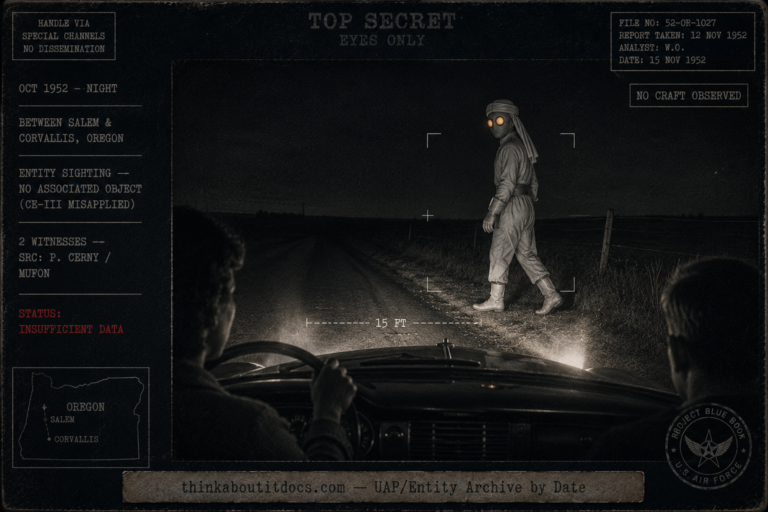
The second thing to set right is the classification, and it is the central correction. The prior page filed this as CE-III, a close encounter of the third kind — but CE-III specifically requires animate beings associated with a UFO, and there is no UFO here. Nothing flew, hovered, landed, or glowed; there was no craft, no light, no sound, and no trace. There were only three pale forms crossing a road. Under the archive’s own standard, an entity report with no associated object is not a close encounter of the third kind but an unassociated humanoid sighting, and it carries no Hynek class. This is the same correction already applied to the nearby Salem–Corvallis “eight-foot man” case, and consistency requires it here.
The third thing to set right is the date’s reliability. The HUMCAT index records the source as a letter from Mrs. Zamrzla written in 1978 — meaning the account, however sincere, was set down roughly twenty-six years after the event. The prior page presented the “September 1952” date and the crisp details as if contemporaneous; in fact they are a long-delayed recollection. That does not make them false, but a memory of a one-minute nighttime event recorded a quarter-century later cannot carry the same evidential weight as a report filed the next day.
With the source credited and the record corrected, the honest analytical question is what three white, limbless, gliding forms briefly seen in a car’s headlights on a dark rural road most likely were — and here a prosaic candidate cannot be dismissed. Animals caught in headlights at night are seen with compressed depth and washed-out features: a pale deer (the Rogue Valley is full of them), light-colored livestock, dogs, or even people in pale clothing can register, in a one-minute glimpse through a windshield, as featureless white shapes “gliding” across the road, their legs lost in roadside shadow and grass. The very details that make the account striking — no extremities, smooth gliding motion, blank white forms — are precisely the information-poor impressions that low light and headlight glare produce. None of this proves misperception; it identifies the most available ordinary explanation, which the brief, dark, single-vantage circumstances cannot rule out.
The prior page closed by calling this “one of the more compelling occupant reports of the early Cold War era,” carrying “a level of credibility that is difficult to dismiss.” That overstates it, and it has been removed. A sincere, multiple-witness, decades-later recollection of featureless shapes crossing a night road, with no craft and an obvious mundane candidate, is genuinely interesting and genuinely unresolved — but it is not a compelling occupant case, because there were no occupants of anything and nothing for them to occupy.
RESEARCHER’S NOTES
The Shmoo Forms — Oregon 1952 and an Entity Report Without a Craft
- Classification correction (CE-III to none): This is the decisive fix. CE-III denotes animate beings associated with a UFO, and this account contains no object of any kind — no craft, light, sound, or trace, only three forms crossing a road. Under the archive’s standard, that is an unassociated humanoid report, not a close encounter of the third kind, and it carries no Hynek class. The correction matches the one already made to the neighboring Salem–Corvallis Oregon entity case, and applying it consistently is part of keeping the archive’s classifications honest.
- Source-chain assessment: The provenance is a genuine strength. The case sits in HUMCAT, the Webb–Bloecher Catalogue of Humanoid Reports, and derives from the witness’s own 1978 letter. Bloecher in particular was a meticulous cataloguer of the 1952 wave, and a named first-person account with family corroboration, preserved in that catalog, is far better than the tabloid or anonymous sourcing behind many entity entries. The honest qualification is not about the collectors but about the timing: the letter postdates the event by about twenty-six years, placing this among recalled rather than contemporaneous reports.
- The mundane candidate, weighed fairly: The most useful analytical point is that the description’s hallmarks — white, limbless, gliding, featureless, briefly seen in headlights — are exactly what nocturnal misperception of ordinary animals or figures produces. A pale deer or light-colored livestock crossing a dark road, legs lost in shadow and the whole compressed by headlight glare and a windshield, can read as a featureless white form in a one-minute glimpse. This is not a debunking — three witnesses saw something, and misperception cannot be proven — but it is the leading ordinary explanation, and a fair entry names it rather than leaping past it to “occupants.”
- Evidentiary weight and why Insufficient Data: Pulling toward seriousness: multiple family witnesses, close range, and a respected catalog source. Pulling against a strong verdict: no craft, no trace, a single car-bound vantage at night, a roughly twenty-six-year recall gap, and a compelling mundane candidate. That balance is Insufficient Data — not a documented anomaly to call Unexplained, and not a demonstrated misperception or hoax to call Explained. The classification correction, not the verdict, is the entry’s main repair.
The Central Point forms make a memorable image — three little limbless white shapes gliding across a Rogue Valley road and into the trees, sincerely reported by a whole family and preserved by good researchers. Told straight, the case needs three things fixed: it is an entity sighting with no craft, so the CE-III is wrong and the class is none; the account is a 1978 recollection of a 1952 event, not a contemporaneous record; and its featureless, gliding, headlight-lit forms have an obvious prosaic candidate the night and the single glimpse cannot exclude. Credited to HUMCAT, stripped of the inflating “compelling occupant report” gloss, and reclassified honestly, it stands as Insufficient Data.