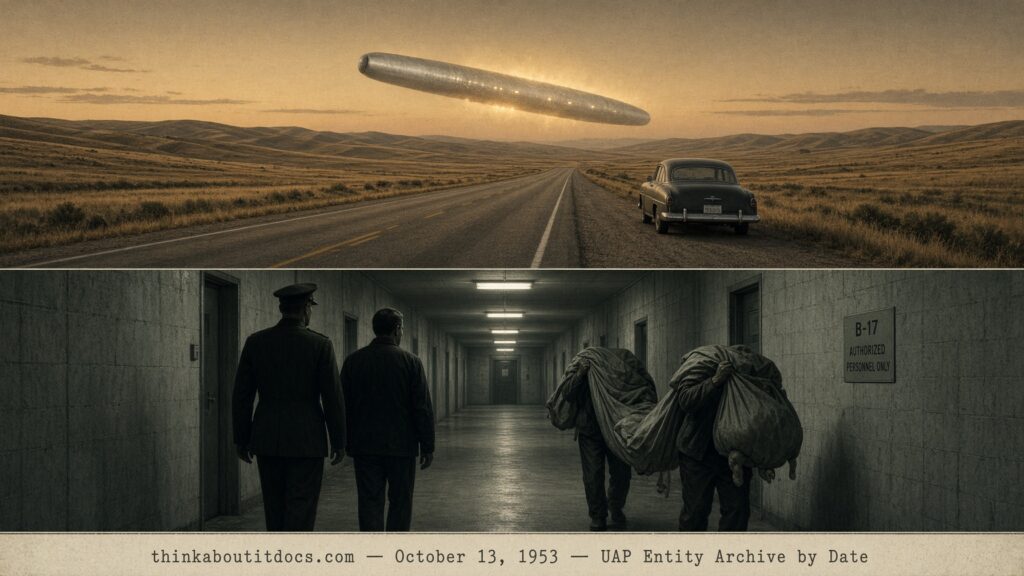
Cecil Tenney's account of a cigar-shaped object near Dutton, Montana and a same-night visit to Malmstrom AFB, October 13, 1953.
THINK ABOUTIT UFO|UAP CRASH REPORT
1953: The Dutton, Montana Crash-Retrieval Claim
Cecil Tenney says he only wanted to report a strange, low-flying cigar-shaped craft he’d seen searching the hills near Dutton, Montana. Instead, by his own account, he found himself summoned to Malmstrom Air Force Base that same evening, marched past officers carrying “Top Secret” packages, interrogated for half an hour, and — on his way out — shoved past two men struggling under the weight of laundry bags that, for just a moment, showed the unmistakable outline of a body inside.
⚠ UNSUBSTANTIATED CRASH-RETRIEVAL CLAIM
This case rests on a single witness’s secondhand-relayed account, with no contemporary documentation, no surviving physical evidence, and a source chain that includes Anton Anfalov — a source this archive has flagged repeatedly elsewhere (see the Kingman, Arizona; Camp Polk, Louisiana; Warmbaths, South Africa; and Zhdanivka, Ukraine entries) as producing claims that cannot be independently verified and frequently contradict documented records. The case also cites “Commander X,” a pseudonymous author whose body of work centers on unverifiable underground-base and government-conspiracy material and carries no independent documentation trail of its own. Leonard Stringfield, the third named source, was a genuine and relatively well-known crash-retrieval researcher — but even his involvement here is as a collector of secondhand “informant” testimony, not a direct investigator of Tenney himself. Per this archive’s locked editorial standard, no Hynek classification is applied to unsubstantiated crash-retrieval claims. The case is retained for its historical circulation within crash-retrieval literature, not as a verified event.
Date: October 13, 1953
Sighting Time: Unknown (the initial aerial sighting occurred during the day; the subsequent base debriefing occurred that evening)
Day/Night: Day (aerial sighting); Evening (base debriefing)
Location: Near Dutton, Montana (aerial sighting on the highway between Dutton and Brady); Malmstrom AFB, Great Falls, Montana (debriefing and alleged body sighting)
Urban or Rural: Rural (sighting); military installation (debriefing)
No. of Entity(‘s): 2 alleged (deceased, seen only briefly and indirectly by the witness)
Entity Type: “Nordic” (per the source material’s own terminology)
Entity Description: Per secondhand description (not directly witnessed in detail by Tenney, who saw only a body outline through a dropped bag): approximately 7 ft tall, severe injuries except to the head, which was helmeted; high broad foreheads, very long blond hair, elongated eyes, small nose and mouth, thin lips, pale skin, light blue eyes, slender human-like hands, flat feet with small toes
Hynek Classification: None — per locked editorial standard, unsubstantiated crash-retrieval claims do not receive a Hynek classification. The original page’s CE-IV (abduction) designation was incorrect: Tenney was not abducted; he reported witnessing alleged evidence at a military facility.
Duration: The aerial sighting lasted approximately 7 minutes; the base interrogation lasted approximately 30 minutes
No. of Object(s): 2 described — the cigar-shaped object Tenney saw searching the area, and the separate disc-shaped craft allegedly recovered at the crash site itself (which Tenney did not personally see)
Description of the Object(s): The aerial object: cigar-shaped, pulsating, flying low and apparently searching the terrain. The alleged crash wreck (per secondhand account, not seen by Tenney): disc-shaped with a dome, one side damaged by an apparent internal explosion, with a long, lacerated crack; interior cabin destroyed and filled with burned equipment.
Shape/Size/Color of Object(s): Cigar-shaped aerial object, color not specified; alleged disc-shaped wreck approximately 40-50 ft in diameter with a dome, color not specified
Distance to Object(s): The aerial object was seen at approximately 200 ft altitude from the highway; distance to the alleged wreck itself is unknown, as Tenney did not visit the crash site
Height & Speed: The aerial object flew at approximately 200 ft altitude before accelerating away; no figures given for the alleged wreck, which was already on the ground
Number of Witnesses: 1 directly (Cecil M. Tenney); the alleged crash and body recovery itself has no named direct witness in the surviving account beyond secondhand references to unnamed military personnel and later “informants”
Special Features/Characteristics: Tenney reported smoke from a nearby mountain the day before the sighting, which he initially assumed was an ordinary forest fire; he was summoned to Malmstrom AFB by phone that evening, escorted through a heavily secured, windowless building, instructed not to look around, interrogated for 30 minutes, and made to sign a notarized statement; while being escorted out, he saw two men struggling with heavy laundry bags, one of which briefly revealed a humanoid body outline before he was forcibly removed from the building. Later, unverified layered claims (not from Tenney himself) assert the bodies were studied at the University of Chicago, seen again at Wright-Patterson AFB in 1959 by an unnamed French biologist, and seen a third time in a Nevada underground facility by an unnamed master sergeant — none of these later claims are independently documented and should be read as accreted folklore rather than part of Tenney’s own testimony.
Case Status: Insufficient Data
Source: Leonard Stringfield (secondhand informant material); “Commander X” (pseudonymous, unverifiable); Anton Anfalov (PROBLEMATIC — see caution notice above)
Summary/Description: While on vacation, Cecil M. Tenney reportedly saw smoke near a Montana mountain and, the next day, a low-flying, pulsating cigar-shaped object searching the terrain along the highway between Dutton and Brady, visible for about 7 minutes. He reported the sighting to Montana state police and discussed it at a local bar. That evening, Malmstrom AFB called and summoned him for an interview. He was escorted through a secured building, told not to look around, interrogated for 30 minutes by a colonel, and made to sign a notarized statement. While being escorted out, he reportedly saw two men carrying laundry bags, one of which briefly revealed the outline of a body before he was forced out of the building. Secondhand accounts — not from Tenney directly — describe an allegedly recovered disc-shaped craft with two “Nordic” alien bodies, later said to have been examined and re-sighted at multiple facilities over subsequent decades. None of this later material is independently documented.
Related Cases: 1953: Kingman, Arizona — Alleged UFO Crash Retrieval (a similarly structured, similarly unsubstantiated 1953 crash-retrieval claim); the Camp Polk, Louisiana crash-retrieval claim documented elsewhere in this archive follows the same evidentiary pattern
Detailed Report
Cecil M. Tenney’s account, as it survives across several secondhand compilations, begins with something almost mundane: smoke rising near a mountain outside Dutton, Montana, while he was on vacation. Forest fires weren’t unusual in the area, and he didn’t investigate.
The following day, driving his usual route from Great Falls back to his flower shop along the highway between Dutton and Brady, Tenney says he saw something considerably less ordinary — a pulsating, cigar-shaped object flying low, roughly 200 feet above the ground, moving in a pattern that struck him as a search, as though looking for something specific in the terrain below. He watched it for about seven minutes before it accelerated away. He reported the sighting to Montana state police and, stopping at the nearest bar afterward, told the story to whoever would listen.
That evening, by his account, Malmstrom Air Force Base in Great Falls called him directly and instructed him to come to the base immediately. What followed reads like the opening of a much larger, much more troubling story than a simple witness interview. He was escorted to a windowless, stockade-like building, isolated from the rest of the base and ringed by a high wire fence, and told explicitly to keep his eyes forward and avoid looking around as he was walked in. Along the way, he says he saw officers carrying packages stamped “Top Secret.” He was interrogated for roughly thirty minutes in a colonel’s office, his statement typed up and signed in the presence of a notary.
It was on his way out, descending the stairs toward the front door, that Tenney says he witnessed the detail that has kept this case circulating in crash-retrieval literature ever since: two men struggling to carry large laundry bags over their shoulders, visibly fatigued by the weight. When one man dropped his bag, Tenney claims he saw the clear outline of a humanoid body inside — a head, knees, feet — before two other men grabbed him and an officer shoved him out the door, shouting at him to leave the base immediately.
Everything beyond this point in the case’s literature is secondhand, relayed through later researchers rather than Tenney’s own direct account: a disc-shaped craft, 40 to 50 feet across, recovered with visible explosion damage and a wrecked interior; two “Nordic” alien bodies extracted, roughly seven feet tall, blond-haired, pale-skinned, with distinctive elongated eyes; a chain of custody said to run from Malmstrom to the University of Chicago for preliminary study, then to Wright-Patterson Air Force Base, where a French biologist reportedly saw them in 1959, and finally to an underground Nevada facility, where a U.S. master sergeant is said to have seen them preserved in transparent tubes. None of these later claims carry independent documentation, named primary sources, or verifiable dates beyond the secondhand assertions themselves.
RESEARCHER’S NOTES
Dutton — 1953 and a Familiar Shape to an Unverifiable Story
- A structural echo of Kingman: The core sequence here — a civilian witness summoned to a secured military facility, marched past classified material, briefly glimpsing evidence of recovered bodies before being forcibly removed and warned to silence — closely mirrors the structure of this archive’s Kingman, Arizona case. Whether that reflects a genuine recurring pattern in real Cold War-era secrecy protocols, or a narrative template that circulated and was adapted across multiple unverified claims, this archive cannot determine — but the structural similarity is worth naming plainly.
- Three sources of very different quality: Leonard Stringfield’s involvement lends the case some genuine standing within crash-retrieval research history, but even his contribution here is secondhand informant material, not direct investigation of Tenney. “Commander X” and Anton Anfalov are both sources this archive treats with significant skepticism — the former for a body of work built entirely on unverifiable claims, the latter for a documented pattern of contradicting established records.
- Layered, undocumented later claims: The chain-of-custody material — Chicago, Wright-Patterson 1959, a Nevada facility — adds decades of unverified elaboration on top of Tenney’s own account, none of it traceable to a named, checkable source. This archive treats this layer the same way it treated the Anfalov/Uhouse material added to the Kingman case: as accreted folklore, not documented fact.
- Tenney’s own testimony is the only element with any specificity: The seven-minute aerial sighting, the phone call, the windowless building, the dropped laundry bag — these details, if we take Tenney’s own account at face value, are specific enough to have been checkable at the time (base visitor logs, the notarized statement itself, Montana state police records) — but no such records are cited as having been located or examined by any researcher in this case’s chain.
- No classification, deliberately: Consistent with this archive’s Kingman precedent, no Hynek tier is assigned here. Applying a formal classification to an account this thinly sourced would lend it more evidentiary weight than the case has earned.
What can be said honestly: Cecil Tenney’s name and a specific, sequential account of events exist in this record, which is more than several other crash-retrieval claims in this archive can offer. What cannot be said: that any part of the body-recovery narrative, or any of the later decades-long chain of alleged sightings, has been independently documented. This case remains, per its own source material, Insufficient Data.
“When one of the men dropped the bag, the outline of a humanoid body was clearly seen inside.”
— Cecil M. Tenney, as relayed via Leonard Stringfield, “Commander X,” and Anton Anfalov