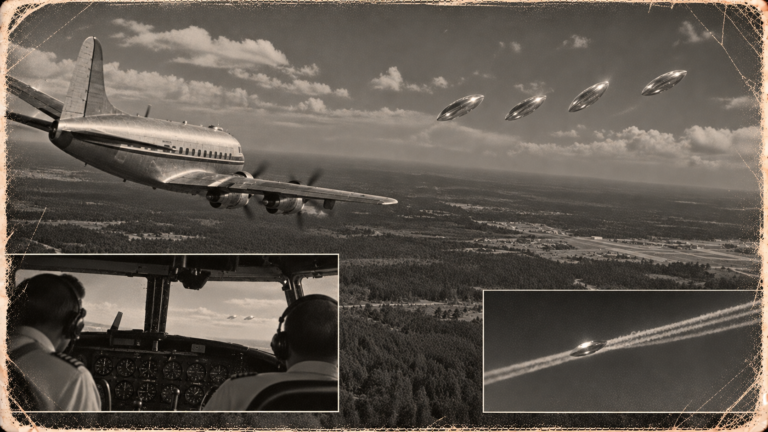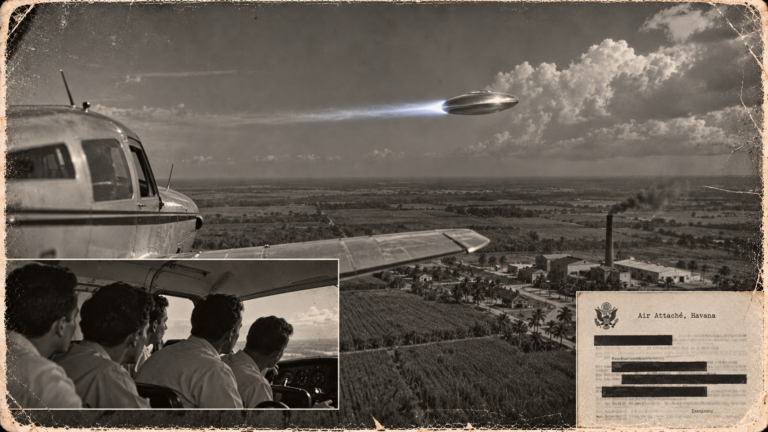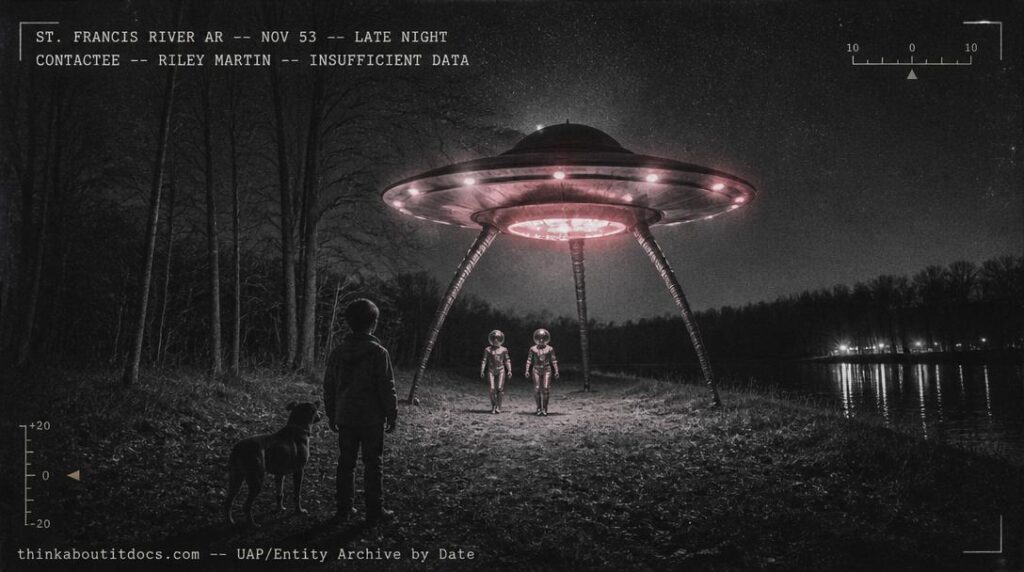
St. Francis River, northeastern Arkansas, November 1953 — Seven-year-old Riley Martin faces a hovering saucer as two small helmeted beings approach. The beginning of a lifelong contactee narrative published in "The Coming of Tan."
THINK ABOUTIT UFO|UAP|ENTITY SIGHTING REPORT
1953: St. Francis River, Northeastern Arkansas Sighting
In November 1953, seven-year-old Riley Martin claimed he was taken aboard a saucer-shaped craft that had landed near the St. Francis River in northeastern Arkansas after three nights of observing strange lights above the water. Aboard the craft he encountered entities he would later call “Biaviians” — small, large-headed humanoids with telepathic communication — and “Stagyians” — tall, red-skinned beings who performed a physical examination. Martin elaborated these childhood claims into a comprehensive alien mythology published in his 1995 book “The Coming of Tan,” which describes a multi-species federation, named alien races, a mothership orbiting Saturn, and a coming global transformation. He became widely known through years of regular appearances on the Howard Stern Show, where his claims were treated as entertainment. Martin died in 2015.
⚠ CONTACTEE ⚠
Riley Martin is a self-identified contactee claiming a childhood abduction followed by lifelong communication with named alien races (“Biaviians,” “Stagyians,” “Targzissians,” among others), participation in a multi-species galactic federation (“Biavvian Federation”), visits to a mothership orbiting Saturn, and a mission to sell symbolic “tickets” to humanity for passage aboard the mothership before an impending global catastrophe. These claims were published in “The Coming of Tan” (1995) and elaborated over years of radio appearances. No independent corroboration exists for any element of the narrative. The childhood abduction claim — made decades after the alleged event — cannot be verified. The case is retained in the archive as a documented example of the contactee tradition.
Date: November 1953 (claimed; reported decades later)
Sighting Time: Late night / early morning
Day/Night: Night
Location: Near the western bank of the St. Francis River, northeastern Arkansas
Urban or Rural: Rural
No. of Entity(‘s): Multiple (two “Biaviians” initially, plus “Stagyians” aboard the craft)
Entity Type: Two types claimed: small humanoids (“Biaviians“) and tall skeletal beings (“Stagyians”)
Entity Description: Biaviians: approximately 4 feet tall (male) and slightly shorter (female). Large heads in proportion to body. Large unblinking oval eyes — male gold-colored, female blue, shades changing with light or emotion. Long arms with fingertips reaching nearly to the knees. Three fingers and a thumb, forefinger longer than middle finger. Flat splayed feet. No external ears, only small holes. Nearly flat nose. Thin slit-like mouth with small uniform teeth. Sharp receding chin giving an egg-shaped face. Female gray-white skin, male yellowish-brown or golden. Communicated via telepathy. Wore shiny blue jumpsuits and bubble-type helmets (removed aboard craft). Stagyians: nearly 6 feet tall. Dark red leathery skin draped loosely over skeletal frames. Long prune-like heads. Tiny close-set black eyes. Wore breathing devices over their mouths. Cold clinical touch. Also telepathic. Described as “pacifists” who hold scientific positions within the Biavvian Federation
Hynek Classification: CE-IV (Close Encounter IV) — claimed childhood abduction
Duration: Not specified
No. of Object(s): 4 lights observed (1 primary craft landed)
Description of the Object(s): Four lights performing acrobatic maneuvers above the river over three consecutive nights, approaching closer each night. The landed craft was saucer-shaped, suspended approximately 12 feet above the ground on three flexible legs, slowly bobbing like a cork on water. It pulsed pink before projecting a light beam toward the witness
Shape of Object(s): Saucer
Size of Object(s): Not specified
Color of Object(s): Lights changed from yellow to white, red, green, and shades of blue. Craft pulsed pinkish before projecting a beam
Distance to Object(s): Landed less than a quarter mile from the witness’s home
Height & Speed: Lights performed rapid maneuvers and immediate stops over the river
Number of Witnesses: 1 (Martin claimed his brothers, who shared his bedroom, could not be awakened — “perhaps by design”)
Special Features/Characteristics: Three consecutive nights of approach, each closer. Brothers could not be awakened despite attempts. The witness’s dog accompanied him to the landing site without protest. Martin was transported into the craft via a light beam — blinding white light, then found himself nude on an operating-table-like surface. Physical examination conducted by “Stagyians.” Martin claimed this was the first of multiple contacts extending throughout his life, culminating in visits to a mothership he said orbits Saturn, where he met additional alien races and a being called “Tan”
Case Status: Insufficient Data — single-witness childhood memory reported decades later, no corroboration, extensive contactee mythology developed from the claimed experience
Source: Riley Martin, “The Coming of Tan” (Historicity Productions, 1995); quoted in George Filer’s “Filer’s Files” #40, September 22, 2004
Summary/Description: In November 1953, seven-year-old Riley Martin observed lights above the St. Francis River near his home in northeastern Arkansas for three consecutive nights. On the third night, he followed the lights to a saucer-shaped craft landed in a clearing near the river. Two small humanoids in blue jumpsuits led him aboard via a light beam. Inside, he was examined by taller red-skinned beings. Martin published these claims and an elaborate associated mythology in “The Coming of Tan” (1995) and discussed them extensively on the Howard Stern Show from the mid-2000s until his death in 2015.
Related Cases: Not Applicable
Detailed Report
Riley Martin’s account, as published in his 1995 book “The Coming of Tan” and summarized in George Filer’s “Filer’s Files” newsletter, describes events he said occurred when he was seven years old, living with his family near the western bank of the St. Francis River in northeastern Arkansas — a tributary of the Mississippi. In November 1953, he noticed strange lights above the river on three consecutive nights, appearing at approximately the same late-night or early-morning hour and coming closer with each visit. By the third night, the lights were close enough to cast a glow on the walls of his bedroom.
Martin claimed his two brothers, who shared the bedroom, could not be awakened despite his attempts — a detail he attributed to possible deliberate influence by the visitors. On the third night he put on his jacket and went outside, accompanied by his dog, Brown Boy. He approached the spot where the largest light had descended behind the trees, less than a quarter mile from the house.
Through the bushes he saw a saucer-shaped craft in a clearing, suspended approximately twelve feet above the ground on three flexible legs, slowly bobbing. The craft pulsed pinkish and Martin found himself caught in a light beam emanating from the ship. Two small beings walked toward him out of the light, dressed in shiny blue jumpsuits with bubble-type helmets. They were barely as tall as the seven-year-old. His dog made no protest as they took his arms and led him toward the craft. Beneath the saucer there was a blinding white light, and his next awareness was of being aboard, lying nude on an examination table.
The two small beings removed their helmets. Martin described them in detail: approximately four feet tall (the male) and slightly shorter (the female), with large heads, oversized unblinking oval eyes (gold for the male, blue for the female), long arms, three-fingered hands, flat noses, slit mouths, and egg-shaped faces with receding chins. They communicated telepathically. He later named their species “Biaviians.”
The physical examination was conducted by a different type of entity — nearly six feet tall, with dark red leathery skin, skeletal frames, prune-like heads, tiny close-set black eyes, and breathing apparatus over their mouths. Their touch was cold and clinical. Martin named these beings “Stagyians” and described them as the scientific-intellectual caste of the “Biavvian Federation” — pacifists despite their frightening appearance.
From this childhood encounter, Martin developed an extensive multi-species cosmology involving additional alien races (including “Targzissians”), a mothership he said orbited Saturn, a being called “Tan” who served as his primary contact, and a mission to inform humanity of an approaching global catastrophe. He sold symbolic “tickets” for passage aboard the mothership. He published “The Coming of Tan” in 1995 and became a regular guest on the Howard Stern Show from the mid-2000s, where he discussed his claims in a context that mixed belief, entertainment, and audience skepticism. He died in 2015.
Researcher’s Notes
The Riley Martin Case — St. Francis River 1953 and the Contactee as Cultural Figure
- Source Chain: The claimed event occurred in November 1953 when the witness was seven years old. It was not reported to any investigating organization at the time. The first public account appears in Martin’s self-published book “The Coming of Tan” (1995) — over forty years after the alleged event. The page’s credited source is George Filer’s newsletter (“Filer’s Files” #40, 2004), which summarized the book’s content. There is no independent corroboration: no family members have publicly confirmed the lights, the brothers who could not be awakened have never provided testimony, and no investigation was ever conducted. The source chain is: Martin’s memory → Martin’s book → Filer’s summary.
- The Contactee Framework: Riley Martin’s claims follow the classic contactee template with every standard element present: a childhood initial contact establishing special status, named alien species with elaborate physical descriptions, a hierarchical multi-species federation with designated roles (Biaviians as leaders, Stagyians as scientists), telepathic communication, a chosen-one narrative, a coming catastrophe, and a commercial component (the sale of “tickets” aboard the mothership). The named-species mythology — complete with species names, societal structures, and interspecies politics — goes far beyond what any single childhood encounter could establish and reflects decades of elaboration. The archive notes that this is consistent with the contactee tradition extending from George Adamski (1950s) through Billy Meier, and that the specificity of the mythology is a product of the retelling rather than evidence of its accuracy.
- The Howard Stern Context: Martin became widely known not through UFO research channels but through years of regular appearances on the Howard Stern Show, where his claims were received in a context that mixed genuine curiosity, entertainment value, and audience ridicule. This media context does not invalidate the claims — a witness’s choice of platform does not determine the truth of their experience — but it does mean that Martin’s public presentation was shaped by the dynamics of entertainment radio, including pressure toward elaboration, performance, and memorable content. The archive notes the context without judgment.
- Assessment: The Riley Martin case is a single-witness childhood memory, reported four decades later, developed into a comprehensive contactee mythology, and presented primarily through entertainment media. No element of the narrative has been independently verified. The case is classified Insufficient Data and flagged as a contactee account. The archive preserves it as what it is — a vivid, detailed, and culturally significant entry in the American contactee tradition, originating on the banks of the St. Francis River when a seven-year-old boy followed lights through the trees on a November night.
Whatever Riley Martin saw — or believed he saw — above the St. Francis River in 1953, he spent the rest of his life building a world around it. The archive holds the claim, names the source, and lets the record speak for itself.