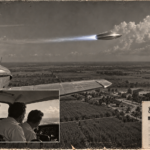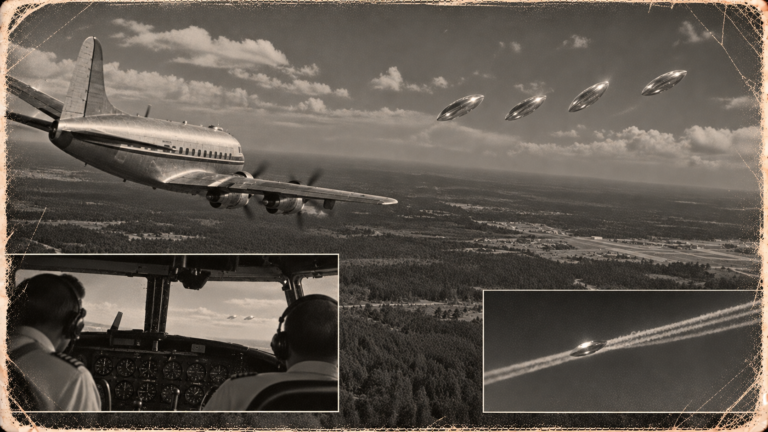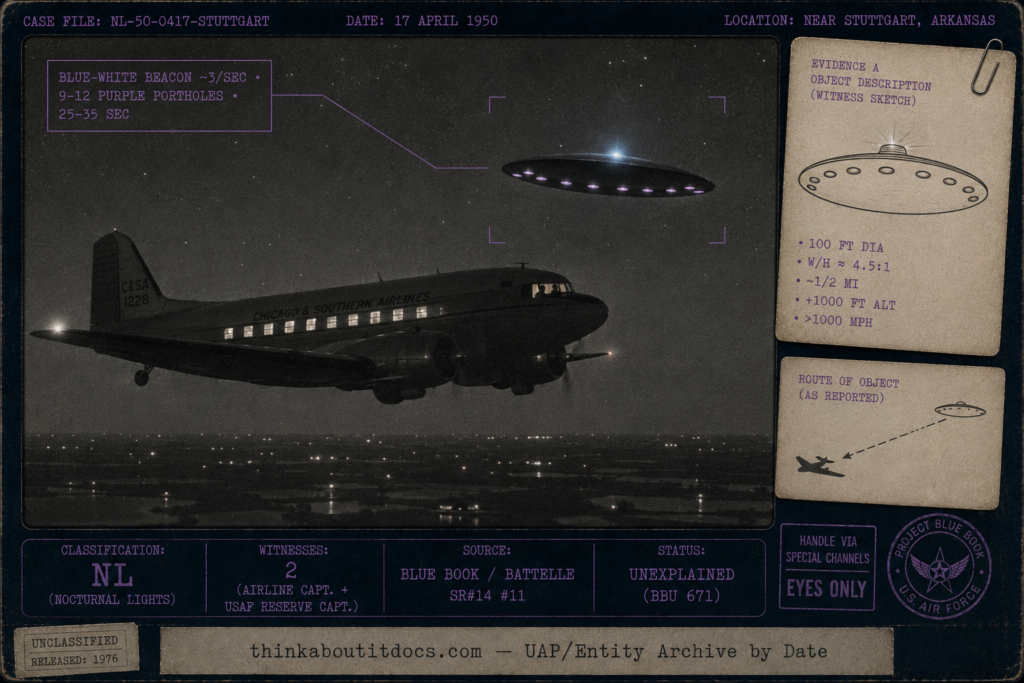
The Stuttgart disc, near Stuttgart, Arkansas, March 20, 1950 — a 100-foot disc with purple-lit portholes that passed a DC-3 at over 1,000 mph, watched by Captain Jack Adams and First Officer G. W. Anderson; classified NL, status Unexplained (double Blue Book / Battelle Unknown).
THINK ABOUTIT UFO | UAP SIGHTING REPORT
1950: Airline Pilots Observe a Fast-Moving Disc — Stuttgart, Arkansas
A little after nine-thirty on the night of March 20, 1950, a Chicago & Southern Airlines DC-3 was droning westward across the Arkansas rice country toward Little Rock when Captain Jack Adams caught a brilliant light closing on his airplane from the south. He called it to his first officer, G. W. Anderson Jr. — who happened also to hold a U.S. Air Force Reserve captaincy — and for the next half-minute the two airmen watched a disc-shaped object cross in front of them and slide off to the right, no more than half a mile away and a thousand feet above. It was perhaps a hundred feet across, with a blinding blue-white light pulsing at its top and a ring of nine to a dozen portholes glowing a soft purple along its underside. Adams put its speed at better than a thousand miles an hour — faster than anything that should have been in the sky over Arkansas in 1950. Both Project Blue Book and the Air Force’s own Battelle Institute study examined it and filed it, twice over, as Unknown.
Date: March 20, 1950 BBU 671
Sighting Time: 9:26 p.m. (21:26)
Day/Night: Night
Location: Near Stuttgart, Arkansas (about 40 miles east of Little Rock)
Urban or Rural: Airborne over rural Arkansas
No. of Entity(‘s): None reported
Entity Type: Not applicable
Entity Description: Not applicable — airborne object sighting, no occupants
Hynek Classification: NL (Nocturnal Lights) — a luminous night object; at roughly half a mile it lay beyond close-encounter range, so NL is correct despite the structural detail resolved
Duration: About 25 to 35 seconds
No. of Object(s): 1
Description of Object(s): A circular, disc-shaped object roughly 100 feet in diameter with a vertical thickness far less than its width (a width-to-height ratio on the order of 4½ to 1). A brilliant blue-white light at the top center blinked about three times a second — so intense it could not have been watched steadily had it not been flashing. Along the underside, about three-quarters of the way out from the center, ran a ring of 9 to 12 symmetrical oval or circular “portholes” emitting a soft purple light.
Shape: Disc (flat circular body)
Size: ~100 feet in diameter
Color: Blue-white top beacon; soft purple light through the underside portholes
Distance: About ½ mile at nearest approach
Height & Speed: ~1,000 feet above the airliner’s altitude; estimated speed in excess of 1,000 mph (700–1,000+ mph across sources)
No. of Witnesses: 2 — Captain Jack Adams (Chicago & Southern Airlines) and First Officer G. W. Anderson Jr. (also a USAF Reserve captain)
Special Features/Characteristics: A structured disc with a ring of glowing portholes and a high-frequency top beacon; estimated speed far beyond 1950 aircraft; observed by two professional pilots; catalogued as a Project Blue Book Unknown and independently as a Battelle Special Report #14 Unknown
Case Status: Unexplained
Source: U.S. Air Force Project Blue Book Special Report #14 (Battelle Memorial Institute study, 1955), Unknown No. 11; Project Blue Book Unknown #671; Brad Sparks, Comprehensive Catalog of Project Blue Book Unknowns; Project 1947; Edward J. Ruppelt
Summary/Description: On the night of March 20, 1950, Chicago & Southern Airlines Captain Jack Adams and First Officer G. W. Anderson Jr. were flying a DC-3 westbound toward Little Rock, near Stuttgart, Arkansas, when Adams directed Anderson’s attention to a brilliant light approaching at high speed from the south. Over roughly 25 to 35 seconds the two pilots watched a disc-shaped object — about 100 feet across, with a blinding blue-white beacon flashing at its top and a ring of 9 to 12 portholes glowing soft purple on its underside — pass in front of the airliner at about half a mile’s distance and a thousand feet higher, then disappear to the right. The crew estimated its speed at over 1,000 mph. The Air Force investigated, and the case was retained as an Unknown both in Project Blue Book and in the Battelle Memorial Institute’s Special Report #14 (as Unknown No. 11).
Related Cases: 1948 — Chiles-Whitted encounter, Alabama (airline crew; structured object with a row of lighted ports) | 1950 — Cortez-Bradenton, Florida / BBU 284 (lighted-window object; Eglin officer witness) | the Project Blue Book Special Report #14 “Unknowns” set (Battelle study)
Full Report
The Stuttgart case is one of the stronger early airline-pilot reports, and its strength lies in the combination of two credible aviators, a structured object close enough to resolve real detail, and an unusually solid documentary pedigree.
The observation was brief but clean. The DC-3 was cruising west toward Little Rock on a routine night leg when Adams, the airline captain, spotted a brilliant light approaching from the south and alerted Anderson, his first officer, who in addition to his airline post held a captaincy in the Air Force Reserve. Both men then watched the object together as it came on, crossed in front of the airplane, and went out of sight to the right — an interval of roughly twenty-five to thirty-five seconds. At closest approach it was about half a mile off and some thousand feet above their altitude, near a medium-sized city (Stuttgart) about forty miles east of Little Rock.
What they described is more than a light. The object was circular and notably flat — a disc perhaps a hundred feet in diameter whose thickness was only a fraction of its width. At the top center sat a light so brilliant that the pilots said it could not have been looked at steadily had it not been blinking, which it did about three times a second. As the disc passed, its underside came into view, and there the crew saw a ring of nine to twelve symmetrical oval or circular portholes set about three-quarters of the way out toward the rim, each glowing with a soft purple light. From the visibility, the duration, and the estimated distance, the crew judged the object’s speed to exceed a thousand miles an hour — well beyond the capability of any conventional aircraft over Arkansas in 1950.
The conventional candidates do not fit. A meteor or fireball is excluded by the structure, the controlled passage across the airliner’s front, and the disappearance to the side rather than a descending burn; meteors also do not present rings of portholes. A conventional aircraft is excluded by the disc shape, the porthole ring, the purple underside lighting, and a speed roughly double that of the fastest aircraft likely to be aloft there at the time. The pilots were trained observers judging the object against an aircraft of known size and their own airspeed and altitude, which is exactly the kind of calibrated estimate that makes pilot cases valuable.
The documentation is what seals the case’s standing. It was investigated by the Air Force and retained as an Unknown in Project Blue Book (catalogued as Unknown 671), and — independently — it was among the cases the Battelle Memorial Institute could not explain in its rigorous statistical study published as Special Report #14, where it appears as Unknown No. 11. Battelle’s analysts succeeded in explaining the large majority of the thousands of cases they reviewed; the residue they could not account for is precisely the set of best Unknowns, and Stuttgart is in it. The case also appears in Edward Ruppelt’s account and in the modern Sparks and Project 1947 catalogs, with the usual minor variances in recorded figures (speed given as 700 to over 1,000 mph, portholes as 9–12 or 7, the flash rate variously transcribed) that come with a brief night observation — variances that touch the numbers, not the substance.
What remains is a short, well-witnessed, well-documented encounter with a structured, fast-moving disc that two professional pilots could not identify and that the Air Force’s own investigators, twice, declined to explain. That is the textbook profile of a genuine Unknown.
RESEARCHER’S NOTES
The Stuttgart Disc — Arkansas 1950 and the Double Unknown
- Classification. This is correctly an NL (Nocturnal Lights) case, and the classification deserves a word because the object showed real structure. Hynek’s NL category covers luminous objects seen at night; a close encounter (CE-I) would require an approach within roughly 500 feet, and here the object passed at about half a mile — outside that threshold. So despite the resolved disc shape and porthole ring, the proper Hynek label remains NL. The page’s classification stands, with that clarification.
- Source chain. The provenance is excellent. The case rests on an Air Force investigation and survives as a documented Unknown in two independent places: Project Blue Book’s master file (No. 671) and the Battelle Institute’s Special Report #14 (No. 11), the most rigorous statistical study the Air Force ever commissioned. It is further preserved in Ruppelt’s first-hand account and in the comprehensive modern catalogs of Brad Sparks and Project 1947. This is primary-tier, government-documented sourcing with named, credentialed witnesses — about as good as the early record offers.
- Pattern context. Stuttgart belongs to the important sub-genre of 1948–1952 airline-crew encounters with structured, lighted objects — its closest relatives being the 1948 Chiles-Whitted sighting over Alabama, with its row of glowing “windows,” and the 1950 Cortez-Bradenton case from elsewhere in this archive, another lighted-port object reported by a credentialed witness and carried as a Blue Book Unknown. The recurring elements — a disc or cylinder, a ring or row of luminous ports, high speed, professional aircrew — appear across these cases independently, which is part of why they have resisted blanket dismissal.
- Physical / evidentiary weight. High for a visual case. There is no photograph or radar trace, and the observation was brief — the limiting factors. But against that stand two professional pilot witnesses in agreement, a structured object close enough (half a mile) to resolve specific detail, a calibrated speed estimate far beyond contemporary aircraft, the exclusion of the obvious mundane candidates, and — decisively — a double Unknown disposition from both Blue Book and the Battelle study. The honest assessment is Unexplained, and it is one of the better-supported airline-pilot Unknowns of the period.
The Stuttgart sighting is the kind of case that anchors the credible end of the early record. It has what the weak cases lack: trained witnesses judging the object against known references, specific structural detail rather than a vague glow, a speed estimate that rules out the ordinary, and an Air Force paper trail that twice ended in the word “Unknown.” Half a minute over the Arkansas rice fields left two pilots describing a hundred-foot disc with a ring of purple-lit ports that neither they nor the government could account for. It belongs in the chronological record as a solid, well-documented Unexplained nocturnal-light case — and as a reminder of what the genuine signal looks like once the noise is set aside.
Pictures