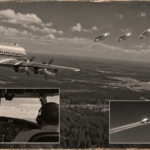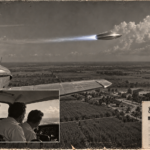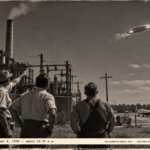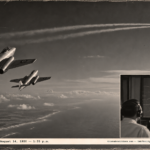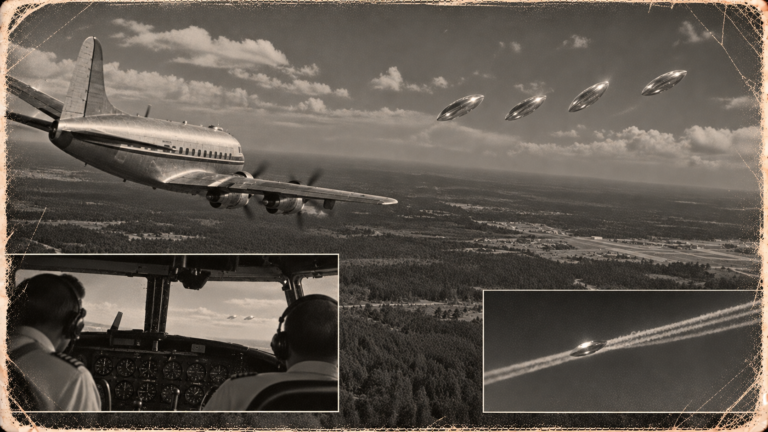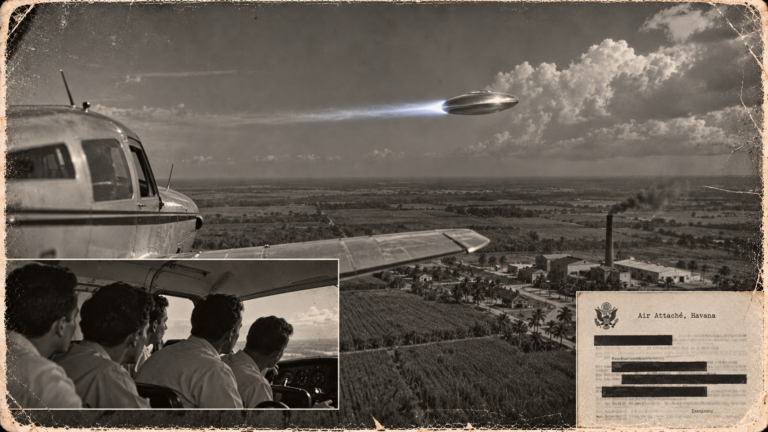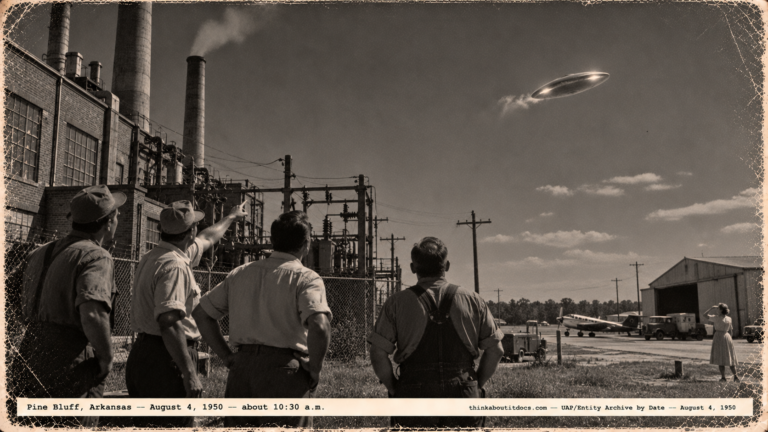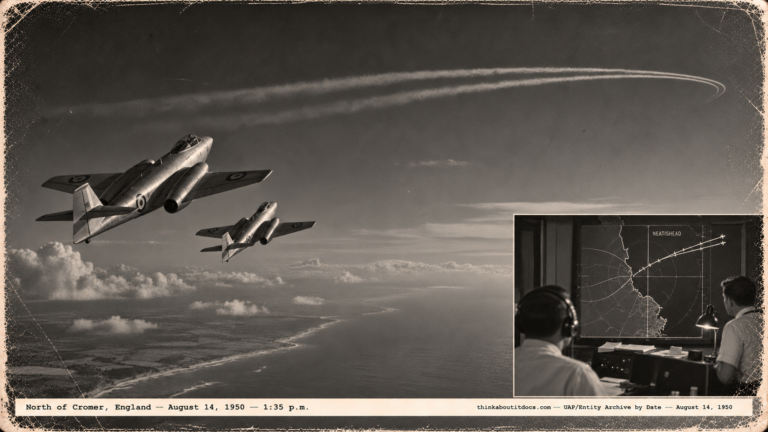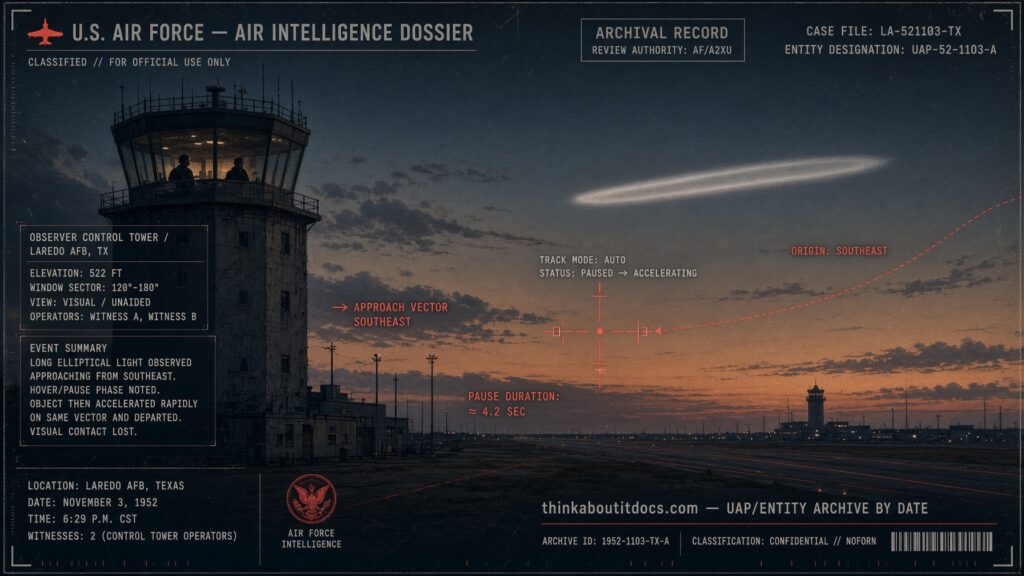
Laredo AFB, Texas, November 3, 1952 — the object as described by control tower operator Lemaster.
THINK ABOUTIT UFO|UAP SIGHTINGS REPORT
1952: Laredo AFB, Texas
A Four-Second Light Blue Book Couldn’t Fully Explain
Two control tower operators at Laredo AFB watched a long, elliptical, whitish-gray light approach the base from the southeast, pause just south of the runway, and then burst away again — gone in barely four seconds, with no tail, no trail, and no follow-up sighting to settle what it was.
Date: November 3, 1952 (BBU 2202)
Sighting Time: 6:29 p.m. CST
Day/Night: Night
Location: Laredo AFB, Texas
Urban or Rural: Air Force Base
Hynek Classification: NL (Nocturnal Light) — point or extended luminous source observed at night
Duration: 3–4 seconds
No. of Object(s): 1
Size of Object(s): Not recorded
Distance to Object(s): Not recorded
Shape of Object(s): Long and elliptical
Color of Object(s): White-gray
Height & Speed: Not numerically recorded; described as approaching, pausing, and departing with an apparent burst of speed
Number of Witnesses: 2 (control tower operator Lemaster and one unnamed colleague)
Special Features/Characteristics: The object approached the base from the southeast, appeared to pause south of the base, then departed to the southeast with a sudden burst of speed. No tail or trail was noted. A T-33 aircraft was in the area but remained visible to the witnesses throughout, ruling it out as the object itself. Weather was two layers of scattered/broken cloud at 5,000 and 10,000 ft, 12 miles visibility, light NNE surface wind.
Case Status: Officially closed by Project Blue Book as “Possibly astronomical,” though the investigating officer’s own writeup flagged an unresolved tension in that explanation: if the object appeared to grow larger before departing — i.e., approaching the tower rather than simply passing by — a meteor explanation would not hold, since meteors do not reverse course. The report itself concedes this apparent approach-and-retreat could be an illusion given how difficult it is to judge the path of an object not moving directly overhead, leaving the case genuinely short of full certainty even in Blue Book’s own words.
Source: Project Blue Book case file; Berliner
Summary/Description: At 6:29 p.m. on November 3, 1952, two control tower operators at Laredo AFB, Texas, including a witness named Lemaster, watched a long, elliptical, whitish-gray light approach the base from the southeast. It appeared to pause south of the base before departing again to the southeast with a sudden burst of speed. The sighting lasted only three to four seconds, with no tail or trail visible. A T-33 aircraft was in the vicinity but remained in view separately throughout, ruling it out as the source. Project Blue Book’s investigation weighed a meteor explanation against the report’s own detail — that the object appeared to grow larger before departing, suggesting genuine approach rather than a simple pass-by — and ultimately closed the case as “possibly astronomical” while acknowledging the approach-and-retreat description didn’t cleanly fit that explanation either.
Related Cases: Not Applicable
Detailed Report
The Laredo AFB case is a brief one, but it’s preserved with an unusually complete piece of primary documentation: Project Blue Book’s own full I-II-III investigative writeup, rather than a bare summary line. That writeup is worth reading closely, because the investigating officer did something many later retellings of “explained” Blue Book cases skip over — he stated plainly why the assigned explanation didn’t fully fit the witness description.
A meteor is, on its face, a reasonable fit for a fast, brief, tailless light. But control tower operators are trained, practiced observers of exactly this kind of aerial phenomenon, and their report specifically described the object appearing to grow larger — approaching the tower — before it departed. A meteor does not reverse course or approach an observer; it travels a single ballistic path. The Blue Book writeup acknowledges this directly, noting that if the object genuinely approached before retreating, “it could not have been a meteor,” while also allowing that judging the path of an object not traveling directly overhead is notoriously difficult, and the apparent approach-and-retreat might simply be a visual illusion of perspective.
That’s an honest piece of Cold War-era bureaucratic writing — a conclusion reached with a stated escape hatch, rather than confidence disguised as certainty. The case’s official label, “possibly astronomical,” reads less like a settled finding and more like the most convenient available answer once the more troubling alternative reading was acknowledged and then set aside.
RESEARCHER’S NOTES
Laredo AFB, Texas — 1952 and an Honest Loose End in Blue Book’s Own File
- The official explanation contains its own caveat: Blue Book’s writeup doesn’t simply assert “meteor” or “astronomical” — it directly flags that the witnesses’ description of an apparent approach doesn’t fit a meteor’s physics, and resolves the tension only by suggesting the approach itself might be an illusion. That’s a notably candid admission for an official case closure.
- Trained observers, brief but specific detail: Control tower operators are professionally attuned to aircraft and aerial movement, which lends some weight to their specific claim of an apparent approach — a detail an untrained witness might describe less precisely.
- A ruled-out red herring: The presence of a T-33 in the area is noted and explicitly ruled out as the object’s identity, since it remained separately visible throughout — a small but useful piece of due diligence in the original file.
- Extremely short duration limits what can be concluded either way: At three to four seconds, there simply wasn’t much time for either witness to firmly establish trajectory, and this archive treats the case’s brevity as a genuine limitation on certainty in any direction.
Seven decades later, “possibly astronomical” remains the case’s official word — but Blue Book’s own file leaves the door open exactly as wide as the witnesses’ four-second glimpse did.
“If, however, the object came toward the tower… it could not have been a meteor.”
— Project Blue Book case assessment, Laredo AFB, Texas, November 3, 1952