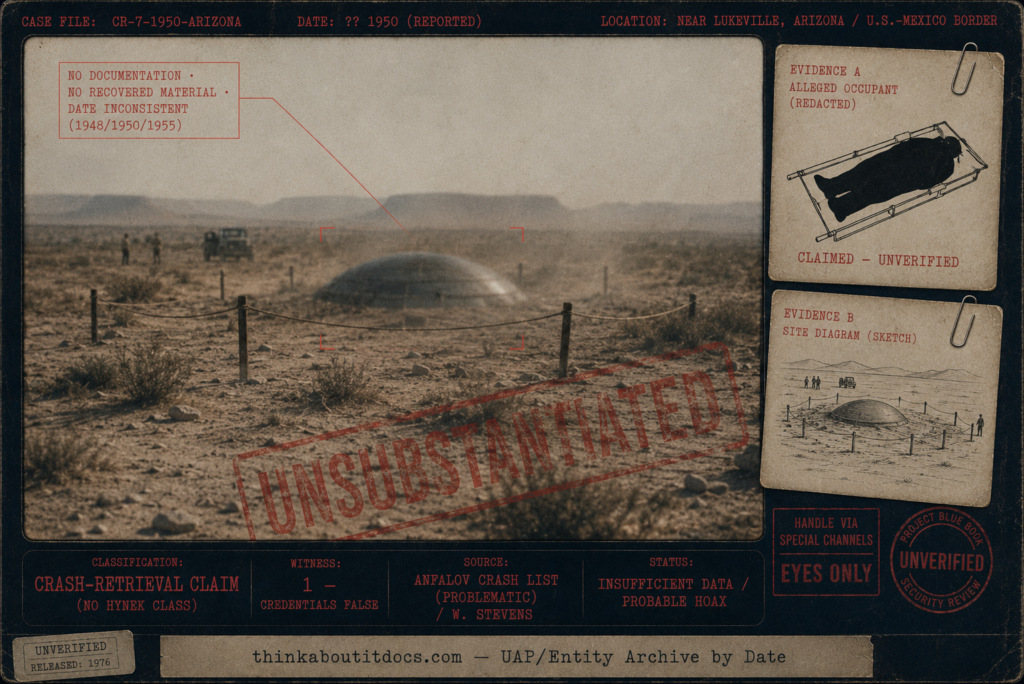
The alleged Del Rio crash, Texas–Mexico border, claimed December 6, 1950 — a crash-retrieval story sourced to a discredited witness and a problematic compiler; no Hynek class, status Insufficient Data / probable hoax.
THINK ABOUTIT UFO | UAP CRASH-RETRIEVAL REPORT
1950: The Alleged Del Rio “Crash” — Texas–Mexico Border
Among the post-Roswell crash legends, the Del Rio story is one of the more elaborate — and one of the more thoroughly dismantled. As it circulates, it has a UFO tracked on radar in December 1950, a USAF jet scrambled to chase it across the Rio Grande, a saucer half-buried in the Mexican desert, dead gray occupants from Zeta Reticuli inside, a surviving crewman levitating away on an anti-gravity device, and the whole craft dragged north to be hidden at Edwards, then Area 51, then S-4. None of it can be documented. The narrative’s exotic details trace to a crash compiler whose work this archive treats with the greatest caution, and the underlying 1950 Del Rio claim rests on a single man — “Colonel” Robert Willingham — whose military record, when finally checked, showed he was never a colonel, never a fighter pilot, and never in Korea. It is preserved here as a case study in how a crash legend is built, and labeled for exactly what it is.
Date: Claimed December 6, 1950 (the date migrated across tellings — first given as 1948, later 1950, and elsewhere 1955)
Sighting Time: Not specified
Day/Night: Not specified
Location: Claimed deserted, sandy ground roughly 30 miles (50 km) west of Del Rio, about 10 miles inside Mexican territory near the Texas border (also placed near El Indio / Guerrero along the Rio Grande)
Urban or Rural: Rural desert
No. of Entity(‘s): 2 claimed (a third said to have survived)
Entity Type: Claimed “gray” type
Entity Description: Per the unverified account, two dead occupants of a “gray” type with four clawed fingers, reptilian in appearance, in tight silver suits; three cabin seats were said to imply a third crew member, claimed to have survived and escaped
Hynek Classification: Not applicable — crash-retrieval claim, not a Close Encounter (the prior CE-IV/abduction label was incorrect on both counts); given the hoax assessment, no classification applies
Duration: Not applicable
No. of Object(s): 1 claimed
Description of Object(s): A claimed disk-shaped craft about 20 feet (6 m) across, said to resemble a convex lens with a dome on top, reportedly partly embedded in soft soil
Shape: Disk (claimed)
Size: ~20 ft / 6 m (claimed)
Color: Not specified
Distance: Not applicable
Height & Speed: Not specified
No. of Witnesses: Effectively one — Robert B. Willingham, for the original sighting claim; the entire recovery narrative is unattributed
Special Features/Characteristics: Claimed radar tracking and an F-94 jet pursuit across the border; a parachuted team allegedly stenciling “USAAF” on the craft to claim it; Mexican Army turned away; a claimed accidental TV broadcast cut off by the government; recovery to Edwards AFB, then Tonopah/Area 51, then “S-4”; a claimed Zeta-2 Reticuli origin and anti-gravity devices — none of it documented
Case Status: Insufficient Data / Probable Hoax — the underlying Del Rio 1950 claim (Robert Willingham) is assessed by leading crash-retrieval investigators as a hoax, and the recovery narrative derives entirely from the problematic Anton Anfalov crash list
Source: Anton Anfalov crash list (a source flagged as PROBLEMATIC); Wendell Stevens, UFO Contact From… series. Underlying claim traced to Robert B. Willingham; critical investigation by Kevin D. Randle
Summary/Description: As circulated, the account holds that on December 6, 1950, U.S. radar tracked an object that was pursued by an F-94 jet and crashed in the desert roughly 30 miles west of Del Rio, about 10 miles inside Mexico. A team is said to have parachuted in, stenciled “USAAF” on the 20-foot domed disk, and turned away the Mexican Army by calling it an experimental American aircraft. Inside, the story claims, were two dead “gray” occupants with clawed fingers in silver suits, with a third crew member surviving and escaping by anti-gravity device; the craft was supposedly hauled to the U.S. and hidden at successive secret facilities. The story’s distinctive details come from the Anton Anfalov crash compilation and Wendell Stevens, while the seed claim — a December 1950 border crash witnessed and chased by a pilot — originates with Robert B. Willingham, whose account has been substantially discredited.
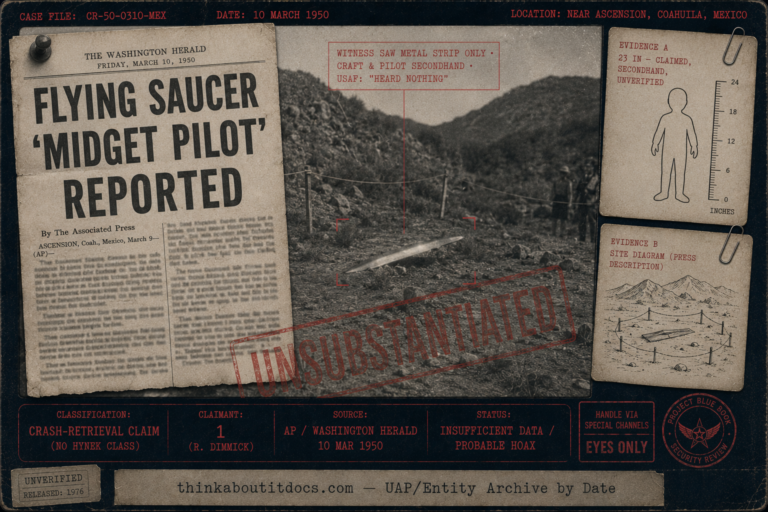
Related Cases: 1948 — Aztec, New Mexico crash (Scully / Newton–GeBauer hoax lineage) | 1950 — Mexico City “midget pilot” crash (contemporaneous dubious Mexican crash claim) | the post-1947 “crashed saucer with dead crew” hoax genre, after Frank Scully’s Behind the Flying Saucers
Full Report
The Del Rio crash is best understood not as an event but as a story, and tracing how the story was assembled is more instructive than recounting its claims as though they happened.
The seed is a single man. In the late 1960s, a Pennsylvania reporter canvassing Civil Air Patrol pilots about UFO sightings collected an account from one Robert B. Willingham, who said he had seen something fall near the Texas–Mexico border. The report drifted to NICAP and sat for years. In the 1970s the researcher W. Todd Zechel pursued it and obtained a 1977 affidavit from Willingham, by then presenting himself as a retired Air Force colonel and combat pilot. His apparent rank and flying career lent the story its credibility — and almost no one checked it.
When investigator Kevin Randle finally did check, the credibility collapsed. Air Force records showed that Willingham entered the Army in December 1945 and left as an enlisted E-4 in January 1947. There was no colonel’s commission, no fighter-pilot record, no Korean War service — the very elements that made his account worth believing were untrue. The date of the supposed crash had also wandered: earlier tellings placed it in 1948, it shifted to December 6, 1950 after Zechel entered the case, and still other versions put it in 1955. The physical heart of the tale — a strange “honeycombed,” indestructible metal fragment — exists only in Willingham’s own changing testimony. Randle’s published conclusion is blunt: other than Willingham, there is no evidence the crash occurred, and the case is a hoax he invented.
The version reproduced on the prior page is not even Willingham’s relatively spare account, but a far more elaborate one — radar tracking, an F-94 chase, a parachute team stenciling “USAAF” on the hull, two dead reptilian grays from Zeta-2 Reticuli, a surviving crewman levitating away on a portable anti-gravity unit, the craft hauled north by a tracked vehicle and hidden in sequence at Edwards, Tonopah/Area 51, and “S-4.” These flourishes are the signature of crash-retrieval compilations associated with Anton Anfalov, whose lists this archive treats as problematic on sight — the same compiler behind a string of unverifiable Soviet contactee and crash claims. Wendell Stevens, the other cited source, was a prolific publisher of contactee and crash material of frequently dubious reliability. There is no document, no named recovery witness, no film, and no metal — only successive layers of narrative.
The one genuine kernel beneath all of it is unrelated to any crash. On or about December 6, 1950, there was a real, brief U.S. air-defense alert: early-warning radar reported a possible formation of unknown contacts approaching North America, defense forces went momentarily to alert, and the contacts evaporated — most likely a radar artifact or misidentification, with the alert quickly stood down. That genuine, mundane Cold War episode appears to have been retrofitted, years later, as the “radar tracking” that supposedly preceded the Del Rio crash. The alert was real; the crash bolted onto it was not.
Presented honestly, then, this is not a sighting to be evaluated but a legend to be sourced. Its provenance runs from a witness who fabricated his credentials, through a problematic crash compiler, into the broad post-Roswell tradition of crashed-saucer-with-dead-crew stories that began in earnest with Frank Scully’s exposed 1950 book. It earns a place in the chronological record only as an example of that tradition — clearly flagged.
RESEARCHER’S NOTES
The Del Rio Legend — Texas–Mexico 1950 and the Anatomy of a Crash Story
- Classification. The prior page’s CE-IV (abduction) is incorrect on two independent grounds, and has been removed. No abduction occurs anywhere in the account, so the abduction category cannot apply; and per consistent practice, crash claims are treated as crash-retrieval reports rather than Close Encounters in any case. Because the account is moreover assessed as a hoax, no Hynek classification is assigned at all. The category line now states that plainly.
- Source chain. This is the determining factor and the worst feature of the case. The distinctive narrative derives from the Anton Anfalov crash list — a source flagged here as problematic without exception — supplemented by Wendell Stevens, a publisher of frequently unreliable contactee material. The seed claim traces to Robert B. Willingham, whose self-asserted rank and pilot career were shown by records research to be false. There is no primary documentation: no FOIA-released crash report, no identified recovery personnel, no photographs, no physical sample. A chain that begins with a fabricated witness and passes through a problematic compiler cannot support any factual claim.
- Pattern context. The story belongs squarely to the post-1947 “crashed saucer with dead occupants” genre that flourished after — and partly because of — Frank Scully’s 1950 Behind the Flying Saucers, itself a documented hoax built on the Newton–GeBauer “Dr. Gee” fabrication. Its closest cousins on this site are the Aztec, New Mexico tale of the same lineage and the contemporaneous Mexico City “midget pilot” crash claim. The recurring template — radar track, military chase, recovered disk, dead grays, secret-base disposition, government cover-up — is a narrative formula, repeated with local variations, rather than a set of independently established events.
- Physical / evidentiary weight. None. There is no recoverable evidence of any kind, the sole originating witness fabricated the credentials that gave his story weight, the crash date is internally inconsistent across versions, and the elaborate recovery details come from a source the archive does not credit. The only verifiable element nearby — the brief December 1950 air-defense alert — was a mundane radar event with no connection to a crash. The honest disposition is Insufficient Data shading firmly into probable hoax: not a genuine unknown, and best catalogued as discredited crash-retrieval lore.
The Del Rio crash reads dramatically, but it does not survive its own paper trail. Strip away the layers and what remains is a man who was not the officer he claimed to be, a date that could not hold still, a recovery narrative supplied by a discredited compiler, and a real but unrelated air-defense scare pressed into service as a prologue. Nothing in it can be verified, and its most authoritative investigator concludes it was invented. It belongs in the chronological record only as an instructive specimen of the crashed-saucer legend — preserved, sourced, and plainly marked as unsubstantiated rather than presented as history.