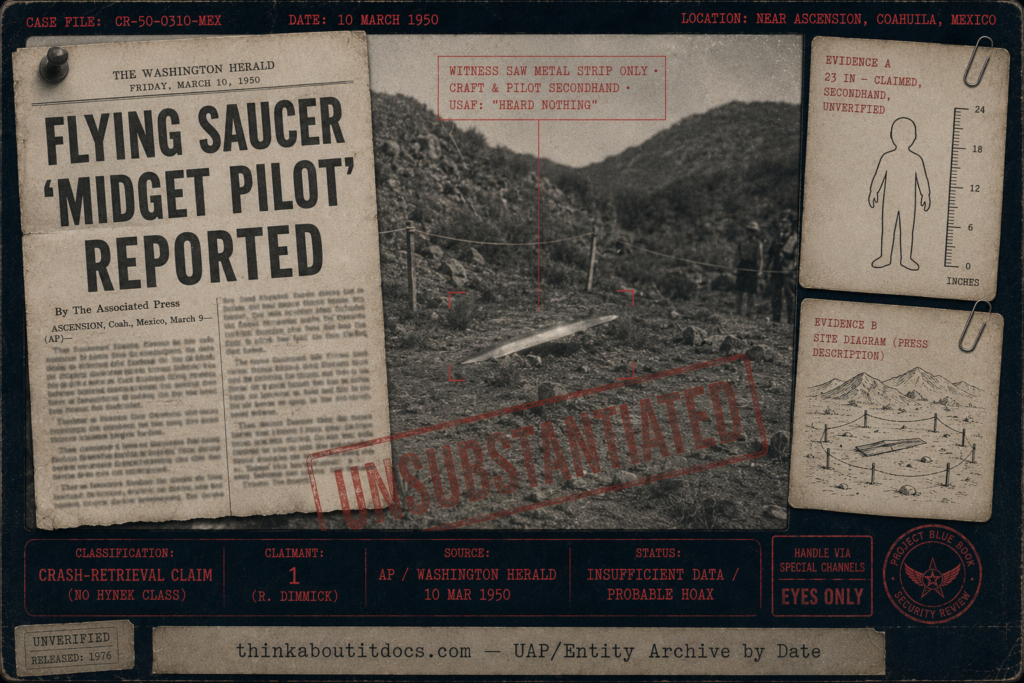
The Dimmick "midget pilot" claim, said to be a Mexico City mountainside, publicized March 1950 — a saucer and 23-inch embalmed pilot known only secondhand from unnamed sources; no Hynek class, status Insufficient Data / probable hoax.
THINK ABOUTIT UFO | UAP CRASH-RETRIEVAL REPORT
1950: The Mexico City “Midget Pilot” Crash Claim
In March 1950, as the country was buzzing with rumors of crashed flying saucers and the “little men” supposedly found inside them, a Los Angeles explosives-company sales manager named Ray L. Dimmick gave reporters a story tailor-made for the moment. He said a streamlined flying saucer, forty-eight feet across and built of a metal harder than aluminum, had crashed on a mountainside near Mexico City — and that its pilot, a man just twenty-three inches tall, had died in the wreck and been embalmed for scientific study. Pressed for details, Dimmick conceded he had personally seen only an eight-foot strip of metal he was told came from the ship; everything else came from two businessmen in Mexico City he declined to name. The Air Force in Washington said it had heard nothing about any of it. The tale belongs squarely to the 1950 wave of crashed-saucer hoaxes, and it is preserved here as a vivid period specimen — clearly labeled for what it is.
Date: Claim publicized March 9, 1950 (Associated Press); the alleged crash said to have occurred about three months earlier (late 1949)
Sighting Time: Not applicable
Day/Night: Not applicable
Location: Claimed mountainside near Mexico City, Mexico
Urban or Rural: Rural (claimed mountainside)
No. of Entity(‘s): 1 claimed
Entity Type: Claimed humanoid (“man”)
Entity Description: Per the unverified, secondhand account, a “pilot” just 23 inches tall, said to have died in the crash and been embalmed for study — not seen by the man who made the claim
Hynek Classification: Not applicable — crash-retrieval claim, not a Close Encounter (the prior CE-III was incorrect; the claimant observed no being); given the hoax-tier nature, no classification applies
Duration: Not applicable
No. of Object(s): 1 claimed
Description of Object(s): A claimed “ultra-streamlined” saucer about 48 feet in diameter, built of a metal resembling aluminum but much harder, said to be powered by two motors; the claimant stated he personally saw only an 8-foot strip of metal (about 8 inches wide and three-quarters of an inch thick) said to have come from it
Shape: Saucer (claimed)
Size: ~48 ft diameter (claimed)
Color: Metallic (aluminum-like; claimed)
Distance: Not applicable
Height & Speed: Not applicable
No. of Witnesses: Effectively one claimant — Ray L. Dimmick, sales manager of the Apache Powder Co. — who said he saw only a metal strip; the crash, the craft, and the “pilot” came secondhand from two Mexico City businessmen (one American, one Chilean) he refused to name
Special Features/Characteristics: No official confirmation (the Air Force said it had heard nothing); the dramatic details were admittedly secondhand from unnamed sources; the claim coincides with the 1950 Frank Scully “little men in crashed saucers” wave; Dimmick also asserted that similar objects had landed across North America under government secrecy
Case Status: Insufficient Data / Probable Hoax — an unsubstantiated press claim of the 1950 crashed-saucer craze, admittedly built on secondhand, unnamed sources and never confirmed
Source: Associated Press wire story, dateline Los Angeles, March 9, 1950, as printed in The Washington Herald, March 10, 1950 (contemporaneous press)
Summary/Description: In early March 1950, Ray L. Dimmick, sales manager of the Apache Powder Company, told Los Angeles reporters that a flying saucer had crashed on a mountainside near Mexico City and that top U.S. officials had viewed it. He described the craft as a 48-foot streamlined disc of an aluminum-like but harder metal, powered by two motors, and said its pilot — a man 23 inches tall — had died in the crash and been embalmed for scientific study. Under questioning, Dimmick acknowledged he had personally seen only an 8-foot strip of metal he was told came from the ship; the rest of the account came from two businessmen in Mexico City whom he would not name. There was no confirmation, and the Air Force in Washington said it had heard nothing about it. The claim appeared amid the 1950 wave of crashed-saucer-with-little-men stories associated with Frank Scully’s soon-to-be-published (and later discredited) Behind the Flying Saucers.
Related Cases: 1948 — Aztec, New Mexico crash (Scully / Newton–GeBauer “little men” hoax, exposed by J.P. Cahn) | 1950 — alleged Del Rio crash (adjacent unsubstantiated Mexican-border crash claim) | Frank Scully, Behind the Flying Saucers (1950) — the documented hoax that defined the genre
Full Report
The Dimmick story is best read not as a crash but as a snapshot of a moment — the spring of 1950, when the idea of recovered flying saucers and their tiny dead crews had taken sudden hold of the American press, and almost anyone with a confident manner could get a hearing for one. Tracing how this particular tale was sourced shows exactly why it never amounted to anything.
The claimant was Ray L. Dimmick, a sales manager for the Apache Powder Company, an explosives concern. In early March 1950 he told reporters in Los Angeles a striking story: a streamlined flying saucer, forty-eight feet across and made of a metal like aluminum but much harder, powered by twin motors, had crashed on a mountainside near Mexico City, and senior U.S. officials had supposedly inspected it. Its pilot, he said, was a man only twenty-three inches tall who had died in the crash and whose body had been embalmed for scientific study. For a few days it was good copy.
The story collapsed on its own details almost immediately. Dimmick admitted, when pressed, that he had personally seen nothing of the saucer or its pilot — only an eight-foot strip of metal that he had been told came from the ship. The crash, the craft’s dimensions, the embalmed dwarf pilot: all of it came secondhand from two businessmen in Mexico City, one American and one Chilean, whom Dimmick declined to identify, saying he would name them only “if requested by the proper authorities.” That is the structure of a rumor, not a recovery: a single intermediary repeating an unverifiable story from anonymous sources, with the one tangible item — a metal strip — unconnected by any chain of evidence to a crash. The Air Force in Washington said flatly it had heard nothing about the matter.
Timing is the rest of the explanation. The claim surfaced in March 1950, in the middle of the first great crashed-saucer craze. Frank Scully’s sensational columns had been running, his book Behind the Flying Saucers would appear that September, and its central tale — small humanoid bodies recovered from crashed discs, supplied by the con men Silas Newton and Leo GeBauer behind the fictitious “Dr. Gee” — was already circulating as lectures and rumor. That whole edifice was later exposed as a fraud by journalist J.P. Cahn. Dimmick’s twenty-three-inch embalmed pilot is unmistakably a product of the same craze: the “little men in a crashed saucer” was the stock motif of the moment, and his version simply relocated it to a Mexican mountainside. His parting flourish — that similar objects had landed across North America under official secrecy — is the same conspiratorial garnish that accompanied the rest of the genre.
Nothing about the claim was ever substantiated. No saucer, no body, no named witness, no official record, no metal that led anywhere. What survives is a contemporaneous Associated Press wire story reporting that a man made a sensational assertion — which is a genuine artifact of 1950 press history, but not evidence of a crash. Presented honestly, this is a period curiosity from the crashed-saucer craze, of interest for what it shows about 1950 rather than for anything it shows about a downed craft.
RESEARCHER’S NOTES
The Dimmick Claim — Mexico City 1950 and the Crashed-Saucer Craze
- Classification. The prior page’s CE-III is incorrect and has been removed. CE-III denotes the close observation of animate beings by a witness — but the claimant, Dimmick, observed no being at all; he saw, by his own admission, only a strip of metal, and the “pilot” was secondhand hearsay. Beyond that, crash claims are treated as crash-retrieval reports rather than Close Encounters in any case, and a hoax-tier claim carries no Hynek classification. The category line now reflects all three points.
- Source chain. The provenance is a single contemporaneous Associated Press story, faithfully reporting that Ray L. Dimmick made a claim — solid as a record of the claim, worthless as evidence of an event. Dimmick himself is the lone named figure, and he sourced the substance to two unnamed Mexico City businessmen. There is no document, no body, no identified saucer, and no corroborating witness. A chain that runs from anonymous sources through a single self-described intermediary to a newspaper cannot establish a crash.
- Pattern context. The claim sits at the center of the 1950 crashed-saucer-with-little-men wave, the genre crystallized by Frank Scully’s Behind the Flying Saucers and its Newton–GeBauer “Dr. Gee” hoax, later exposed by J.P. Cahn. Its nearest cousins on this site are the Aztec, New Mexico tale of that same lineage and the contemporaneous alleged Del Rio border crash. The twenty-three-inch embalmed pilot is a direct echo of Scully’s “little men,” and the whole account follows the era’s template: recovered disc, tiny crew, exotic metal, officials secretly involved, blanket government secrecy.
- Physical / evidentiary weight. None. The dramatic content is admittedly secondhand from unnamed sources; the only tangible object is an undescribed metal strip with no established connection to any crash; there is no body, no craft, no documentation, and an explicit Air Force denial of any knowledge. The honest disposition is Insufficient Data shading firmly into probable hoax — a tall tale of the 1950 saucer-crash craze, not a recoverable event. It earns its place in the chronological record only as an illustrative period specimen, plainly marked.
The Mexico City “midget pilot” story is a small artifact of a feverish season. In the spring of 1950, the image of a tiny dead spaceman in a recovered saucer was everywhere, and Ray L. Dimmick supplied a colorful local version of it — undercut, within the same news cycle, by his own admission that he had seen only a piece of metal and was passing along what unnamed others had told him. No saucer, no pilot, and no confirmation ever materialized. The tale belongs to the history of the crashed-saucer craze rather than to the history of any crash, and it is catalogued here as exactly that: an unsubstantiated, probably hoaxed period claim, preserved and clearly flagged.
 The Washington Herald-3-10-1950
—Los Angeles, March 9 (AP)
An expert on chemicals and explosives told reporters yesterday he had seen the wreckage of an ultra streamlined flying saucer on a Mexico City mountainside, and that top U.S. officials have viewed it.
But there was no confirmation of the account, related by Ray L. Dimmick sales manger of of the Apache Powder Co., and the Air Force in Washington said it had heard nothing about it.
Says Saw “Strip of Metal”
Dimmick later told newsmen he had seen only a strip of metal which he was told came from the space ship.
The remainder of his information Dimmick said, came from two businessmen in Mexico City, one an American, the other a Chilean. Dimmick declined to name them, said he would divulge that information “if requested by the proper authorities.”
Part of the information he said, was that a man 23 inched tall, the pilot of the plane, died in the crash and that his body had been embalmed for scientific study.
It was an exquisite piece of machinery, Dimmick told the first interviewers. He then described it in detail, saying it was 48 feet in diameter, built of a metal resembling aluminum, but much harder, and was powered by two motors.
He was then taken to the scene of the crash by associates and that the wreckage was roped off. The crash occurred three months ago he said.
Dimmick said later that the piece of metal he saw was actually eight feet long, 8 inches wide, and three-quarters of an inch thick.
Others Sighted
Reminded that the Air Force announced last December it was dropping its investigation of Flying Saucers because of preponderance of evidence that they do not exist, Dimmick said:
“I’m big enough to take the consequences of what I said and stand my ground.”
He said he has reports of that similar objects landed in various parts of North America in the last year, “but governments have clamped veils of secrecy about their investigations.”