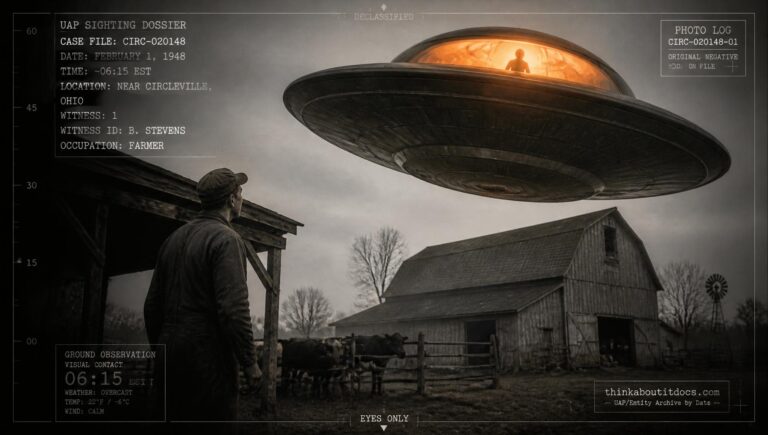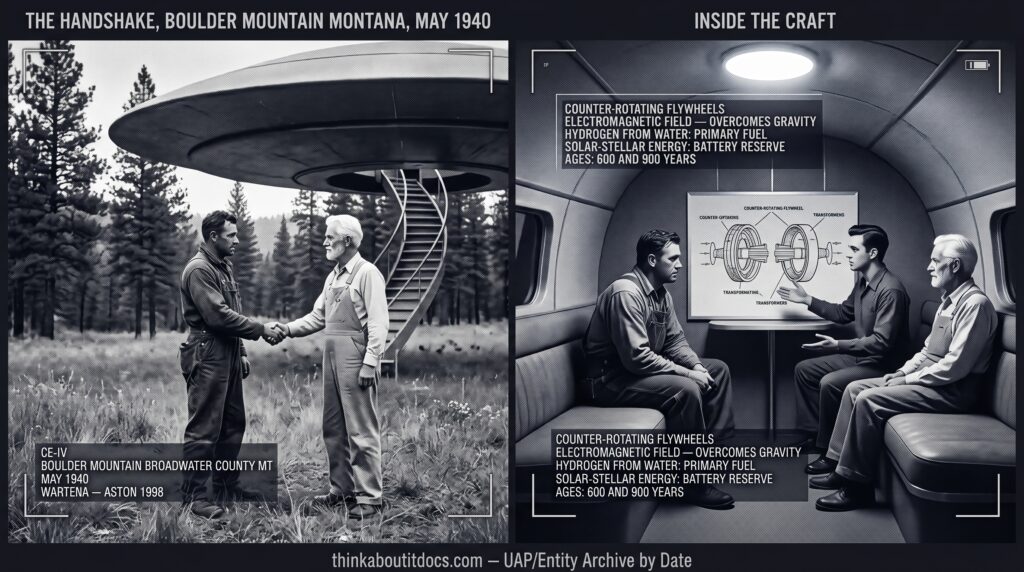
Boulder Mountain, Broadwater County, Montana, May 1940 — Dutch immigrant miner Udo Wartena encounters a 35-foot-high, 100-foot-wide disc craft hovering above his mining claim meadow. A human-appearing occupant in gray overalls descends the stairway, shakes his hand, requests water, and invites him aboard. Inside, two men claiming ages of approximately 600 and 900 years explain counter-rotating flywheel propulsion and hydrogen fuel extraction. An X-ray scan is performed. Udo declines an invitation to leave with the craft. Physical trace: crushed grass at stairway base. Post-departure energy loss for several hours. Udo kept the experience secret for over 20 years; three handwritten accounts preserved before his death in 1989. Source: Warren Aston, UFO Magazine, March/April 1998. thinkaboutitdocs.com.
THINK ABOUTIT UFO | UAP | SIGHTING/ABDUCTION REPORT
1940: Broadwater County Montana
On a mid-morning in May 1940, a 37-year-old Dutch immigrant named Udo Wartena was moving boulders at his mining claim near the base of Boulder Mountain in Broadwater County, Montana, when he heard a humming sound he initially attributed to aircraft from Great Falls. When it continued, he climbed to higher ground and saw a disc-shaped craft approximately 35 feet high and over 100 feet across hovering just above the meadow where he had built his dam — resembling two soup plates, one inverted over the other, the color of stainless steel though not as bright or shiny. A circular stairway let down from the bottom. A man descended and walked toward him. The man shook his hand, apologized that they had not known anyone was in the area, and asked if the craft could take some water from the stream. Then he invited Udo aboard. Udo went without fear. Inside he met a second man with snow-white hair, and was told that one was approximately 600 years old as we measure time and the other over 900. They spoke over five hundred languages. They explained their propulsion — counter-rotating flywheels generating their own gravitational field, energy drawn from the sun and stars stored in batteries for emergencies, the craft focusing on distant stars to ride their light like ice skating. They scanned him with an X-ray-like device. They asked if he wanted to go with them. He said he thought it would be interesting, but felt it would inconvenience too many people, and later wrote that he had wondered why he said that. When he walked away, the stairway retracted. He waved at the portholes. The craft rose straight up and was gone. He lost his strength for several hours. Where the stairway had rested: only crushed grass.
Date: May 1940 (early in the month)
Sighting Time: Mid-morning; inside the craft approximately two hours (according to the sun, Udo estimated departure around noon)
Day/Night: Day
Location: Boulder Mountain mining claim, near Canyon Ferry Lake, near Townsend, Broadwater County, Montana, USA (southeast of Helena)
Urban or Rural: Rural — isolated forest mining claim
No. of Entity(‘s): 2
Entity Type: Human-appearing occupants
Entity Description: Both men appeared human. One described as approximately Udo’s age (37) — nice-looking, strong, clear almost translucent skin, white hair despite young appearance. Wore light gray overalls, a tam (circular cap) of the same material, and slippers or moccasins. The second man was older in appearance with snow-white hair. Both claimed ages of approximately 600 and 900 years respectively. Both spoke English slowly and precisely, described as linguists picking their way carefully. No unusual physical features noted beyond the translucent skin quality and the white hair at apparent young age.
Hynek Classification: CE-IV — Close Encounter of the Fourth Kind (voluntary boarding; two-hour interior contact; physical examination; invitation to depart permanently)
Duration: Approximately two hours (mid-morning to around noon by the sun’s position)
No. of Object(s): 1
Description of the Object(s): Two soup plates, one inverted over the other. Stainless steel color though not as bright and shiny. Circular stairway with solid bottom let down from the hull. Approximately 12 by 16 foot entry room with sliding door, indirect ceiling lighting, upholstered benches. Counter-rotating flywheels or rings approximately three feet wide and several inches thick, separated by rods turned by motors, next to battery/transformer-type units around the inside perimeter. Multiple portholes. Hose or pipe lowered to take water from the stream.
Shape of Object(s): Disc — two inverted plates
Size of Object(s): Approximately 35 feet high and over 100 feet across
Color of Object(s): Stainless steel appearance — not bright and shiny
Distance to Object(s): Hovering just above the meadow — stairway rested on the ground
Height & Speed: Hovering at meadow level on arrival; rose straight up until clearing the trees, then virtually straight up and out of sight rapidly on departure
Number of Witnesses: 1 — Udo Wartena (1903–1989); Dutch immigrant, Northwest Mining Company, Broadwater County MT
Special Features/Characteristics: Water collection via hose from stream (hydrogen extraction for fuel); two counter-rotating flywheels generating electromagnetic gravitational field override; solar/stellar energy stored in batteries for emergency use; unknown additional power source not explained; X-ray-like scanning device used on Udo; invitation to leave with craft declined; post-departure physical weakness lasting several hours; crushed grass where stairway rested (physical trace); multiple handwritten accounts by Udo; verbal corroboration by family and close friends before death in 1989; possible related disappearance of a young man in the same area approximately two years earlier
Case Status: Unexplained
Source: Warren Aston, UFO Magazine, March/April 1998; based on two handwritten accounts and one typewritten account by Udo Wartena plus verbal recollections from family and friends; first published summary by James L. Thompson, Aliens and UFOs (Horizon, 1993)
Summary/Description: In May 1940, Dutch immigrant miner Udo Wartena encountered a large stainless-steel-colored disc at his isolated Montana mining claim. A human-appearing man descended a stairway, shook his hand, requested water, and invited him aboard. Inside, two men claiming to be approximately 600 and 900 years old explained their propulsion system, scanned him with an X-ray device, and invited him to leave with them — an offer he declined. Post-encounter physical weakness for several hours. Crushed grass physical trace at the stairway site. Udo kept the experience secret for over two decades, confiding only in close friends and family before his death in 1989.
Related Cases: 1939 Serra do Gordo Brazil — two tall metallic-suited occupants boarding invitation (Faleiro) | 1936 Port Colborne Ontario — boarding invitation (Bartholomew/Musgrave) | 1936 Pacific Maria — voluntary retention (Zigel/Anfalov) | 1950 Steep Rock Lake Ontario — water collection by craft
Detailed Report
The Udo Wartena case of May 1940 is one of the most substantively documented pre-modern CE-IV accounts in the American record, and its credibility rests on a foundation that distinguishes it clearly from standard contactee narratives of the 1950s. Udo Wartena was a private man who kept his experience secret for more than two decades — not telling his wife, not seeking publicity, not publishing a book about visits from Venusians. Before his death in 1989 he confided in two close friends and then wrote three separate accounts — two handwritten, one typewritten — specifically to preserve the record. Warren Aston, the Australian researcher who eventually published the case in UFO Magazine in 1998, assembled the account from those documents and from verbal corroboration by the handful of family members and friends Udo had trusted.
This source chain is more robust than most pre-modern CE-III/IV cases. The primary record is Udo’s own handwriting. The corroborating witnesses — family members who confirmed the core details — are not anonymous. The first published summary appeared in Thompson’s 1993 book, predating Aston’s fuller account by five years. The case has a documented 49-year silence followed by a deliberate decision to preserve the record — a pattern consistent with genuine experience rather than fabrication.
The landing sequence is precise and internally consistent with the physical geography. Canyon Ferry Lake, the stream at the base of Boulder Mountain, the meadow where Udo had built his dam for the mining operation, the ditch he had cleared to divert water — these are specific geographic features of a real landscape in Broadwater County, Montana. The craft’s water request, and the subsequent detail that hydrogen extracted from water was the fuel source, is not a 1940 cultural cliché; the 1940 American public had no framework for hydrogen fuel cells or water-based propulsion. The detail that the stream’s water was preferred to the lake because it was “free of algae” — as if they had used the same source before — is the kind of specific operational knowledge that is difficult to fabricate convincingly.
The interior description is equally precise. The entry room’s dimensions (approximately 12 by 16 feet), the indirect ceiling lighting, the upholstered benches, the sliding door — these are consistent architectural details. The propulsion explanation — counter-rotating flywheels or rings generating an electromagnetic field that overcomes gravitational pull, with energy drawn from solar and stellar sources stored in batteries for emergency use — is described in Udo’s own words as concepts he did not fully understand at the time and that he recorded as faithfully as he could. The analogy to “skating on ice” and the description of riding light waves to distant stars predates by decades the theoretical framework Alcubierre would develop in 1994 for warp-type faster-than-light travel.
The case’s contactee elements — human-appearing occupants, extreme longevity claims, covert human surveillance, invitation to leave the planet — are structurally consistent with the post-war contactee literature of the 1950s, which is both a credibility complication and an analytical data point. Either Udo Wartena experienced something genuine in 1940 that anticipated the post-war contactee pattern by a decade, or the case was retrospectively shaped by that literature before Aston published it in 1998. The physical trace evidence — crushed grass, post-departure energy loss — and the 49-year secrecy argue against the latter.
RESEARCHER’S NOTES
The Miner’s Handshake — Boulder Mountain 1940 and the Pre-Modern American CE-IV Record
- Source Chain Assessment: Warren Aston is a credible Australian UAP researcher. His methodology — assembling primary handwritten accounts, cross-referencing with family testimony, noting the Thompson 1993 publication as a prior independent summary, and acknowledging that Thompson’s version contained factual errors — is consistent with field research standards. The three Wartena documents are primary testimony. The family and friends corroboration is secondary but named. The 49-year silence before any public record is the case’s strongest credibility marker.
- The Contactee Classification Problem: The Wartena case has significant structural overlap with 1950s contactee accounts — human-appearing occupants, longevity claims, covert surveillance disclosure, invitation to accompany the craft. This overlap creates a classification challenge. The case predates the contactee wave by at least a decade and its primary record is handwritten by the witness himself. If treated as a genuine pre-modern CE-IV it is one of the most significant American cases in the record. If treated as a retrospectively contaminated account it loses much of its evidential value. The physical trace (crushed grass, energy loss) and the secrecy pattern tip the balance toward genuine experience, but the contactee-adjacent content warrants flagging.
- The Water Collection Detail: The craft’s request for water and the hydrogen fuel explanation is a recurring element in the pre-modern contact record. The 1950 Steep Rock Lake Ontario case documents a craft’s crew collecting water from a lake in a similar fashion. The Wartena case’s additional detail that the stream’s water was preferred for being algae-free — suggesting prior familiarity with the location — is the kind of operational specificity that resists fabrication. The hydrogen extraction explanation also anticipates technology that was not in common public discourse in 1940.
- The Missing Young Man: Udo’s recollection of a young man who had disappeared in the same area approximately two years earlier — despite days of searching by a sheriff’s team — and his speculation that the young man might have met the same craft and accepted the invitation Udo declined is an unverifiable but structurally significant detail. If accurate, it implies the craft had operated in the Boulder Mountain area at least since approximately 1938, consistent with a recurring-location pattern seen in the Porlier Pass BC sphere case and the West Yaroslavl Russia series.
Udo Wartena shook a man’s hand on a Montana mountainside in May 1940, went aboard a craft the size of a small office building, learned that its two occupants were several hundred years old, was offered a seat that would have taken him off the planet, declined because he thought it would inconvenience too many people, waved at the portholes on his way out, and told almost no one for twenty years. He wrote it down in three separate accounts before he died in 1989 so it would not be lost. The grass where the stairway had rested was crushed. His strength was gone for several hours. Warren Aston published it in 1998. The case is Unexplained — the physical trace is real, the secrecy is real, the accounts are in Udo’s handwriting. What stood in that Montana meadow on a mid-morning in May 1940 has not been identified.