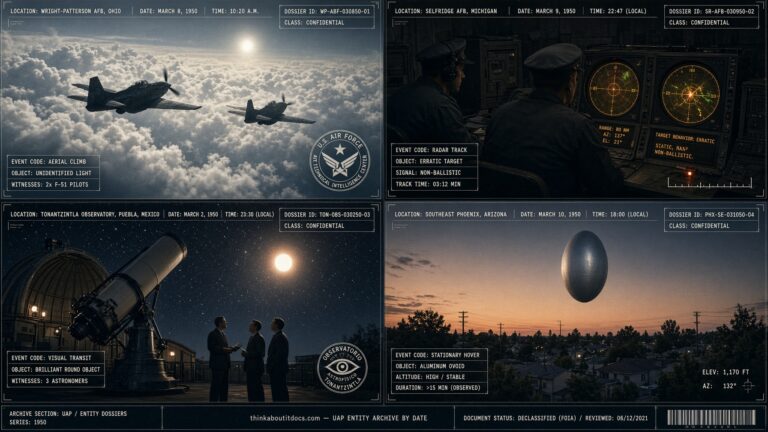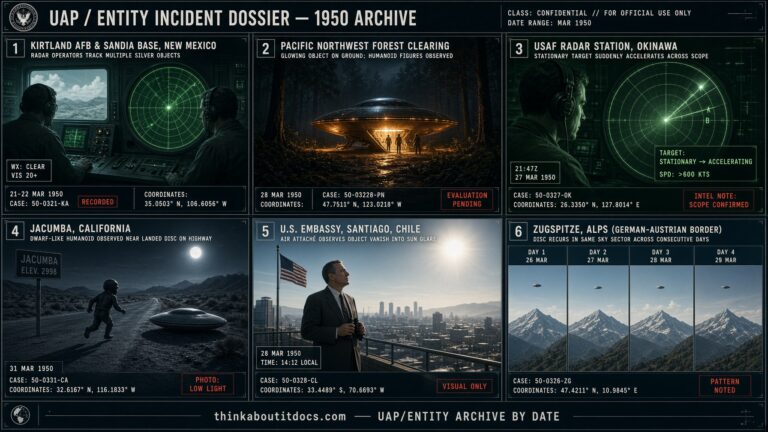
Five defining cases from August 1950, headlined by the Great Falls, Montana UFO film and the Holloman AFB Project TWINKLE interception attempt.
1950: August UFO|UAP & Entity Sightings Archive
August 1950 produced one of the most famous pieces of UFO film evidence ever captured — Nick Mariana’s Great Falls, Montana footage — alongside a dense run of military radar-visual cases spanning England, Cyprus, Bermuda, and Newfoundland, and a pair of remarkable Holloman AFB sightings that closed out the month with a failed jet interception. The Air Force and Navy files add an unusual amount of paperwork: a ship’s officers’ sighting in the North Atlantic that interviewers called certainly not a conventional aircraft, a Pine Bluff, Arkansas disc seen by six people, an RAF and USAF file that treated the Cromer contrails as a possible foreign aircraft, and a Newfoundland report that links radar blips to the shooting of an airman. The month’s entity content ranges from a shape-shifting figure in rural Greece to a childhood chapter of the extensively documented Andreasson abduction case, both documented in full via the standalone reports linked below.
Date: August 1950
Location: Agia Mavra Village, Ilia, Greece
Time: Daytime
Summary: Miltiades Boyopoulos, at a location called Gefyria, saw a woman dressed in black walking toward him. When the distance between them had closed to about six meters, the woman suddenly shrank until she was the height of a ten-year-old child, made a 90-degree turn to the left, and entered the tall vegetation of a nearby crop. The witness was terrified.
Source: Makis Nodaros
Date: August 1950
Location: Águilas, Murcia, Spain
Time: Night
Summary: A man named Mendoza, finishing an outdoor film screening and cleaning the projector’s filters, noticed a bright light descend and hover silently overhead. A telepathic voice instructed him to write; looking up, he saw a huge luminous sphere suspended in midair. Lacking paper, he used carbon paper from the projector and chalk to record a message from an entity identifying itself as “Messenger Herion,” said to be from the fourth planet orbiting Alpha Centauri. The message concerned the virtues of Earth and its inhabitants, referenced a coming universal “Absolute Truth,” and was dated to the year 10,860 from the sinking of Atlantis. The sphere then departed silently.
Source: Grupo Tseyor, Barcelona, Spain
Date: August 2, 1950
Location: Belle Vernon, Pennsylvania
Time: Unknown
Summary: A farmer who found a strange-looking “aircraft” on August 2 wrote to the Air Force Technical Intelligence Division on August 4, after reading a magazine story about flying saucers, to ask what to do with it. His description: a wooden framework with a 4-foot main strip and shorter cross strips, covered with white paper on top and nine silver triangles and three white ones below, with three strings tied to its points leading up to a pink rubber balloon with a red nozzle, which folded into a triangle about 4 by 3 feet. Air Materiel Command replied that it was a pilot balloon target, carried aloft by a free-rising balloon so it can be tracked electronically to determine wind speed and direction, expendable and unclassified. The Air Force card evaluates the case as Balloon.
Source: Project 10073 Record Card (Balloon); witness letter to Air Force Technical Intelligence Division, August 4, 1950; Air Materiel Command reply (Col. Bryan L. Davis), August 1950; Blue Book August 1950 sightings listing (physical specimen)
Date: August 3, 1950
Location: Dardennes, Var, France
Time: 14:00
Summary: Three-year-old Lily F. went to play in a field belonging to a local merchant and failed to return home. Her parents searched the area for over two hours without success before finding her sitting peacefully at the bottom of a small ravine, essentially unharmed. According to the child, she had been cared for by a “beautiful lady” in a brilliant white costume who comforted her.
Source: Denys Breysse, Project Bécassine
Date: August 4, 1950
Location: At sea, 39°35’N, 72°43’W (approximately 100 miles southeast of New York City)
Time: 10:00 a.m. EDT
Summary: Master Nils Lewring, Chief Mate Jacob Koelwyn, and the Third Mate of the M/V Marcala, bound from Nova Scotia to an East Coast port in clear weather, saw a roughly 10-foot elliptical, half-egg or cylindrical object with a shiny aluminum or metallic-white surface sparkling in sunlight, approaching from the southwest on a course opposite the ship’s at 50-100 feet above the water. It closed to within an estimated 1,000 feet to 10 miles (accounts vary), moving at 25 to 500 mph (accounts vary) with a churning or rotary motion and a visible shadow on the sea, then accelerated and rose out of sight to the northeast; the sighting lasted from 15 seconds to a minute and a half. Two intelligence officers who interviewed the mates and the master on August 8 and 9 concluded they had seen something unusual that was certainly not any conventional type of aircraft. See the Full Report.
Source: Intelligence information report on the M/V Marcala sighting, August 1950; Berliner; Tony Rullan; NICAP (BBU #773)
Date: August 4, 1950
Location: Pine Bluff, Arkansas (Arkansas Power & Light plant and Toney Air Field)
Time: Shortly before noon (about 10:30-11:00 a.m.)
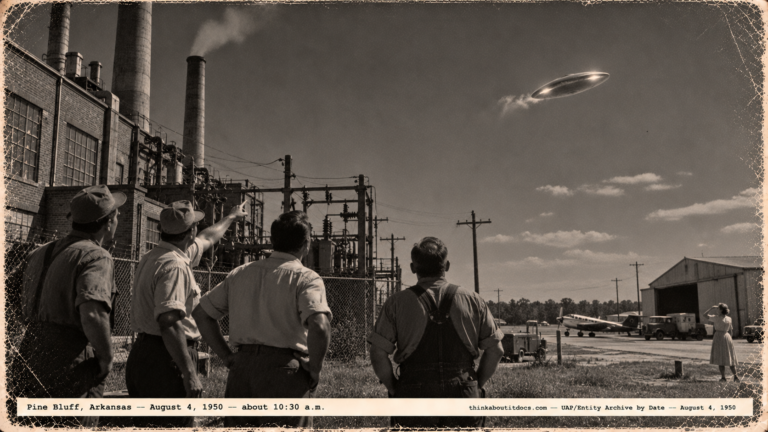
Summary: Five Arkansas Power & Light employees at the plant and a woman at Toney Air Field about a mile away watched a bright silver, disc-shaped object cross the sky heading northeast for about 20 seconds in a clear sky. One man spotted it and phoned the air field, telling her to look. Apparent size estimates ranged from about 12 inches to about 50 feet, speed from that of a fighter plane to faster than a light plane, and it tilted slightly to the east before going out of sight; one witness said it emitted four balls of smoke. The plant superintendent said the men were sincere and reliable, and the Fourth Army intelligence officer judged them truthful but young; the Blue Book listing evaluates the case as A/C. See the Full Report.
Source: Fourth Army letter to Air Materiel Command, August 17, 1950; Incident No. 5055 Guide to Investigation (interviewed August 11, 1950); Blue Book August 1950 sightings listing (A/C)
Date: August 6, 1950
Location: Riverdale (Chicago), Illinois
Time: Unknown
Summary: A 32-year-old resident said he heard what sounded like an airplane and then spotted a flat, circular object passing over his house “very high and very fast,” too round to be an airplane and too fast to be a balloon. Fifth Army forwarded the clipping to Air Materiel Command on August 10, 1950 and contemplated no further investigation; the Blue Book listing evaluates the case as Insufficient Data.
Source: Chicago Herald-American, August 7, 1950; Fifth Army letter, August 10, 1950; Blue Book August 1950 sightings listing (Insufficient Data)
Date: August 7, 1950
Location: Santa Fe, New Mexico
Time: Approximately 4:00 a.m. (card: 11:50Z)
Summary: A USAF fighter pilot of the 93rd Fighter Interceptor Squadron at Kirtland AFB (Frazier, per catalogs) saw a dark or black object about 15 miles away that first looked like an aircraft but later could not be identified. He descended to follow it, indicating over 620 mph, but could not close, and it flew straight and level on a heading of 20 degrees with no exhaust, lights, supports or sound, fading in the distance after about five minutes. The pilot evaluated it as an aircraft, and the Air Force card reads A/C.
Source: AFOSI report; Project 10073 Record Card (A/C); Project 1947; FUFOR Index
Date: August 7, 1950
Location: Pacific Ocean off Mexico, 21°50’N, 105°46’W (M/V Minerva)
Time: After sunset (card: 03:50Z, August 8)
Summary: The master, chief mate, engineer and a seaman aboard the motor vessel Minerva, bound from San Francisco for the Panama Canal, saw a flaming body rise from the southwest horizon that the seaman first took for a high star. It flew over the ship at what they called unbelievable speed and disappeared to the northeast, the chief mate yelling “flying saucer,” the engineer describing a flaming body half the size of the setting sun with an orange-yellow tail and a spray of sparks. They said it did not look like a meteor. A Navy intelligence officer in Panama thought the report deserved possible credence; the Air Force card evaluates it as Astro (Meteor).
Source: Project 10073 Record Card (Astro — Meteor); 15th Naval District intelligence report DIO-15ND, Serial 21-50; Blue Book August 1950 sightings listing
Date: August 11, 1950
Location: Washington, Oregon and Idaho
Time: 7:30 p.m.
Summary: A blue-green fireball, apparently oval or cigar-shaped and so brilliant that it showed a noticeable disk, flew a horizontal path over the Pacific Northwest, silently broke into three pieces and vanished; more than 100 witnesses reported it. It occurred during the Perseid shower maximum, and the American Meteoritics Society cataloged it as AMS 2336.
Source: American Meteoritics Society report (AMS 2336), summarized in a book excerpt in the Minerva file; Blue Book August 1950 sightings listing (Astro — Meteor)
Date: August 11, 1950
Location: Japan (Niigata area)
Time: About 21:00 K
Summary: Several Japanese and one CIC agent reported an unidentified object that looked like a flying saucer, of medium altitude, yellow turning to blue then red, which separated into parts and faded out without dropping, with a hissing noise like air released from a balloon. A Japanese weather station received about 30 phone calls about it; the speed was estimated at 1 mile in 5 seconds. Far East Air Forces reported it to Washington by message, and the Blue Book listing evaluates it as Astro (Meteor).
Source: Far East Air Forces message, August 12, 1950 (via Air Materiel Command, Technical Analysis Division); Blue Book August 1950 sightings listing (Astro — Meteor)
Date: August 12, 1950
Location: Near Bogalusa, Louisiana
Time: 6:40 p.m.
Summary: A vacationing family of five strolling a country lane heard a light peal of thunder though the sky was cloudless and saw an object moving due west at about 1,400 to 2,500 feet at least 450 mph. It appeared 14 inches long by 8 inches wide at arm’s length, with aluminum-colored rounded edges, a fiery red or old-gold center the size of an orange, and stood at a 45-degree angle, top to the north, while traveling west. The father wrote to the Air Force from Lake Charles on September 10; he judged it had a motor. The Air Force card evaluates the case as Astro (Meteor). See the Full Report.
Source: Witness letter, Lake Charles, Louisiana, September 10, 1950; Project 10073 Record Card (Astro — Meteor)
Date: August 12, 1950
Location: Flat Rock, Newfoundland
Time: About 22:15
Summary: A woman behind her house heard a fairly loud hiss and saw an object about 4.5 feet long and a foot across, about 110 feet up, with a reddish glow along the front and a red flame behind it about as long as itself, flying very fast toward Torbay Airport in a clear sky. The OSI at Pepperrell AFB found only one C-54 in the air that evening and no jet aircraft recorded in the area during August. The Blue Book listing evaluates the case as Astro (Meteor).
Source: OSI Report of Investigation 24-185, Pepperrell AFB, August 21, 1950; Blue Book August 1950 sightings listing (Astro — Meteor)
Date: August 14, 1950
Location: 10 miles north of Cromer, England
Time: 1:22 p.m. GMT
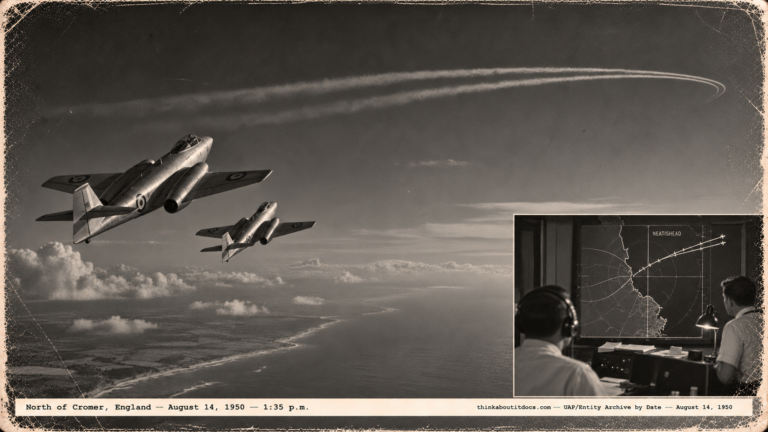
Summary: RAF Fighter Command’s Neatishead radar tracked an unidentified aircraft 90 miles out, with the initial height given as 15,000 feet and speed about 325 knots (roughly 375 mph); the Type 13 radar then gave 40,000 feet. Two RAF Meteor jet fighters of 257 Squadron were scrambled at 1:24 p.m., airborne by 1:27, and at 1:35 p.m., 10 miles north of Cromer and climbing, the pilots saw two distinct vapor trails at great distance and higher altitude on a parallel course, suggesting widely spaced engines on a single aircraft. They got slightly ahead of the trails at a radar range of about 5 miles and saw the trails turn to starboard; no aircraft was seen, and by about 38,000 feet the trails had vanished. USAF and RAF investigations did not identify the aircraft, and the Blue Book listing evaluates the case as Other (Contrails). See the Full Report.
Source: Third Air Division, USAF, summary to the Director of Intelligence, 1950; RAF Fighter Command letters, August 22 and September 7, 1950; Jan Aldrich
Source Status: The Third Air Division and RAF summaries date the plot to 14:00Z, while the Eastern Sector signal in the same file gives 13:22Z. The documents treat the event as an unidentified aircraft; they do not call it a UFO.
Date: August 15, 1950
Location: Great Falls, Montana
Time: Approximately 11:25-11:29 a.m.
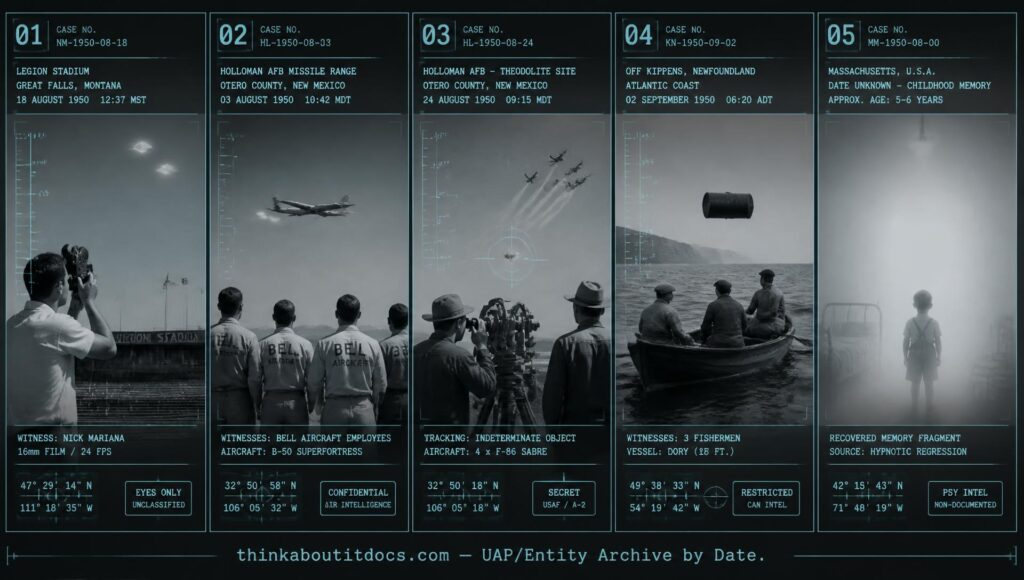
Summary: Nick Mariana, general manager of the Great Falls “Electrics” minor-league baseball team, and his secretary Virginia Raunig were at Legion Stadium preparing for that afternoon’s game when they saw two bright, rotating, disc-shaped objects crossing the sky. Mariana ran for his 16mm color movie camera and captured roughly 315 frames — about 16 seconds — of the objects as small silvery points of light. The Air Force’s own investigation concluded the objects were most likely reflections off two F-94 jet fighters known to be in the area, though this explanation has been challenged by independent analysts, and portions of the film showing the objects at closer range with visible rotating rims were reportedly missing when the footage was returned by the Air Force. See the Full Report.
Source: NICAP, UFO Evidence, 1964; Project Blue Book files; Dr. Robert M. L. Baker Jr., photogrammetric analysis
Source Status: The Blue Book August 1950 listing carries the Great Falls case as A/C, with a separate folder and photographs.
Date: August 19, 1950
Location: Pacific Northwest (Tacoma, Seattle, Port Angeles, Salem and Astoria)
Time: Shortly after noon (12:06 p.m. at Astoria)
Summary: A brilliant “ball of fire,” visible even in bright noon sunshine, streaked across Pacific Northwest skies from Salem to Seattle and from Ellensburg to the Oregon coast. Tacoma callers described a “silver streak” like a rocket that turned downward; an Astoria bar pilot fixed the time at 12:06 p.m. and thought it descended toward the ocean northwest of town; a Port Angeles woman said it seemed brighter than the sun; some saw a blue tail and silver and red fringes. A Portland professor suggested a Perseid straggler. In 1958 the Air Force Air Technical Intelligence Center told a congressman’s office the object had been a bolide, a fireball; the Air Force card evaluates the case as Astro (Meteor). See the Full Report.
Source: Tacoma News Tribune and AP, August 20, 1950; Project 10073 Record Card (Astro — Meteor); ATIC letter, July 1958
Source Status: The Project 10073 card and the 1958 Air Force letter date this August 20, 1950; the August 20 newspaper account describes the sighting as occurring Saturday, August 19.
Date: August 20, 1950
Location: Nicosia, Cyprus
Time: 1:30 p.m.
Summary: USAF MATS liaison officer Lt. William G. Ghormley, Col. William V. Brown, and Lt. Col. Lloyd W. Brauer heard an aircraft overhead (a Turkish C-47 heading to Beirut at 9,500 feet) and looked up, instead spotting a small, round or elliptical, bright object directly overhead traveling west at very high speed and altitude, moving somewhat erratically as it passed near the glare of the sun with no change in brightness, before disappearing 30-35 degrees above the horizon in clear weather with 50-plus miles visibility. The sighting lasted 15-20 seconds.
Source: Jan Aldrich (BBU 793, possibly 783)
Date: August 21, 1950
Location: Echterdingen Air Base, Stuttgart, Germany
Time: About 9:54-9:58 a.m.
Summary: A USAF weather observer tracking a pilot balloon by theodolite noticed a small white object cross his field of view just before the balloon burst. Three minutes later, following a balloon fragment, he saw a small white oval cross his 2-degree field heading south for about a minute, growing in size, appearing grayish-white with several small lines on its surface, and then abruptly change direction to the west-southwest at high speed and disappear into the sun. The Blue Book listing evaluates the case as Balloon.
Source: Sparks; Blue Book microfilm, Maxwell Roll 8, pp. 161-162 (via NICAP 1950 chronology); Blue Book August 1950 sightings listing (Balloon)
Date: August 23, 1950
Location: Philadelphia, Pennsylvania
Time: 9:05 p.m. EDT
Summary: Retired USAF Col. D. Moreau Barringer and his mother-in-law saw a white point of light with a sharp leading edge and a flickering trail ending in a short yellowish flame rise from the horizon and pass near the zenith, passing close to bright stars including Vega, noiseless and without changing course, for 30 to 40 seconds before it disappeared into the trees. The Blue Book listing evaluates the case as Astro (Meteor).
Source: Sparks; Blue Book microfilm, Maxwell Roll 8, pp. 164-167 (via NICAP 1950 chronology); Blue Book August 1950 sightings listing (Astro — Meteor)
Date: August 24, 1950
Location: About 250 miles southwest of Bermuda
Time: 8:04-8:27 p.m. AST
Summary: A USAF 373rd Reconnaissance Squadron B-29, piloted by 1st Lt. Frank J. Stockton and flying at 10,000 feet, had radarman S/Sgt. William W. Shaffer track a distinct, bright, unidentified target moving at the same speed and heading as the bomber, roughly 1,000 feet lower and a mile and a half away. Two officers independently verified the radar readings; a visual search found nothing, likely due to cloud cover. The target held position for several minutes, fell behind, was overtaken by the B-29, then passed the bomber on the right before turning away and accelerating rapidly out of radar range at roughly 460 mph. Minutes later, a crew member saw a bluish streak flash past the aircraft from head-on, resembling a meteor but dimmer than lightning.
Source: Jan Aldrich (BBU 787)
Date: August 27, 1950
Location: Near Brockton, Massachusetts
Time: 6:30 p.m.
Summary: Navy radio mechanic and licensed civilian pilot John T. Early, flying with a 12-year-old passenger at 1,300 feet, spotted a shiny white spherical object about 20 feet in diameter, with no projections or irregularities, at least 1,000 feet below their aircraft, moving east on a steady course against a south wind at what he thought was jet speed, with no exhaust smoke or unusual noise. The passenger corroborated the description. The first district OSI took no investigative action, and the Air Force card evaluates the case as Balloon.
Source: Project 10073 Record Card (Balloon); AFOSI report, First District, September 25, 1950; Jan Aldrich
Date: August 30, 1950
Location: Ernest Harmon AFB, Newfoundland
Time: 0545Z (1:15 a.m. local)
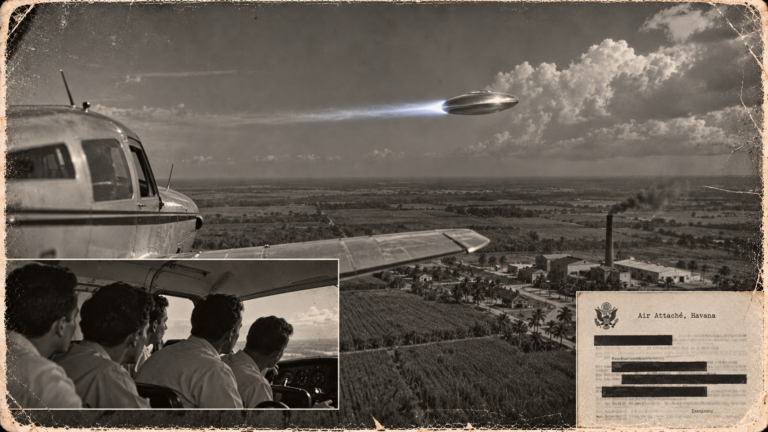
Summary: A GCA scope picked up an object traveling at an estimated 40-60 mph at 4,000-6,000 feet on a course of 120 degrees, faint until the 5-mile ring, where it paused for 30 seconds and became brighter and more distinct, comparable to a small aircraft. A blip on a second scope then veered to a heading of roughly 210 degrees, then 140 degrees, disappearing at approximately 9 miles’ range. No aircraft were in the GCA area, and no weather or radiosonde balloon had been released; two airmen reported it and were rated well qualified and very reliable. The Air Force card evaluates the case as Other (Weather Returns). See the Full Report.
Source: Air Intelligence Information Report IR-244-50, Hq MATS, September 7, 1950; Project 10073 Record Card (Other — Weather Returns); Dan Wilson
Source Status: The same Hq MATS report records a September 2 radar blip, an airborne sighting just offshore and the shooting of a 17-year-old airman on the runway, with a note that a tie-in was possible; those events belong to the September page.
Date: August 30, 1950
Location: South of Sandy Point/Indian Head, Newfoundland, Canada
Time: 1:30-1:50 p.m. ADT (1620-1650Z)
Summary: Three civilian Harmon AFB Water Transportation Section employees in a boat about two miles south of Indian Head saw a black or dark, round, barrel-sized object resembling a large balloon, roughly three miles offshore, hovering just above the water. After a few minutes it slowly ascended to 15-20 feet, then descended again, cycling this way three times over 40-60 seconds each; on the final cycle it remained near the surface for three to four minutes before ascending vertically out of sight at 1:50 p.m. A helicopter search launched shortly afterward found nothing. A similar object was separately reported near Kippens around 2:00 p.m. the same day. Their employer rated all three men very reliable; the Air Force card reads Unidentified. See the Full Report.
Source: Air Intelligence Information Report, Hq MATS, September 27, 1950; Project 10073 Record Card (Unidentified); Jan Aldrich (BBU)
Date: August 30, 1950
Location: South of Kippens, Newfoundland, Canada
Time: Around 2:00 and again around 4:00 p.m. ADT
Summary: William Alexander, his son Bill, and nephew Austin Alexander, fishing in a dory about 1.5 miles offshore from Kippens, saw a black or yellowish-brown object roughly the size of their dory (about 20 feet), some 1.5-2 miles away, and 15-20 feet above the water — shaped like a large aerial gunnery target balloon or a barrel with a pole or periscope trailing into the water, moving toward shore at 3-5 mph. The object disappeared over the horizon and was briefly re-sighted from high ground ashore around 4:00 p.m. It was reported to the USAF at 4:10 p.m.; a helicopter search launched at 4:20 p.m. found nothing. No smoke, exhaust, noise, or markings were observed. See the Full Report.
Source: Air Intelligence Information Report, Hq MATS, September 27, 1950; Jan Aldrich (BBU #790)
Date: August 30, 1950
Location: Holloman AFB, Alamogordo, New Mexico
Time: 10:45 a.m.
Summary: During a Bell Aircraft MX-776 Shrike missile test (a precursor to the Rascal air-to-ground strategic missile), a USAF Master Sergeant and eight Bell Aircraft employees on base saw two glaringly bright, circular-to-elliptical unidentified objects maintain relative position to each other while following the B-50 launch aircraft on both a dry run and the live missile release. The objects gave off a strong glare not attributable to reflected sunlight, maneuvered at estimated speeds up to ten times the B-50’s own (roughly 2,500 mph) over short distances, left no vapor trails, hovered, accelerated rapidly, and made abrupt right-angle turns with apparent size changes suggesting ascent and descent, over a 30-minute observation period.
Source: Sparks; Jan Aldrich; McDonald files (BBU)
Date: August 31, 1950
Location: Holloman AFB, Alamogordo, New Mexico
Time: 10:00 a.m. – 1:00 p.m. MST
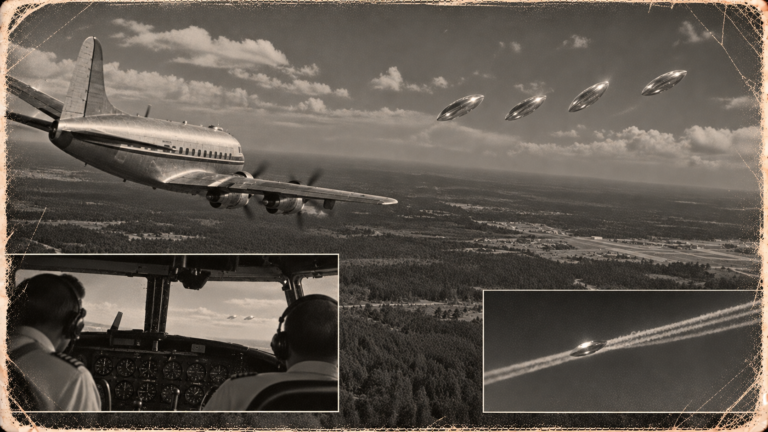
Summary: Following V-2 missile launch No. 51, Project TWINKLE Askania theodolite crews tracked and filmed multiple objects sporadically from several directions at very high speeds over roughly three hours. Cinetheodolite station P-5 filmed one object using color film, with two seconds of footage showing its elevation angle changing at 0.37 degrees per second. A four-F-86 jet interception attempt from the 93rd Fighter Interceptor Squadron, Kirtland AFB, failed over an hour to locate the objects, which apparently returned only after the jets left the area. Cinetheodolite observers described an object with a definite shape and three-dimensional depth but indistinct edges, no smoke or trail, an apparent rocking or oscillating motion, and a tendency to be lost from sight whenever the observer looked away to check an angle reading.
Source: Sparks; McDonald files; Jan Aldrich (BBU)
Source Status: The Blue Book August 1950 listing carries the Holloman August 30-31 case as Insufficient Data.
Date: Fall 1950
Location: Westminster, Massachusetts
Time: Morning
Summary: Thirteen-year-old Betty Aho (later Betty Andreasson, subject of the extensively documented Andreasson Affair) reportedly saw an object “like a moon” grow larger before becoming unable to move; she then found herself inside a misty white room, examined by three small gray-skinned beings with large oval heads and eyes, before an elaborate journey involving an underwater tunnel of preserved humans, a meeting with a robed figure called “The One,” and the removal and replacement of her right eye. This account was not reported in 1950 — it was recovered decades later, around 1977-1982, under hypnotic regression as part of investigator Raymond Fowler’s inquiry into Betty’s better-known 1967 adult encounter. See the Full Report for the complete account and analysis of the hypnotic-recovery method’s limitations.
Source: Raymond E. Fowler, The Andreasson Affair: Phase Two, 1982
EXECUTIVE SUMMARY
From a Montana Ballpark to a Failed Jet Intercept
August 1950 is bookended by two of the archive’s most historically significant cases: the Great Falls, Montana film footage, one of the earliest and most analyzed motion-picture UFO records, and the closing Holloman AFB Project TWINKLE case, in which a four-jet interception attempt failed to locate objects that had been actively tracked and filmed by theodolite crews only hours earlier. Between them, the month produced an unusually dense run of military radar-visual cases — England, Cyprus, Bermuda, and three separate Newfoundland sightings within a single day — reflecting the period’s intensive Cold War-era aerial monitoring infrastructure. The Westminster, Massachusetts entry is presented with particular care: though dated to 1950 within its own narrative, it was recovered only decades later through hypnotic regression as part of the celebrated Andreasson Affair, a method this archive treats as producing sincere but historically unverifiable testimony.
The month’s paperwork adds three things worth noticing. The M/V Marcala report shows trained ship’s officers disagreeing sharply on distance and speed while agreeing on what they saw. The Cromer file shows the RAF and USAF treating a pair of contrails as a possible unidentified aircraft, not a UFO. And the Ernest Harmon AFB report records a radar blip, two fishing-boat sightings and the shooting of a young airman in a single intelligence summary that raises, but does not answer, a possible tie-in. Several of the month’s other cases, a daylight fireball over the Pacific Northwest, a ship’s fireball off Mexico and a Louisiana evening object among them, were closed as meteors, which is part of the 1950 record too.
“Object with definite shape and 3-D depth but indistinct or not sharp edges… lost when observer looked away to get angle reading.”
— Cinetheodolite observers, Project TWINKLE, Holloman AFB, August 31, 1950