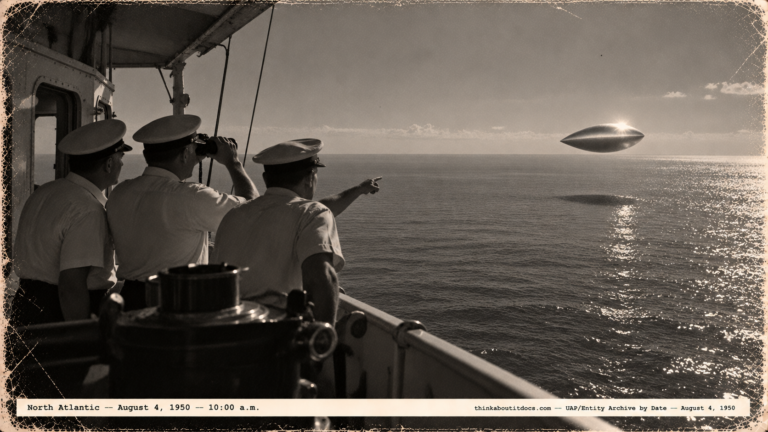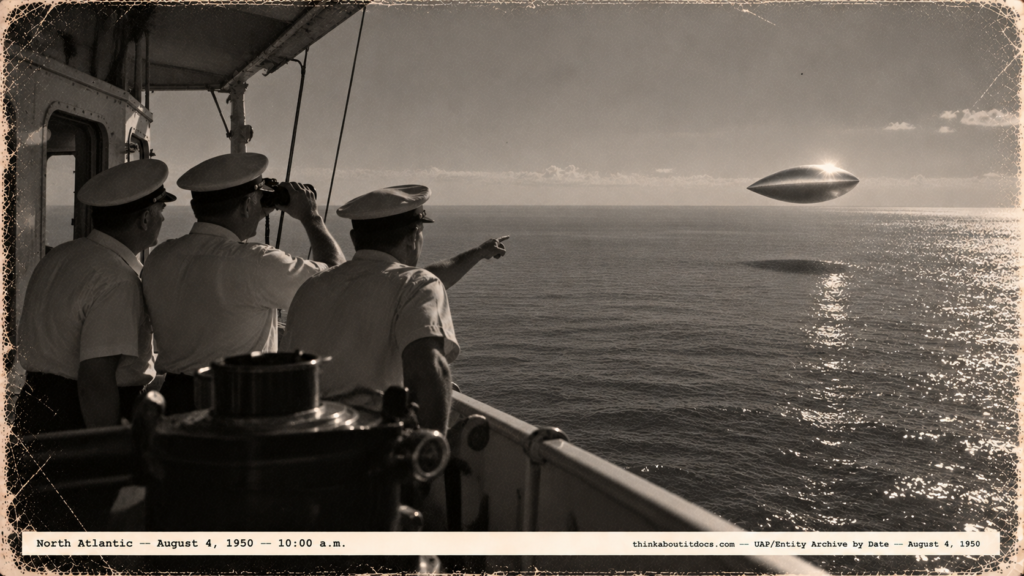
On August 4, 1950, three officers of the M/V Marcala watched a shiny half-egg object skim the sea and accelerate away.
THINK ABOUTIT UFO|UAP SIGHTINGS REPORT
1950: North Atlantic, 100 Miles Southeast of New York
The Half-Egg Over the Marcala
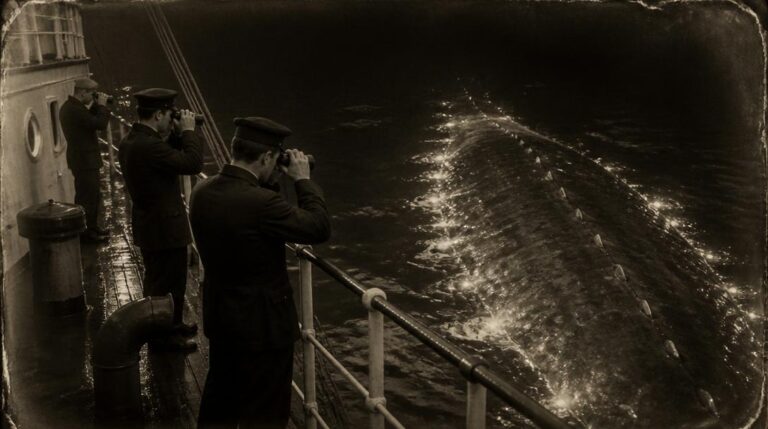
At 10:00 on the morning of August 4, 1950, with a smooth sea, clear weather and 14 miles of visibility, the Third Mate of the freighter M/V Marcala, bound from Nova Scotia for an East Coast port, shouted that a flying object was off the starboard bow. Within seconds three officers were watching a shiny, elliptical object about ten feet across skimming the water on a course opposite to the ship’s, casting a shadow on the sea. It wobbled or churned past, then accelerated and rose out of sight in the northeast.
Two intelligence officers interviewed the mates and the master days later and reported that the men had certainly seen some unusual object that was just as certainly not any conventional type of aircraft. The officers disagreed sharply on distance and speed, and the interviewers could not explain the gap. This M/V Marcala UFO case is cataloged as Blue Book Unknown #773.
Date: August 4, 1950 (Friday)
Sighting Time: 10:00 a.m. EDT
Day/Night: Day
Location: At sea aboard the M/V Marcala, 39°35’N, 72°43’W, about 100 miles southeast of New York City; the ship was on a heading of 245° true from Nova Scotia
Urban or Rural: Open ocean
No. of Entity’s: 0 — Not Applicable
Entity Type: Not Applicable
Entity Description: Not Applicable
Hynek Classification: DD (daylight disc)
Duration: 15 seconds to about a minute and a half, depending on the witness
No. of Object(s): One
Description of the Object(s): A small elliptical or cylindrical object, half an egg cut lengthwise by one description, with depth, shiny aluminum or metallic white, wobbling or churning, silent
Shape/Size/Color of Object(s): About 10 feet in diameter, length about six times the breadth with a belly depth of perhaps 2 to 5 feet; shiny aluminum or metallic white, sparkling in sunlight; one mate likened it to a Japanese diamond box kite
Distance to Object(s): Closest approach 1,000 feet (master) to about 10 miles (chief mate); the third mate put it at about 12 miles
Height & Speed: 50 to 100 feet above the water; speed from over 25 mph (master) to 400 or 500 mph or more (mates); one mate guessed 26 miles in 15 seconds
Number of Witnesses: 3 ship’s officers: the master (38, Danish citizen), the chief mate (47, Dutch citizen) and the third mate (33); named in catalogs as Master Nils Lewring and Chief Mate Jacob Koelwyn
Special Features/Characteristics: A visible shadow on the water; the object reappeared several seconds after vanishing, ascending faster; all three men were quite evidently very much upset by the sighting
Case Status: Blue Book Unknown #773 (Blue Book listing: Unidentified); interviewing officers: not any conventional type of aircraft
Source: Unclassified intelligence information report, “Unidentified Airborne Object,” August 1950 (statements of the three officers); Berliner; Tony Rullan; NICAP
Summary/Description: Three ship’s officers watched a small, shiny, half-egg-shaped object skim the Atlantic and accelerate away.
Related Cases: None established
Detailed Report
The setting. The report states that the M/V Marcala, owned by the Savannah Steamship Company of Jacksonville, Florida, was underway from Walton, Nova Scotia, to an East Coast U.S. port on a heading of 245° true. The sea was smooth, the weather clear, visibility 14 miles and the barometer 30.03. The three officers made their statements on forms headed as unevaluated information.
The master. The master was in the chart room just aft of the bridge when the Third Mate, at mid-bridge checking the compass, shouted. He climbed to the conning position, by which time the object was on the starboard beam. It was traveling on a course reciprocal to the ship’s, 50 to 100 feet above the water at an estimated speed of over 25 mph. He watched it with binoculars for about a minute and a half until it disappeared into the horizon in the northeast. He put the closest approach at about 1,000 feet. It was ovular and cylindrical, about 10 feet in diameter, silent, shiny aluminum and sparkling in the sunlight; as it passed abeam it appeared to pick up considerable speed and had a churning or rotary motion.
The chief mate. On the main deck forward of the bridge, he saw an object of elliptic shape, like half an egg cut lengthwise, traveling at a great rate of speed on a reciprocal course. He ran to the stern, port side, and watched it disappear into the horizon; 15 seconds elapsed from the alert to the end. He believed it was going possibly faster than 500 mph, about 70 feet off the water and about 10 miles away, and he clearly saw its shadow on the water. It wobbled, made no noise and was metallic white, its length about six times its breadth.
The third mate. The third mate saw the object about 70 feet above the horizon at a distance of about 12 miles; it came toward the ship, then ran on a reciprocal course and turned off into the northeast. He clearly saw its shadow on the water and said it was elliptical, not unlike a Japanese diamond box kite in shape, with a length about six times its breadth and a depth of two to five feet, silent, at a tremendous speed, with a spinning or wobbly motion. After it disappeared, he saw it reappear several seconds later, ascending at an even faster speed. He called it one of the most frightening experiences he had ever had, and roughly estimated that it traveled 26 miles in the 15 seconds he watched.
The interviewers. A note appended to the report says the chief and third mates were interviewed on August 8 by two intelligence officers, and the master, who was absent then, on August 9 by one of them. The mates reenacted their movements, and the time from the chief mate’s first sight of the object abeam to his reaching the after deck and seeing it vanish was timed at 15 seconds. Laying the angles out on a chart and assuming a distance of ten miles, the officers concluded the object was certainly traveling at a very high rate of speed, about 400 to 500 miles per hour. They noted a tremendous, unexplained discrepancy between the master’s speed estimate and the mates’, since the men were very careful in their statements and insisted their observations were correct.
RESEARCHER’S NOTES
Three Careful Witnesses, Three Different Distances
- The discrepancy: The master’s 25 mph and 1,000-foot closest approach, against the mates’ 10 to 12 miles and 400 to 500 mph, is the case’s central puzzle. The interviewers could not explain it and did not attribute it to carelessness.
- Shadow on the water: Two of the three mates reported a clearly visible shadow on the sea, which suggests the object was low and relatively near, at odds with the 10-mile estimates. The report does not discuss this.
- A reconstruction: The 400 to 500 mph figure is the interviewers’ own chart reconstruction, not a witness estimate; the third mate’s 26 miles in 15 seconds would be far faster.
- Reappearance: The third mate said the object reappeared and rose faster; neither of the other officers mentions this.
- Unfinished page: The report breaks off in a description of the vessel’s conversion; the rest of that page is not in the file.
- Catalog tag: The Blue Book listing evaluates the case as Unidentified, which matches the Berliner/NICAP Unknown number.
A small, shiny object, three experienced observers and a note from the interviewing officers that it was not any kind of conventional aircraft make the Marcala report unusual among 1950 sea sightings. The distance and speed estimates never converged, and the file does not say what was made of that.
“just as certainly not any conventional type of aircraft”
— Intelligence officers’ note on the M/V Marcala sighting, August 1950