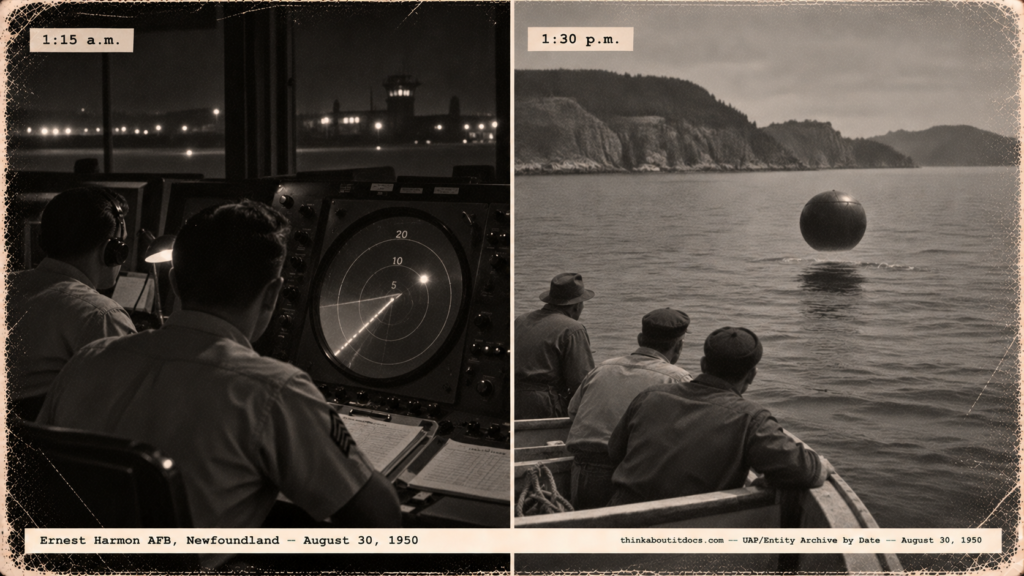
On August 30, 1950, Ernest Harmon AFB radar tracked an unidentified blip and fishermen watched a dark barrel-sized object over the bay.
THINK ABOUTIT UFO|UAP SIGHTINGS REPORT
1950: Ernest Harmon AFB, Newfoundland
A Radar Blip, a Barrel and a Shooting
At 0545Z, about 1:15 a.m. local, on August 30, 1950, a GCA radar scope at Ernest Harmon Air Force Base in Newfoundland picked up an object traveling at an estimated 40 to 60 mph at 4,000 to 6,000 feet. It paused for 30 seconds at the 5-mile ring, brightening there to resemble a small aircraft, and a blip on a second scope then veered through headings of about 210 and 140 degrees before disappearing at about 9 miles. Later that day three base employees in a boat saw a black, barrel-sized object rise and sink three times over the water at Sandy Point, and a father, son and nephew fishing off Kippens saw what looked like a barrel with a pole in the water.
The Air Force report that carries these events contains something no other sighting file this month does. On September 2 a 17-year-old airman on the east end of the runway reported a silhouette between him and the beach, a flash and a burn in his hand, and was found to have a bullet wound in his ring finger. The intelligence summary says that, although the information was sketchy, a possible tie-in with the GCA sightings existed. This Ernest Harmon AFB Newfoundland UFO file is a radar-visual case, two sea sightings and a shooting in one report.
Date: August 30, 1950 (follow-up events September 2, 1950)
Sighting Time: Radar: 0545Z (1:15 a.m. local); Sandy Point: 1620Z-1650Z (about 1:20-1:50 p.m. local); Kippens: about 1700Z and again about 1900Z
Day/Night: Night (radar); day (sea sightings)
Location: Ernest Harmon AFB, near Stephenville, Newfoundland; about two miles off Indian Head, Sandy Point (48°29’N, 58°30’W), the object about three miles southwest; and about 1.5 miles off Kippens, St. George’s Bay
Urban or Rural: Rural base and coastal waters
No. of Entity’s: 0 — Not Applicable
Entity Type: Not Applicable
Entity Description: Not Applicable
Hynek Classification: GCA radar target (first event); DD (the two sea sightings)
Duration: Radar: a few minutes, with a 30-second pause; Sandy Point: three 40-to-60-second cycles and a 3-to-4-minute pause, in view about 30 minutes; Kippens: about five minutes
No. of Object(s): One radar target (and a second blip); one object at each sea site
Description of the Object(s): Radar: faint until the 5-mile ring, then brighter and more distinct, comparable to a small aircraft. Sandy Point: round, black or dark, about the size of a barrel, resembling a large balloon. Kippens: about dory-sized, like a target balloon, black or brownish-yellow, with a pole from its center to the water
Shape/Size/Color of Object(s): Round, barrel-sized (Sandy Point); dory-sized, about 20 feet, with a pole (Kippens); black, dark or brownish-yellow
Distance to Object(s): Radar: 5 to 9 miles; Sandy Point: about 3 miles southwest, 1 to 1.5 miles offshore; Kippens: 1.5 to 2 miles from the dory
Height & Speed: Radar: 40 to 60 mph at 4,000 to 6,000 feet on 120 degrees; Sandy Point: hovered just above the water, rising to 15 to 20 feet and back, then ascended vertically; Kippens: 15 to 20 feet up, moving north-northeast at 3 to 5 mph
Number of Witnesses: 2 GCA airmen (rated well qualified and very reliable); 3 civilian base employees at Sandy Point (ages 36, 45 and another, rated very reliable by their officer); 3 fishermen at Kippens (ages 65, 24 and 26)
Special Features/Characteristics: No weather or radiosonde balloon was released during the radar period; the only radiosonde that day, released at 1800Z, was white and about 7 by 6 feet; helicopter searches found nothing; a B-29, a TCA DC-3 and a KLM DC-3 were tracked over the field before the sea sighting
Case Status: Radar: Other (Weather Returns), possible atmospheric phenomena (Project 10073 card); Sandy Point: Unidentified (Project 10073 card); Kippens: BBU #790 per catalogs
Source: Air Intelligence Information Reports IR-244-50 (Hq MATS, September 7, 1950) and the September 27, 1950 report on the St. George’s Bay sighting; Project 10073 Record Cards; Dan Wilson; Jan Aldrich
Summary/Description: A radar blip, a barrel-sized object over the water at two sites and a nighttime shooting of an airman appear in the same MATS report.
Related Cases: Ernest Harmon AFB, September 2, 1950 (radar blip, airborne sighting offshore and the shooting; see the September page)
Detailed Report
The radar. The Hq MATS Air Intelligence Information Report of September 7, 1950, quoting a priority message, says that at 0545Z on August 30 the Ernest Harmon AFB GCA scope picked up a blip traveling an estimated 40 to 60 mph at an estimated 4 to 6 thousand feet on a course of 120 degrees until reaching the 5-mile ring, where it paused for 30 seconds. A blip on a second scope veered to a heading of approximately 210 degrees, then 140 degrees, and disappeared at about 9 miles range. The blip was faint until the 5-mile range, when it became brighter and more distinct, comparable to a small aircraft. The message says possible atmospheric phenomena, that no weather or radiosonde balloon was released during the period, that there were no aircraft in the GCA area at that time, and that the two airmen reporting were well qualified and very reliable.
Sandy Point. The Intelligence Officer of the 1226th Air Base Group reported that three Newfoundland employees of the Water Transportation Section of the base, aged 36 and 45 and a third who had worked there one and a half years, sighted an object from about two miles off Indian Head. They described it as round, black or some dark color, about the size of a barrel, resembling a large balloon. At first they thought it was an aircraft with only part of it distinct; as it rose they decided it was a balloon or something dropped from an aircraft. It was first just off the water, then rose to 15 to 20 feet, then slowly descended nearly to the water, a cycle of 40 to 60 seconds that repeated three times, after which it rose straight up out of sight. It stayed near the surface 3 to 4 minutes before the final ascent and was in view from about 1620Z to 1650Z. The Water Transportation Officer rated all three men very reliable, quiet and truthful.
Kippens. About 1910Z a man reported to the Kippens Receiver Site an object thought to be a submarine, sighted at about 1700Z, three miles offshore, like a barrel with a periscope or long pole. The base dispatched a helicopter at 1920Z from the base to Port au Port; it and a check around Indian Head found nothing. At 2200Z the witnesses were questioned: a man of 65, his son of 24 and a nephew of 26, fishing from a dory about 1.5 miles off Kippens at 1700Z, saw an object an estimated 1.5 to 2 miles out, about the size of a dory and like a large target balloon, black by the elder man’s account and brownish-yellow by the others’, 15 to 20 feet above the water with a pole from its center to the waterline, traveling north-northeast at 3 to 5 mph. It was in sight about five minutes before moving over the horizon, with no smoke, exhaust noise or markings.
The men and the balloon question. The three Sandy Point men and the Kippens witnesses had limited education and no military experience, and they associated the object with a target balloon because they had watched aircraft target practice there during the war; they made no effort to investigate and left for shore thinking there might be aerial gunnery. The report says weather personnel did not think any locally released balloon would be in that area, that only one radiosonde balloon was released that day at 1800Z and it was white and about 7 by 6 feet, and that ceiling balloons and the radiosonde all headed northeast. The control tower and GCA personnel were questioned with negative results, and a B-29, a TCA DC-3 and a KLM DC-3 had been tracked over the field before the sighting. Local weather at 1630Z was a 3,000-foot overcast with 15 miles visibility and winds from the north-northwest at 10 knots.
September 2. The September 7 report adds that at about 0024Z on September 2 the base picked up a blip on a scope four to five miles offshore, and at 0530Z an object was reported airborne just offshore at about 60 mph, cruising in the area; investigation of both had negative results. At about 0130Z on September 2, a 17-year-old Air Police airman of the 43rd Bomb Wing on the east end of the runway sighted the silhouette of a person between the beach and himself, saw a flash and felt his hand burn, and fired four .45-caliber pistol rounds and three carbine rounds with unknown results. He was shot in the ring finger of his left hand by what was believed to be a .22 or .25 caliber jacketed slug, with no powder burns; a search found nothing. The report concludes that although the information was sketchy, the possibility existed of a tie-in between the shooting and the GCA sightings.
RESEARCHER’S NOTES
A Cluster the File Itself Linked
- The card evaluation: The radar card reads Other (Weather Returns), “possible atmospheric phenomena,” but the same report says no weather or radiosonde balloon was released and rates the airmen very reliable. The reasoning for the evaluation is not given.
- Balloon fit: The only radiosonde balloon was released at 1800Z, after the 1620Z-1700Z sea sightings, and was white; the objects were reported black or dark.
- Two sites: The Sandy Point object rose vertically out of sight; the Kippens object moved north-northeast at 3 to 5 mph over the horizon. The file does not locate the two sites relative to each other.
- The shooting: The shooting is not tied to any object by evidence; the intelligence summary only says a tie-in was possible. Its details belong on the September page.
- Missing file: A second Ernest Harmon file is expected; it may add detail on August 30 or the September events.
- Catalog tags: Catalogs give Kippens BBU #790 and Sandy Point a BBU tag; the Sandy Point card in the file reads Unidentified.
The Ernest Harmon file is notable less for any one sighting than for how the intelligence officers filed it: a radar blip, two odd objects over the water and a shooting under a single summary with a flagged possible link. The objects are described plainly, the explanations offered are conditional, and the link is left open.
“possibility exists of tie-in between shooting of airman and GCA sightings”
— Hq MATS Air Intelligence Information Report IR-244-50, September 7, 1950