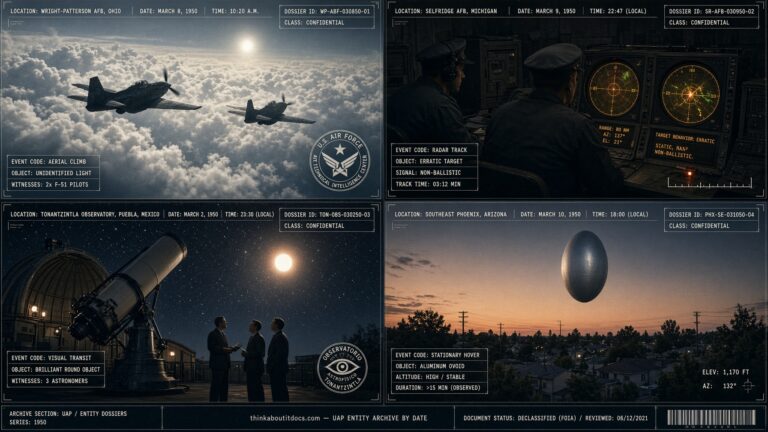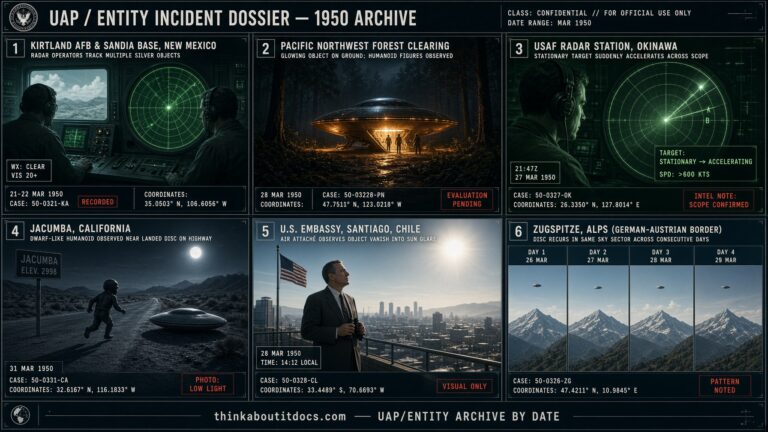
Four cases from September 1950, headlined by the MIT-tracked Provincetown, Massachusetts radar sighting.
1950: September
UFO|UAP & Entity Sightings Archive
A shorter month, September 1950 is anchored by the Provincetown, Massachusetts radar case — an MIT-tracked object making a violent, high-g turn near two Air Force jet fighters — alongside an Ohio State Prison sighting with reported occupants and a scattering of military visual reports across Alaska, Newfoundland, and Colorado. The month’s paperwork adds a three-case run at Fairchild AFB and Spokane, a five-hour balloon chase over Poplar Bluff, Missouri, a regional fireball reported by fourteen Colorado-area observers and a Newfoundland airman wounded by gunfire during a radar flap. The month also includes a case worth noting for the opposite reason: an oft-repeated but entirely unsourced “Albuquerque crash” claim, traced here to its likely origin in the debunked Aztec hoax.
Date: September 1950
Location: Near Columbus, Ohio
Time: 03:00
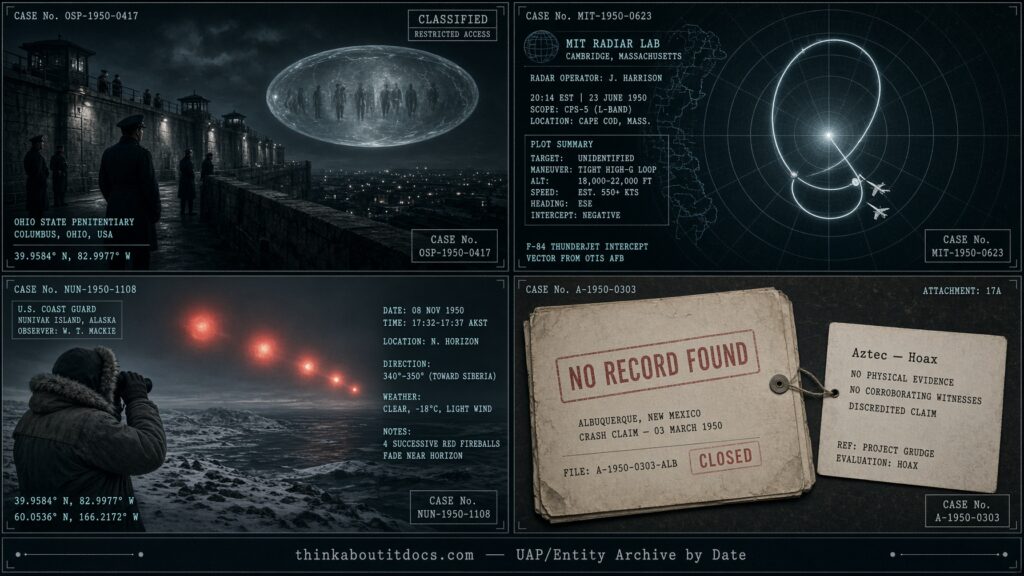
Summary: Guards at the Ohio State Prison, including Roy Beck, watched a huge, luminous, disc-shaped craft glide silently just above the compound walls. The object’s center appeared to rotate, and it seemed to have antennas on its upper section. At one point it became somewhat translucent, and the guards reported seeing several man-like figures moving inside; the terrified guards attempted to fire on the object but were stopped by a superior officer.
Source: UFO Notebook #12
Date: September 1950
Location: Guam (Agana)
Time: Unknown
Summary: A man told the FBI in 1958 that in September 1950 he saw a circular, flat object offshore at Guam, 600 to 1,000 feet wide and about 300 feet above the water, with portholes emitting blue gas. The Air Technical Intelligence Center found no report of any unusual airborne object from Guam that month, noted that an object that size would have been seen by many people and by radar, and suggested a lenticular altocumulus cloud; it called the source a persistent but harmless correspondent whose later letters claimed a saucer had been “shooting” him with rings for years. The Air Force card reads Other (Psychological).
Source: Project 10073 Record Card (Other — Psychological); ATIC memorandum, May 27, 1958; Air Force Public Information Division reply, June 6, 1958
Source Status: The sighting was first reported in 1958, about eight years later, through the FBI; no 1950 record of it exists.
Date: September 1950 (exact date unknown)
Location: Off the coast of Korea
Time: Early morning, about 7:00 a.m.
Summary: A catalog narrative says three Navy fighter-bombers from a carrier, each with a pilot and radar gunner, bound for a truck convoy about 100 miles from the Yalu, saw two huge, circular, silvery objects with a reddish glow shaped like a coolie hat, 600 to 700 feet across, with oblong ports emitting copper-green light and a shimmering red ring, a coal-black circle on the underside and a jittering motion. One radar gunner said his scope bloomed and went useless as he readied his guns and that radio frequencies were blocked by a buzzing noise; the objects circled the planes, then left at high speed. This is a secondhand, undated account.
Source: Lorenzen (as reproduced in the Blue Book file); Blue Book September 1950 sightings listing (information only)
Source Status: The account is uncorroborated and carries no date or unit; the Blue Book listing records it as information only.
Date: September 1, 1950
Location: Mekoryuk, Nunivak Island, Alaska
Time: 7:30-7:35 p.m.
Summary: Nunivak Island CAA Airways Observer Timothy J. Kenick, George Williams, and others saw a deep red ball of fire near the horizon to the north toward Siberia, “hundreds of feet” up, which slowly faded. It was followed by the sudden appearance of another round, red ball of fire above the first, also slowly fading, repeated two or three more times while gradually becoming oval-shaped and moving toward Siberia, finally disappearing behind clouds. The Blue Book listing evaluates the case as Astro (reflection of the setting sun).
Source: Jan Aldrich; Blue Book September 1950 sightings listing (Astro — Reflection of Setting Sun)
Date: September 1-2, 1950
Location: Ernest Harmon AFB, Newfoundland, Canada
Time: Evening (about 01:30Z, September 2)
Summary: A 17-year-old Air Police airman of the 43rd Bomb Wing, on the east end of the runway, saw the silhouette of a person between the beach and himself, then a flash, and felt a burning pain in his hand; he fired four .45-caliber pistol rounds and three carbine rounds with unknown results. He had been shot through the ring finger of his left hand by what was believed to be a .22 or .25 caliber jacketed slug, with no powder burns, and a search found nothing. The same Hq MATS report records a GCA blip four to five miles offshore at about 00:24Z and an object seen airborne just offshore at about 05:30Z cruising at 60 mph, with negative investigations, and says that although the information was sketchy, a possible tie-in between the shooting and the radar sightings existed. See the Full Report.
Source: Air Intelligence Information Report IR-244-50, Hq MATS (September 7, 1950); John Brent Musgrave, UFO Occupants & Critters; Blue Book September 1950 sightings listing (Insufficient Data)
Source Status: The earlier version of this entry described military personnel and a witness approaching the figure; the report says the airman fired from where he stood. The August 30 radar contact in the same report appears on the August page.
Date: September 3, 1950
Location: Spokane, Washington
Time: 2:00 p.m.
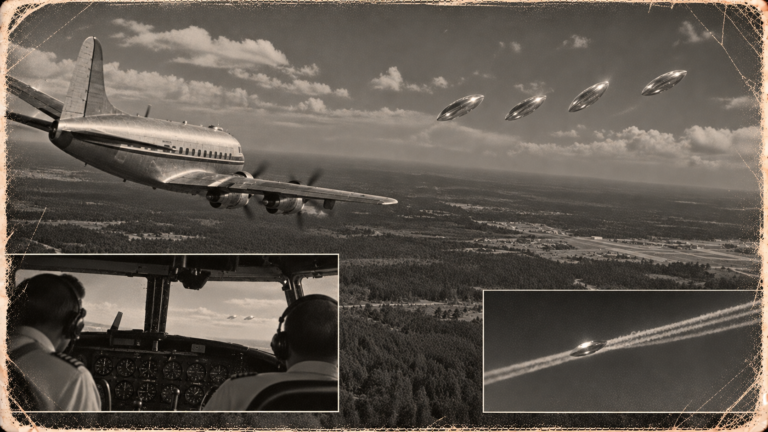
Summary: Maj. Russell J. Gardinier, relaxing in his backyard at the edge of Spokane, saw three flat, pancake-shaped objects, 20 to 30 feet across and 2 to 6 feet deep, appear out of the northwest at about 2,000 feet, khaki tan to the eye and metallic bronze through a 6×23 monocular. They quivered and oscillated, changed direction and speed abruptly and could hang motionless, all three acting independently. After two or three minutes two left toward Fairchild AFB, and his wife and a neighbor watched the third climb away in the same direction. They had orbited near the northwest corner of the city for about five minutes in CAVU weather, with no sound, debris, trail, smoke or flame. The Blue Book listing evaluates the case as Unidentified. See the Full Report.
Source: 57th Air Division letter, “Sightings of Unusual Objects,” 1950; Berliner; FUFOR Index (BBU 797)
Date: September 3, 1950
Location: Fairchild AFB, Washington (Highway 2 east of the base)
Time: 22:20
Summary: Capt. and Mrs. Fortney, returning from Spokane, were driving west on Highway 2 when Mrs. Fortney saw a bluish-white light approach their car from the northeast at high speed and pass over it, frightening her. It continued southwest over the runways and hangar area, growing from the size of an auto headlight to twice that, shedding sparks in a fiery trail of colors other than blue-white, and then suddenly went out, with no sound and no aircraft nearby. Her husband, concentrating on driving with his sun visor down, did not see it. The Air Force card evaluates the case as Astro (Meteor). See the Full Report.
Source: 57th Air Division letter, 1950; Project 10073 Record Card (Astro — Meteor)
Source Status: The 57th Air Division letter calls this a Monday (September 3, 1950 was a Sunday); the card and Blue Book listing give September 3.
Date: September 8, 1950
Location: Fairchild AFB, Washington
Time: 22:20
Summary: 1st Lt. Clifford L. Ponsness, a pilot walking north on a street in the base housing area, saw a bluish-white light about the size of an auto headlight approach the field from the north, pass over its western edge, enlarge, emit sparks as a trail for a few seconds and abruptly go out, with no sound and no aircraft nearby. He estimated it at about 150 mph, paralleling the ground from northeast to southwest. The 57th Air Division said that aircraft, landing lights, jet trails, meteorites and other natural phenomena had been ruled out as explanations. The Air Force card evaluates the case as Astro (Meteor). See the Full Report.
Source: 57th Air Division letter, 1950; Project 10073 Record Card (Astro — Meteor)
Source Status: The 57th Air Division letter calls this a Saturday (September 8, 1950 was a Friday).
Date: September 8, 1950
Location: Germany
Time: Unknown
Summary: No further detail on this sighting survives in the available source beyond its listing as a Blue Book Unknown case.
Source: McDonald list (BBU)
Source Status: The Blue Book September 1950 listing in the archive file has no Germany entry on this date; its only September 8 case is the Fairchild AFB report above.
Date: September 10, 1950 (claimed; unverifiable)
Location: Near Albuquerque, New Mexico
Time: Unknown
Summary: No documented crash exists at this date and location. The claim — that three alien bodies were “recovered from a crash” near Albuquerque — traces to an unsourced line on a 1990s undifferentiated “crashed object” list, with no named witness, no investigation, and no time or craft description of any kind. Its “three small bodies in New Mexico, 1950” signature most closely matches the FBI’s Guy Hottel memo of March 22, 1950 (itself an uninvestigated, secondhand claim the Bureau never verified), which in turn echoes the Aztec, New Mexico crashed-saucer story later exposed as a deliberate hoax by con men Silas Newton and Leo Gebauer. This entry is preserved to document the claim’s lack of foundation, not as a real event. See the Full Report.
Source: Unsourced 1990s list compilation
Date: September 11, 1950
Location: Aboard the USCG cutter Northwind, about 40 miles north of Adak, Alaska
Time: About 4:45 p.m. local (03:45Z, September 12)
Summary: A Coast Guard photographer took four 4 by 5 negatives of the total solar eclipse, whose path crossed the Aleutians, and noticed nothing unusual at the time. Developing them nearly two years later, on July 6, 1952, he found extra spots on the images and reported them to the Air Force. Air Technical Intelligence Center and Air Force photographic laboratory staff concluded the spots were flare images from overexposure to the sun. The Air Force card evaluates the case as Other (Lens Flare). See the Full Report.
Source: Project 10073 Record Card (Other — Lens Flare); Coast Guard letter to Project Blue Book, July 30, 1952; ATIC and Air Force Photo Reconnaissance Laboratory memoranda, 1952
Date: September 13, 1950
Location: 6 miles southwest of Effingham, Illinois
Time: 7:30-7:40 p.m. CST
Summary: A Cessna test pilot, with a passenger, was flying at about 8,000 feet when he saw a set of three lights on a collision course. He flashed his landing light several times and, after a slow closure, turned sharply right; seeing plenty of clearance, he made a climbing left turn to look, and the lights appeared as a dim rosy red triangle, with nothing else visible in the dark, before they disappeared. Air Materiel Command interviewed him in early October; its analysis says the details did not provide a basis for a comprehensive technical investigation, and that no other reports of similar observations came from people in the vicinity. The Blue Book listing evaluates the case as A/C (aircraft).
Source: Project 10073 Record Card; Air Materiel Command report, October 3, 1950; Blue Book September 1950 sightings listing (A/C); Project 1947; FUFOR Index
Date: September 17, 1950
Location: Tatum, New Mexico (near the Amerada State RA “1” well, Chaves County)
Time: 5:50 p.m. local
Summary: An oil geologist driving to a wildcat well in heavy rain saw an orange-red ball, wider in the center than at its edges, first vertical for about ten seconds, then much closer, perhaps a mile or a mile and a half away and horizontal, for 15 to 20 seconds or perhaps a minute, gliding toward him. He judged it larger than the largest plane he had seen, thought first of a tornado or lightning bolt, and saw it bank slightly, recede and vanish; a third time it appeared as a larger round ball like a comet. Later he saw a gray hill-like mass that does not exist in the area and patches of light with small clouds settling to the ground. No one at the rig saw it. He wrote the statement at 8:45 p.m. and mailed it to Army Intelligence at Roswell. The Blue Book listing evaluates the case as Astro (reflection of the setting sun).
Source: Witness letter to Army Intelligence, Roswell, September 18, 1950; Project 10073 Record Card; Blue Book September 1950 sightings listing (Astro — Reflection of Setting Sun)
Date: September 17, 1950
Location: Roswell (Walker AFB), New Mexico
Time: About 21:00
Summary: Five 509th Bomb Group airmen on the 830th ramp saw a circular, bluish-white light about 10 feet across and about 8,000 feet up approach from the southeast, travel northwest and veer sharply right about two miles northwest of the base before disappearing, with no sound. Base Operations reported no aircraft in the area, the ceiling was 23,000 feet with 15 miles visibility, and the base’s early warning radar was inoperative. The Blue Book listing evaluates the case as A/C (aircraft).
Source: Air Intelligence Information Report, 509th Bomb Group, September 17, 1950; Project 10073 Record Card; Blue Book September 1950 sightings listing (A/C)
Date: September 18, 1950
Location: Tinker AFB, Oklahoma City, Oklahoma
Time: 21:52 CST
Summary: An intelligence staff sergeant of the 513th Reconnaissance Squadron (Weather) saw an elliptical area of amber light about 25 feet across, without distinct edges, at 3,000 to 4,000 feet over Tinker AFB moving northwest at an estimated 300 to 400 mph. As it passed overhead it made jerky sideward movements and climbed to about 10,000 feet over about three minutes. Skies were clear to 25,000 feet, and no local aircraft were known to be aloft. The Air Force card evaluates the case as Balloon.
Source: Air Intelligence Information Report, Hq MATS (October 1950); Project 10073 Record Card; Blue Book September 1950 sightings listing (Balloon)
Date: September 19, 1950
Location: Poplar Bluff, Missouri
Time: Afternoon into evening (reported 16:30; lost from sight about 19:00)
Summary: A silver, sphere-like object hovered or drifted over Poplar Bluff for about five hours. Tennessee Air National Guard F-51s from Memphis were sent up; the first pilot could not reach it at 30,000 feet, and the second climbed to 40,000 feet and still could not attain its altitude, calling it a very large silver balloon with no fire, lights or exhaust. Residents had described it as a “translucent wash tub,” two white balloons tied together, or a silver sphere with a red tube hanging beneath. At about 19:18 the second pilot saw green and white lights above him move very fast in bursts toward St. Louis and said they might have no connection to the object. The Air Force card and Blue Book listing evaluate the case as Balloon. See the Full Report.
Source: Air Intelligence Information Report IR-291-50, Hq MATS; Memphis Press-Scimitar, September 19, 1950; Third Army letter, September 22, 1950; Project 10073 Record Card; Blue Book September 1950 sightings listing (Balloon)
Source Status: The earlier version of this entry was filed as “Poplar, Montana (source uncertain)” and described an erratic round object; the Air Force file and newspaper place the case at Poplar Bluff, Missouri, on September 19.
Date: September 20, 1950
Location: Kit Carson, Colorado, possibly 10 miles south of Akron
Time: 10:49 a.m. per the Blue Book Unknowns list (Berliner: 10:45-10:49 a.m. MST)
Summary: A “reliable observer” reported two large, round, glowing objects and three smaller, internally lit objects. The two larger objects hovered for about a minute, then moved as the three smaller objects emerged from behind or within them, and all sped upward and away together. Berliner’s catalog also attaches the account of a USAF B-25 crew of the 3416th Training Squadron, who saw a brilliant white, star-like object accelerate and decelerate while emitting sparks. The Blue Book listing carries the Kit Carson case as Unidentified.
Source: Berliner; Project 1947; Blue Book Unknown case list (BBU 807)
Source Status: The Blue Book Unknown list gives the time as 10:49 a.m., but the description of glowing, internally lit objects and the Denver-area reports of the same date, timed 22:45 MST, suggest the clock may actually be evening; the Kit Carson file itself has not been examined. The B-25 crew’s statement in the Denver file is recorded there under the Astro (Meteor) Denver case, not under Kit Carson. The earlier version of this entry gave “September 19 or 20.”
Date: September 20, 1950
Location: Western Kentucky and Tennessee (Murray, Kentucky meteorite fall)
Time: 1:35 a.m.
Summary: A giant fireball (American Meteoritics Society AMS 2326) roared from north to south over southeastern Illinois, leaving a luminous train visible in five states and lighting the countryside from St. Louis to Louisville and from Memphis to Knoxville. Its final detonation over western Kentucky was heard over an area about 1,000 miles square and shook buildings from Paducah to Memphis; about fifty pounds of meteorites fell around Murray, Kentucky, and are now in the Smithsonian. Nashville police patrols raced north toward a reported impact that was not confirmed.
Source: AP wire story, Nashville, September 20, 1950, in the New York World-Telegram and Sun; American Meteoritics Society report, as summarized in an excerpt in the Blue Book files (information only)
Date: September 20, 1950
Location: Denver, Akron and other Colorado points, with reports from Utah and Nebraska
Time: About 22:45 MST (22:45-22:50)
Summary: Fourteen people reported objects to the Lowry Flight Service Center at about 22:45, most describing red or orange balls of fire heading south: Lowry airmen and a CAA group at Stapleton, a United Air Lines captain, a Denver resident who saw a ball of fire with a tail three times its size, a state policeman at Akron who saw five objects at about 500 feet, a theater patron who saw two red balls of flame at about 300 mph, a Lowry major who saw two round white lights at about 16,000 feet near Cheyenne Wells, a Continental Air Lines captain who saw a yellow triangular glide at 20,000 feet over Colorado Springs, a United captain who saw a very large object break into four pieces over St. George, Utah, and a Cornhusker Ordnance Depot patrolman who saw a long object with blue lights in front and a bright white light behind. The three-man crew of a Lowry B-25 — two pilots and an aircraft observer — said the object looked like a landing light, became ten to twenty lights of the same size like a string of landing lights, faded out with no exhaust trail or sound, was not a jet, and came right across them on a 154-degree magnetic heading near Akron. The Air Force card evaluates the case as Astro (Meteor). See the Full Report.
Source: Air Intelligence Information Report IR-284-50, Hq MATS (September 29, 1950); statement of the B-25 crew, September 21, 1950; Project 10073 Record Card (Astro — Meteor); Blue Book September 1950 sightings listing (Astro — Meteor)
Date: September 21, 1950
Location: Provincetown, Massachusetts (MIT radar, Cambridge, tracking jets between Provincetown and the Isles of Shoals)
Time: 9:52 a.m. EST
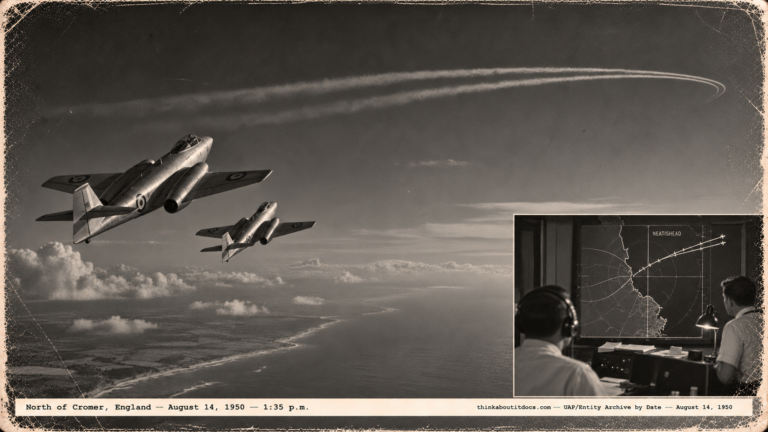
Summary: An MIT Weather Radar Research Group research associate, who was also an Air National Guard major and staff weather officer, and two colleagues were tracking two jet fighters at about 30,000 feet and 250 mph indicated airspeed with an SCR-615-B radar when they noticed another signal on a closing course. About four minutes after first contact the echoes nearly merged, the object crossing about three miles ahead of the jets, whose pilots, warned by radio, saw nothing in the haze; the object then made a sharp turn of nearly 270 degrees and closed on them again about a minute later. MIT put its speed at about 22 miles a minute (roughly 1,320 mph) and the turn at 11 or 12 g, and said it gave a steady, solid echo of moderate strength, not a hydrometeor. The Air Force card carries the case as Unidentified. See the Full Report.
Source: Spot Intelligence Report ID-OSI 24-0-175, 1st District OSI (October 5, 1950); MIT Weather Radar Research Group letter, October 6, 1952; Signal Corps transmittals, 1952; Project 10073 Record Card (Unidentified); Jan Aldrich; Hynek, UFO Report, pp. 139-141 (BBU 809)
Source Status: Catalogs, including Aldrich, give a closest approach of a mile to a mile and a half, a speed of 1,500 mph and a turn of 15 g; the 1950 OSI report gives about 1,320 mph, and the MIT letter written in 1952 gives about three miles, 22 miles a minute and 11 or 12 g. The OSI report calls the jets F-86s while the 1952 MIT letter says F-84s.
Date: September 25, 1950
Location: Mt. Palomar Observatory, California
Time: 20:36
Summary: Two March AFB navigators standing outside Mt. Palomar Observatory at 6,000 feet, watching the stars, saw what looked like a shooting star above the handle of the Big Dipper, 15 degrees above the horizon. It moved a great distance from about 310 to 100 degrees horizontally in two to three minutes, making a loud, swirling, whooshing noise like a rocket exhaust; only a bluish-white light flickering intermittently, about the size of a star, was visible. The Air Force card evaluates the case as A/C (aircraft).
Source: Report of Unidentified Aerial Objects, 2d Bombardment Wing (September 26, 1950); Project 10073 Record Card; Blue Book September 1950 sightings listing (A/C)
Date: September 29, 1950
Location: Sandia Base, New Mexico (Igloo area)
Time: 04:45
Summary: A military police soldier driving a jeep in the Igloo area saw a movement of light: a slightly oblong object with a cut-off rear spraying a bluish-yellow flame and sparks, larger than a jet and smaller than a bomber, at about 50 degrees elevation from northwest to southeast over about 3 to 4 seconds at an estimated 350 to 400 mph, in clear moonlight with no sound and a flame trail about 4 to 5 feet long. Fourth Army forwarded the report on October 26, 1950 and the Kelly OSI district took no investigative action; the Air Force card evaluates the case as Astro (Meteor).
Source: Fourth Army letter and Kelly OSI Spot Intelligence Report 24-0-115 (October 1950); Project 10073 Record Card; Blue Book September 1950 sightings listing (Astro — Meteor)
EXECUTIVE SUMMARY
A Radar-Confirmed Loop Over Cape Cod
September 1950’s standout case is the Provincetown, Massachusetts radar tracking, in which an MIT-operated weather radar recorded an unidentified object making a sudden, extremely high-g turn near two Air Force jets that never managed to see it through the haze — one of the more precisely instrumented sightings of the year, and a useful reminder that radar and visual evidence do not always arrive together even in well-equipped, professionally staffed cases. The month also serves as a case study in how unverified claims propagate: the “Albuquerque crash” entry is retained specifically to document its lack of any real foundation, tracing its likely origin through the FBI’s uninvestigated Hottel memo back to the exposed Aztec hoax.
The Air Force files show how many September cases were closed as ordinary things: a balloon over Poplar Bluff, a reflection of the setting sun at Tatum and Nunivak, an eclipse lens flare at Adak and meteors at Fairchild, Denver and Sandia. They also show where that was harder: a Spokane major’s three tumbling bronze discs and the Provincetown radar echo were carried as Unidentified, and a Newfoundland base recorded radar blips, an offshore object and the shooting of a young airman in a single report that called a tie-in possible.
“Our best estimate of the speed of the ‘Saucer’ was 22 miles per minute.”
— MIT Weather Radar Research Group, letter on the September 21, 1950 Provincetown tracking, October 6, 1952