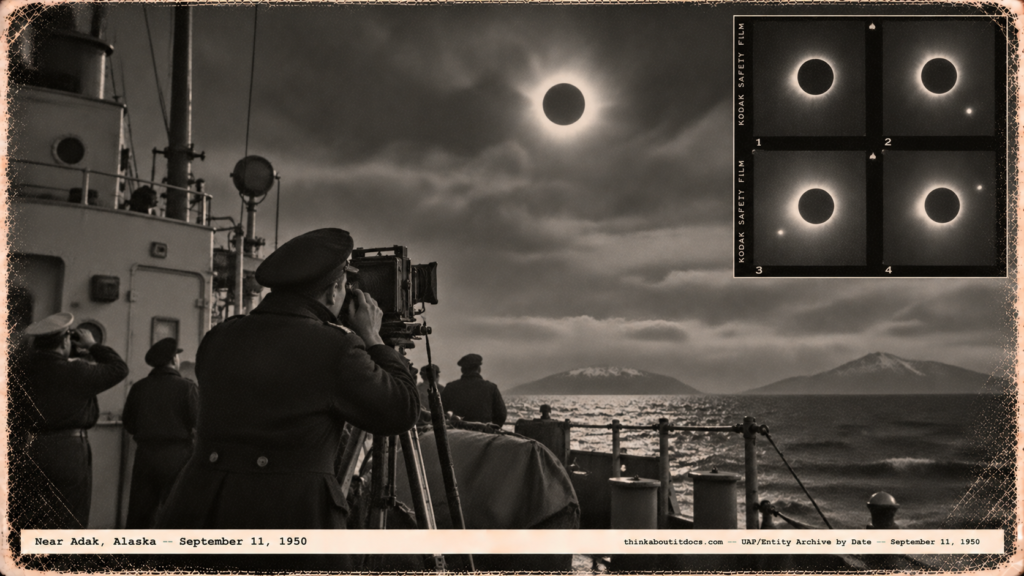
On September 11, 1950, a Coast Guard photographer on the Northwind photographed the total solar eclipse near Adak.
THINK ABOUTIT UFO|UAP SIGHTINGS REPORT
1950: Aboard the USCG Cutter Northwind, Near Adak, Alaska
The Eclipse Photographs
On September 11, 1950, a Coast Guard electronics technician on the weather deck of the cutter Northwind, about 40 miles north of Adak in the Aleutians, photographed the total eclipse of the Sun with a 4 by 5 Speed Graphic. He noticed nothing odd at the time. Nearly two years later, on July 6, 1952, he developed the four negatives and found extra spots on the film in addition to the Sun’s images, and wrote to the Air Force.
Project Blue Book’s Capt. Edward Ruppelt wrote back asking for details, and the Air Technical Intelligence Center and the Air Force Photo Reconnaissance Laboratory examined them. Their conclusion was that the spots were lens flare from heavy overexposure to the Sun. The card closes this Adak, Alaska photographic case as Other (Lens Flare), and the file shows the method as clearly as the answer.
Date: September 11, 1950 (negatives developed July 6, 1952)
Sighting Time: About 4:45 p.m. local, zone +11 (card: 03:45Z, September 12); the Coast Guard letter says about 1600
Day/Night: Day, during a total solar eclipse
Location: Weather deck of the U.S. Coast Guard cutter Northwind, about 40 miles north of Adak, in the Bering Sea off the Aleutian Islands
Urban or Rural: At sea
No. of Entity’s: 0 — Not Applicable
Entity Type: Not Applicable
Entity Description: Not Applicable
Hynek Classification: Not Applicable (photographic artifacts; nothing seen at the time)
Duration: The eclipse photographs; “about 6 minutes” is recorded on the card
No. of Object(s): Unidentified spots on four negatives, in addition to the eclipsed Sun images
Description of the Object(s): Extra images on the negatives that the photographer described as transparent and, by his questionnaire, unidentified
Shape/Size/Color of Object(s): Not determinable; the photographer said he could not tell the size
Distance to Object(s): Not applicable
Height & Speed: Not applicable
Number of Witnesses: 1 photographer; other crew members also photographed the eclipse; nobody saw the spots at the time
Special Features/Characteristics: A 4 by 5 Speed Graphic with a coated 127mm Kodak Ektar lens at f/4.7, Super-XX film pack, Wratten A filter, 1/100 second at f/22; four negatives numbered 2, 3, 4 and 5; developed in Microdol
Case Status: Other (Lens Flare) per the Project 10073 card; the Air Force photo laboratory: flare spots due to overexposure
Source: Project 10073 Record Card; Commandant, U.S. Coast Guard letter to the Director of Intelligence, USAF, July 30, 1952; Capt. Edward J. Ruppelt letter, July 7, 1952; Air Technical Intelligence Center and Photo Reconnaissance Laboratory memoranda, 1952
Summary/Description: A Coast Guard photographer’s eclipse negatives showed extra spots that the Air Force lab attributed to lens flare.
Related Cases: None established
Detailed Report
The photographs. The Coast Guard letter describes the negatives: a 4 by 5 Speed Graphic, a coated Kodak Ektar 127mm lens, Kodak Super-XX film pack, a Wratten A filter, an exposure of 1/100 second at f/22, taken from the weather deck of the cutter Northwind about 40 miles north of Adak in the Bering Sea at about 1600 hours in the zone. The total eclipse of the Sun in the summer of 1950 had its path of totality across the Aleutians near Adak. The film was developed on July 6, 1952 in Kodak Microdol, and the negatives carry pack sequence numbers 2, 3, 4 and 5.
The photographer’s questionnaire. On the Air Force sighting questionnaire he wrote that he was photographing the eclipse, did not see the object at the time and discovered the images two years later on the negatives. He gave the time as 4:45 p.m. in the Bering zone (card: 03:45Z on September 12), said other crew members had taken pictures too, marked the object transparent, and wrote that he could not estimate size, distance or speed and had no opinion on what it was. He suggested someone who could scrutinize the negatives might come up with positive answers.
The Air Force examination. Capt. Ruppelt wrote to the Coast Guard on July 7, 1952 to ask for details. The Commandant forwarded the material on July 30; Maj. Fournet forwarded it to ATIC on August 9 and suggested asking the Coast Guard what had become of the negatives. ATIC’s Technical Analysis Division sent the photos to the Air Force photo laboratory, noting they were evidently multiple exposures of the Sun during an eclipse. The laboratory pointed a 4 by 5 Speed Graphic with a coated lens toward the Sun and examined the image on the ground glass. With the lens wide open at f/4.7 a pronounced flare spot appeared in addition to the main image, and camera movement moved the spot as well as the Sun. A flat glass filter in front of the lens produced additional flare spots that shifted with small changes in filter orientation.
The conclusion. The laboratory wrote that flare images are always encountered when an unusually bright object is in the field of view and the exposure is not proportionally reduced, that the stated exposure was considerably in excess of normal for an object as bright as the Sun, and that the negatives showed considerable halation about the Sun images. It judged it probable that the spots were nothing more than flare spots from overexposure. The Project 10073 card reads Other (Lens Flare).
RESEARCHER’S NOTES
A Case Closed by Reproduction
- Method: The laboratory did not just assert lens flare; it reproduced the effect with a similar camera, lens and filter. That is unusually concrete for a 1950-era file.
- The exposure: The laboratory says the exposure was too long for the Sun; the photographer’s settings (1/100 second at f/22) are listed in the Coast Guard letter, and the file does not reconcile the two beyond the lab’s statement.
- Two years: The images were noticed only after development in 1952; no one saw anything on the cutter in 1950.
- The date: The Blue Book listing places the sighting on September 11; the card’s Zulu time falls on September 12.
- Names: The photographer is not named here.
The Adak photographs belong in this archive mainly as a documented explanation. A person with a camera, a bright sun and a long exposure produced spots that looked unexplained, and the Air Force reproduced them. The file leaves no room for another reading.
“nothing more than flare spots due to overexposure”
— Air Force Photo Reconnaissance Laboratory, 1952