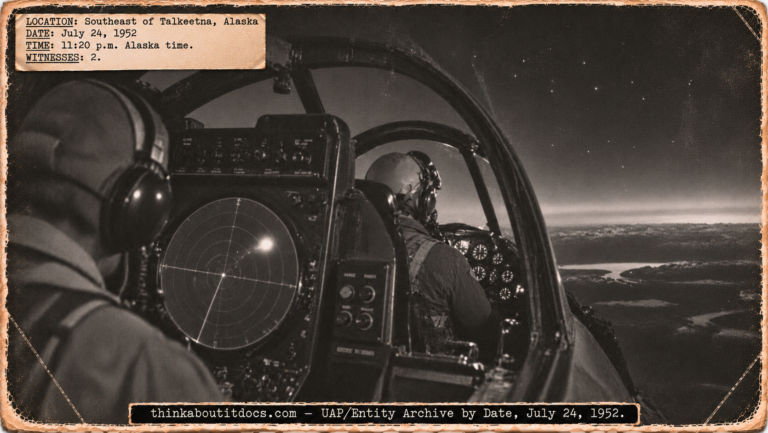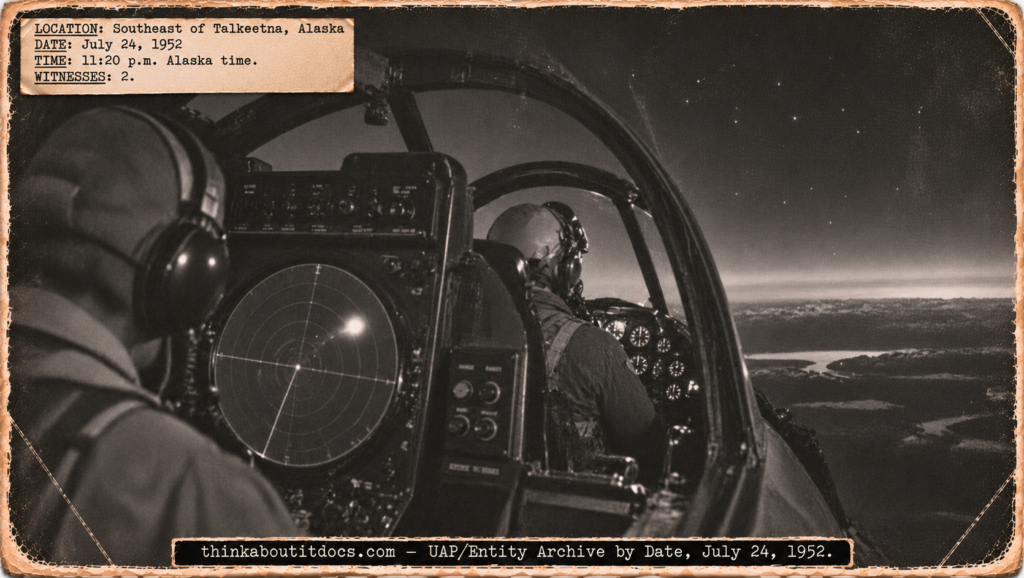
Alaska, July 24, 1952: a target that kept pulling away.
THINK ABOUTIT UFO|UAP SIGHTINGS REPORT
Elmendorf AFB, Alaska F-94 Radar Chase:
A Target Pulling Away at 350 Knots, July 24, 1952
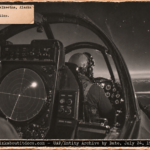
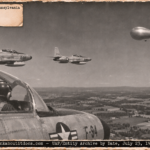
At 11:20 on the night of July 24, 1952, an F-94 flying southeast of Talkeetna, Alaska picked up a radar target that looked larger than the jet itself. The crew, 1st Lt. Jones and 2nd Lt. Aubrey M. Brenner, locked on at 14,000 yards. The target was moving 40 knots faster than they were. They pushed the throttle to 350 knots and climbed at 4,200 feet a minute. The target was still pulling away at more than 100 knots.
The Elmendorf AFB, Alaska F-94 chase is the second Alaska interceptor case of the week in this archive, three days after Beluga Lake. Like it, the target outpaced the jet. At 18,500 feet the target seemed to level off and speed up, and the crew broke off the chase.
Date: July 24, 1952
Sighting Time: 11:20 p.m. Alaska time (0820Z, July 25)
Day/Night: Night
Location: Southeast of Talkeetna, Alaska (F-94 from Elmendorf AFB), United States
Urban or Rural: Rural
No. of Entity(‘s): Not Applicable
Entity Type: Not Applicable
Entity Description: Not Applicable
Hynek Classification: Radar only (no visual sighting recorded; Hynek’s closest category, Radar-Visual, requires a visual sighting)
Duration: Not recorded; from radar contact at 14,000 yards through a climb to 18,500 feet until the chase was broken off
No. of Object(s): 1
Description of the Object(s): An unidentified radar target that appeared larger than an F-94 on the radar scope
Shape/Size/Color of Object(s): Not recorded (radar contact only)
Distance to Object(s): Radar contact at 14,000 yards
Height & Speed: Target 40 knots faster than the F-94 at lock-on; still pulling away at over 100 knots when the aircraft was at 350 knots in a 4,200 feet-per-minute climb; the target leveled off and increased speed after the jet reached 18,500 feet
Number of Witnesses: 2 (the F-94 crew: 1st Lt. Jones, pilot, and 2nd Lt. Aubrey M. Brenner, radar observer)
Special Features/Characteristics: Airborne radar lock-on; target outpaced the interceptor in a sustained climb; the chase ended when the target leveled off and accelerated
Case Status: No Blue Book evaluation is recorded in the sources I could check; the case does not appear on the Blue Book Unknowns lists I reviewed
Source: Date-page source listed as Unknown; no source for the crew names or figures was identified in the materials available for this rebuild
Summary/Description: An F-94 crew southeast of Talkeetna locked on to a target larger than their jet. Climbing at 350 knots, they could not close; it leveled off at about 18,500 feet and sped away.
Related Cases: Beluga Lake, Alaska F-94 radar intercept of July 21, 1952; Boston and Trenton F-94 chases of July 22-23, 1952
Detailed Report
The crew was 1st Lt. Jones, the pilot, and 2nd Lt. Aubrey M. Brenner, the radar observer, flying an F-94 southeast of Talkeetna, Alaska, at 11:20 p.m. local time on July 24, 1952 (0820Z on July 25).
They made radar contact with a target that appeared larger than an F-94 on the scope at a range of 14,000 yards. They achieved lock-on with the target moving 40 knots faster than the aircraft.
The pilot increased the aircraft’s speed to 350 knots in a climb of 4,200 feet per minute. The target was still pulling away at more than 100 knots. After the aircraft climbed to 18,500 feet, the target appeared to level off and increase speed. The crew broke off the chase.
The account is a summary of the radar chase with no visual sighting recorded.
RESEARCHER’S NOTES
A Radar Chase That Mirrors Beluga Lake
- The pattern: Beluga Lake on July 21 and this chase three days later share a sequence: radar contact, lock-on, a target that holds or gains speed, a broken-off pursuit. They involve different crews and different Alaskan areas.
- Closing speed: A target 40 knots faster at lock-on and more than 100 knots faster after a 350-knot climb means the target was accelerating relative to the jet, not holding a steady speed.
- Radar size: A target that “appeared larger than an F-94” is a statement about the size of the echo, not the object. Echo size depends on aspect, range and reflectivity.
- No visual: The sources record no visual sighting, so an aircraft, weather echo or other radar artifact cannot be ruled out from this record alone.
- Sourcing gap: Your date page lists the source as Unknown, and I could not find the crew names or figures on Blue Book or NICAP lists I reached. Treat the details as unverified until the source is identified.
The Elmendorf chase reads like a well-observed intercept, but its source is not identified in the materials available. It belongs in the archive as a documented-looking report that still needs a primary source.
A radar target larger than an F-94, still pulling away at more than 100 knots as the interceptor climbed at 350 knots.
— Summary of the July 24, 1952 Elmendorf AFB F-94 radar chase (paraphrased)