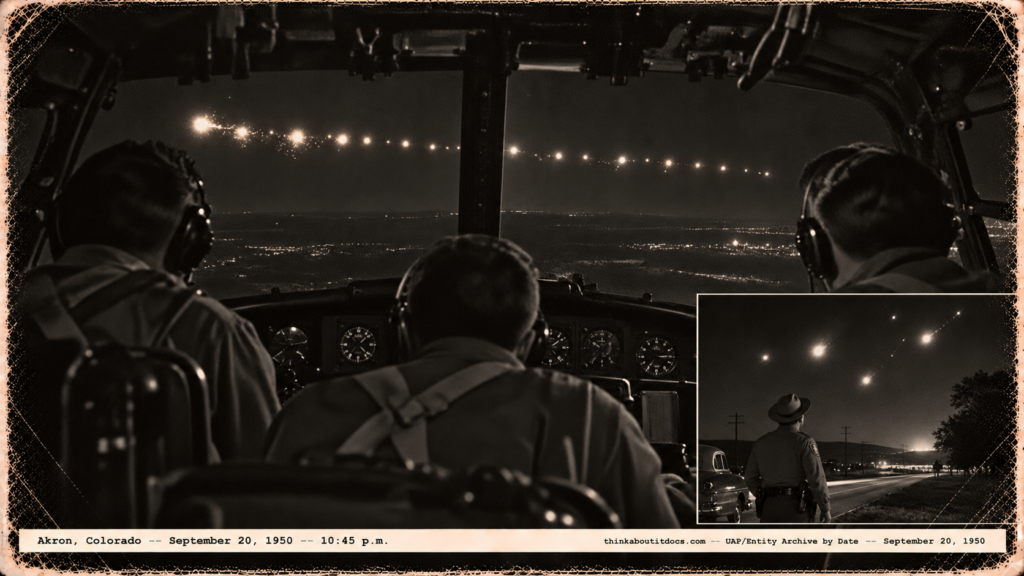
On September 20, 1950, a Lowry B-25 crew and thirteen other witnesses reported fireballs over Colorado.
THINK ABOUTIT UFO|UAP SIGHTINGS REPORT
1950: Denver, Akron and the Western States — Fourteen Reports of Fire Overhead
At about 10:45 on the night of September 20, 1950, the Lowry Flight Service Center near Denver began taking reports of balls of fire crossing Colorado from north to south. By the time they were done there were fourteen of them: airmen at Lowry and CAA staff at Stapleton, a United Air Lines captain, a state policeman at Akron who thought he saw five objects, a theater patron at a drive-in, a Continental Air Lines captain who saw a yellow triangle gliding over Colorado Springs, and a United captain over St. George, Utah, who watched a very large object break into four pieces.
Among them was a three-man crew in a Lowry B-25, two pilots and an observer, who said the object looked like a landing light, became ten to twenty lights like a string of landing lights, and faded out with no exhaust trail and no sound. The Air Force card evaluates this Denver and Akron, Colorado case as Astro (Meteor), and a book excerpt in the file notes that on the same night about 10:45 p.m., aircrews reported fireballs over a six-state area.
Date: September 20, 1950 (Wednesday)
Sighting Time: About 22:45 MST (reports from 22:45 to 22:50)
Day/Night: Night (clear skies)
Location: Denver, Akron, Stapleton and Lowry fields, Eagle, Cheyenne Wells and Colorado Springs, Colorado; over St. George, Utah; and a report from Grand Island, Nebraska
Urban or Rural: City, airfields and open country
No. of Entity’s: 0 — Not Applicable
Entity Type: Not Applicable
Entity Description: Not Applicable
Hynek Classification: NL (nocturnal lights)
Duration: 10 to 30 seconds for the B-25 crew; seconds to a minute for others
No. of Object(s): One to five or more, by witness; the B-25 crew counted 10 to 20 lights
Description of the Object(s): Balls of fire turning from white to red, sparks that “burned out,” a ball of fire with a long tail, a string of lights like landing lights, a yellow triangle gliding, a very large object breaking into four pieces; mostly traveling south
Shape/Size/Color of Object(s): Brilliant white to orange-red; spherical with tails; one reported triangular and yellow; one long and narrow with blue lights in front and white behind
Distance to Object(s): Not stated; one policeman guessed about 500 feet; one airman about 25,000 to 30,000 feet
Height & Speed: 500 feet to 30,000 feet by estimate; the B-25 crew estimated about 700 mph (F-86) as the speed on the card; a theater patron said 300 mph
Number of Witnesses: 14 reporters to Lowry Flight Service Center, including the 3-man B-25 crew (2 pilots and an aircraft observer of the 3416th Student Officer Squadron) and airline pilots
Special Features/Characteristics: Reports from Colorado, Utah and Nebraska at nearly the same minute; no sound; the B-25 crew said it was not a conventional aircraft or a jet and perhaps rocket powered
Case Status: Astro (Meteor) per the Project 10073 card and the Blue Book listing (Denver); the Kit Carson report of the same night is carried as Unidentified (BBU 807)
Source: Air Intelligence Information Report IR-284-50, Hq MATS (September 29, 1950); Lowry Flight Service Center reports; statement of the B-25 crew (September 21, 1950); Project 10073 Record Card; book excerpt on meteors in the files
Summary/Description: Fourteen witnesses in several states reported fireballs and lights at about 10:45 p.m.; the card calls it a meteor.
Related Cases: Kit Carson, Colorado, September 19 or 20, 1950 (BBU 807); Murray, Kentucky meteorite fall, September 20, 1:35 a.m. (a separate fireball)
Detailed Report
The Lowry reports. The Commanding Officer of the Lowry Flight Service Center reported to Hq MATS unidentified flying objects in the vicinity of Akron and Denver on the night of September 20 at about 2245 MST, with fifteen-mile visibility and clear skies. The reports were received by the clearance officer on duty. They include a woman at Eagle who saw five balls of fire change from white to red heading south; a United captain, first officer, a CAA mechanic and another man who saw balls of fire heading south over Stapleton and Lowry; a Denver resident who called in a meteor over the city; a Continental Air Lines captain who saw an unidentified triangular yellow object gliding at 20,000 feet over Colorado Springs; a United captain eastbound over St. George, Utah, who saw a very large object travelling west to east break into four pieces; a state policeman who saw five objects over Akron, thought them about 500 feet up and heading south; a drive-in patron who saw two red balls of flame at about 300 mph; a Lowry major who saw two round white lights near Cheyenne Wells at about 16,000 feet that came down to 11,000 to 12,000 feet and went back up, heading north, then east, then south; and a patrolman from the Cornhusker Ordnance Depot who phoned Grand Island CAA about what he thought was an aircraft in distress, with bright blue lights in front and an exceptionally bright white light behind, long and traveling south at great speed, at 2247.
The Lowry airmen. A technical sergeant of the 3415th Maintenance Squadron saw two streamlined objects over Lowry Field like two balls of orange-red fire traveling south in a straight line at about 25,000 to 30,000 feet and thought they were jets. A Denver resident saw a ball of fire with a tail three times the size of the ball, yellow, traveling south-southeast with no sound at 2250.
The B-25 crew. In a statement dated September 21 the crew said the object was like a landing light in the air; it became more lights of the same size, looking like a string of landing lights seen from above, about 10 to 20 at once. These faded out. The objects seemed to have a “going ahead” power because they accelerated rapidly. There was no exhaust trail and no sound. The light was similar to an aircraft on fire, except ragged in back; it was not a conventional aircraft and not a jet, perhaps rocket powered; there was no blue flame; static electricity on wing tips is something they had seen, but this was not the same, since it would not be possible to see that far and that brilliant a light. They believed the object had about a 154-degree magnetic heading, came right across them, and that they were on the south range of Akron radio.
The card and the context. The Project 10073 card, with the source USAF pilots and aircraft observer, records 2245 MST, a color of brilliant white to orange-red, a meteor shape, a speed slightly faster than an F-86 (700 mph), 8,000 feet, 10 to 30 seconds, a course of 154 degrees magnetic, two in the group, changes in speed, and the remark that the object looked like a landing light that emitted a string of bright sparks that “burned out.” A book excerpt in the file says that on the same night, about 10:45 p.m., fireballs were reported by plane crews flying over a six-state area: Idaho, Wyoming, Utah, Colorado, Arizona and New Mexico.
RESEARCHER’S NOTES
Many Observers, One Evening, One Explanation
- The meteor verdict: The card evaluates the B-25 and the other reports as a meteor; the 14 reports, from several states within minutes, are consistent with a single large fireball seen along its path, which is the Air Force reading.
- What differs: The crew’s multiple-lights description and the Continental captain’s yellow triangle are not obviously a single streak, and the crew itself rejected a conventional aircraft and static electricity.
- Kit Carson: The Kit Carson case of September 19 or 20 is carried as Unidentified (BBU 807), though it occurred the same night and involves the same unit; the files do not reconcile that.
- Names: The airline captains and the policeman are named in the text of the Lowry report; the B-25 crew’s names appear in signed form, but this page identifies them by role.
A fireball explains why fourteen people in four states saw something at the same minute, and the Air Force took that route. The B-25 crew’s careful rejection of a conventional aircraft or a jet is what keeps the Denver and Akron reports in this archive as more than a footnote to a meteor.
“It was not a conventional aircraft and not a jet.”
— Statement of the Lowry B-25 crew, September 21, 1950