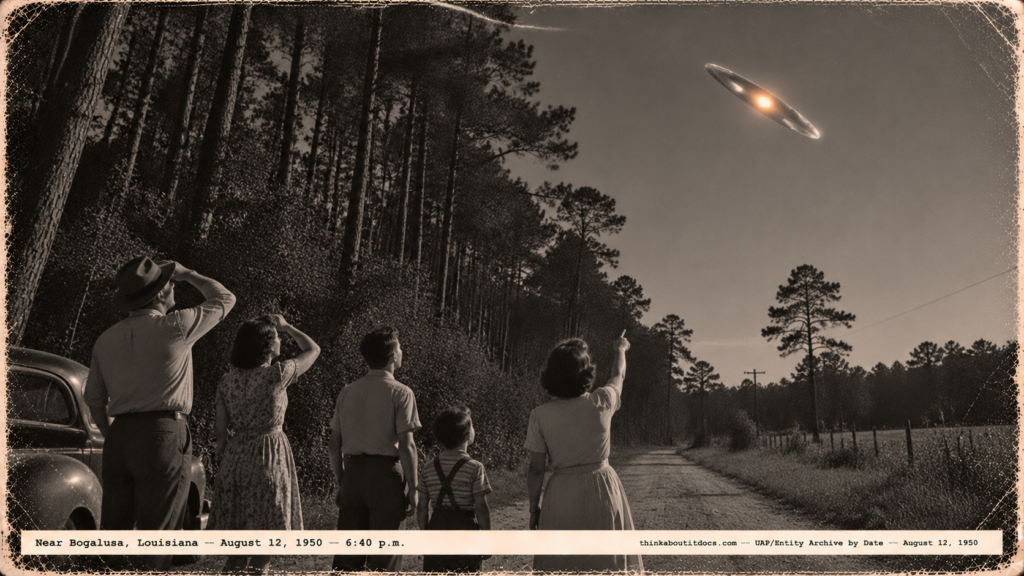
On August 12, 1950, a family near Bogalusa heard a thunder-like sound under a clear sky and saw a tilted object cross west.
THINK ABOUTIT UFO|UAP SIGHTINGS REPORT
1950: Near Bogalusa, Louisiana — August 12, A Tilted Object and a Peal of Thunder
At 6:40 p.m. on Saturday, August 12, 1950, a vacationing family of five walking a country lane near Bogalusa, Louisiana, heard what sounded like a light peal of thunder though there was not a cloud in the sky. Looking straight up, they saw an object moving due west at about 1,400 to 2,500 feet and at least 450 miles an hour: elongated and rounded at the ends, with aluminum-colored edges and, at its center, a fiery red or old-gold round spot the size of an orange. It stood at a 45-degree angle, top to the north and bottom to the south, while traveling west.
The father wrote to the Air Force from Lake Charles on September 10, saying he judged the thing had a motor, and that he might have dismissed the experience except for an August 1950 magazine story handed to him that evening, “The Great Flying Saucer Mystery,” which ended by asking readers to write to Technical Intelligence. The Air Force card evaluates this Bogalusa, Louisiana UFO case as Astro (Meteor).
Date: August 12, 1950 (Saturday)
Sighting Time: 6:40 p.m. (card: 1840)
Day/Night: Day (early evening, cloudless)
Location: A country lane near Bogalusa, Louisiana; the witnesses were walking due north
Urban or Rural: Rural
No. of Entity’s: 0 — Not Applicable
Entity Type: Not Applicable
Entity Description: Not Applicable
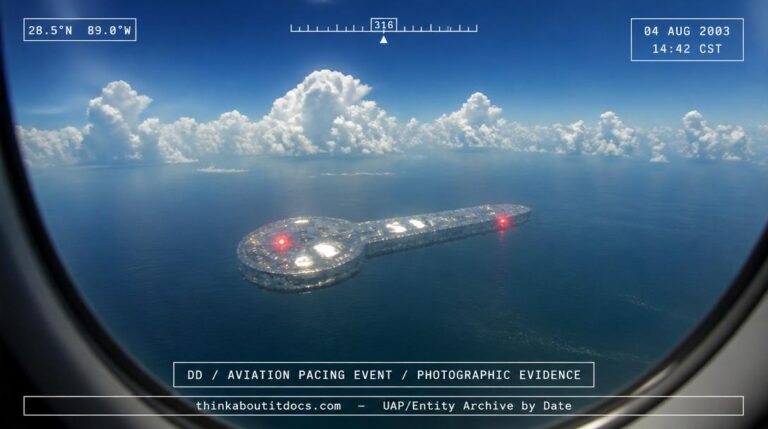
Hynek Classification: DD (daylight disc)
Duration: A matter of seconds
No. of Object(s): One
Description of the Object(s): An elongated object, rounded at both ends, standing at a 45-degree angle while moving west; aluminum-colored outer edges and a fiery red or old-gold round center; a sound like a light peal of thunder
Shape/Size/Color of Object(s): Apparent size about 14 inches long by 8 inches wide; orange per the card; aluminum edges with a red-gold center the size of an orange
Distance to Object(s): Overhead and low, not stated more precisely
Height & Speed: About 1,400 to 2,500 feet (the card says 1,800 to 2,500); at least 450 mph by the witness (the card says 350 mph); due west
Number of Witnesses: 5: the writer, his wife, his sister-in-law, a 14-year-old son and a 9-year-old (the card records 1)
Special Features/Characteristics: A thunder-like sound with no clouds; the object tilted at 45 degrees; the writer judged it had a motor
Case Status: Astro (Meteor) per the Project 10073 card
Source: Witness letter, Lake Charles, Louisiana, September 10, 1950; Project 10073 Record Card
Summary/Description: A family heard thunder under a cloudless sky and saw a tilted, aluminum-edged object cross west at 1,400 to 2,500 feet.
Related Cases: Flat Rock, Newfoundland, August 12, 1950 (same date; no connection established)
Detailed Report
The letter. The writer, vacationing at the home of his wife’s sister near Bogalusa, wrote that at 6:40 p.m. on Saturday, August 12, 1950, while walking north on a country lane with tall pines on the right and shorter ones on the left, they saw and heard a “flying saucer.” His sister-in-law looked directly overhead and exclaimed. He was more concerned with the sound: it definitely had a motor, like a light peal of thunder, unlike a putt-putt gasoline engine or the swish of a jet, and he was puzzled by the thunder because there were no clouds. He looked at his watch and it was 6:40.
The object. It moved due west, to their left, rather low at about 1,400 to 2,500 feet but fast, at least 450 miles an hour, and was gone within seconds. His wife thought it was slightly falling, but they agreed it was probably following the curvature of the earth. Disregarding any allowance for height, it appeared about 14 inches long and 8 inches wide; the difficult thing to realize was that it stood in the sky at a 45-degree angle, top to the north and bottom to the south, while traveling west. It appeared rounded and not square at each end, with pronounced aluminum outer edges, and right in the center a round object about the size and shape of a good-sized orange, of a fiery red or old-gold color. They decided they did not hear it earlier because they were talking and because of the tall trees on their right.
The aftermath. Back at the house, a local resident said it was not uncommon to see those things apparently flying up out of the swamps and disappearing toward Mississippi, but no one could verify this and his sister-in-law said it was the first she had seen. Shortly after returning, the writer was handed the August 1950 Open Road, “The Young People’s Magazine,” which carried a story titled “The Great Flying Saucer Mystery,” with the subheadings “Are They Mystery Rockets?”, “Wild Imaginings of Crackpots?” and “Or Space Ships from Other Planets?” It ended by asking readers who saw a saucer they were sure was not a bird, balloon or B-29 to write to the Technical Intelligence Division at Wright-Patterson Air Force Base. He wrote that he was sure of two things: they had seen the flying saucer as described, and they did not intend to eat plenty of dandelion blooms, a reference to a joke in the story.
The card. The Project 10073 card, with a date of information of August 12, 1950, lists a civilian source, a time of 1840, orange shape and a fiery red color, 14 by 8 inches, 350 mph, an altitude of 1,800 to 2,500 feet, course west, one in the group, the sound as “light peal of thunder,” and the maneuver as the object seeming to travel tilted at a 45-degree angle. The handwritten evaluation is Astro (Meteor).
RESEARCHER’S NOTES
A Meteor Label on a Thunder-Like Sound
- Card and letter: The card records one witness and 350 mph; the letter has five witnesses and at least 450 mph. The card’s altitude (1,800 to 2,500) is also higher than the letter’s 1,400 to 2,500.
- The sound: A thunder-like noise under a clear sky is the detail the witness stressed most. The file does not say how it was reconciled with a meteor.
- The tilt: A 45-degree tilt in a direction different from the line of travel is a stated observation; the card repeats it without comment.
- The magazine: The writer read the saucer article after the sighting, not before; he said it made him sure he should report it.
- Names: The writer’s name is redacted in the scan and is not used here.
The Bogalusa report is a thoughtful family sighting with a sound that the witness could not fit to any engine he knew. Blue Book closed it as a meteor and the card kept the thunder-like sound and the tilt on file, which is as much as the record says.
“The thing definitely had a motor.”
— Witness letter, Lake Charles, Louisiana, September 10, 1950