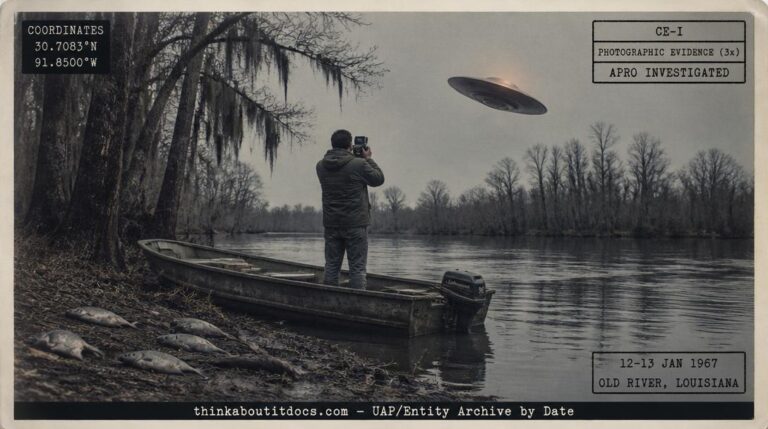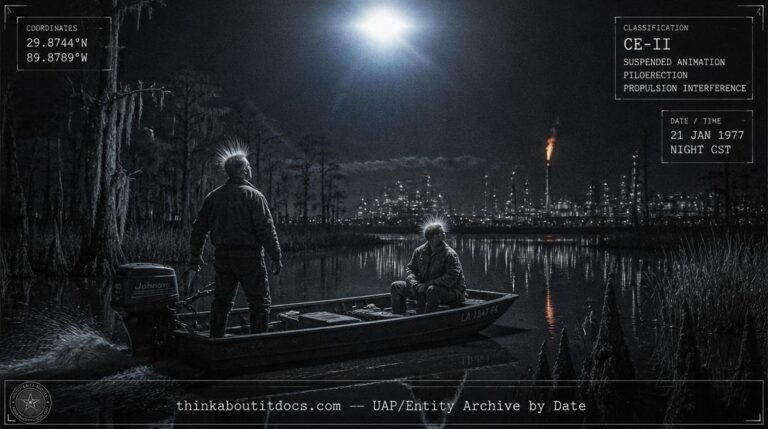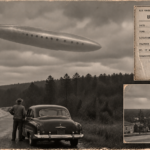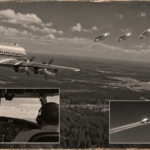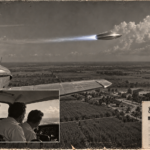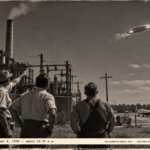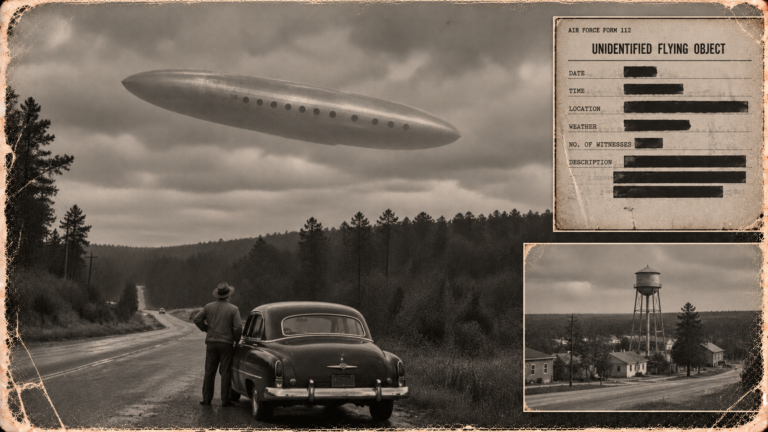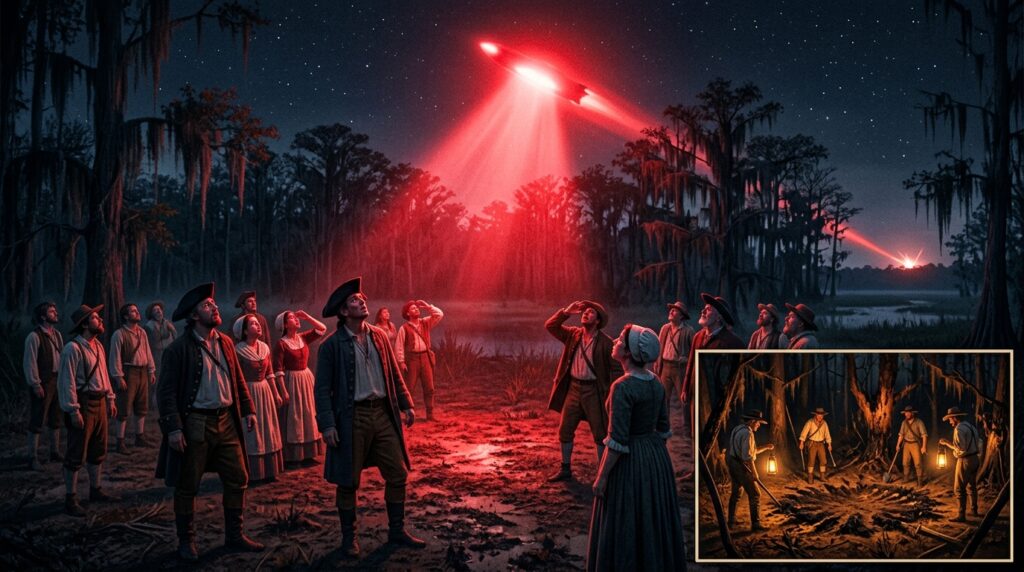
April 5, 1800 CE — Baton Rouge, Louisiana. A crimson red luminous object approximately 70 feet long passed directly over spectators at 200 yards altitude producing near-sunbeam ground illumination with heat felt but no electric sensation, before terminating northeast with a violent rush and earthquake-force crash that broke up the earth's surface and burned all vegetation at the impact site. Written by William Dunbar, communicated by Thomas Jefferson to the American Philosophical Society January 16, 1801. Published Transactions of the APS Vol. 6 Part 1, 1804.
THINK ABOUTIT CRASH REPORT
1800: Baton Rouge, Louisiana Sighting/Crash
On the night of April 5, 1800, a phenomenon passed over Baton Rouge, Louisiana that William Dunbar — one of the most respected naturalists in the American South — could only describe as singular. It appeared in the southwest, passed directly over the heads of multiple spectators, and disappeared to the northeast in approximately fifteen seconds. In that quarter of a minute, it left impressions that Dunbar spent months gathering testimony about. The object was approximately 70 to 80 feet long, wholly luminous without emitting sparks, colored crimson red like the sun near the horizon on a cold frosty evening. It was approximately 200 yards above the surface of the earth. When it passed directly overhead, the light on the surface of the ground was little short of the effect of sunbeams — yet looking in another direction simultaneously, the stars were still visible, confirming the moderate elevation Dunbar had estimated. A considerable degree of heat was felt. No electric sensation was felt. This distinction — heat but not electricity — is a specific observational detail that 1800 natural philosophy would not have fabricated because it had no framework to understand its significance. Immediately after it disappeared to the northeast, a violent rushing noise was heard as if the phenomenon was bearing down the forest before it. Then a tremendous crash — similar to the largest piece of ordnance — caused a sensible earthquake. Search was made in the area where the burning body fell. A considerable portion of the earth’s surface was found broken up, and every vegetable body was burned or greatly scorched. Dunbar wrote his account from Natchez on June 30, 1800. Thomas Jefferson — President of the American Philosophical Society and Vice President of the United States — communicated it to the Society on January 16, 1801. It was published in the Transactions of the American Philosophical Society, Volume 6, Part 1 in 1804. It has been in continuous scholarly publication since.
Date: April 5, 1800
Sighting Time: 20:00
Day/Night: Night
Location: Baton Rouge, Louisiana, USA
Urban or Rural: Rural
No. of Entity(s): None observed
Entity Type: N/A
Entity Description: N/A
Hynek Classification: CE-II — Close Encounter of the Second Kind; physical effects on the environment — heat felt by witnesses, earthquake caused by terminal impact, forest destruction documented, surface earth broken up, all vegetation burned or scorched at impact site; the object passed directly overhead of multiple witnesses at 200 yards altitude producing near-sunbeam illumination
Duration: Approximately fifteen seconds — a quarter of a minute from first sight in the southwest to disappearance in the northeast
No. of Object(s): 1
Description of Object(s): An object resembling Figure 5 in Plate IV of the 1804 Transactions publication — unfortunately the plate is missing. Approximately 70 to 80 feet long. Wholly luminous without emitting sparks. Crimson red in color — like the sun near the horizon on a cold frosty evening. Approximately 200 yards above the surface of the earth. When directly overhead produced light on the ground little short of sunbeams. Stars simultaneously visible in other directions confirming the moderate elevation. Produced a violent rushing noise after passing. Terminated in a tremendous crash like the largest piece of ordnance producing a sensible earthquake. The burning body broke up a considerable area of earth’s surface and burned or scorched all vegetation in the impact zone.
Shape of Object(s): Disc — classified as disc based on the Hynek classification and the reference to Fig. 5 in the missing plate; the shape was specific enough for Dunbar to reference a figure in his own diagram
Size of Object(s): 70 to 80 feet long — approximately the size of a large house, as Dunbar described it
Color of Object(s): Crimson red — specifically described as the color of the sun near the horizon in a cold frosty evening
Distance to Object(s): 200 yards above the surface — directly overhead of the spectators at closest approach
Height & Speed: 200 yards altitude; traversed the full visible horizon from southwest to northeast in approximately fifteen seconds — an extraordinary velocity
Number of Witnesses: Multiple — spectators who were passed over and felt the heat; additional witnesses who reported the impact aftermath to Dunbar
Special Features / Characteristics: Thomas Jefferson as communicating officer — the president of the American Philosophical Society personally presented this account to the Society at its January 16, 1801 meeting; William Dunbar as author — one of the most respected naturalists in the American South, known for scientific rigor; published in the Transactions of the American Philosophical Society Volume 6 Part 1 1804 — the most prestigious scientific publication in the early American republic; the heat-but-no-electricity distinction — a specific observational detail of extraordinary analytical significance: the witnesses felt considerable heat but no electric sensation, a distinction that 1800 natural philosophy had no theoretical framework to explain; the simultaneous star visibility while the object illuminated the ground to near-sunbeam intensity confirms the altitude estimate; the violent rushing noise after passing — consistent with displaced air or energy wake effects; the terminal seismic event — a crash producing a sensible earthquake is the most powerful physical evidence in the case; the impact site investigation — earth broken up, all vegetation burned or scorched, is a documented physical survey result; the missing plate with Figure 5 is one of the most tantalizing lost documents in early American UAP history
Case Status: Unexplained — attributed to meteor in some analyses; terminal behavior and physical impact site evidence documented
Source: William Dunbar, communicated by Thomas Jefferson; Transactions of the American Philosophical Society, Vol. 6, Part 1 (Philadelphia, 1804), p. 25
Summary/Description: On the night of April 5, 1800, a crimson red luminous object approximately 70–80 feet long passed over Baton Rouge, Louisiana at 200 yards altitude, illuminating the ground to near-sunbeam intensity while spectators felt heat but no electricity, before terminating to the northeast with a violent rush, a tremendous crash producing a sensible earthquake, and an impact site where the earth was broken up and all vegetation was burned. Written by naturalist William Dunbar, communicated to the American Philosophical Society by Thomas Jefferson, and published in the Transactions of the APS Volume 6 Part 1 in 1804.
Related Cases: 1790 CE Schoharie County New York Serpentine Light | 1808 CE Camden Maine Cynthia Everett Diary | Early American UAP Archive
DETAILED REPORT:
April 5, 1800. Baton Rouge is part of the Territory of Mississippi — the young American republic’s southwestern frontier on the Mississippi River, under Spanish colonial administration until 1810 and populated by a mix of French, Spanish, American, and African inhabitants. William Dunbar is in Natchez — approximately 100 miles north of Baton Rouge on the Mississippi — gathering information from witnesses and regional contacts about what has happened.
The phenomenon appears in the southwest at eight o’clock at night.
Multiple spectators see it. It moves from southwest to northeast — the dominant diagonal of its transit — directly over the heads of those watching. From first sight to disappearance it takes approximately fifteen seconds. Fifteen seconds to cross the full visible horizon from southwest to northeast while producing near-sunbeam illumination at 200 yards altitude.
The color is crimson red. Dunbar chooses his comparison carefully — not simply red, not orange, not blood-colored, but the specific quality of red that the sun presents near the horizon on a cold frosty evening. This is an observer who knows his color comparisons and who applies them with precision.
The size he estimates as approximately the size of a large house — 70 to 80 feet long. At 200 yards altitude, an object of this size would present a substantial angular diameter in the night sky. The light it produced at the surface when passing directly overhead was little short of the effect of sunbeams — an extraordinary illumination level that Dunbar specifically qualifies. He notes that simultaneously, looking in another direction, the stars were still visible. This simultaneous observation — sunbeam-level illumination below the object while stars remain visible in other directions — is the specific observation that confirms his altitude estimate of 200 yards. If the object were at higher altitude, the scattered light would have obscured more of the sky. At 200 yards it illuminated the ground beneath it brilliantly while leaving the rest of the sky relatively dark.
The physical sensation felt by the witnesses under it: a considerable degree of heat. And specifically — no electric sensation.
This distinction is the most analytically extraordinary detail in the Dunbar account for 1800. The witnesses were capable of distinguishing between heat and electricity as separate physical sensations. They experienced one and not the other. Dunbar recorded both the presence and the absence as separate observational facts. In 1800, the relationship between heat, electricity, and luminosity in aerial phenomena was entirely unresolved in natural philosophy. Benjamin Franklin had established the electrical nature of lightning in 1752. The theoretical framework for electromagnetic radiation did not exist. The witnesses’ ability to distinguish heat from electricity in an overhead aerial phenomenon — and Dunbar’s decision to record both observations — is a physical data point that has no conventional 1800 natural philosophy explanation and that modern physics would find analytically significant.
After it passed and disappeared to the northeast, the witnesses heard a violent rushing noise — as if the phenomenon was bearing down the forest before it. Then, a few seconds later, a tremendous crash. Dunbar compares the sound to the largest piece of ordnance — the most powerful acoustic reference available to someone in 1800 who has heard heavy artillery fire. The crash caused a very sensible earthquake — perceptible ground motion felt across the region.
Search was made. People went to the area where the burning body fell. They found a considerable portion of the surface of the earth broken up. Every vegetable body in the impact area was burned or greatly scorched. This is a physical site investigation with specific documented findings — broken earth, burned vegetation — that constitutes the physical evidence record for the Baton Rouge April 5, 1800 event.
William Dunbar wrote his account from Natchez on June 30, 1800 — eighty-six days after the event. He had spent that time gathering testimony from witnesses and awaiting replies to queries he had sent regarding additional details. His account was communicated to the American Philosophical Society by Thomas Jefferson — the third President of the United States and at that time also President of the APS, the most prestigious scientific organization in the young republic — and was read to the Society on January 16, 1801. It was published in the Transactions in 1804.
The document included a reference to Figure 5 in Plate IV — a diagram Dunbar prepared showing the object’s shape. The plate is missing from surviving copies. Whatever shape Dunbar drew to match his description of the object has been lost. The written description — 70 to 80 feet long, wholly luminous, crimson red — remains.
RESEARCHER’S NOTES:
The Dunbar-Jefferson Account — Heat Without Electricity, The Missing Plate, and the APS Publication Chain
- Thomas Jefferson as Communicating Officer: The president of the American Philosophical Society personally presenting William Dunbar’s account to the Society and having it read at the January 1801 meeting establishes the most institutionally credentialed presentation chain for any early American UAP account in the archive. Jefferson was simultaneously the Vice President of the United States. His personal communication of this account to the APS was a deliberate institutional decision to bring Dunbar’s observations into the formal scientific record.
- Heat Without Electricity as Physical Data: The witnesses’ specific observation of heat without electric sensation is a physical measurement that precedes by decades the scientific vocabulary to make it analytically meaningful. In modern terms, the distinction between infrared thermal radiation and electromagnetic ionization effects is precisely this — heat felt without electric shock. The 1800 Baton Rouge witnesses made this distinction from direct physical experience, and Dunbar recorded both observations. This is the most analytically forward-looking physical data point in the early American UAP record.
- The Missing Plate: Dunbar’s reference to Figure 5 in Plate IV describes a shape drawing that no longer exists in surviving copies of the 1804 Transactions. Whatever shape he drew for Figure 5 was specific enough that he referenced it rather than describing the shape in words — suggesting either that the shape was complex enough to require a diagram or that the diagram was already prepared and he chose to reference it rather than duplicate it in text. The loss of this plate is one of the most significant gaps in the early American UAP physical evidence record.
- The Impact Site Survey: The documented investigation of the terminal impact site — broken earth, burned and scorched vegetation — provides physical evidence independent of the aerial observation. Site investigation findings are the strongest category of physical evidence available in pre-photographic UAP cases. The Baton Rouge 1800 impact site was investigated and specific findings were documented and reported to Dunbar, who included them in his account. This is a two-stage physical evidence chain: observation and site survey.
William Dunbar watched witnesses who had seen a 70-foot crimson-red luminous object at 200 yards altitude illuminate the Louisiana night like sunbeams, felt considerable heat, felt no electricity, heard a rush like a forest being torn down, and felt the earth shake when it hit — and he wrote it up from Natchez and sent it to Thomas Jefferson who communicated it to the American Philosophical Society on January 16, 1801. They published it in 1804 with a reference to a plate that no longer exists. The impact site had broken earth and burned vegetation. The archive holds what Dunbar wrote and what the site survey found. Whatever passed over Baton Rouge on the night of April 5, 1800 at 200 yards altitude and 15 seconds transit time was felt as heat but not electricity, was seen as crimson red, was 70 feet long, and made the earth shake when it was done. The plate is gone. The account is not.