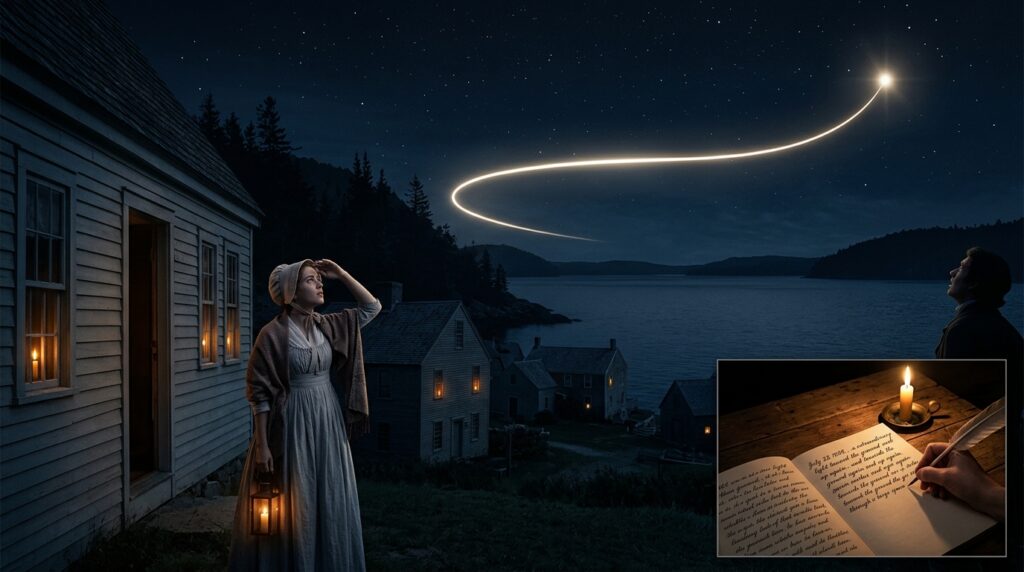
July 22, 1808 CE — Camden, Maine. Schoolteacher Cynthia Everett wrote in her diary: I thought it was a Meteor, but from its motion I soon perceived it was not. She was the kind of person who would have explained it as a natural phenomenon, if she could have. She could not. Preserved in a 170-year manuscript chain. Published Courier-Freeman March 28, 1978.
THINK ABOUTIT UFO|UAP SIGHTING REPORT
1808: UFO reported in Camden Maine Paper
On the night of July 22, 1808, at approximately ten o’clock, Cynthia Everett — a Massachusetts-born schoolteacher living in Camden, Maine — looked east and saw a very strange appearance. Her first thought was a meteor. Then it moved. Not the way meteors move — in a single ballistic arc — but in a sustained, controlled pattern: darting initially as quickly as light, then lowering toward the ground, then maintaining an equal distance while sometimes ascending and sometimes descending. It moved around the visible horizon and then returned the way it had come, and they did not view it again until it was extinguished. Cynthia Everett wrote it down that night in her diary — the same diary in which she recorded earthquakes and the appearance of comets, the diary of a woman whose son would grow up to captain a clipper ship and navigate by the stars. She was the kind of person who would have explained it as a natural phenomenon, if she could have. She could not. Dr. Judith Becker Ranlett — a historian at the State University College at Potsdam, studying the diary as the basis for scholarly research on women’s history — read the passage during transcription and recognized it immediately for what it was: a first-hand UAP account written by one of the most observationally credible witnesses in the early 19th century American record, preserved in yellowing rag paper in a firm hand for 170 years before a historian found it.
Date: July 22, 1808
Sighting Time: 22:00 — approximately ten o’clock at night
Day/Night: Night
Location: Camden, Maine, USA
Urban or Rural: Rural — small coastal town, early 19th century Maine
No. of Entity(s): None observed
Entity Type: N/A
Entity Description: N/A
Hynek Classification: NL — Nocturnal Light; point or extended luminous source observed at night; the controlled flight behavior — initial dart, lowering toward ground, maintained equal distance with ascending and descending variations, circular horizon transit, and return — eliminates meteor, atmospheric phenomenon, and any known natural light source of the period
Duration: Several minutes — from first appearance through the horizontal transit and return until extinguished
No. of Object(s): 1
Description of Object(s): A light proceeding from the east. Initially assessed as a meteor — then the motion corrected this assessment. It darted at first as quickly as light. It appeared to be in the atmosphere. It lowered toward the ground and maintained an equal distance while sometimes ascending and sometimes descending. It moved around in the visible horizon. It returned back again. They did not view it until it was extinguished.
Shape of Object(s): Not recorded — appeared as a light
Size of Object(s): Not recorded
Color of Object(s): White light
Distance to Object(s): In the atmosphere — aerial; lowering toward the ground; visible across the horizon
Height & Speed: Atmospheric — initially moved with meteor-like speed; then controlled lower-altitude motion with ascending and descending variations; returned the way it came
Number of Witnesses: Cynthia Everett — primary witness; the entry uses the word we, suggesting at least one additional witness present with her
Special Features / Characteristics: The word we in the diary entry — Cynthia did not observe alone; at least one other person was with her; initial meteor assessment immediately corrected by motion — the self-correction is the most analytically significant behavioral feature of the witness, demonstrating both astronomical knowledge and observational honesty; the controlled flight pattern — darting speed followed by lower altitude sustained flight with ascending and descending variations and a return transit — eliminates every natural aerial light source of the period; Cynthia Everett’s witness profile — schoolteacher, diarist who recorded natural phenomena including earthquakes and comets, mother of a future navigation-star-using clipper ship captain — establishes her as a trained natural observer with no motive for exaggeration; Dr. Ranlett’s scholarly assessment — a historian with no personal UFO interest who recognized the account during women’s history research; the diary was preserved from 1808 to 1978 when Dr. Ranlett transcribed it — a 170-year unbroken manuscript chain; published in the Courier-Freeman March 28, 1978 in Hal Stokes’s article “Diary Describes UFO Seen In 1808”; the Camden Maine location — a small coastal town on Penobscot Bay, 1808, with no industrial light sources, air traffic, or balloon activity
Case Status: Unexplained
Source: Diary of Cynthia Everett (1804–1815); Dr. Judith Becker Ranlett, State University College at Potsdam; Hal Stokes, “Diary Describes UFO Seen In 1808,” Courier-Freeman, March 28, 1978
Summary/Description: On the night of July 22, 1808, Cynthia Everett — a Maine schoolteacher of exceptional observational credibility — recorded in her diary a light from the east that she initially identified as a meteor before its controlled motion corrected her assessment. It darted, lowered toward the ground, maintained altitude with ascending and descending variations, transited the visible horizon, returned, and was extinguished. The diary was transcribed by historian Dr. Judith Becker Ranlett in 1978 who identified the passage as a first-hand UAP account, noting that Everett was exactly the person who would have explained it naturally if she could have. Published in the Courier-Freeman March 28, 1978.
Related Cases: 1806 CE Maine Reverend Abraham Cummings Globe Entity | 1638–1639 CE Charlton Massachusetts Muddy River Sighting | Early American UAP Archive | Maine Sightings Archive
DETAILED REPORT:
July 22, 1808. Camden, Maine. The town sits on the western shore of Penobscot Bay — a small coastal community in the young state of Maine, surrounded by the dark landscape of early 19th century New England where the night sky was unobstructed by any artificial light source beyond candles and lanterns. Cynthia Everett is twenty-three years old. She was born in Rutland, Massachusetts, in 1785, moved to Maine with her family in 1804, and has been keeping her diary since that year. She teaches school. She is — by every measure available to a 21st century researcher — an exceptional witness.
At approximately ten o’clock she sees a light coming from the east.
Her first thought — recorded in the diary with the honest precision of someone trained to identify natural phenomena — is a meteor. This initial identification is the most analytically significant element of her account. Cynthia Everett knew what meteors looked like. Her diary recorded earthquakes and comets. Her son would grow up to navigate clipper ships by the stars out of Thomaston, Maine — a family relationship to celestial observation that does not develop in households where the night sky is not carefully and regularly observed.
She knew what a meteor looked like. She saw what she thought was a meteor. And then it moved in a way that was not a meteor.
From its motion I soon perceived it was not.
This self-correction — immediate, honest, based entirely on observed behavior rather than prior belief — is the defining analytical feature of Cynthia Everett’s account. A less careful or less honest witness would have recorded a meteor and moved on. She recorded the initial identification and the motion-based correction, because the correction was what actually happened in her observation. The movement told her it was not what she first thought, and she wrote down both what she thought and what the movement showed her.
It darted at first as quickly as light — confirming the initial meteor impression, the speed that caused her to reach for that explanation. Then it appeared to be in the atmosphere — not burning through the upper atmosphere on a ballistic path but present within the lower atmosphere. Then it lowered toward the ground — descending from its initial altitude. It kept on at an equal distance, sometimes ascending and sometimes descending — a controlled altitude variation around a mean distance, a flight pattern that has no natural atmospheric light source equivalent.
It moved around in the then visible horizon — a horizontal transit across the entire visible arc of sky. Then it returned back again — it came back the way it had come, reversing its course. They did not view it until it was extinguished — the final moments were not departure over the horizon but an extinction of the light itself at a specific point.
The word they — we in the original — establishes that Cynthia was not alone. At least one other person was present with her and shared the observation. The diary entry does not name this companion, but their presence means the account has corroboration beyond Cynthia’s own testimony.
Dr. Judith Becker Ranlett — a historian at the State University College at Potsdam, New York — encountered this entry while transcribing the diary in 1978 for scholarly research on women’s history. She was not looking for UAP accounts. She was building a picture of early 19th century women’s lives from a primary source document. When she read Cynthia’s entry she recognized it immediately for what it was — not because of any personal interest in the subject, but because the entry did not do what Cynthia’s other entries did.
She was the kind of person who would have explained it as a natural phenomenon, if she could have.
Dr. Ranlett’s assessment is the most concise and analytically precise evaluation of witness credibility in the archive’s early American record. It captures in one sentence everything that makes Cynthia Everett’s account analytically significant: her observational training, her habit of natural explanation, and her failure to provide one here — not from credulity or lack of knowledge, but because no natural explanation fit what she saw.
Hal Stokes published the story in the Courier-Freeman on March 28, 1978 — bringing a 170-year-old diary entry into the public UAP record for the first time.
RESEARCHER’S NOTES:
The Camden Diary — Witness Self-Correction, the We Pronoun, and 170 Years of Manuscript Preservation
- The Self-Correction as Analytical Gold Standard: Cynthia’s immediate self-correction of her initial meteor assessment based solely on the object’s motion is the most analytically valuable feature of her account. She applied the correct natural explanation first. The object’s behavior eliminated it. She recorded both. This is the observational discipline of a woman trained in natural phenomena who understood the difference between what she expected and what she saw, and who was honest enough to record the discrepancy. No amount of subsequent analysis can replicate the analytical value of a witness who self-corrects in real time and documents it.
- The We as Corroboration Indicator: The use of we — they did not view it till it was extinguished — establishes that at least one additional person was present during the observation. The identity of this companion is not preserved, but their presence means Cynthia’s account was shared in real time by at least one other witness, providing contemporaneous corroboration that her diary entry represents a genuine shared observation rather than an individual anomalous experience.
- Dr. Ranlett’s Assessment as Third-Party Credibility Anchor: Dr. Ranlett’s recognition of the account during women’s history research — by a historian with no personal interest in UAP phenomena who explicitly stated she had no feelings one way or the other on UFOs — is the case’s most authoritative third-party credibility anchor. Her assessment of Cynthia as the kind of person who would have explained it naturally if she could is not a UFO researcher’s advocacy. It is a historian’s evaluation of a primary source document from within her professional expertise.
- 170-Year Manuscript Chain: The diary’s preservation from July 22, 1808 through the family to Dr. Ranlett’s 1978 transcription — 170 years of unbroken manuscript chain — gives this account one of the longest and most verifiable document preservation records of any early American UAP case. The rag paper was in remarkably good condition. The hand was firm. The entry was part of a continuous diary record that included earthquakes, comets, and other natural phenomena — establishing that Cynthia’s diary entries were genuine contemporaneous records rather than retrospective compositions.
Cynthia Everett wrote her account of July 22, 1808 in a firm hand on rag paper that was still in remarkably good condition when a historian found it 170 years later. She thought it was a meteor. Then it moved. She wrote down both thoughts — the right one and the corrected one — because she was a schoolteacher who observed natural phenomena and called them what they were, and this was not what she thought it was. Dr. Ranlett knew what kind of person Cynthia was from studying her diary. She was the kind of person who would have explained it naturally. She could not. The archive holds what the diary held: a night in Camden, a light from the east, a meteor that was not a meteor, a controlled flight pattern across the visible horizon and back, and the word we that means at least one other person in Camden, Maine on the night of July 22, 1808 saw the same thing and went to bed without being able to explain it either.
Diary Describes UFO Seen In 1808
by Hal Stokes
Back in 1808 in Camden, Maine, there certainly were no weather balloons or Air Force jets to be confused with flying saucers. George Washington’s soldiers had barely gotten back home to their farms. But something odd happened one summer night that year which was recorded in the diary of a Potsdam man’s great-grandmother.
Today the passage is interpreted by his wife, an historian who is studying the diary, as a first-hand account of a UFO sighting in the early 19th century.
“I thought she was describing a UFO when I first read it,” said Dr. Judith Becker Ranlett, an historian who teaches at the State University College at Potsdam. “If she had seen something normal, she would have attempted to explain it as a natural phenomenon,” according to Dr. Ranlett, who is using the diary as the basis for scholarly research on women’s history.
The diary was written by Cynthia Everett, a Massachusetts-born school teacher who taught in Maine during the early 1800s. Born in Rutland, Mass., in 1785, she moved to Maine in 1804 with her family and kept the diary between 1804 and 1815, the year she married. The diary remained in the family.
The past year, Dr. Ranlett undertook the task of transcribing the manuscript into 600 typewritten pages. It was then that she first read the passage that she believes describes a UFO sighting. The account is written in a firm hand on yellowing rag paper that is in remarkably good condition. The entry begins as a new paragraph to her recollections of the events of July 22, 1808; it is quite unrelated to the passage that proceeds it.
“About 10 o’clock I saw a very strange appearance. It was a light which proceeded from the East. At the first sight, I thought it was a Metier, but from its motion I soon perceived it was not. I[t] seem to dart at first as quickly as light; and appeared to be in the Atmosphere, but lowered toward the ground and kept on at an equal distance sometimes ascending and sometimes descending. It moved round in the then visible Horizon, (it was not very light) and then returned back again, nor did we view it till it was extinguished.”
That is the only passage in the entire diary that mentions the sighting, according to Dr. Ranlett. She finds it significant that Cynthia Everett did not explain what she witnessed as a natural phenomenon, since she was well-educated and had first-hand knowledge about the night sky. “She was the kind of person who would have explained it as a natural phenomenon, if she could have,” said Dr. Ranlett, “In fact she did, her first thought was that it was a meteor.”
Cynthia Everett was a woman who was well aware of the occurrences of nature according to Dr. Ranlett. In her diary she recorded earthquakes and the appearance of a comet. Her son became the captain of a clipper ship and navigated by the stars on a ship out of Thomaston, Maine. Dr. Ranlett is quick to point out that she herself is personally not a fan of the extraterrestrial. “I have no feelings one way or the other on UFOs,” she said.
 The sighting must have been at night, Dr. Ranlett reasoned, because Cynthia would have been teaching school at 10 a.m. and besides she always made her entries in the diary just before she went to bed. Dr. Ranlett said she determined that the sighting was in Camden through the various people that are referred to on that day.

Cynthia was 24 years old when she wrote about seeing the strange light. She was single but was living, as teachers did, with a family in the area of the school. She changed her lodgings about once a week, according to Dr. Ranlett.
The schoolteacher had a good education for the period, Dr. Ranlett said. She had attended Leicester Academy at Leicester, Mass., one of the few truly coeducational schools where women went to class with men. The diary was written until Cynthia was in her 30th year. Entries cease three days after her marriage to John Ranlett, a widower with six children. He later died, but she remarried and the diary went to her soon, who kept it in the family. Her grandson, who became a lawyer, did some work transcribing it about 1880. The manuscript was bound in a handmade cover made of cloth backed with newspaper.
The diary belongs to Dr. Ranlett’s father-in-law, who loaned it to her. She said that she is not nearly as interested in the passage about the strange light as she is about the revelations of the woman earning her own living in the early 19th century.