July 1806 CE — Maine, USA. Reverend Abraham Cummings — a Brown University Master's graduate who came specifically to disprove local apparition reports — dismissed a white globe on a hillside as a rock, then watched it go airborne, move to his position at lightning speed, transform into a luminous female figure, and grow from girl-height to adult height in response to his unspoken thought. On her head was the representation of the sun diffusing rectilinear rays to the ground. He published thirty affidavits in 1826.
THINK ABOUTIT UFO|ENTITY ENCOUNTER REPORT
1806: Maine UFO| UAP Entity Encounter
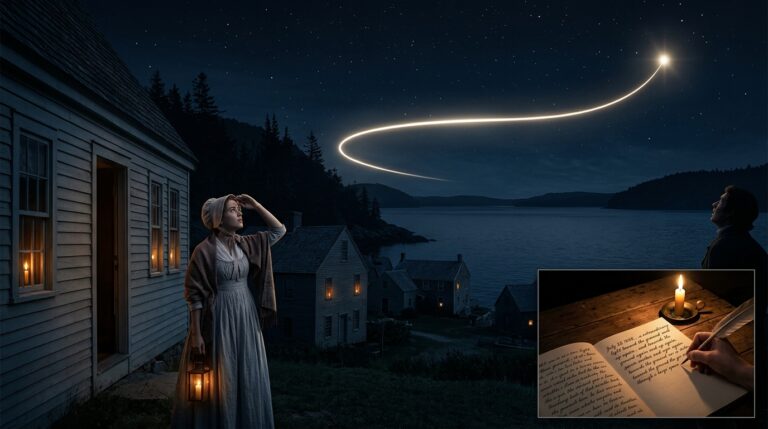
In July 1806, the Reverend Abraham Cummings — a serious scholar with a Master’s degree from Brown University who had deliberately gone to Maine to investigate and debunk the local reports of a recurring apparition — walked outside one evening after two people told him they had just seen the Spectre in the field. He was sure they had been mistaken. Looking toward an eminence twelve rods away, he saw what he supposed was one of the white rocks on the hillside. That confirmed his opinion. He paid no attention to it. Three minutes later he accidentally looked in the same direction again. The white rock was in the air. Its form was a complete globe, tinged with red, approximately two feet in diameter. Fully satisfied this was nothing ordinary, he walked toward it. While his eye was constantly upon it he had gone four or five steps when it came to him from eleven rods away as quick as lightning — and instantly assumed a personal form with a female dress, appearing no taller than a girl of seven years old. In his mind he thought: you are not tall enough for the woman who has so frequently appeared among us. Immediately she grew to the full height he associated with that woman. On her head was the representation of the sun diffusing luminous rectilinear rays in every direction to the ground. Through the rays he could see her personal form and her dress. Abraham Cummings, who had come to Maine to prove a fraud, published thirty affidavits from witnesses in Immortality Proved by the Testimony of Sense in 1826. The entity had been encountered on scores of occasions. He had seen her himself. He could not explain her.
Date: July 1806
Sighting Time: Evening
Day/Night: Evening
Location: Maine, USA — exact location not recorded in surviving accounts; within twelve rods of a dwelling house
Urban or Rural: Rural — field near a house; eminence on the landscape
No. of Entity(s): 1
Entity Type: Luminous female humanoid — appearing initially as a small white globe, transforming to a girl-sized figure, growing to adult size in response to the witness’s thought
Entity Description: Initially appeared as a complete globe approximately two feet in diameter with a tincture of red — resting on the ground and dismissed as a white rock until observed to be airborne. Moved from eleven rods distant to the witness’s position as quick as lightning. Instantly assumed a personal form with female dress, initially appearing no taller than a girl of seven years old. Grew to adult height in apparent response to the witness’s unspoken mental observation. At full height: luminous, with the representation of the sun on her head diffusing rectilinear rays to the ground in every direction. The personal form and dress visible through the rays. On scores of other occasions the entity appeared as a small luminous cloud that grew until taking the form of a specific deceased woman, then departed by diminishing back to a cloud.
Hynek Classification: CE-III — Close Encounter of the Third Kind; direct close-range observation of and apparent interaction with a non-human animate luminous being; the entity’s apparent response to the witness’s unspoken thought is the most analytically unusual feature. The page’s CE-V classification is noted but CE-III more accurately reflects the encounter structure — the entity initiated and controlled the encounter rather than both parties voluntarily engaging in bilateral communication.
Duration: Not recorded for this specific observation — other appearances lasted long enough for thirty affidavits to be gathered across scores of occasions
No. of Object(s): 1 — the globe/entity; observed initially as a two-foot globe with red tinge
Description of Object(s): A complete globe approximately two feet in diameter with a tincture of red — observed resting on the ground and then airborne at twelve rods distance. Moved to the witness at lightning speed and transformed into a humanoid entity. On other occasions appeared as a small luminous cloud that grew into human form.
Shape of Object(s): Globe — initial form; female humanoid — transformed form
Size of Object(s): Two feet in diameter as globe; girl-sized then adult-sized as entity
Color of Object(s): White with red tinge — globe form; luminous with solar-ray crown — entity form
Distance to Object(s): Initial observation at twelve rods; moved to within immediate proximity at lightning speed
Height & Speed: Ground level initially; airborne when noticed; moved to witness at lightning speed from eleven rods
Number of Witnesses: Abraham Cummings — primary witness; thirty additional witnesses who provided affidavits published in 1826; the entity appeared on scores of occasions
Special Features / Characteristics: Deliberate skeptic as primary witness — Cummings specifically went to Maine to disprove the apparition reports; initial rock misidentification — he dismissed the globe as a white rock, eliminating the possibility that suggestion or credulity produced the observation; the globe-to-humanoid transformation at lightning speed — one of the most dramatic and specifically described transformation sequences in the early American entity record; the mental command response — the entity grew from girl-height to adult height in apparent response to Cummings’s unspoken thought; this is one of the earliest documented cases of apparent telepathic entity response to witness thought in the American record; solar-ray crown — the representation of the sun diffusing rectilinear rays to the ground is one of the most specific luminous crown descriptions in the archive; rectilinear rays are straight-line rays — precise, not diffuse; Cummings published Immortality Proved by the Testimony of Sense in Bath, Maine in 1826 with thirty affidavits; C.J. Ducasse, a philosopher and parapsychology researcher, reproduced Cummings’ testimony in 1969; Cummings was a Master’s graduate of Brown University — not a rural credulous witness but an educated scholar who came to debunk
Case Status: Unexplained
Source: C.J. Ducasse, Paranormal Phenomena, Science and Life After Death (New York Parapsychology Foundation, 1969); Abraham Cummings, Immortality Proved by the Testimony of Sense (Bath, Maine, 1826)
Summary/Description: In July 1806 in Maine, Reverend Abraham Cummings — a Brown University Master’s graduate who came specifically to disprove local apparition reports — observed a small white globe airborne at twelve rods distance, watched it move to his position at lightning speed, and saw it transform into a luminous female figure that grew from girl-height to adult height in apparent response to his unspoken thought. On her head was a solar representation diffusing rectilinear rays to the ground. The entity had appeared on scores of previous occasions; Cummings published thirty affidavits in Immortality Proved by the Testimony of Sense in 1826.
Related Cases: 1806 CE Providence Rhode Island Reverend Cummings Globe Entity | 1531 CE Tepeyac Mexico Virgin Mary | 1664 CE Laus France Our Lady of Laus | American CE-III Archive
DETAILED REPORT:
July 1806. Maine. The Reverend Abraham Cummings is not a man who believes in ghosts. He has a Master’s degree from Brown University — one of the oldest and most respected educational institutions in New England. He has come to investigate and expose a fraud. The local community has been reporting repeated apparitions of a deceased woman for some time, and Cummings has concluded these reports will prove fabricated or deluded when examined by a trained skeptical intelligence.
He goes outside in the evening because two people have just told him they saw the Spectre in the field.
He is sure they were mistaken.
He looks toward an eminence twelve rods from the house — approximately sixty yards — and sees a white rock on the hillside. This confirms his opinion of their spectre. A white rock. He pays no further attention to it.
Three minutes later he looks again by accident.
The white rock is in the air.
At this moment the Rev. Abraham Cummings is confronted with a phenomenon that his skeptical framework cannot absorb. A white rock does not go into the air. Whatever he had dismissed as a white rock was not a white rock — it was a two-foot globe with a tincture of red that had been resting on the ground at twelve rods distance and was now airborne. Fully satisfied this was nothing ordinary, Cummings made the decision that defines this account as one of the most analytically significant CE-III cases in the early American record: he walked toward it.
He kept his eye constantly on the globe as he moved. He had gone four or five steps when the globe came to him — from eleven rods away, as quick as lightning. Instant. No transit time he could perceive.
It arrived at his position as a personal form — a female figure in female dress. Appearing no taller than a girl of seven years old.
Cummings looked at her. In his mind — not aloud but in his mind — he formed the observation: you are not tall enough for the woman who has so frequently appeared among us.
She grew.
Immediately. From the height of a seven-year-old child to the full adult height he associated with the repeatedly reported apparition. She grew in direct response to an unspoken thought — a thought he formed in his own mind without speaking, without gesture, without any external indicator of what he was thinking.
Then she appeared glorious.
On her head was the representation of the sun — not the sun itself but its representation, a structured symbolic form — diffusing luminous rectilinear rays in every direction to the ground. Straight lines of light radiating outward from the head to the ground around her. And through those rays, Cummings could see her personal form and her dress.
He published this in 1826. With thirty affidavits.
Abraham Cummings — the skeptic who came to Maine to prove a fraud — collected thirty witness statements from other people who had observed the entity on scores of occasions, combined them with his own first-person account of the globe transformation and the growth-in-response-to-thought sequence, and published the entire document in Bath, Maine under the title Immortality Proved by the Testimony of Sense. The title reflects his theological interpretation — he concluded the entity was evidence of the afterlife. The archive holds his account as CE-III — a luminous globe that transformed into a luminous female entity at lightning speed, responded to an unspoken thought, and bore a solar crown of rectilinear rays — regardless of the interpretive framework Cummings applied to it.
C.J. Ducasse — a philosopher at Brown University and research director of the American Society for Psychical Research — reproduced Cummings’ testimony in his 1969 work on paranormal phenomena, placing the account in the scholarly parapsychological literature 163 years after the original event.
RESEARCHER’S NOTES:
The Maine Globe Entity — Deliberate Skeptic, Mental Command Response, and the Solar Crown
- The Deliberate Skeptic as Gold Standard: Abraham Cummings’s analytical value as a witness is directly proportional to his initial skepticism. He came to Maine specifically to disprove the apparition reports. He dismissed the globe as a white rock. He looked away for three minutes. When he looked back and the rock was airborne, his response was not fear or credulity — it was the decision of a trained scholar to approach the phenomenon for more accurate examination. His transformation from certain skeptic to firsthand witness against his prior conviction is one of the strongest possible witness credibility configurations in the archive.
- The Rock-Misidentification as Analytical Evidence: Cummings’s initial dismissal of the globe as a white rock on the hillside is analytically significant for the same reason Siercy’s initial negative observation at Chimney Rock is significant — it establishes that at first observation the phenomenon was not visually distinctive enough to compel attention. Three minutes passed. Then it was airborne. The misidentification-to-confirmation sequence eliminates suggestion and credulity as explanatory factors.
- Mental Command Response as Unique Feature: The entity’s growth from girl-height to adult height in apparent response to Cummings’s unspoken thought is one of the earliest documented cases of apparent entity telepathic response in the American record. The thought was not spoken. No gesture was made. The entity responded to the content of his unspoken observation. Whether this represents genuine telepathic sensitivity in the entity, a coincidental size change at the moment of his thought, or something else, it is preserved in the account as a direct sequential relationship: he thought it, she grew.
- Rectilinear Solar Crown: The representation of the sun diffusing luminous rectilinear rays to the ground in every direction is a specific luminous crown description that appears in the archive’s female entity contact record — connecting to the 1531 Tepeyac Virgin Mary who appeared with garments shining like the sun, the 1806 Providence Rhode Island entity whose head bore a representation of the sun emitting luminous rays, and the broader tradition of luminous solar-crown female entities across the global CE-III record. The precision of rectilinear — straight lines, not diffuse glow — is a specific observational detail that argues for genuine observed optical characteristics.
Abraham Cummings came to Maine to prove a ghost story false, dismissed a globe on a hillside as a white rock, and three minutes later watched it float into the air, come to him as quick as lightning, and become a woman who grew from a child’s height to an adult’s in response to a thought he had not spoken aloud, crowned with the representation of the sun and its rectilinear rays reaching to the ground. He collected thirty affidavits and published them in Bath, Maine in 1826. C.J. Ducasse put them in a 1969 parapsychology volume. The archive holds the account now — the initial skepticism, the white rock, the three minutes, the airborne globe, the lightning transit, the female form, the unspoken thought, the growth, the solar crown, the thirty witnesses who saw her scores of times before and after. Whatever appeared in a Maine evening field in July 1806 came out of a dismissed white rock and grew to adult height for a Brown University scholar who had come specifically to prove it did not exist. He published the proof that it did.