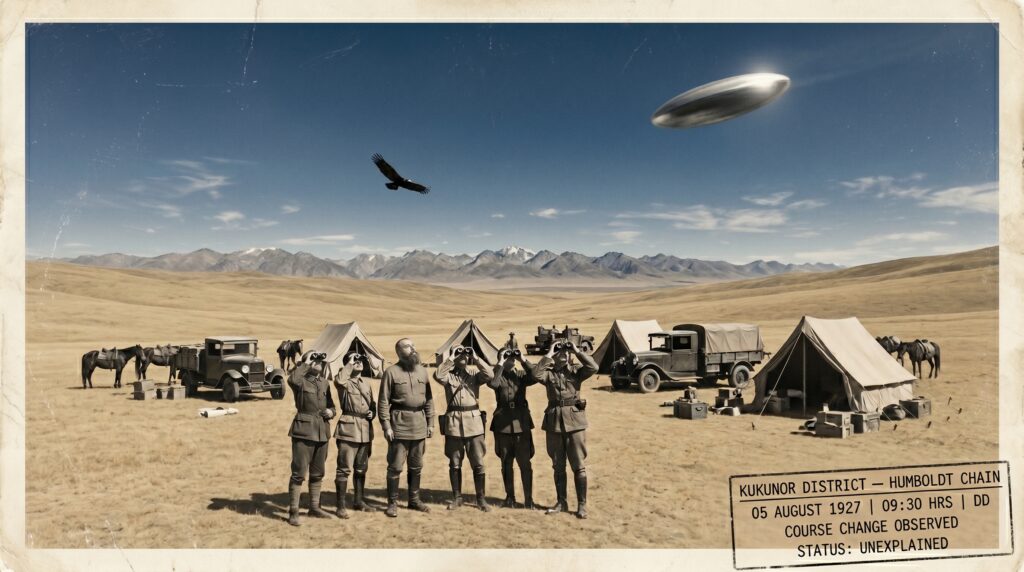
Kukunor district, near Humboldt Chain, Central Asia, August 5, 1927, 9:30 AM — Nicholas Roerich and six caravan members observed a huge shiny oval at great speed change course from south to southwest before disappearing into the intense blue sky. Field glasses confirmed the oval form and differential sun illumination. Weather balloon explanation eliminated by quantitative analysis — proposed source expedition was 400 miles away. Source: Nicholas Roerich, Altai-Himalaya, 1929. Case status: Unexplained.
THINK ABOUTIT UFO | UAP | SIGHTING REPORT
1927: Himalayan Mountain Sightings
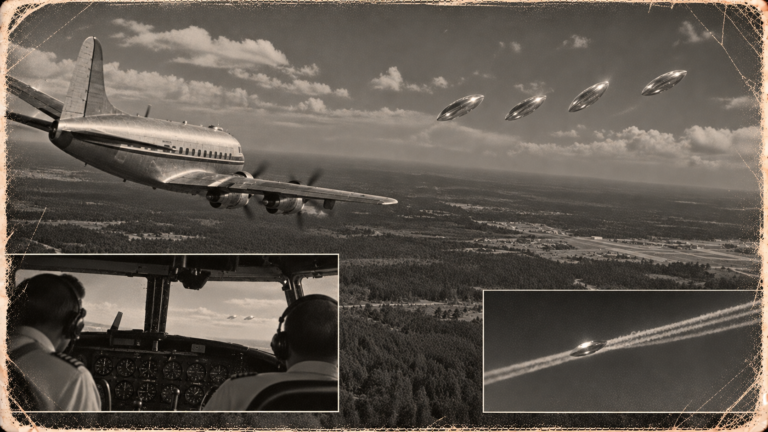
At half past nine on the morning of August 5th, 1927, Nicholas Roerich — one of the most celebrated artists and explorers of the 20th century, a man whose Central Asian expedition journals were published and widely read — was encamped in the Kukunor district near the Humboldt Chain with his caravan when one of his men noticed a large black eagle overhead. Seven of them watched it. Then another man shouted: there is something far above the bird. What all seven then observed through field glasses was a huge shiny oval moving at great speed from north to south, crossing their camp, changing direction to the southwest, and disappearing into the intense blue sky. Roerich wrote it in his diary that day. The diary was published in 1929 as Altai-Himalaya. The weather balloon explanation proposed decades later required the balloon to have been launched from a second expedition whose closest approach to Roerich was four hundred miles. The archive files this case where the quantitative evidence places it — under Unexplained.
Date: August 5, 1927
Sighting Time: 9:30 AM
Day/Night: Day
Location: Kukunor district, near the Humboldt Chain — the Koko Nor (Qinghai Lake) region of what is now Qinghai Province, China; in the broader Himalayan/Central Asian expedition territory. Note: the post is categorised under Nepal Sightings but the Kukunor district is in the Qinghai/Tibet plateau region of China, not Nepal. The archive notes this geographic correction.
Urban or Rural: Rural — remote high-altitude Central Asian plateau, caravan expedition
No. of Entity(‘s): None observed
Entity Type: None
Entity Description: None
Hynek Classification: DD (Daylight Disc) — large shiny oval object observed in full daylight at great speed by multiple independent witnesses using field glasses; course change documented; correctly classified
Duration: Long enough for seven witnesses to observe with the naked eye, retrieve field glasses, observe the oval form and shiny surface in detail, and track the object until it disappeared — estimated several minutes total observation
No. of Object(s): 1
Description of the Object(s): Something big and shiny reflecting the sun, like a huge oval moving at great speed — Roerich’s own words from his published diary. Observed first at a direction north to south, crossing the camp, then changing direction to south-southwest before disappearing into the intense blue sky. When observed through field glasses the witnesses could quite distinctly see the oval form with the shiny surface, one side of which was brilliant from the sun — indicating a three-dimensional solid reflective object with differential sun reflection on its surfaces, consistent with a large metallic disc or oval craft in daylight
Shape of Object(s): Oval
Size of Object(s): Huge — Roerich’s word; quantitative analysis by Brad Sparks places the object at approximately half a mile to one mile from the witnesses at the point of clearest observation; at that distance an object requiring field glasses to resolve its oval form clearly would need to be of significant physical size
Color of Object(s): Shiny — highly reflective surface; one side brilliant from sun reflection
Distance to Object(s): Approximately half a mile to one mile — Brad Sparks angular size analysis based on Roerich’s field glasses detail observation
Height & Speed: Great speed — Roerich’s characterization; the object crossed the entire visible sky horizon and changed course; exact altitude not recorded but above the altitude of a large eagle in flight
Number of Witnesses: 7 — Nicholas Roerich and six named caravan members; all retrieved field glasses and observed the oval form in detail
Special Features/Characteristics: Course change — the object changed direction from south to southwest while under observation by the entire group; field glasses observation confirming oval form and differential sun reflection on surfaces; primary source published in a 1929 book during Roerich’s lifetime — Altai-Himalaya; the date discrepancy (1926 in NICAP, 1927 per Roerich’s published diary) was resolved by researcher Leon Davidson who verified the correct date from the primary source; the weather balloon explanation proposed by Davidson was demolished by quantitative analysis showing the Sven Hedin Sino-Swedish expedition was approximately 400 miles from Roerich’s position — far beyond any possible visibility range for a 2.5 to 4-foot diameter weather balloon
Case Status: Unexplained — primary published source by the primary witness; seven independent witnesses with field glass confirmation; weather balloon explanation quantitatively eliminated; course change inconsistent with any balloon or natural phenomenon
Source: Nicholas Roerich, Altai-Himalaya, 1929 (primary diary source); NICAP UFO Evidence, 1964, Hall; Brad Sparks analysis (quantitative weather balloon elimination)
Summary/Description: On August 5th, 1927 at 9:30 AM, Nicholas Roerich and six caravan members in the Kukunor district near the Humboldt Chain observed a huge shiny oval object moving at great speed from north to south, crossing their camp, then changing direction to the southwest before disappearing. Field glasses confirmed the oval form and shiny reflective surface with differential sun illumination. Roerich recorded the event in his expedition diary, published in 1929 as Altai-Himalaya. The weather balloon explanation was quantitatively eliminated by Brad Sparks who demonstrated the proposed balloon source expedition was approximately 400 miles from Roerich’s position. Case status: Unexplained.
Related Cases: 1926: Bert Acosta — Six Circular Objects Near Wichita Kansas | 1916: Lt. Morgan, Royal Flying Corps, Rochford Essex | 1904: USS Supply — Three Objects in Echelon | Central Asian Sightings Archive
Detailed Report
The Shiny Oval Over Kukunor — Nicholas Roerich’s Expedition Diary, August 5, 1927
Nicholas Roerich requires no introduction to the archive. One of the most celebrated Russian artists of the early 20th century, philosopher, archaeologist, and peace activist, Roerich led a major Central Asian expedition from 1924 to 1928 that crossed through India, Sikkim, China, Mongolia, and Tibet. His expedition diaries were published and widely read. Altai-Himalaya, published in 1929, is the primary source for the August 5th, 1927 observation.
Roerich’s own words from the diary:
On August fifth — something remarkable! We were in our camp in the Kukunor district, not far from the Humboldt Chain. In the morning about half-past nine, some of our caravaneers noticed a remarkably big black eagle flying above us. Seven of us began to watch this unusual bird. At the same moment, another of our caravaneers remarked: there is something far above the bird, and he shouted his astonishment. We all saw, in the direction north to south, something big and shiny reflecting sun, like a huge oval moving at great speed. Crossing our camp this thing changed in its direction from south to southwest, and we saw how it disappeared in the intense blue sky. We even had time to take our field glasses and saw quite distinctly the oval form with the shiny surface, one side of which was brilliant from the sun.
The date as recorded by NICAP in 1964 was listed as 1926. Researcher Leon Davidson verified from the primary source — Roerich’s published 1929 diary — that the correct date is August 5th, 1927. The archive uses the corrected date.
The Weather Balloon Explanation — and Its Quantitative Elimination
Leon Davidson subsequently proposed that the sighting was caused by a weather balloon launched by the Sven Hedin Sino-Swedish expedition. Brad Sparks subjected this explanation to quantitative analysis using the published specifications of the balloons Dr. Waldemar Haude launched for meteorological data collection.
The two balloon sizes used by Haude’s program were 2.5 feet and 4 feet in diameter, with ascent rates of approximately 500 and 800 feet per minute respectively. For a 4-foot balloon to be visible to Roerich’s party at all — even with field glasses — it would need to be no more than approximately 4,000 feet away horizontally, having been launched no more than 4 to 5 minutes prior at nominal wind speeds.
At that distance — less than one mile — the Roerich party and the Hedin expedition would have been within shouting distance of each other on a flat plain with visibility extending 50 to 100 miles in every direction. They would have seen each other’s campfires at night, crossed paths on the trails, and been acutely aware of any balloon launching operation. No such proximity or contact occurred.
The two expeditions were in fact approximately 400 miles apart. The Hedin expedition was following the old Silk Road trade route through the Gobi Desert to the north, heading west toward Urumchi. Roerich was in the Kukunor district near Koko Nor. The balloon explanation required proximity that the documented geography of both expeditions categorically excludes.
Davidson provided no meteorological launch records. Haude’s balloon data was published prior to World War II bombing, and those records have not been produced to verify a launch on August 5th, 1927 anywhere near Roerich’s position.
What Roerich and his six companions observed through field glasses at 9:30 AM on August 5th, 1927 was not a 4-foot weather balloon. The quantitative evidence says so. The archive holds the case as Unexplained.
RESEARCHER’S NOTES
The Shiny Oval Over Kukunor — Nicholas Roerich 1927 and the Credentialed Explorer as Archive Witness
- Nicholas Roerich as Witness — Exceptional Institutional Credibility: The archive has held accounts from farmers, firemen, police officers, pilots, and soldiers. Nicholas Roerich occupies a different tier entirely. By August 1927 he was internationally famous — a celebrated painter, a philosopher whose work influenced both Eastern and Western thought, an archaeologist, the founder of the Banner of Peace international cultural heritage movement, and the leader of a major documented Central Asian expedition funded by significant institutional and private support. His expedition diaries were not private notebooks — they were written with the expectation of publication and were read by educated audiences across multiple countries. When Roerich wrote something remarkable in his diary and described what he saw in careful observational language, he was writing for posterity with full awareness that his words would be read and evaluated. The archive holds his account with the weight appropriate to an internationally credentialed observer writing for a public record.
- The Field Glasses Confirmation as Evidentiary Anchor: The detail that the seven witnesses had time to retrieve their field glasses and observe quite distinctly the oval form with the shiny surface, one side of which was brilliant from the sun, is the evidentiary anchor of this case. Field glasses in 1927 provided 6x to 10x magnification — sufficient to resolve shape and surface detail on an object that the naked eye could see only as a large shiny moving form. The differential sun illumination — one side brilliant, implying a three-dimensional reflective surface catching direct sunlight at a specific angle — is the observation of a solid metallic object in three-dimensional space, not a light source, not a reflection, and not a balloon with its characteristic rounded bright-all-over appearance. Seven trained expedition observers, through field glasses, confirmed an oval three-dimensional metallic form moving at great speed and changing course. That is the record.
- The Course Change — The Decisive Anomaly: The object changed its direction from south to southwest while under observation. A weather balloon changes direction when the wind changes direction. A wind direction change significant enough to alter a balloon’s course by approximately 45 degrees while the balloon is visible to observers is a meteorological event — it would be felt on the ground as a wind shift, it would affect the dust and vegetation around the observers, and it would be noted in the diary. Roerich noted no wind event. The course change is described as the object’s own directional change, not a response to atmospheric conditions. A solid metallic oval at great speed changing course by 45 degrees of its own accord is not a balloon, not a cloud, and not any known 1927 natural atmospheric phenomenon.
- The 400-Mile Gap — Quantitative Elimination of the Only Proposed Explanation: The weather balloon explanation is not merely implausible — it is quantitatively impossible. Brad Sparks’s analysis demonstrates that for a 4-foot diameter balloon to be visible to Roerich’s party using field glasses, it would need to be within approximately 4,000 feet of their position, launched within 4 to 5 minutes prior. The Hedin expedition whose balloon program Davidson invoked was 400 miles away — a distance that places it beyond any conceivable visibility range by a factor of approximately 500. The archive has encountered many proposed conventional explanations for UAP cases. Most fail on qualitative grounds. The weather balloon explanation for the Roerich sighting fails on quantitative grounds that do not require any subjective judgment about the witness’s reliability, perception, or honesty. The math says it was not a balloon. The archive accepts the math.
At 9:30 in the morning on August 5th, 1927, seven people on a high plateau in central Asia watched a huge shiny oval change course above them and disappear into an intense blue sky. One of them was Nicholas Roerich and he wrote it in his diary and his diary was published the same year as the Altai-Himalaya and the object has not been explained in the ninety-eight years since. The weather balloon was 400 miles away. The archive holds the record here — with the case status it deserves, which is Unexplained.