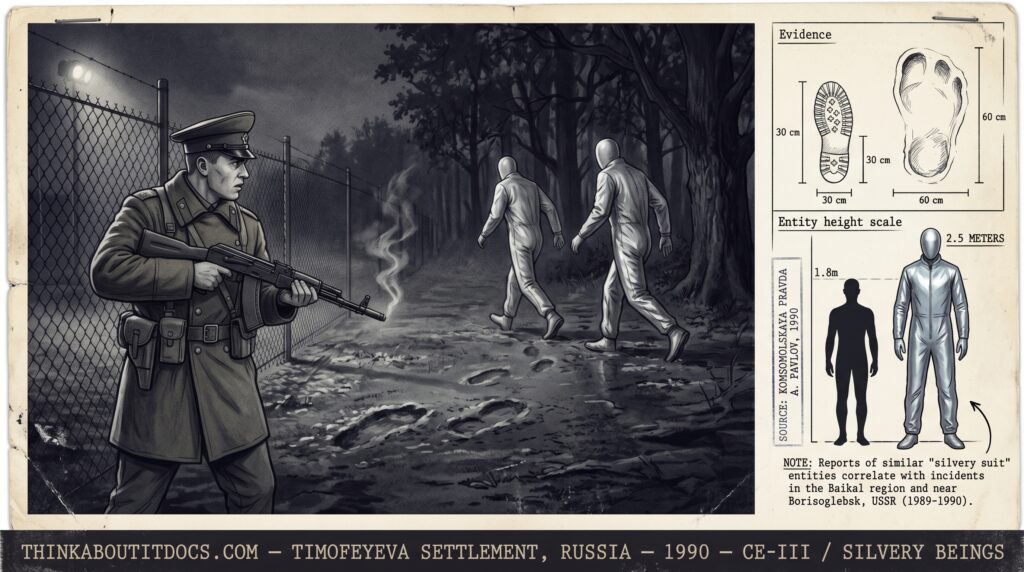
Timofeyeva Settlement, Far Eastern Military District, Russia — 1990. Soviet military sentry fires warning shot at two silvery-overall-clad beings approximately 2.5 meters tall emerging from oak grove. Entities immediately return to grove at speed. Counterintelligence officers document large shapeless footprints in wet soil. Source: Komsomolskaya Pravda, A. Pavlov, December 1 2000; Far Eastern Air Defense District military documents provided to Dr. Dvozilni.
THINK ABOUTIT ALIEN ENCOUNTER REPORT
1990: TIMOFEYEVA SETTLEMENT, RUSSIA THE SILVERY ONES — MILITARY SENTRY ENCOUNTER
A sentry fired a warning shot. That is the formal record — the moment at which this encounter becomes documentable, the point at which a Soviet military witness discharged his weapon and an alarm was raised. What had prompted the shot: two figures, approximately two and a half meters tall, in silvery overalls, walking out of an oak grove toward the military brigade’s position at the Timofeyeva settlement. After the shot, the two figures immediately ran back into the grove. They were fast. Russian counterintelligence officers arrived at the scene and found large footprints in the wet soil — shapeless, huge — in the area where the figures had been walking. The soil was wet from a recent rain. The footprints were there. The figures were not.
Date: 1990
Sighting Time: Unknown — during sentry duty at military installation
Day/Night: Unknown
Location: Timofeyeva Settlement, Far Eastern Military District, Russia
Urban or Rural: Rural — military brigade installation
No. of Entity(‘s): 2
Entity Type: Humanoid
Entity Description: Two beings approximately two and a half meters (approximately 8 feet) tall, clad in silvery overalls. Emerged from a nearby oak grove and walked toward the military position. After warning shot was fired, immediately ran back into the oak grove at speed. No additional anatomical detail recorded beyond height and clothing description.
Hynek Classification: CE-III
Duration: Brief — sentry observation, warning shot, immediate departure of entities
No. of Object(s): 0 craft directly observed
Description of the Object(s): No craft reported at scene
Shape of Object(s): N/A
Size of Object(s): N/A
Color of Object(s): N/A — entities wore silvery overalls
Distance to Object(s): Close range — sentry on duty, close enough for warning shot to be the appropriate response
Height & Speed: Entities approximately 2.5 meters tall; after warning shot departed at speed into oak grove
Number of Witnesses: At least 1 — the sentry (name not recorded); subsequently counterintelligence officers who examined the scene
Special Features/Characteristics: Silvery overalls; height approximately 2.5 meters; emerged from oak grove; departed immediately after warning shot; large shapeless footprints found in wet post-rain soil by counterintelligence officers; case included in documents provided by commander of Far Eastern Air Defense District to local UFO researchers; Dr. Dvozilni (Dalnegorsk Crash researcher) among recipients of documents
Case Status: Unexplained
Source: Komsomolskaya Pravda, article by A. Pavlov, December 1, 2000; documents provided by commander of Far Eastern Air Defense District to local UFO researchers including Dr. Dvozilni; cited by Paul Stonehill
DETAILED REPORT
The Timofeyeva settlement encounter was first brought to public attention in an article by A. Pavlov published in Komsomolskaya Pravda on December 1, 2000 — a major Russian newspaper, not a fringe publication. The article described a documented close working relationship that had developed between the local Russian military and UFO researchers in the Far Eastern military district, specifically noting that the commander of the Far Eastern Air Defense District had provided local ufologists with military documents relating to anomalous encounters. Dr. Dvozilni, known primarily for his extensive research into the 1986 Dalnegorsk crash case, was among the researchers involved.
Among the documents provided was one describing the 1990 Timofeyeva incident. A military brigade at the Timofeyeva settlement, Far Eastern Military District, was staffed with a sentry on duty when the alarm was raised. The sentry had observed two beings emerge from a nearby oak grove. They were walking toward the military position. They were approximately two and a half meters tall — roughly eight feet — and wore silvery overalls.
The sentry fired a warning shot. This is standard Soviet and Russian military procedure for unidentified individuals approaching a military installation after warnings have failed or in the absence of proper identification. The warning shot was the appropriate military response. It was also the moment that produced the encounter’s first independent corroboration: the shot created the alarm, the alarm brought others to the scene, and the subsequent investigation by counterintelligence officers produced the physical trace evidence.
After the warning shot, the two figures immediately ran back into the oak grove. The word immediately is specific in the source text — the response was instant and the departure was at speed. No return, no further observation.
Russian counterintelligence officers arrived at the scene. The soil was wet from recent rain. In the area where the two figures had been walking, they found large footprints. The source describes them as huge and shapeless — not the clean defined toe-and-arch impression of a boot or a bare human foot, but large, irregular impressions in wet soil. The size was inconsistent with any human being of normal dimensions. The officers documented what they found. That documentation became part of the file that the Far Eastern Air Defense District commander would later share with Dvozilni and his colleagues.
The silvery overalls description places this case in direct morphological alignment with the 1982 Baikal lake swimmers (tight-fitting silvery suits) and the 1922 Hérault, France CE-III (shining suits with belly lights). The height — approximately 2.5 meters — is consistent with the 3-meter beings of the lake encounters, the 3.5-meter Borisoglebsk entity of May 26, 1982, and the recurring pattern of significantly oversized humanoids in Soviet and European pre-modern encounter records. The oak grove setting — a discrete woodland feature in an otherwise open landscape, used as both a concealment point and a departure route — appears in a small number of other entity encounter cases and may be an operational feature worth noting in the comparative record.
The 1990 date places this encounter in the glasnost period following the 1989 removal of Soviet censorship restrictions on the UFO subject — which may partially explain why the Far Eastern Air Defense District commander was willing to share the documentation with civilian researchers a decade later.
RESEARCHER’S NOTES
Military Document Provenance — Source Chain Assessment: his case has an unusually clean source chain for a Soviet-era anomalous entity encounter. The primary document is a military file provided directly by the commander of the Far Eastern Air Defense District to named civilian researchers including Dr. Dvozilni. The document was referenced in Komsomolskaya Pravda — a mainstream Russian newspaper — in a December 2000 article. This is not Fate Magazine or a fringe publication. The source chain is: military document → Far Eastern Air Defense District commander → Dr. Dvozilni and local researchers → A. Pavlov / Komsomolskaya Pravda → Paul Stonehill. Three independent channels (military, newspaper, researcher) converge on the same event with the same details.
The Silvery Overalls Pattern — Morphological Thread: The silvery overalls description is one of the most consistent morphological elements in the Soviet and Central Asian humanoid encounter record. In 1982, the Lake Baikal swimmers wore tight-fitting silvery suits. In the same year, the Borisoglebsk entity wore silvery clothing with greenish hues. In 1990 at Timofeyeva, two beings wore silvery overalls. In 1915, the Sulitjelma Norway humanoids wore dark brown overalls — a different color but the same close-fitting uniform type. The consistency of this clothing description across independent Soviet and European cases spanning decades is a pattern element the archive tracks as significant. Whether it reflects a real uniform type, a culturally transmitted expectation, or something else is not resolvable from the current record.
Physical Trace Evidence — Counterintelligence Documentation: The footprints found by counterintelligence officers in wet post-rain soil are the case’s physical evidence anchor. The description — large, shapeless, inconsistent with human dimensions — was documented by trained investigators operating in their professional capacity, not by frightened civilians. The shapeless quality of the impressions is consistent with the ground trace descriptions from other oversized-entity cases including the Webster City 1919 cane-mark impressions and the 1922 Hubbell Nebraska snow tracks. Whether the shapeless quality reflects an unusual foot morphology, a suit covering the foot entirely, or the effect of very heavy weight on wet soil is not determinable.
Connection to the 1982 Baikal / Soviet Anomalous Lake Cluster: The 1990 Timofeyeva encounter occurs eight years after the 1982 Baikal frogmen incident in the same broad Soviet military operational context. The Far Eastern Military District covers the Lake Baikal region. The same district whose commander provided the Timofeyeva documents is the district where Soviet frogmen died attempting to capture lake humanoids in 1982. Whether the silvery-overalled figures at Timofeyeva and the silvery-suited swimmers in the lakes are the same phenomenon in a different environment — amphibious beings operating in both aquatic and terrestrial contexts — is one of the archive’s open analytical questions.
A sentry fired, two silvery figures ran, and counterintelligence officers documented what was left in the wet soil. The Far Eastern Air Defense District kept a file. A decade later a commander handed it to researchers. A major Russian newspaper ran the story. That is the full extent of what the archive can verify. The footprints are in a document in the Far Eastern Military District’s files. The figures that made them went back into the oak grove and did not return. The archive’s position is that this happened, that it was investigated by trained personnel, and that no conventional explanation for two eight-foot beings in silver overalls emerging from a Russian oak grove has been proposed or documented.