Vnukovo, Yaroslavl Province, Russia, 1932 — a large craft lands and buries itself in a village potato field. The crew of approximately eight greenish hoofed beings occupies the village for an extended period, removing grain, cheese, and eggs, inserting tubes onto sleeping residents, and conducting experiments on livestock. The leader communicates telepathically with locals. Soviet officials are later imprisoned for the missing food. Primary witness: Vera Alexandrovna T., age 12. Source: Kukushkin/Anfalov, Yaroslavl UFO Group. thinkaboutitdocs.com.
THINK ABOUTIT UFO | UAP SIGHTING REPORT
1932: Vnukovo, Yaroslavl Province, Russia
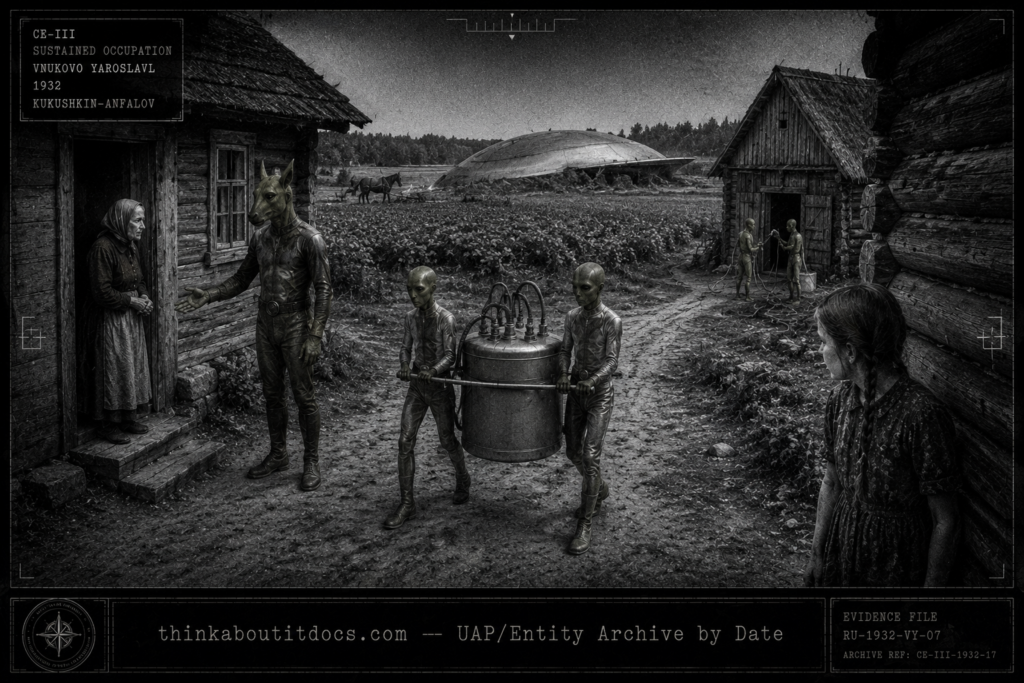
In 1932, a large flying craft appeared over the village of Vnukovo in Yaroslavl Province, Russia, flew low over the local river generating a wave that threw boats onto the bank, then landed on a potato field behind the village, dug itself partially into the ground, and began what would become a sustained occupation. What followed was not a brief sighting. It was weeks — possibly longer — of green-skinned, four-fingered beings walking the village lanes carrying shiny tanks with tubes, entering houses at night to insert those tubes onto the bodies of sleeping inhabitants, conducting experiments on sheep, stealing grain, eggs, cheese, and potatoes, and deploying strange dog-like and monkey-like animal creatures that contaminated the hay and terrified the livestock. The beings’ leader — tall, hoofed, and human-sized — sat at Vera’s aunt’s table drinking tea and communicated with locals by apparent telepathy, joking with them while his crew stripped the village’s food stores. Twelve-year-old Vera Alexandrovna T. watched from a window as the green men connected hoses inscribed with Arabic-like lettering into the village granary, and an elephant-sized creature with tanks on a yoke walked from the craft to collect the grain. When the grain and cheese disappeared, Soviet local officials were arrested and charged with sabotage.
Date: 1932
Sighting Time: Unknown — multiple incidents over an extended period
Day/Night: Daytime (initial landing and entity activity); nocturnal (tube-insertion on sleeping residents)
Location: Vnukovo, Yaroslavl Province, Russia
Urban or Rural: Rural — village
No. of Entity(‘s): 8 (approximately — 1 leader plus approximately 7 workers; plus non-human animal creatures)
Entity Type: Greenish humanoids; one tall leader; expressionless workers; non-human animal companions
Entity Description: Workers — slim, greenish-brown cement-dust-colored skin, sallow complexion, shiny silvery outfits, severe expressionless faces, four fingers without thumb, feet without toes. Leader — human-sized, same skin tone but with distinct facial expressions, hoofed feet, communicated via apparent telepathy. Animal companions — dog-like creatures with upright human-positioned heads; monkey-like creatures, quick-moving, omnipresent, avoiding direct sight of villagers.
Hynek Classification: CE-III — Close Encounter of the Third Kind (entities observed in vicinity of craft and interacting with environment and witnesses). Correction: this entry previously listed CE-V, which is incorrect. CE-V designates voluntary bilateral contact initiated by humans. This event was uninvited, sustained, and not initiated by the witnesses. Correct classification is CE-III.
Duration: Extended — multiple days to weeks (exact duration unrecorded)
No. of Object(s): 1
Description of the Object(s): Large “flying ship.” Flew low over the river generating a wave large enough to throw boats onto the bank. Landed on the potato field behind the village, then dug a hole in the ground and submerged into it almost completely. No further structural description recorded.
Shape of Object(s): “Flying ship” — no detailed shape description given
Size of Object(s): Large — sufficient to generate river wave and house multiple crew plus animal companions and large pack-animal creature
Color of Object(s): Not recorded
Distance to Object(s): Immediately adjacent to village — craft partially buried in field behind village, crew active in village streets and houses
Height & Speed: Not recorded
Number of Witnesses: Village-wide — multiple residents of Vnukovo and neighboring village of Vlasiha; primary witness Vera Alexandrovna T., age 12
Special Features/Characteristics: Craft self-buried in field; crew deployed tank-and-tube apparatus for apparent biological measurement on sleeping humans and animal experiments on sheep; grain removal via hose-suction system and large pack-animal transport; leader communicated telepathically with locals; Arabic-script-like inscriptions on equipment hoses; prolonged resource extraction operation affecting two villages; Soviet local officials subsequently imprisoned for the resulting food shortages
Case Status: Unexplained
Source: Valeriy A. Kukushkin, Yaroslavl UFO Group “Chimeras of the X Location”; Anton Anfalov. Source caveat: per this archive’s standing policy, Anton Anfalov is flagged as a problematic source on Soviet/CIS-territory cases; this entry’s retention rests primarily on Kukushkin’s named regional research group and the internal consistency of the broader multi-year West Yaroslavl cluster, not on Anfalov’s involvement alone.
Summary/Description: In 1932 a large craft landed on a potato field behind the village of Vnukovo, Yaroslavl Province, Russia and partially buried itself in the ground. Over an extended period, a crew of approximately eight greenish humanoids — one tall expressive leader and approximately seven shorter expressionless workers — occupied the village. They carried shiny tanks with tubes, inserted tubes onto sleeping residents at night apparently taking measurements, conducted experiments on sheep, and systematically removed food stores including grain, cheese, potatoes, and eggs using hose apparatus and a large draft animal. Two dog-like and monkey-like alien animal companions accompanied them. The leader communicated with locals by apparent telepathy. The operation also affected the neighboring village of Vlasiha. Soviet local officials were subsequently imprisoned on sabotage charges for the missing food stores. The beings eventually departed.
Related Cases: 1937 West Yaroslavl Province Russia — Anna iodine request (Kukushkin/Anfalov) | 1937 West Yaroslavl Province Russia — Parshin newspaper liaison (Kukushkin/Anfalov) | 1938 West Yaroslavl Province Russia — Ivan Ivanov lake contact (Kukushkin/Anfalov) | 1938 West Yaroslavl Province Russia — Alexander Gusev bonfire contact (Kukushkin/Anfalov) | 1939 West Yaroslavl Province Russia — Maria Barabashova tea visit (Kukushkin/Anfalov)
Detailed Report
The 1932 Vnukovo case is the earliest and most operationally complex entry in the West Yaroslavl contact cluster — a series of documented encounters in the same geographic area spanning 1932 to 1939, all drawn from Valeriy Kukushkin’s “Chimeras of the X Location” research compilation via Anton Anfalov. Where the later cluster entries describe brief encounters — Anna’s iodine request, Parshin’s newspaper deliveries, Ivanov’s lakeshore meetings — the Vnukovo case describes something categorically different: an extended, village-scale resource extraction operation conducted openly by a crew that made no apparent effort to conceal itself.
The craft’s arrival was not quiet. It flew low over the local river — low enough and fast enough to generate a wave that physically displaced boats onto the bank. It then landed on the potato field behind Vnukovo and, in a detail without parallel in the pre-modern record, dug a hole in the ground and submerged into it almost completely. The self-burial behavior is operationally significant: a craft buried in a field is invisible from the air, concealed from distant observers, and structurally protected. It also suggests either a specific technical function — ground interface for the tube-and-tank extraction system — or a deliberate concealment strategy inconsistent with the crew’s otherwise conspicuous village presence.
Vera Alexandrovna T. was twelve years old and her testimony is the primary source. She observed one of the smaller entities at close range and was struck by its resemblance to a boy — slim, silvery-suited, severe-faced, expressionless. The anatomical details she recorded are precise: four fingers without a thumb, feet without toes. The leader by contrast was human-sized, hoofed, and expressively communicative — he sat at her aunt’s table, drank tea, picked up bread with four fingers, and apparently told jokes. The workers may have been biological constructs, remotely directed entities, or beings whose expressionless affect was cultural or physiological rather than indicative of mechanical origin; the record does not support a determination.
The operational pattern is consistent across the reported events. The crew deployed tank-and-tube apparatus with inscribed copper-ringed hoses — the inscriptions described as resembling Arabic lettering — into village houses at night and onto sleeping residents. Sheep were found punctured in the yards. Food stores disappeared systematically: potatoes from the fields, grain from the granary, cheese and eggs from domestic stores. The grain removal operation was the most elaborate: hoses connected to the granary, an elephant-sized pack animal with tanks on a yoke lumbering from the buried craft to the storage building, the grain suctioned through the hoses into the tanks, and the animal transporting them back. Vera ran for adults; they were all at work. The animal companions — dog-like creatures with vertical head placement and monkey-like creatures that drank milk and stole eggs while hiding from direct human observation — left excrement throughout the area, contaminating the hay and making it unusable for livestock.
The societal consequence was concrete and documented through an independent channel: Soviet local officials were subsequently arrested and imprisoned on charges of sabotage for the missing food stores. This is the only case in the West Yaroslavl cluster where the encounter’s effects intersected with the Soviet administrative and legal apparatus in a verifiable way. The arrests are consistent with what would be expected in a Stalinist collective-farm system encountering unexplained food shortages in 1932 — a year of catastrophic famine across the Soviet Union. That local officials faced criminal charges for food that had been systematically removed by an unknown external agency captures with grim precision the bureaucratic logic of the era.
RESEARCHER’S NOTES
The Village at Vnukovo — 1932 and the Cluster Origin
- Source Chain Assessment: The entire West Yaroslavl series — of which this is the earliest entry — derives from Valeriy Kukushkin’s “Chimeras of the X Location” research compilation, transmitted to the Western record via Ukrainian researcher Anton Anfalov. This is a secondary research chain, not primary contemporaneous documentation — Vera’s testimony was collected decades after the 1932 events. The internal consistency of the cluster across seven years and six separate witnesses, all drawing on the same local area and the same basic being-type (hoofed, green-tinged, hooded, telepathic), strengthens the assessment that Kukushkin was working from a coherent body of field testimony rather than constructing a narrative.
- Classification Correction — CE-V vs CE-III: The previous page classification of CE-V (voluntary bilateral contact) has been corrected. CE-V designates encounters initiated by human intent toward contact — a category this archive already rejects for pre-modern cases. The Vnukovo case involves uninvited entry into a village, nocturnal intrusion into homes, physical experiments on sleeping residents, and forced resource extraction. The correct classification is CE-III.
- The 1932 Context — Soviet Famine and the Invisibility of the Event: The Vnukovo encounter occurred during the opening year of the Soviet famine of 1932–1933. In this context, the arrest of local officials for missing food stores is not merely a bureaucratic footnote — it is a tragedy within the encounter’s aftermath. Officials who had no means to explain the food loss were imprisoned for it. The political system made it impossible to report the actual cause.
- Comparative Pattern — Resource Extraction Operations: The Vnukovo case is structurally unique in the pre-modern record for its explicit depiction of a sustained biological and material resource extraction operation conducted at village scale. The nocturnal tube-insertion on sleeping residents has structural parallels with medical examination sequences in post-1947 abduction literature, but the context here is different — it is systematic and repeated across an entire population rather than focused on individual witnesses.
The record of the 1932 Vnukovo encounter does not resolve. The beings came, they worked, they took what they needed, and they left. The village’s food stores were gone, the livestock was disturbed, the hay was contaminated, and the local Soviet officials who could not explain the losses were imprisoned for them. Twelve-year-old Vera watched it all and remembered it — the leader drinking tea at her aunt’s table, the hoses with their copper rings and Arabic letters, the enormous animal with tanks on its back walking from the buried ship to the granary. The source is Kukushkin and Anfalov, the chain is secondary, and the case is Unexplained. What it describes — if faithfully recorded — is the most sustained and operationally elaborate pre-modern contact event in the compiled literature.