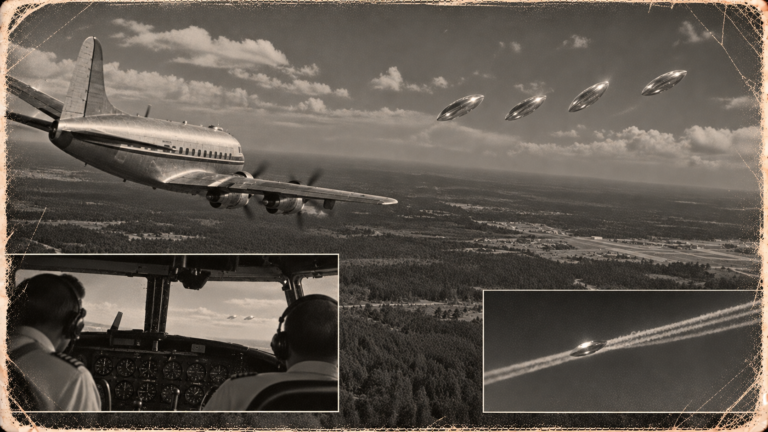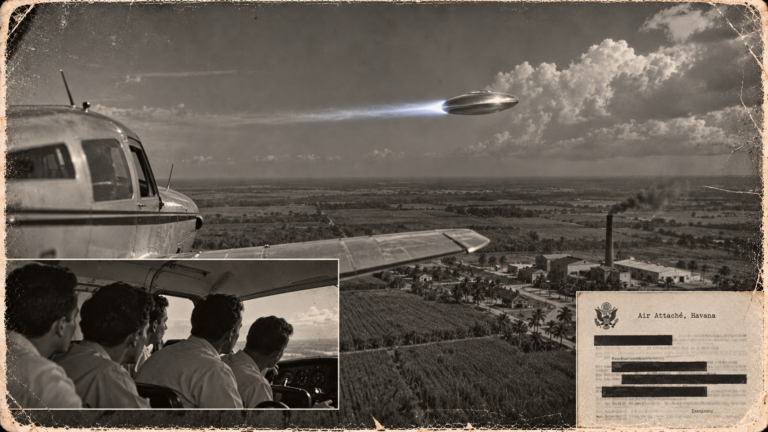
c.1790 CE — Carlisle, Schoharie County, New York. A German settler watched a 300-yard serpentine luminous object at 65 feet altitude follow the Schoharie Valley terrain for a mile and a quarter at horse-race speed, warming through his house and leaving a burning tar and sulphur odor lasting all the next day. He swore to it publicly in 1823 stating mine own eyes and sound mind and body bear witness of the truth.
THINK ABOUTIT UFO|UAP SIGHTING REPORT
1790: Carlisle, Schoharie County, New York UFO Sighting
About 1790, on a clear summer evening in Carlisle, Schoharie County, New York, a German settler was sitting on his porch playing the fiddle at around nine o’clock at night when a shine of light appeared in the northern sky. It grew. It intensified. It became brighter than the noonday sun — bright enough, he would later swear, that he could have picked up a pin in every corner of his porch. Then came a great roaring from the north. He stood up and looked out. Coming toward him at about 250 yards to the west and sixty to seventy feet above the cleared ground was something he called, in his sworn statement, a fiery meteor — or as the Germans call it a mine droke, a dragon. He watched it for a mile and a quarter. It was approximately 300 yards long. Its shape was serpentine, except for its head which resembled the root of a tree plucked up by force. It had no neck. Its body was as thick as a bullock and tapered off like a serpent at the tail. It sparkling like welding hot iron. It moved at the speed of a horse in a horse race. It followed the terrain — descending into a hollow, rising suddenly over tall trees so as not to touch them, ascending as the ground rose at the foot of Owelus Sowless hill — and when it crested the hill he could no longer see it. The immense heat warmed through his whole house. The stench of burning tar and sulphur was smelled all the next day. He swore out this account on August 23, 1823 in the town of Carlisle. It is preserved in the records of the Historical and Philosophical Society of the State of New York. The man who watched it for a mile and a quarter from his porch placed but small confidence in ghost stories and apparitions and unconfirmed traditions. For this, he wrote, mine own eyes and sound mind and body bear witness of the truth.
Date: c. 1790 — approximately; sworn statement made August 23, 1823
Sighting Time: Around 21:00 — approximately 9 o’clock in the evening
Day/Night: Night — clear summer evening
Location: Carlisle, Schoharie County, New York, USA
Urban or Rural: Rural — German colonial settlement, early upstate New York
No. of Entity(s): None observed
Entity Type: N/A
Entity Description: N/A
Hynek Classification: NL — Nocturnal Light; extended luminous source observed at night at low altitude with defined morphology, controlled terrain-following flight behavior, physical environmental effects, and specific olfactory residue; the scale, the terrain-following navigation, and the physical effects elevate this well beyond conventional NL
Duration: Sufficient for a one-mile-and-a-quarter sustained observation — several minutes
No. of Object(s): 1
Description of Object(s): Approximately 300 yards long. Serpentine in shape. Head resembling the root of a tree plucked up by force. No neck. Body as thick as a bullock, tapering like a serpent at the tail. Sparkling like welding hot iron. Brilliant white luminosity — brighter than the noonday sun at its peak. Roaring sound. Moving at the speed of a horse in a horse race. Approximately 60–70 feet above the cleared ground. Followed terrain contours — descending into the hollow, rising suddenly over tall trees, ascending with the ground rise at Owelus Sowless hill.
Shape of Object(s): Serpentine — approximately 300 yards long; head like an uprooted tree root; body thick as a bullock, tapering to a serpent tail
Size of Object(s): 300 yards long — approximately 900 feet; this is a massive object by any classification standard
Color of Object(s): Bright luminous — similar to welding hot iron; brighter than the noonday sun
Distance to Object(s): Approximately 250 yards to the west; 60–70 feet above the cleared ground
Height & Speed: 60–70 feet above the cleared ground; speed of a galloping or racing horse — approximately 30–40 mph; terrain-following at low altitude
Number of Witnesses: 1 — the German settler; name deleted from the published record; sworn statement made publicly
Special Features / Characteristics: The scale — 300 yards long at 65 feet altitude is extraordinary; terrain-following navigation — the object followed the landscape contour descending into the hollow and rising over the trees and ascending with the hill rather than maintaining a fixed altitude, arguing for controlled intelligent navigation rather than ballistic flight; brighter-than-noon-sun luminosity — sufficient to illuminate a porch to pin-picking visibility; specific acoustic signature — great roaring from the north preceding visual observation; physical heat effect — the immense heat warmed through the entire house; specific olfactory residue — burning tar and sulphur smelled all the following day; the German settler’s explicit distinction between unconfirmed traditions and this sworn personal account — he specifically stated he places small confidence in ghost stories and apparitions for want of confirmation, then applied that standard to his own account; sworn public statement August 23, 1823 — 33 years after the event, indicating sustained memory and conviction; preserved in Historical and Philosophical Society of the State of New York records; published in John M. Brown’s Brief Sketch of the First Settlement of the County of Schoharie by the Germans (Schoharie: L. Cuthbert, 1823)
Case Status: Unexplained — conventional meteor explanation proposed in the text but not supported by terrain-following behavior, sustained low altitude, or 300-yard length
Source: John M. Brown, Brief Sketch of the First Settlement of the County of Schoharie (NY) by the Germans (Schoharie: L. Cuthbert, 1823); Historical and Philosophical Society of the State of New York
Summary/Description: Around 1790 in Carlisle, Schoharie County, New York, a German settler observed from his porch a serpentine luminous object approximately 300 yards long at 60–70 feet altitude moving at racing-horse speed from north to west while terrain-following for a mile and a quarter. It was brighter than the noonday sun, roared, warmed through his house with intense heat, and left a burning tar and sulphur odor lasting all the next day. Sworn statement made August 23, 1823 and published in the Historical and Philosophical Society of the State of New York records.
Related Cases: 1808 CE Camden Maine Cynthia Everett Diary UFO | 1638–1639 CE Charlton Massachusetts Muddy River Sighting | Early American UAP Archive
DETAILED REPORT:
Approximately 1790. Carlisle is in Schoharie County in the Schoharie Valley of upstate New York — a farming community established by German immigrants who received land grants from the British colonial government in the early 18th century and remained after American independence. The German settlers of Schoharie County are among the earliest documented colonial communities in New York State. This man is a member of the first German settlement in the area — a pioneer farmer with three decades of life in this landscape before he sits down at his porch on a clear summer evening to play his fiddle.
Around nine o’clock, a shine of light appears in the northern sky.
He watches it grow. It intensifies beyond what he has any natural reference for — beyond the midday sun in its brightness, reaching a luminosity that illuminates his porch with enough clarity to pick up a pin in every corner. Then the roar arrives from the north — preceding the visual main event, giving the account a specific acoustic timeline. He stands up and looks north.
It is coming from the north and passing to the west at 250 yards distance. The altitude is 60 to 70 feet above the cleared ground — not the upper atmosphere, not hundreds of feet up, but sixty to seventy feet above the surface of the field. At that altitude and that distance, a 300-yard-long object would present an extraordinary visual experience in the summer night of 1790 upstate New York.
He watches it for a mile and a quarter.
This is the most analytically significant observational detail in the Schoharie case — the sustained observation distance. A meteor at low altitude would transit a mile and a quarter in seconds. This object moved at the speed of a common horse in a horse race — approximately 30 to 40 miles per hour. A mile and a quarter at that speed takes approximately two minutes. He watched it for two minutes. Not a flash, not a streak, not the brief brilliance of a conventional meteor — a sustained low-altitude flight at horse-race speed across a mile and a quarter of Schoharie County landscape.
And it followed the terrain.
This is the detail that conclusively eliminates the conventional meteor explanation. A meteor follows a ballistic trajectory — it does not adjust its altitude based on the ground features below it. The Schoharie object descended into the hollow as the ground descended. On the other side of the hollow it met the rising of the hill covered with woods and tall trees — and there it took a sudden rise, going just over the tall trees so as not to touch them. Then over the flat ground. Then at the foot of Owelus Sowless hill it elevated, ascending as the ground rose, and went over the hill out of sight.
This is terrain-following navigation. An object 300 yards long, 65 feet above the ground, adjusting its altitude to match the contours of the landscape — descending with valleys, rising suddenly over tree lines, ascending with hillsides. No meteorite does this. No natural atmospheric phenomenon does this. Terrain-following at 65 feet altitude at horse-race speed for a mile and a quarter is the behavioral profile of a controlled vehicle with environmental awareness.
The physical effects are substantial and independently verifiable. The immense heat warmed through his whole house — the thermal signature of a 300-yard luminous object at 65 feet altitude extending sufficiently to penetrate the walls of a colonial farmhouse. The stench of burning tar and sulphur lingered all the following day — an olfactory residue specific enough to be described with precise comparative vocabulary and persistent enough to be present the morning after the event.
The witness calls it a meteor in his sworn statement. He uses the German word for it — mine droke — which also translates as dragon, the 18th century German folk vocabulary for an unexplained aerial fire phenomenon. Then he describes its behavior. Then he swears to it publicly. He was 33 years beyond the event when he made his sworn statement — suggesting the observation had not faded in his memory or been explained by subsequent experience.
His explicit preamble is one of the most self-aware credibility statements in the early American UAP record: traditions, superstitions and fabulous stories are often told of meteors, apparitions and ghosts, wherein I place but small confidence for want of confirmation, but for the above, mine own eyes and sound mind and body bear witness of the truth I have here related.
He placed himself in the category of skeptic who requires confirmation. Then he provided his own confirmation: his own eyes, his own sound mind, his own present body. And he signed it.
RESEARCHER’S NOTES:
The Schoharie Serpent — Terrain Following, Scale, and the Skeptic Who Swore
- Terrain-Following as Classification Evidence: The object’s documented response to landscape features — descending with the hollow, rising suddenly over the tree line, ascending with Owelus Sowless hill — is the single feature that most definitively eliminates meteor and natural atmospheric phenomenon as explanations. Terrain-following requires environmental awareness and the capacity for real-time altitude adjustment. No known natural aerial phenomenon of the late 18th century — or any century — does this at low altitude for a mile and a quarter.
- Scale as Physical Evidence: A 300-yard-long object at 65 feet altitude at 250 yards distance presents an angular size in the sky that would be overwhelming — spanning a significant arc of the witness’s visual field. The scale of the Schoharie object is the most physically extraordinary feature of the account. Nothing in the 1790 natural or technological world produces a luminous serpentine object 900 feet long at 65 feet altitude.
- Physical Effects as Independent Evidence: The heat warming through the house and the sulphur/tar odor lasting all the following day are physical effects that would have been verifiable by other family members and neighbors. The olfactory residue in particular — a specific persistent smell lasting into the next day — is not a perceptual artifact of an anomalous visual experience. It is a physical atmospheric chemical signature that other people in the area would have noticed.
- The Explicit Skeptic Framework: The witness’s preamble — his explicit statement that he does not place confidence in ghost stories and apparitions for want of confirmation — is the early American equivalent of the deliberate skeptic witness configuration that makes the Cummings Maine account and the Siercy Chimney Rock account analytically valuable. He applied his skeptical standard to his own account and swore to it publicly in 1823. The Historical and Philosophical Society of the State of New York found it worth preserving.
A German settler in Carlisle, Schoharie County was playing fiddle on his porch around 1790 when the northern sky became brighter than noon and something 300 yards long at 65 feet altitude roared past him at horse-race speed following every contour of the valley — down into the hollow, suddenly up over the trees, ascending with Owelus Sowless hill — for a mile and a quarter before going over the hill and out of sight. It warmed through his house. It left burning tar and sulphur in the air all the next day. He didn’t believe in ghost stories. He swore to this one publicly 33 years later. The Historical and Philosophical Society of the State of New York preserved his statement. John Brown published it. The archive holds it now — mine own eyes and sound mind and body bear witness of the truth. A 300-yard serpentine object following the landscape of upstate New York at 65 feet altitude in 1790 has not been explained in 235 years. The stench was gone by morning. The account has outlasted everything.
Excerpt from ” BRIEF SKETCH OF THE FIRST SETTLEMENT OF THE COUNTY OF SCHOHARIE (NY) BY THE GERMANS“
Being an Answer to a Circular Letter, Addressed to the Author, by “The Historical and Philosophical Society of the State of New York”
By JOHN M. BROWN SCHOHARIE PRINTED FOR THE AUTHOR BY L. CUTHBERT 1823
The meteor About the year 1790, on a clear summer evening, I was sitting on the stoop playing the fiddle. About 9 o’clock in the evening a shine of light appeared and increased until it overshone even the light of the meridian sun in some clear day, and enlightened my stoop in such a manner, that I might have picked up a pin in every corner. Then I heard a great roaring coming direct from the North, I started up and looked out from the stoop, and behold! I saw a fiery meteor, or as the Germans call it a “mine droke,” a dragon coming on and passing by at the distance of about 250 yards West of me, a distance of about 60 or 70 feet above the cleared ground.
It kept along down through the hollow, on the other side of the hollow it met with the rising of the hill covered with woods and tall trees, there it took a sudden rise and went just over the tall trees so as not to touch them, and on over a kind of flat or level ground, until it met with the foot of the noted hill, by the Indians called “Owelus Sowless,” then it ascended higher, ascending as the ground rose, and went over the hill where I could not watch it farther. I had had a view of it about a mile and a quarter. It moved about as fast as a common horse in a horse race.
The meteor as I shall now call it, was about 300 yards long in a serpentine shape, excepting the head which resembled the root of a tree plucked up by force. It had no appearance of a neck, the body was thick as a bullock, tapering off like a serpent at the end of the tail. The appearance was similar to welding hot iron and sparkling like it. The immense heat warmed through my whole house, and left a stench like burning tar and sulphur, which was smelled all the next day. Traditions, superstitions and fabulous stories are often told of meteors, apparitions and ghosts, wherein I place but small confidence for want of confirmation, but for the above, mine own eyes, and sound mind and body bear witness of the truth I have here related. As witness my hand. Carlisle, August 23, 1823. ((name deleted))