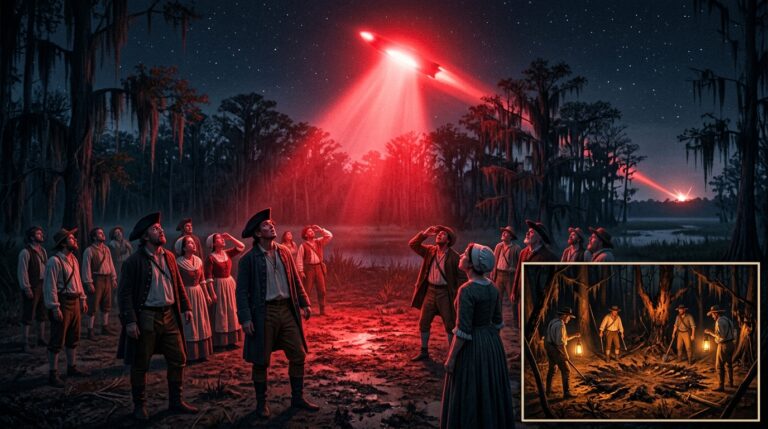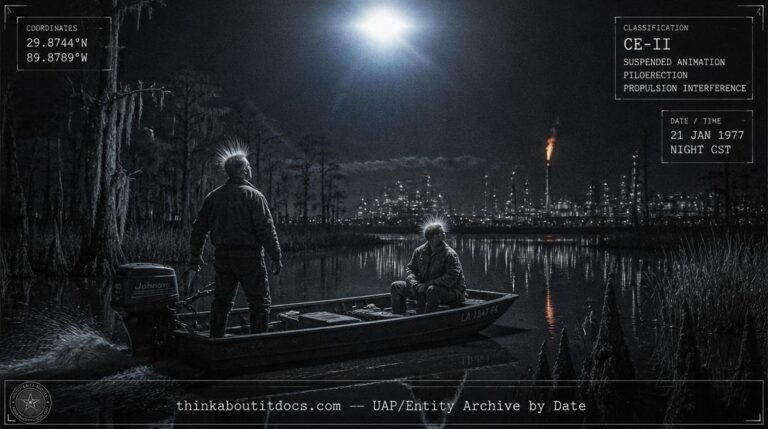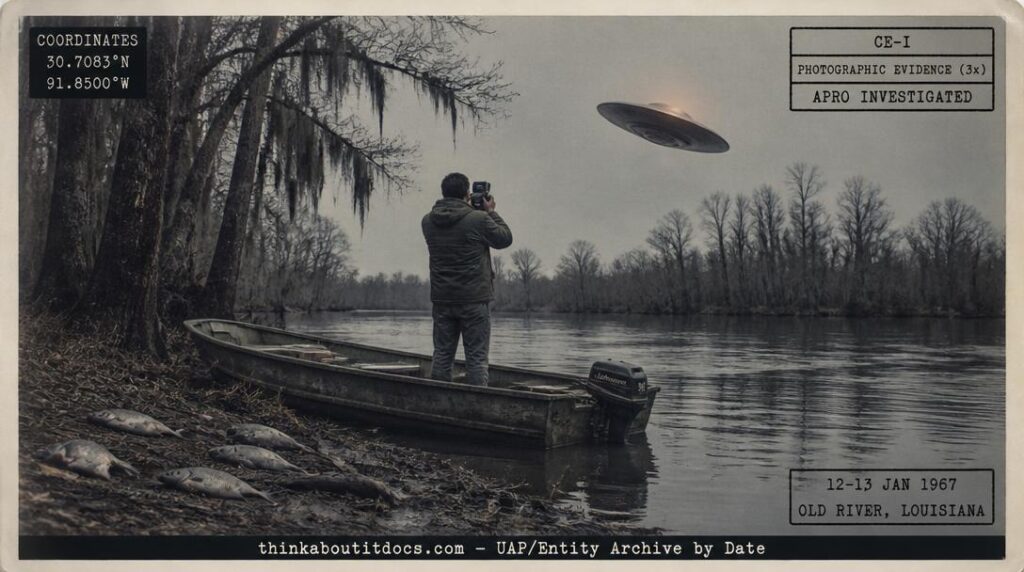
A dossier-style reconstruction of the January 1967 Old River encounters north of Baton Rouge, Louisiana, where a fisherman captured three Polaroid photographs of a disc-shaped UFO across two days of repeated close-range sightings.
THINK ABOUTIT UFO|UAP SIGHTING REPORT
1967: Baton Rouge Louisiana Encounters
Over two days in January 1967, a lone fisherman on the banks of Old River north of Baton Rouge, Louisiana, had three separate encounters with a disc-shaped object that appeared to be conducting repeated low-altitude passes over the same stretch of waterway — and managed to capture three Polaroid photographs of the craft. The witness, who requested anonymity, described the object’s sound as resembling a massive vacuum cleaner at full power. On the second night, an eerie nocturnal event added a deeper layer of strangeness: a deafening vacuum-like noise drew the witness by motorboat into the pitch-black river, followed the next morning by an unusually large die-off of fish along the bank. The case was investigated by APRO and reported in the APRO Bulletin, with two of the photographs published alongside the witness’s detailed account.
Date: January 12–13, 1967
Sighting Time: First encounter approximately 4:00 p.m. (January 12); second encounter approximately 9:00 p.m. (January 12); third encounter approximately 1:00 a.m. (January 13, during target shooting near the camp)
Day/Night: Both (daylight and nighttime encounters)
Location: North of Baton Rouge, Louisiana (west side of Old River)
Urban or Rural: Rural (river and bayou environment)
No. of Entity(‘s): None observed
Entity Type: Not Applicable
Entity Description: Not Applicable
Hynek Classification: CE-I (Close Encounter I) Observation of an object in close proximity to the witness (i.e. within 500 feet)
Duration: First encounter: approximately 5 seconds (object completed a turn and departed at high speed). Second encounter (auditory only): extended period, ceased when witness returned to camp. Third encounter: brief — object completed a turn and rose vertically into overcast.
No. of Object(s): 1 (same or similar object observed on three occasions)
Description of the Object(s): A disc-shaped craft captured in Polaroid photographs. Emitted a sound compared to a massive vacuum cleaner at full power.
Shape of Object(s): Disc
Size of Object(s): Not precisely estimated; described as large
Color of Object(s): Not described in detail (photographic evidence available)
Distance to Object(s): Close range — the object was described as “almost on top of” the witness during the first encounter
Height & Speed: Low altitude during approaches; departed at high speed after turning. Third encounter: rose vertically “like an elevator” into the overcast.
Number of Witnesses: 1
Special Features/Characteristics: The witness captured three Polaroid photographs across two encounters — an unusually high photographic yield for a 1967 case. The object displayed a consistent behavioral pattern: approaching in a near-straight line toward the witness, executing a slow turn when close, then departing at high speed. The vacuum-cleaner sound was loud enough to be audible over a running motorboat engine, and an anomalous mass fish die-off was discovered the following morning along the riverbank. The object’s third encounter departure was vertical — rising straight up into cloud cover “like an elevator.” A large congregation of crows behaving abnormally (“chattering like crazy”) was observed immediately before the third sighting.
Case Status: Unexplained
Source: APRO (Aerial Phenomena Research Organization); APRO Bulletin, photographs published
Summary/Description: On January 12, 1967, a witness sitting in a boat on the west side of Old River north of Baton Rouge observed a disc-shaped object approaching in a near-straight line. He photographed it with a Polaroid camera as it executed a slow rightward turn, capturing it at approximately a 45-degree angle. It departed at high speed. That evening, while checking trout lines two miles south, he heard a powerful vacuum-cleaner sound and pursued it by motorboat in pitch darkness without visual contact. The following morning, he discovered an unusually large number of dead fish along the bank. During target shooting near camp around 1:00 a.m. on January 13, he heard a mass of crows behaving erratically across the river, looked up, and saw the same or similar object in the sky above the opposite bank. He photographed it twice — the second shot capturing it as it rose vertically into the overcast. Three photographs total were obtained and published by APRO.
Related Cases: 1977: Louisiana UFO Flap — Yscloskey | 2003: Gulf of Mexico — Metallic Object Photographed from Plane
Detailed Report
The Baton Rouge Old River encounters of January 12–13, 1967, represent a rare multi-event, photographic CE-I case investigated by APRO and published with accompanying imagery in the APRO Bulletin. The case involves three separate sightings of the same or similar object across a roughly 21-hour window, all centered on a stretch of Old River north of Baton Rouge.
The witness, a Louisiana resident who carried a Polaroid camera habitually, was sitting in his boat on the west side of Old River at approximately 4:00 p.m. on January 12, 1967. The sky was overcast and the temperature was cool. He glanced eastward and observed an object approaching in a near-straight line. He grabbed the camera and raised it as the object came close — “almost on top of” him — at which point it began a slow rightward turn. He captured the photograph at approximately a 45-degree angle during the turn. Within five seconds of completing the turn, the object accelerated to high speed and vanished into the east. There was no time for a second shot.
The acoustic signature was distinctive: the witness compared the sound to a huge vacuum cleaner running at full power but heard from a distance. This is a less common but documented acoustic description in the CE-I literature, distinct from the more typical humming, buzzing, or silence reported in most cases.
At approximately 9:00 p.m. that same evening, while checking trout lines two miles south of the north end of Old River, the witness heard the vacuum sound again — this time much stronger and closer. The night was pitch black with no visual reference. He started his motorboat and headed toward the sound, but the boat motor masked the noise. When he shut down the engine, the vacuum sound was louder than before and seemed to be nearby. Unable to see anything, he turned around and headed back to camp. When he arrived and cut the motor, the sound was gone.
The following morning — January 13 — the witness discovered an unusually large number of dead fish along the riverbank. While he acknowledged that dead fish were not uncommon in the area, the quantity was abnormal, and his attention was heightened by the previous day’s events. The fish die-off may have been coincidental, but in the context of a close encounter with an object emitting an intense, unidentified energy source (sufficient to produce the vacuum-like sound), the possibility of an environmental effect cannot be dismissed.
At approximately 1:00 a.m. on January 13, the witness was doing some target shooting with a rifle near the camp, carrying his camera. Walking along the bank with the river in sight, he heard what sounded like an enormous congregation of crows in a clump of trees across the river, behaving in an agitated, chaotic manner. He looked toward the sound and saw the same or a similar object in the sky above the opposite bank, again approaching in what appeared to be a straight line toward him. This time the object was farther away. He raised the camera, waited for it to get closer, and snapped a photograph as it began its turn. He quickly pulled the exposed film and snapped a second shot. By the time the second photograph was taken, the object had completed its turn and risen vertically — “like an elevator” — into the overcast, disappearing from view.
Three photographs total were obtained: one from the January 12 afternoon encounter and two from the January 13 early morning encounter. Two photographs and enlargements were published in the APRO Bulletin.
Researcher’s Notes
The Old River Encounters — Baton Rouge 1967 and the Problem of Photographic Yield
- Classification — CE-I with Possible CE-II Elements: The visual encounters qualify as CE-I based on the object’s close proximity to the witness. However, the mass fish die-off discovered the following morning introduces the possibility of a CE-II component — a physical environmental effect potentially linked to the object’s presence or energy output. The Hynek system requires a demonstrated causal connection for CE-II classification, and the fish die-off alone, without independent confirmation of timing or cause, is insufficient to establish that link definitively. The classification is held at CE-I with a notation that CE-II environmental effects are suspected but not confirmed.
- Source Chain Assessment — APRO Investigation with Anonymous Witness: The case was investigated by APRO and published in the APRO Bulletin (Vol. unknown, circa early 1967), a peer-reviewed civilian research publication with editorial standards. The photographs were examined and reproduced. However, the witness’s preference for anonymity limits the ability to independently verify his background, credibility, and the precise location of the encounters. The detailed narrative, consistent behavioral description, and three-photograph yield argue against fabrication, but the anonymous sourcing necessarily places the case below named-witness events in the evidentiary hierarchy.
- Behavioral Pattern — Repeated Approach-Turn-Depart Cycle: The object displayed a consistent behavioral pattern across both visual encounters: approach in a straight line toward the witness, slow rightward turn at close range, and high-speed departure. This consistency across two sightings separated by approximately 21 hours suggests either a habitual flight path associated with a specific operational objective, or a deliberate approach-and-observation behavior directed at the witness or his location on Old River. The vertical departure in the third encounter — ascending “like an elevator” into the overcast — adds a different departure mode to the behavioral repertoire, suggesting operational flexibility.
- Environmental Anomalies — Animal Behavior and Fish Die-Off: Two environmental anomalies bracketed the third sighting: the mass die-off of fish discovered on the morning of January 13, and the agitated, chaotic behavior of a large congregation of crows immediately preceding the third visual encounter. Both phenomena have been reported in other CE-I and CE-II cases. Anomalous animal behavior — particularly in birds — is one of the most frequently cited environmental indicators of UAP proximity in the research literature. The fish die-off, if causally linked to the object’s nocturnal presence on the river, would suggest an energy emission capable of affecting aquatic organisms — potentially acoustic, electromagnetic, or thermal in nature.
The Old River encounters of January 1967 are a case that gives the researcher more than most: three photographs, three sightings across two days, a consistent behavioral pattern, an unusual acoustic signature, and environmental anomalies that may point to physical effects on the local ecosystem. The anonymous sourcing is a limitation, but the APRO investigation and published photographs provide an institutional foundation that compensates in part for the absent witness name. The object came back. It followed the same pattern. And the witness, camera in hand, was ready. The photographs sit in the APRO archive. The dead fish along Old River are long gone. The record is what remains.