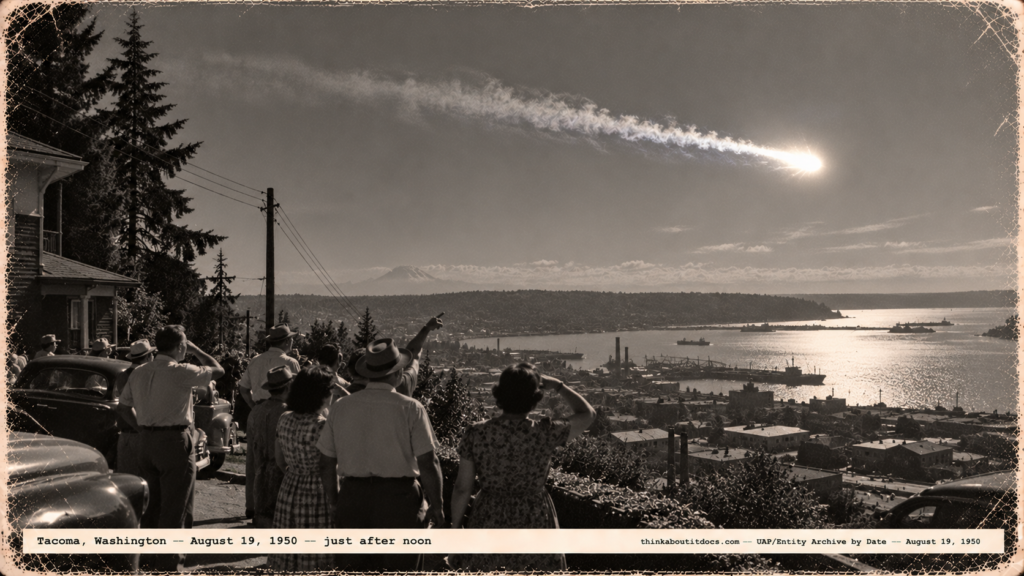
On August 19, 1950, a brilliant fireball streaked across the Pacific Northwest in broad daylight.
THINK ABOUTIT UFO|UAP SIGHTINGS REPORT
1950: Pacific Northwest — The Daylight Fireball and the 1958 Congressional Inquiry
Shortly after noon on Saturday, August 19, 1950, a brilliant “ball of fire,” visible even in bright noon sunshine, streaked across Pacific Northwest skies from Salem to Seattle and from Ellensburg to the Oregon coast. Tacoma callers to the News Tribune described a “silver streak” like a rocket that turned downward; an Astoria bar pilot fixed the time at 12:06 p.m. and thought it dropped toward the ocean northwest of town; a Port Angeles woman said it looked brighter than the sun; some saw a blue tail and silver and red fringes.
The Air Force card closes it as Astro (Meteor), and a Portland science professor suggested a Perseid straggler that same day. But the Astoria and Tacoma fireball is also unusual for its aftermath: in 1958 a congressman’s staff member who had seen it reflected in Puget Sound asked the Air Technical Intelligence Center what it was, and the center’s scientific advisor wrote back that it was a bolide, a fireball. The result is a clean look at how a UFO file was answered eight years later.
Date: August 19, 1950 (the Project 10073 card and the 1958 Air Force letter say August 20)
Sighting Time: Shortly after noon; 12:06 p.m. at Astoria (card: 20/2006Z)
Day/Night: Day
Location: Pacific Northwest: Tacoma and Seattle, Washington; Port Angeles; Salem, Oregon; Ellensburg; and Astoria on the Oregon coast (the card reads “Astoria, Washington area”)
Urban or Rural: Regional, cities and coast
No. of Entity’s: 0 — Not Applicable
Entity Type: Not Applicable
Entity Description: Not Applicable
Hynek Classification: DD (daylight; a fireball)
Duration: Not reported; seconds
No. of Object(s): One
Description of the Object(s): A ball of fire with a bluish-gray tail, a silver streak like a rocket, an oblong object shooting down behind trees, luminous even in daylight; some saw a blue tail and silver and red fringes
Shape/Size/Color of Object(s): Ball of fire or oblong streak; silver; bluish-gray tail; blue and red tints on the fringe; brighter than the sun to one observer
Distance to Object(s): Not stated
Height & Speed: Terrific speed; “three times or faster than jet a/c” on the card; moving southwest, from northeast to southwest, and turning downward
Number of Witnesses: Many, across the region; callers to the Tacoma News Tribune, an Astoria bar pilot, a Port Angeles woman, a Portland professor and a Seattle astronomer reported on or commented
Special Features/Characteristics: Visible in bright noon sunshine; reported by a congressman’s staff member who saw its reflection in Puget Sound; revisited in 1958 correspondence with the Air Technical Intelligence Center
Case Status: Astro (Meteor) per the Project 10073 card; ATIC 1958: a bolide, or fireball
Source: Tacoma News Tribune and AP, August 20, 1950; Project 10073 Record Card; correspondence between the office of Rep. Thor C. Tollefson and Dr. A. Francis Arcier, ATIC, June-July 1958; handwritten telephone-call note on an Astoria caller
Summary/Description: A daylight fireball seen across the Pacific Northwest, closed by the Air Force as a meteor and explained again in 1958.
Related Cases: August 11, 1950 Pacific Northwest blue-green fireball (AMS 2336, 7:30 p.m.)
Detailed Report
The newspaper account. The Tacoma News Tribune of August 20 reported that a brilliant meteor, seen in broad daylight, was reported by a number of Tacomans shortly after the noon hour Saturday. Callers included a man of Tacoma who said he and four neighbors saw a silver streak that looked like a rocket going southwest and leaving a trail, which turned downward and disappeared, and a resident who saw an oblong object shoot down behind trees and thought it a crashing jet plane. Others thought they had seen a flying saucer, but all agreed it was going at terrific speed and appeared luminous even in daylight.
The AP report. The Associated Press said the ball of fire, visible in the noon sun, was seen from Salem north to Seattle and from Ellensburg to Astoria, and that it flashed brilliantly. A Port Angeles woman said it seemed brighter than the sun, and some observers could see a blue tail while others thought they saw silver and red on the fringe. A science professor at Lewis and Clark College in Portland said it was possibly a straggler from the annual Perseid display, which was at its height on August 11. An Astoria bar pilot fixed the time at 12:06 p.m. and thought it descended toward the ocean northwest of Astoria, and a Seattle astronomer thought it probably burned itself out before striking the earth.
The Air Force file. The Project 10073 card, with date-time group 20/2006Z at Astoria, lists a civilian source, a ball of fire with a bluish-gray tail, three times or faster than a jet, traveling from northeast to southwest, evaluated as a meteor observation. A handwritten note records a telephone call from an Astoria caller: about noon, north of Astoria, like a ball of fire with a bluish-gray tail, moving at high speed and looking down, certainly faster than a jet airplane; the note adds that no full address was taken and no questionnaire was sent, and that the object had all the appearances of a typical fireball.
The 1958 inquiry. On June 27, 1958, a public relations assistant on Rep. Thor C. Tollefson’s staff, who had attended a June 20 Air Force briefing in another congressman’s office, wrote to Dr. A. Francis Arcier, Scientific Advisor at the Air Technical Intelligence Center, enclosing two Tacoma newspaper articles and asking what record or explanation the Air Force held. Arcier replied on July 2 that he had started the investigation and, around July 10, that Air Force records showed a UFO reported from Washington State at precisely that time on August 20, 1950: a seldom-seen bolide, a fireball, a form of meteorite; the earth was just passing through the Perseids; and the identity was confirmed by independent reviews of private scientists. He explained that fireballs, unlike smaller meteorites, often do not burn up high but stay intact as a large glowing mass until they disintegrate at lower levels or strike the earth, and appear more often during meteor showers, and he enclosed material on the 1957 Texas fireball. On July 21 she thanked him, saying she had never heard of a fireball before, and asked to use his letter in her Sunday column; Arcier replied on July 24 that the information was not classified.
RESEARCHER’S NOTES
A Fireball Explained Twice
- The date: The newspaper says Saturday, August 19. The card and the Air Force letter say August 20, and the card’s time group, 20/2006Z, fits a 12:06 p.m. Pacific Standard Time sighting on the 20th, so one of the dates is off by a day.
- The Perseids: The Perseid shower peaks around August 11 and 12; the 1950 professor called the object a straggler, while the 1958 letter said the earth was just passing through the Perseids at that time. The two statements differ in emphasis.
- Card and file: The card is a later compilation; the file also shows no questionnaire was ever sent to the Astoria caller.
- Observers: Reports of a rocket-like silver streak, a crashing jet and a flying saucer in one Tacoma account are a good illustration of how the same fireball produced very different descriptions.
- No names: The congressman’s staff member is not named here.
The Astoria and Tacoma fireball is a straightforward daylight meteor with an unusual paper trail. It was recorded in 1950 as a ball of fire seen across three states, closed on a card as a meteor, and re-explained to a congressional staffer in 1958 as a bolide, with her own sighting as the case that revived it.
“a ball of fire, visible even in bright noon sunshine”
— Associated Press report in the Tacoma News Tribune, August 20, 1950