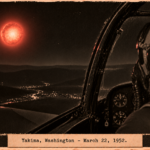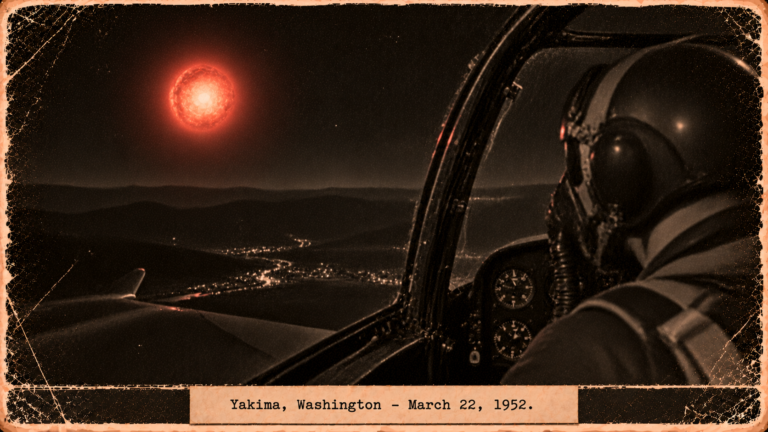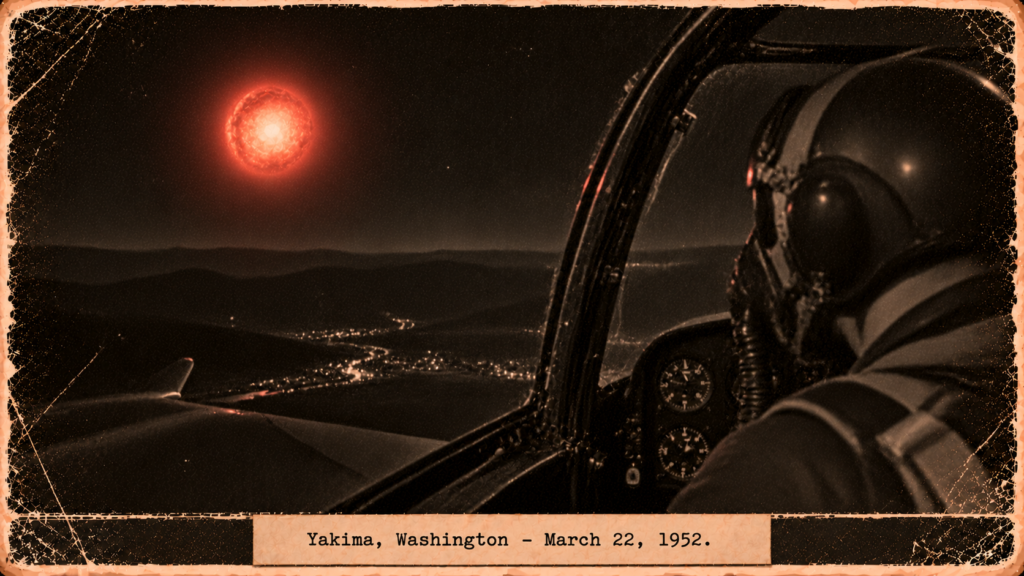
An F-94 crew watches a ball of fire build and fade near Yakima, March 22, 1952.
THINK ABOUTIT UFO|UAP SIGHTINGS REPORT
1952: An F-94 Crew Twice Watches a Ball of Fire Build and Fade South of Yakima While Ground Radar Plots It Drifting at 78 Knots
On the evening of March 22, 1952, the 4704th Defense Wing at McChord AFB, Washington, scrambled an F-94 after ground radar picked up an unidentified track near Yakima. Twice, once at 22,500 feet and once at 25,000, the crew saw an object like a large red ball of fire build in brilliance and then fade away over about 45 seconds, about ten degrees above the level line of sight.
The radar observer, working under his hood, never saw it on his scope, and the ground radar track computed a speed of only 78 knots. The wing’s intelligence officer noted that the track’s speed and direction matched the prevailing wind. Blue Book rated the radar return as a balloon and the air-visual sighting as Unidentified, which makes this Yakima, Washington UFO case an unusual split verdict.
Date: March 22, 1952 (March 23 Zulu)
Sighting Time: Radar pickup about 6:05 p.m. PST (0205Z); F-94 sightings about 6:56 p.m. and 7:15 p.m. PST (0256Z and 0315Z, pilot’s estimate)
Day/Night: Night; scattered clouds at 20,000 and 25,000 feet, visibility 30 miles
Location: About 20 miles south of Yakima, Washington (grid PF5055 for the intercept)
Urban or Rural: Airborne, over rural eastern Washington
No. of Entity’s: Not Applicable
Entity Type: Not Applicable
Entity Description: Not Applicable
Hynek Classification: RV (Radar-Visual)
Duration: About 45 seconds of brilliance each time; the radar track lasted about an hour
No. of Object(s): 1
Description of the Object(s): An object resembling a large ball of fire that would build up and then fade away, with an indefinite shape; red; no trail or exhaust; no forward speed observed
Shape/Size/Color of Object(s): Indefinite; single large ball of fire, red
Distance to Object(s): About 20 miles from the F-94 on the fighter track, and about ten degrees above the level line of sight
Height & Speed: Ground radar gave an altitude of about 35,000 feet; the F-94 was at 22,500 and 25,000 feet at 360 knots true; the computed speed of the target was 78 knots
Number of Witnesses: 2 (the F-94 pilot, usually reliable, and the radar observer, who saw nothing); ground radar operators of the 4704th Defense Wing
Special Features/Characteristics: The object faded from the ground radar at the same time; the radar observer under the hood could not pick it up on the airborne scope; no physical evidence
Case Status: Blue Book: radar return, Balloon; air-visual sighting, Unidentified (BBU 1076)
Source: Air Intelligence Information Report IR-4704-52 (4704th Defense Wing, McChord AFB; Capt. Thomas B. Hennessy, Wing Intelligence Officer); WADF forwarding letter WDOID 350.9; status report extract; Blue Book record cards; Berliner
Summary/Description: An F-94 scrambled on a ground radar track twice saw a red ball of fire swell and fade for about 45 seconds; ground radar computed 78 knots, the speed of the wind aloft. The wing intelligence officer suspected a drifting object, but no balloon could be matched and Blue Book left the visual sighting Unidentified.
Related Cases: Point Conception B-29 radar target (March 24, 1952); Keflavik GCA radar targets (March 13, 1952); March 1952 archive
Detailed Report
Report IR-4704-52 from the 4704th Defense Wing says the F-94 pilot was scrambled at 0233Z on March 23, 1952 on tracks H-70 and H-75. The DOCODAP log shows the track was picked up at 0205Z and the Air Defense Control Center was notified at 0215Z. The fighter was scrambled to grid PF5055, and the ground radar gave the target’s altitude as about 35,000 feet.
Twice the pilot saw an unidentified flash of light resembling a large ball of fire which would build up and then fade out; the total period of brilliance each time was about 45 seconds. His position at that time was just south of Yakima. Each time he turned the F-94 toward the object so the radar observer could pick it up, and each time the object appeared about ten degrees above the level line of sight; the radar observer, under the hood, did not see it visually and could not get it on his scope.
The pilot estimated the sightings at 0256Z and 0315Z but did not keep a record of the times. He observed it visually from the F-94, speed 360 knots true, at 22,500 feet on a heading of 30 degrees the first time and at 25,000 feet on a heading of 180 degrees the second. Ground radar, he said, placed the object 20 miles south of Yakima. He is considered usually reliable.
Weather at the point of sighting was 20,000 scattered and 25,000 scattered with 30 miles visibility; winds aloft were from 315 degrees at about 80 knots at 25,000–30,000 feet, 80–100 knots at 18,000 (the jet stream) and 40 knots at 10,000. The report states that no activity, meteorological or otherwise, was found that could account for the sightings, no physical evidence was obtained and no local aircraft could have accounted for it. An overlay of the interceptor track, with times, shows the ground radar plot of the unknown object at a computed speed of 78 knots and the estimated position drifting at 80 knots.
The preparing officer commented that during the short period the target was tracked, its speed and direction coincided with those of the prevailing wind. No weather balloon was known to have been released from McChord AFB at the relevant position; other installations releasing balloons in the area could not be effectively contacted by the wing, and the report says the object appears to have been drifting with the wind rather than being propelled.
RESEARCHER’S NOTES
A Wind-Speed Target and a Split Verdict
- Why 78 Knots Matters. The computed speed is close to the wind at altitude (80 knots from 315 degrees), which is the basis for the balloon rating of the radar return. The visual sighting is a separate evaluation, and Blue Book left it Unidentified.
- The Times. The live page gave 6:05 p.m.; that is the 0205Z radar pickup. The pilot put his sightings at about 6:56 and 7:15 p.m. PST, and the report notes he kept no record of the times.
- Radar Observer Saw Nothing. The F-94 turned toward the object each time so the radar observer could pick it up on his scope; he did not. This is the main gap in treating it as a true radar-visual match.
- Altitude Conflict. Ground radar gave about 35,000 feet; the pilot saw the object ten degrees above level at 22,500 and 25,000 feet, which would place it well above him at the distance he estimated.
- Balloon Unchecked. The report could not confirm a balloon release from every installation in the area.
Yakima is a good example of a case where the explanation fits one half of the evidence and not the other. A wind-speed radar track points to something drifting, yet the crew of an F-94 watching from the air saw a red ball of fire swell and fade, and the Air Force left that part unexplained.
“It appears that the unidentified object was drifting with the wind, however, rather than being propelled.”
— Air Intelligence Information Report IR-4704-52, 4704th Defense Wing, McChord AFB, March 1952