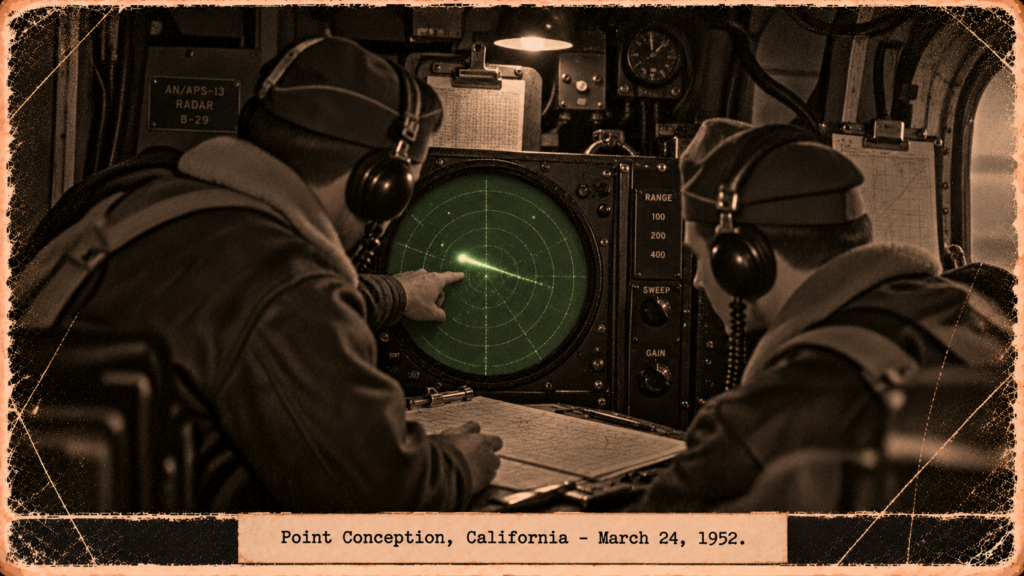
A B-29 radar crew tracks an unidentified return off Point Conception, March 24, 1952.
THINK ABOUTIT UFO|UAP SIGHTINGS REPORT
1952: A B-29 Radar Observer and Navigator Track a Target Crossing the Scope at 2,000 Knots West of Point Conception
At 8:45 on the morning of March 24, 1952, a B-29 flying west at 25,000 feet, about 60 miles off Point Conception, California, picked up an unknown return on its radar. The radar observer, Lt. Hancock of the 102nd Bomb Squadron, said it was “a clear and distinct radar return,” and he called in the navigator, Lt. Cone, who confirmed it.
It stayed on the scope for only 20 to 30 seconds, but in that time it went from due south of the bomber to a northerly track at less than 25,000 feet. The status report lists the speed as 2,000 knots, more than three times what any aircraft of the day could fly. Blue Book lists this Point Conception, California UFO radar case as Unidentified.
Date: March 24, 1952
Sighting Time: 8:45 a.m. PST (1645Z)
Day/Night: Day; weather clear
Location: About 34°30’N, 121°30’W, 60 miles west of Point Conception, California
Urban or Rural: Airborne, over the Pacific
No. of Entity’s: Not Applicable
Entity Type: Not Applicable
Entity Description: Not Applicable
Hynek Classification: Radar-only (outside Hynek’s visual classes)
Duration: 20 to 30 seconds
No. of Object(s): 1
Description of the Object(s): An unidentified radar return, clear and distinct, first seen due south of the B-29 and then traveling north or northwest
Shape/Size/Color of Object(s): Not applicable; radar return only
Distance to Object(s): Not recorded
Height & Speed: Less than 25,000 feet; the status report gives 2,000 knots on a heading of 315 degrees; the B-29 flew at 200 mph on a course of 270 degrees at 25,000 feet pressure altitude
Number of Witnesses: 2 (Lt. Hancock, radar observer, and Lt. Cone, navigator, of the 102nd Bomb Squadron)
Special Features/Characteristics: Both officers saw the return on the scope; both were combat veterans; no physical evidence; weather clear
Case Status: Blue Book: Unidentified (BBU 1077)
Source: Air Intelligence Information Report and message to ATIC (March 1952); statement of the radar observer dated March 25, 1952; status report extract; Blue Book record card; Berliner; Shough
Summary/Description: A B-29 radar observer and navigator watched a distinct return cross their scope in 20–30 seconds at about 2,000 knots. Both were experienced officers, and the report cannot separate a real fast object from electronic activity. Blue Book lists it as Unidentified.
Related Cases: Misawa T-6 and F-84 disc (March 29, 1952); Keflavik GCA radar targets (March 13, 1952); March 1952 archive
Detailed Report
The Air Intelligence Information Report carries a statement dated March 25, 1952 by Lt. Hancock, radar observer of the 102nd Bomb Squadron: while on a routine mission on March 24 he observed on his radar scope a return he was unable to identify. The observation was verified by Lt. Cone, the navigator, who also ascertained that the object gave a clear, distinct return.
The return first appeared on the scope at 1645Z and was observed for between 20 and 30 seconds. The statement gives its calculated speed as about 3,000 (the unit is smudged on the scan), while the status report extract lists 2,000 knots. The observation was by electronic means only. The aircraft was a B-29 whose speed was 200 mph at a pressure altitude of 25,000 feet on a course of 270 degrees, and its position was 34°30’N, 121°30’W, which is 60 miles west of Point Conception.
The object was first seen due south of the aircraft and was traveling north, at an altitude of less than 25,000 feet. The status report lists the heading as 315 degrees and the local time as 0845. The radar observer personally saw the return, as did the navigator. Weather was clear and no physical evidence is available. Both officers had combat experience and are regarded as highly reliable.
The report notes that although no cause could be given, the sighting is either of a rapidly moving object or of possible electronic activity (the scan of this line is partly illegible), and the status extract’s comment line points to similar phenomena and interference. The Air Force message to ATIC repeats the same facts in point form.
RESEARCHER’S NOTES
A Fast Blip, Two Witnesses and an Open Question
- Speed. At 2,000 knots the target would be moving at about 2,300 mph, a speed no aircraft of 1952 could reach. The statement’s own figure is smudged and reads about 3,000, which is why the live page gave about 3,000 mph.
- Date and Time. The live page gave March 24 at 8:45, “possibly p.m.” The 1645Z time group is 8:45 a.m. PST, so it was morning. The status report and the statement are dated March 25 because they were written then.
- Radar Only. Nothing was seen visually. The report allows that it could have been electronic interference, and the status extract says as much; Blue Book kept it as Unidentified.
- Two Observers. The radar observer called in the navigator to confirm the return, which is the main strength of the case. The report records no physical evidence.
- Similar Cases. The same month’s Fort Stockton B-50 scope case and the Keflavik GCA contacts are also radar-only; Blue Book filed those as Aircraft and radar ghosts, and left Point Conception Unidentified.
A 20-second return is a thin basis for any conclusion, and the report says so. But two trained observers confirmed it, the speed was far above anything flying, and Blue Book’s evaluators did not label it a balloon, a ghost or an aircraft. Point Conception sits in the March list as one of four cases left Unidentified.
“The return first appeared on the scope at 1645Z and was observed for between 20-30 seconds.”
— Statement of the radar observer, 102nd Bomb Squadron, March 25, 1952