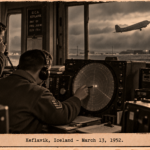
Keflavik GCA radar tracks eight unidentified targets, March 13, 1952.
THINK ABOUTIT UFO|UAP SIGHTINGS REPORT
1952: Keflavik Radar Tracks Eight Unidentified Targets in an Hour While a C-47 Searches Blind Above the Clouds
Between about 7:12 and 8:09 a.m. on March 13, 1952, the Ground Controlled Approach radar at Keflavik Airport, Iceland, picked up eight unidentified targets, each crossing the scope near the airport’s radio range station on a track that lasted 15 to 60 seconds. M/Sgt J. W. Kelly, the GCA director, reported the first to the tower at 0715Z, and Reykjavik Oceanic Control confirmed no other aircraft had been cleared into the area.
A MATS C-47 on practice approaches was told to break off, climb to 10,000 feet and intercept. The crew was vectored onto the targets in poor weather and saw nothing. The pilot later wrote that the GCA operator told him one target had crossed his scope faster than the F-86s he had clocked at more than 700 mph. The Air Force filed this Keflavik, Iceland UFO radar case as Other, radar “ghosts.”
Date: March 13, 1952
Sighting Time: 0712Z to about 0809Z (about 7:12 a.m. to 8:09 a.m.)
Day/Night: Day; poor weather
Location: Keflavik Airport, Iceland, near the airport radio range station
Urban or Rural: Airfield
No. of Entity’s: Not Applicable
Entity Type: Not Applicable
Entity Description: Not Applicable
Hynek Classification: Radar-only (outside Hynek’s visual classes)
Duration: Eight targets of 15 to 60 seconds each over about an hour
No. of Object(s): 8, at intervals of about 11 minutes
Description of the Object(s): Unidentified radar targets; no visual contact was made
Shape/Size/Color of Object(s): Not applicable; radar returns only
Distance to Object(s): Within two to five miles of the center of the airport when last seen
Height & Speed: Report estimate about 250 knots and above 8,000 feet; the GCA director told the C-47 pilot one target crossed his scope faster than F-86s clocked at over 700 mph; the search system gives no altitude
Number of Witnesses: Several: M/Sgt J. W. Kelly (GCA traffic director), a GCA crew chief, Capt. Frank Schreiber (operations duty officer), and Capt. Clyde B. Knipfer (C-47 pilot)
Special Features/Characteristics: C-47 climbed to 10,000 feet and was vectored toward the targets without any visual contact; radio calls on VHF and HF frequencies drew no answer; scopes monitored until 0930Z showed nothing more
Case Status: Blue Book: Other (radar “ghosts”)
Source: Air Intelligence Information Report TR-110-52 (Intelligence Division, Hq MATS, Andrews AFB); SAC cable via AFOIN-V/TC to ATIC (Ruppelt); certified statements; Blue Book March list; Dan Wilson
Summary/Description: The Keflavik GCA scope showed eight unidentified targets in about an hour. A C-47 sent up to look found nothing in the poor weather. ATIC suggested radar ghosts, which can show terrific speeds and are common along coastlines.
Related Cases: Point Conception B-29 radar target (March 24, 1952); Yakima F-94 fireball (March 22, 1952); March 1952 archive
Detailed Report
The Air Intelligence Information Report from the Intelligence Division, Headquarters MATS, reports a GCA radarscope sighting on March 13, 1952 of eight unidentified objects observed by a GCA team working with a C-47 on practice runs at Keflavik. The first object appeared on the scope for about one minute at 0712Z; the rest followed at intervals of about eleven minutes; the last was observed for about 15 seconds at about 0809Z. Weather was poor.
The statement of Capt. Frank Schreiber, operations duty officer of the 1400th Air Base Squadron, says that at 0715Z M/Sgt J. W. Kelly, GCA traffic director, reported to the tower that an unidentified target was on his scope. After the tower relayed it, Schreiber called Reykjavik Oceanic Aero Control, which had cleared no aircraft into the area. At 0735Z he reached the GCA unit and was told the first target had been seen at 0712Z three miles from the center of the airport inbound on a heading of about 190 degrees, and last seen five miles out. Further targets followed at about 0722Z, 0733Z, 0745Z, 0756Z and 0809Z, each lasting 15 to 30 seconds on similar tracks.
The GCA crew chief’s own statement lists the same targets near the radio range station and says he broadcast descent and holding instructions on several VHF and HF frequencies without an answer, and that the scopes were watched until 0930Z with nothing further seen. As soon as the first blip was noted, the C-47 was told to break its pattern, climb to 10,000 feet and try to intercept. The aircraft was vectored toward the target by the GCA team but made no visual sighting or contact.
Capt. Clyde B. Knipfer, pilot of the C-47, wrote that the GCA operator he was talking to said an object had crossed his scope at a speed faster than the F-86s he had clocked on speed runs, which he knew was over 700 mph. The crew climbed above the cloud layer and searched ten to fifteen minutes near the range station without seeing anything.
The report’s estimates were about 250 knots and an altitude above 8,000 feet, and the report notes that no altitude information is available on the search system of the radar. An ATIC analysis says ghosts or angels can produce radar returns that are in most cases indistinguishable from real targets, are usually observed along a sea coast, and are identified as ghosts by the terrific speeds sometimes seen; they should be treated as bogey aircraft when observed.
RESEARCHER’S NOTES
Eight Contacts, a Blind Search and an ATIC Ghost Theory
- Speed Conflict. The report’s estimate is 250 knots. The GCA operator’s remark to the C-47 pilot implies one pass above 700 mph. The file does not reconcile these.
- The Search. The C-47 climbed to 10,000 feet and was vectored onto the targets, but the weather prevented any visual contact. The report says the vectoring itself did not produce a contact.
- Ghosts Along a Coast. ATIC’s own analysis says radar ghosts are usually seen near a coast, which fits Keflavik, but also says terrific speed is a sign of a ghost; that reasoning is how the case was filed as Other.
- The Cable. A SAC cable quoting the GCA team reached ATIC for Ruppelt’s attention before the full report; a later corrected copy of one portion shows the first version contained errors.
- No Altitude. The GCA scope gives no altitude, so the 8,000-foot figure is an estimate.
Keflavik shows what a radar-only case looked like in 1952: certified statements, a C-47 sent up to look, a clean negative, and an analyst’s theory. The theory may be right, but eight returns at regular intervals near a radio range station is a pattern the report itself does not fully explain.
“Certain radar phenomena called ghosts or angels, the mechanics of which are not thoroughly understood, are capable of producing radar returns which in the majority of cases are indistinguishable from real targets.”
— ATIC analysis of Air Intelligence Information Report TR-110-52, Keflavik, March 13, 1952