THINK ABOUTIT UFO|UAP|ENTITY SIGHTINGS REPORT
1952: Child Abduction in Evergreen, Colorado
It is filed as a 1952 case, but almost nothing about it belongs to 1952. The account — a small “guardian” being, missing time, tall large-headed “Elders,” examination tables, other captive children — is the full vocabulary of the modern abduction narrative, and that vocabulary did not exist when the event supposedly happened. It was assembled across the decades that followed, from the 1961 Hill case through the abduction literature of the 1980s and 90s. What the archive actually holds here is a single uninvestigated self-report, submitted to a witness database long after the fact by an adult recalling a night from when she was eight years old. The story is logged because it sits in the record under a named source. But the honest frame comes first: this is a recovered childhood memory shaped by a template that postdates it by decades, with nothing to corroborate and nothing to disprove.
Date: Reported as July 7, 1952 (date is a submission-form value, not an established fact; see Researcher’s Notes)
Sighting Time: Reported as 2200 (likewise a form value, not reliably recalled)
Day/Night: Night
Location: Evergreen, Colorado (rural wooded area)
Urban or Rural: Rural
No. of Entity(‘s): Multiple — a small guardian humanoid, several taller “Elders,” and one human-appearing male figure
Entity Type: Small grey-type humanoid (guardian); tall large-headed humanoids (“Elders”); a “humanoid-type man”
Entity Description: A small humanoid with large eyes who remained beside the witness; taller beings with large, hairless heads and large eyes; and a man-like figure the witness recalled as striking but could not describe in detail
Hynek Classification: CE-IV (Close Encounter IV) — abduction or direct contact; provisional, as the report is a single uninvestigated source
Duration: Not recorded (missing time reported)
No. of Object(s): 1 craft
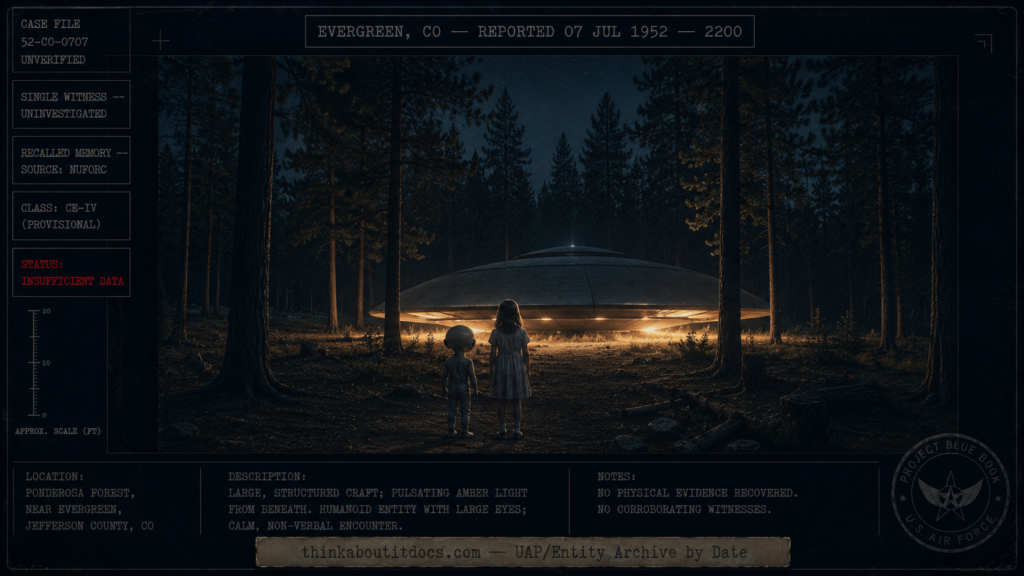
Description of the Object(s): A craft reported resting on the forest floor; the witness recalled standing beneath a large structure with no memory of entering it. Interior details included panel boards, a ceiling emitting rhythmic pulsating light, and clear amber ring-like objects
Shape of Object(s): Not clearly described
Size of Object(s): Recalled as large; not measured
Color of Object(s): Not recorded for the craft exterior; interior reported as amber and pulsating
Distance to Object(s): Close (witness reported being beneath and inside)
Height & Speed: Not recorded
Number of Witnesses: 1
Special Features/Characteristics: Reported missing time; a calm state the witness attributed to the small guardian entity; multiple entity types in one encounter; the apparent presence of other abductees, including an infant and another young girl; amber ring-like objects and pulsating ceiling lights
Case Status: Insufficient Data
Source: NUFORC — a self-submitted, uninvestigated witness report, recalled from childhood and entered into the database in the modern era (see Researcher’s Notes)
Summary/Description: An adult witness, recalling a night from when she was eight years old, reported encountering a craft at rest in the woods near Evergreen, Colorado, with no memory of how she came to be inside it. She described a small large-eyed humanoid who kept her calm, an interior of panel boards and pulsating amber light, the apparent presence of two other children, and a group of tall, large-headed beings she called the “Elders,” along with one man-like figure. The account is a single uninvestigated self-report; its date and time are submission-form values rather than established facts, and the narrative reflects an abduction template that developed well after 1952.
Related Cases: 1952: Abduction in Tucson, Arizona | 1961: Hill abduction, New Hampshire (the first widely publicized US abduction account, and the origin point of much of the later template) | the broader corpus of recalled-memory CE-IV self-reports
DETAILED REPORT
The account, as submitted, describes an experience the witness places on a summer night in 1952, when she was eight years old, in the rural woods around Evergreen, Colorado. By her recollection it began when she noticed a craft resting on the forest floor. She remembered standing beneath a large structure but had no conscious memory of how she moved from the ground into the vessel — the “missing time” that recurs throughout this category of report.
Once inside, she described an unnatural calm, which she attributed to a small humanoid with large eyes who stayed beside her and seemed to dampen her fear as she was moved through the craft. She recalled a room of panel boards and a ceiling that gave off rhythmic, pulsating light, and reported the presence of two other apparent abductees — an infant and another young girl — near clear amber ring-like objects. She was then taken to meet a group of taller beings she called the “Elders,” described as having large, hairless heads and large eyes, and among them a single man-like figure she remembered as striking but whose features she could not recall.
That is the substance of the report, and the way it reaches the archive matters as much as its content. The source is NUFORC, a clearinghouse that posts witness submissions without investigating them. There is no second witness, no contemporaneous record, no investigator’s file, and no physical trace — only a narrative entered into a database decades after the events it describes, by a person recalling early childhood. The exact date and time on the record are not memories so much as required fields on a submission form; a child of eight does not retain a precise calendar date and clock hour across a half-century, and those values should be read as data-entry conventions, not established facts.
Set against the calendar, the deeper problem becomes clear. The elements that give the account its shape — the imposed calm, the missing time, the small grey companion, the tall large-headed “Elders,” the examination setting, the other captive children — are the standard furniture of the abduction narrative as it developed after 1961 and especially through the 1980s and 90s. None of that framework existed in the culture in 1952. An experience genuinely dating to 1952 but recalled and described in the modern era would almost inevitably be remembered through that later template, whether or not anything happened on a Colorado night decades ago. The report cannot be confirmed, and it cannot be ruled out; what can be said is that its form belongs to a much later period than its date.
RESEARCHER’S NOTES
The Evergreen “Elders” — Colorado 1952 and a Memory Told in a Later Language
- Classification, held but provisional: CE-IV is the correct descriptor for the type of claim — an abduction with direct entity contact — and so it stands. But the class describes the claim, not its reliability. With a single uninvestigated witness and no corroboration of any kind, the CE-IV here should be read as “the category this report falls into,” not as a vouched-for abduction. The classification and the Insufficient Data status are doing two separate jobs, and both belong on the page.
- Source-chain assessment, the central caveat: The entire case rests on one self-submitted NUFORC narrative. NUFORC performs no investigation and posts reports as received; a 1952 entry in its modern database is necessarily a recollection submitted long after the fact. The previously published version of this page treated the report’s form-field date and time as hard facts and closed with promotional language calling it a significant piece of Colorado UFO history. Both have been removed. What remains is presented as exactly what it is — an uncorroborated single-witness recollection — with the date and time explicitly marked as submission values rather than established record.
- Pattern and chronological problem: The most important analytical point is the mismatch between the event date and the narrative’s vocabulary. The full template on display — guardian grey, missing time, tall large-headed Elders, exam-room setting, multiple abductees — postdates 1952 by decades, taking shape only after the 1961 Hill case and the abduction literature that followed. This does not prove the witness invented anything; memory is reconstructive, and a real fright in childhood can later be re-narrated in whatever language the culture has since supplied. But it does mean the report tells us more reliably about the era in which it was remembered than about the year it is filed under.
- Evidentiary weight and why Insufficient Data: There is no second witness, no contemporaneous documentation, no investigation, and no physical evidence — and there is equally no positive evidence of fabrication or of a mundane misidentification. That symmetry is precisely what Insufficient Data describes. “Unexplained” would imply a documented anomaly that resists explanation, which this is not; “Explained” would require grounds the record does not provide. The archive’s value here is in declining to inflate a single recovered-memory submission into a confirmed 1952 abduction, while still preserving it, honestly labeled, as part of the chronological record.
The Evergreen account is one of the more elaborate early-1950s abduction entries on file, and also one of the least anchored. It comes down to a single voice, recalling childhood through the language of a movement that did not yet exist, entered into a database that does not test what it receives. The archive keeps it, dates it as the source dates it, and refuses to pretend it is more than it is — an uncorroborated recollection, logged as Insufficient Data, its vivid detail noted and its evidentiary footing left exactly as thin as the record makes it.