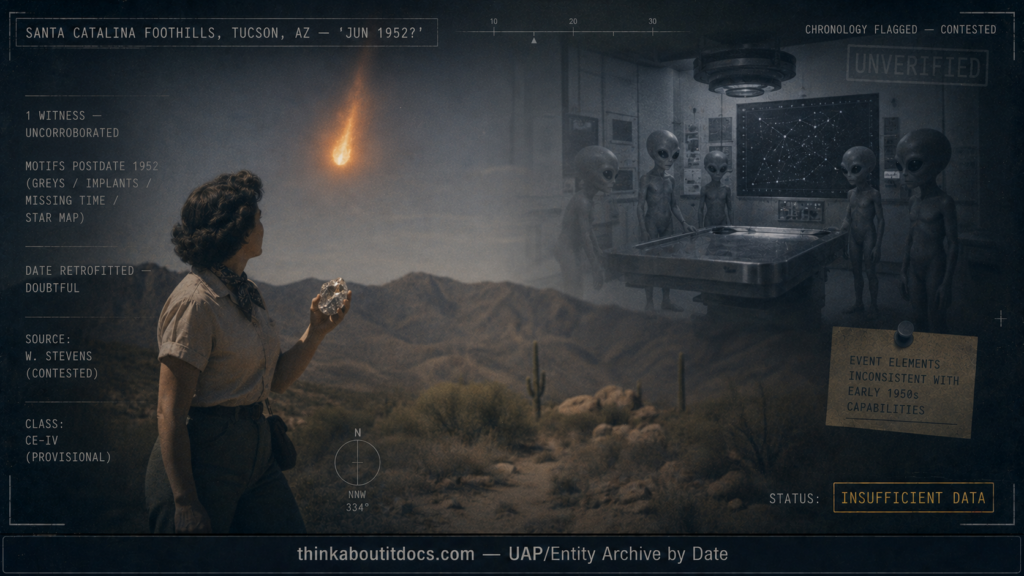
The "1952" Tucson abduction — Greys, exam table, implants, missing time, a star map. Every motif postdates 1952 by decades, so the date is almost certainly retrofitted. A contested single-witness account; logged Insufficient Data. (thinkaboutitdocs.com — UAP/Entity Archive by Date)
THINK ABOUTIT UFO|UAP|ENTITY SIGHTINGS REPORT
1952: Reported Abduction near Tucson, Arizona
DATE UNRELIABLE
the account is built almost entirely of abduction motifs that did not exist until the 1960s–1990s. Read with strong caution; the “1952” is very likely retrofitted.
On its face it is a striking story: a woman out rock-hunting in the desert near Tucson sees a controlled “ball of fire” drop behind a ridge, meets a small grey being who tells her telepathically not to be afraid, blacks out, and wakes on a sterile examining table surrounded by bald, black-eyed humanoids who probe her with instruments, implant devices in her ear and abdomen, show her a book of strange symbols, and display a three-dimensional star map. The problem is the date. Every distinctive element of this account — the bald grey with huge black eyes, the clinical exam table, the implants, the telepathy, the missing time, the star-map screen — entered UFO culture long after 1952, most of it after 1961 and much of it in the 1980s and 1990s. A genuine 1952 witness could not have drawn on imagery that did not yet exist. The honest reading is not that this case “predates the Greys,” as the prior page claimed, but that its 1952 date is almost certainly wrong or retrofitted. The archive keeps the entry and files it as Insufficient Data, with the dating problem front and center.
Date: Given as about June 17, 1952 — but see Researcher’s Notes; the date is highly doubtful
Sighting Time: Afternoon (as stated)
Day/Night: Day (afternoon)
Location: Desert in the Santa Catalina foothills near Tucson, Arizona
Urban or Rural: Rural (open desert)
No. of Entity(‘s): 4 or 5
Entity Type: “Grey”-type humanoids
Entity Description: First a single small grey being on the trail; then, in the reported exam room, four or five small grey humanoids with large bald heads and large bulging black eyes
Hynek Classification: CE-IV (abduction / direct contact) — provisional; the abduction is claimed by a single witness across a memory gap, and the account’s contents postdate 1952 (see Researcher’s Notes)
Duration: Not recorded (includes a period of unconsciousness / missing time)
No. of Object(s): 1 (a “ball of fire” seen descending; the exam-room “craft” is inferred, not observed in approach)
Description of the Object(s): A brilliant “ball of fire” that crossed the sky and, said to move under control, descended behind a mountain ridge; the witness later found herself in a small, sterile room with a metallic examining table and a sourceless “fuzzy” light, and reported a large three-dimensional screen showing deep space and star systems
Shape of Object(s): Ball / sphere of light (the only object actually observed)
Size of Object(s): Not recorded
Color of Object(s): Fiery (ball of fire)
Distance to Object(s): Descended behind a ridge at unknown distance; the entities were at close range in the reported room
Height & Speed: The object crossed the sky and descended; not quantified
Number of Witnesses: 1
Special Features/Characteristics: Controlled “ball of fire”; telepathic message (“Do not be afraid”); sudden drowsiness and loss of consciousness (missing time); sterile exam room and table; medical examination with thin instruments and a ceiling-mounted device; reported implants in the ear and abdomen; a book of indecipherable symbols; a three-dimensional star-map screen — a cluster of motifs that postdate 1952
Case Status: Insufficient Data
Source: Wendelle C. Stevens (UFO collector/investigator; prolific but of contested reliability, best known for championing the Billy Meier contactee case)
Summary/Description: By a single account preserved by Wendelle Stevens, a woman rock-hunting in the desert near Tucson, Arizona — dated to about June 1952 — saw a controlled “ball of fire” descend behind a ridge, encountered a small grey being who told her telepathically not to be afraid, lost consciousness, and woke on a sterile examining table surrounded by four or five bald, black-eyed grey humanoids who examined her, reportedly implanted devices in her ear and abdomen, showed her a symbol book, and displayed a three-dimensional star map. Because the account’s distinctive features all postdate 1952, the date is highly doubtful; the case rests on a single uncorroborated witness and is logged as Insufficient Data.
Related Cases: 1961: The Betty and Barney Hill Abduction, New Hampshire (origin of the exam-and-star-map template) | 1952: Child Abduction in Evergreen, Colorado (another 1952-dated account with anachronistic abduction elements) | the broader corpus of late-recalled “Grey” abduction narratives
DETAILED REPORT
The account, preserved by the UFO collector Wendelle C. Stevens, runs as follows. A woman was walking a remote desert trail in the foothills near Tucson, Arizona, pursuing her hobby of hunting for interesting rocks and minerals, on an afternoon dated to about June 1952. She noticed a brilliant “ball of fire” crossing the sky; unlike a meteor, it appeared to descend under control and dropped behind a nearby mountain ridge. Curious, she walked toward where it had gone down. As she bent to pick up a sparkling rock, she was startled by a small grey being walking toward her, which projected into her mind, without speaking, the message “Do not be afraid.” She was at once overcome by drowsiness and apparently lost consciousness.
When she came to, she was lying on a metallic examining table in a small, sterile room lit by a strange, sourceless “fuzzy” light, surrounded by four or five small grey humanoids with large bald heads and huge bulging black eyes. They examined her with thin instruments and lowered a ceiling-mounted device that moved up and down her body; she felt small objects being implanted in her ear and in her abdomen. Before release she was shown a book of indecipherable symbols and a large three-dimensional screen displaying deep space and distant star systems.
Anyone familiar with the history of the abduction phenomenon will notice the difficulty immediately, and it is decisive: this is a textbook modern Grey-abduction narrative, and almost none of its furniture existed in 1952. The short grey humanoid with the oversized bald head and huge black eyes is not a 1952 image; it crystallized in the public mind after the Betty and Barney Hill case of 1961 and became dominant only after Whitley Strieber’s “Communion” in 1987. The sterile medical examination on a table is the Hill template, from 1961. Bodily implants — and specifically the small devices placed in the body — are a motif of the 1980s and 1990s abduction research of Budd Hopkins and David Jacobs. “Missing time” as a structuring idea was popularized by Hopkins’s 1981 book of that name. The three-dimensional star map echoes Betty Hill’s famous star map, again from the 1961 case. Telepathic reassurance and the “book of symbols” are likewise standard later-contactee and abduction tropes.
A witness in June 1952 — five months before the term “Project Blue Book” even existed, nine years before the Hills, decades before Hopkins, Jacobs, and Strieber — could not have assembled a narrative from imagery the culture had not yet produced. There are only a few possibilities, and all of them undercut the 1952 date. The account may have been recovered or recounted much later (Stevens worked as an investigator chiefly from the 1970s onward) and then attached to a 1952 memory, with the intervening decades of abduction culture shaping the details. The date may simply be in error. Or the narrative may be a later construction, sincere or otherwise, that was filed under 1952. In every case, the content cannot be what a person actually experienced and described in 1952; it is the content of the abduction genre as it developed afterward.
The source compounds the caution. Wendelle Stevens was an indefatigable collector of UFO accounts, but his critical judgment is not a guarantee of reliability — he is best known as the principal champion of the Billy Meier “Pleiadian” contactee case, widely regarded as a hoax, and of other contested abduction claims. His preservation of a story establishes that the story was told and kept, not that it happened or that its dating was checked.
None of this means the witness was dishonest. Sincere people produce vivid abduction narratives, often shaped unconsciously by the surrounding culture, and the “drowsiness, then waking elsewhere, then procedures, then release” structure overlaps strongly with sleep-related and screen-memory experiences that feel entirely real. But as a putative 1952 event, the account fails the most basic test of internal consistency with its own date. There is a single witness, no corroboration, no contemporaneous record, a compromised source, and a narrative woven from motifs that postdate the claimed year by one to four decades. That is not a documented 1952 anomaly.
RESEARCHER’S NOTES
The Tucson Abduction — Arizona and a 1952 Date on a Post-1961 Story
- The anachronism, which governs the case: The single most important analytical point is chronological. The account’s defining features — the bald black-eyed Grey, the exam table, the implants, the missing time, the star-map screen — are all post-1952 cultural products, most flowing from the 1961 Hill case and the 1980s–90s abduction research that followed. The prior page treated the case’s apparent precedence (“predates the mainstream popularity of Grays”) as a mark of significance. It is the opposite: a 1952 narrative cannot authentically contain imagery the culture invented later, so the precedence is the red flag, not the value. The date is the problem, and it has to be stated plainly rather than celebrated.
- Source-chain assessment: The case comes through Wendelle Stevens, a prolific collector whose reliability is genuinely contested — his signature cases include the Billy Meier contactee material, broadly considered a hoax. A collector’s preservation of an account is not corroboration of it. Combined with the single-witness nature, the absence of any contemporaneous 1952 documentation, and a memory gap at the center of the story, the evidentiary foundation is weak regardless of the dating issue.
- Classification, held provisional: CE-IV is the nominal report-type, since an abduction is claimed, and it is retained on that basis. But it rests entirely on one person’s account across a period of unconsciousness, with the only actually-observed object being a vague “ball of fire”; the structured craft and exam room are reconstructed after the memory gap. The classification therefore marks a category, not a documented abduction, and sits beside an Insufficient Data status.
- Why Insufficient Data rather than Explained: The case can be confidently said to be inconsistent with its 1952 date, and to depend on a contested source and a single uncorroborated witness — which is why it cannot be called a documented Unexplained event. It stops short of a flat “Explained (hoax)” only because the underlying experience may be sincere, the mis-dating may be an artifact of late recall or cataloguing rather than fabrication, and the record is too thin to demonstrate deliberate invention. The honest verdict is Insufficient Data, with the strong caveat that the narrative is a modern abduction template wearing a 1952 label.
The Tucson desert abduction is a vivid specimen of the mature Grey-abduction story — telepathic greeting, missing time, the sterile table, the implants, the star map — and that is exactly why its 1952 date cannot stand. None of that imagery existed when the event supposedly happened; it was assembled by the culture over the following forty years. Stripped of the prior page’s claim that this makes the case an important early precursor, and credited honestly to a single witness and a contested collector, it stands as Insufficient Data: not a window into 1952, but a modern abduction narrative filed under a year it could not have come from.