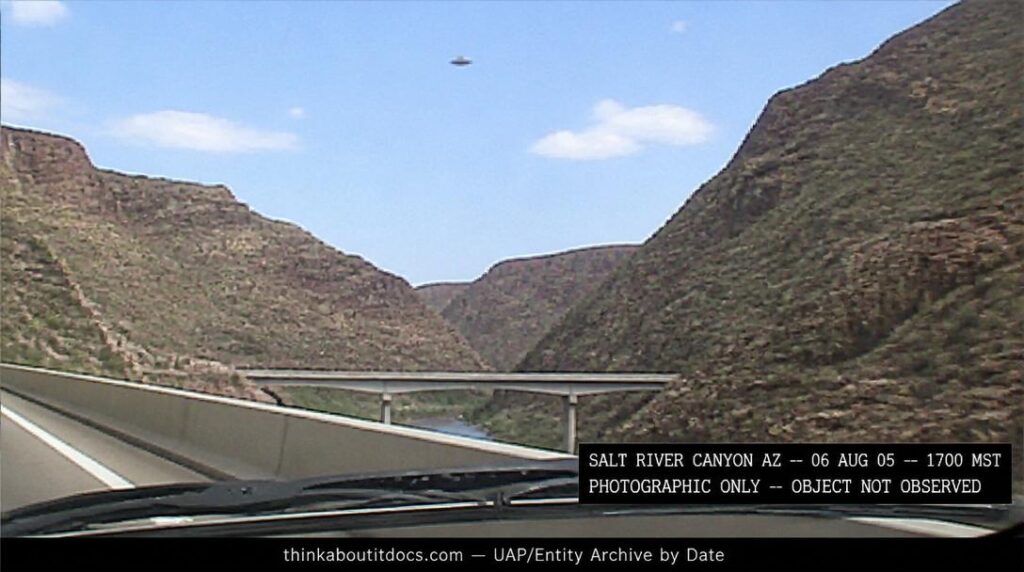
Salt River Canyon, Arizona Route 60, August 6, 2005 — A disc-shaped object appears in a photograph taken by crane operator Ed O'Toole. The object was not seen at the time. Photographic-only case.
THINK ABOUTIT UFO|UAP SIGHTING REPORT
2005: Disc-shaped object photographed in Arizona
On August 6, 2005, crane operator Ed O’Toole photographed the bridge at the bottom of Salt River Canyon on Arizona State Route 60 between Globe and Show Low. He did not see anything unusual at the time. When he downloaded the images to his computer, one photograph contained a disc-shaped object in the sky above the canyon. The photograph was submitted to UFOEvidence.org. The object was not observed visually by either O’Toole or his wife, who was driving.
Date: August 6, 2005
Sighting Time: Approximately 5:00 p.m.
Day/Night: Day
Location: Salt River Canyon, Arizona State Route 60, between Globe and Show Low (Gila County), near the bridge at the bottom of the canyon
Urban or Rural: Rural (remote canyon highway)
No. of Entity(‘s): None observed
Entity Type: Not Applicable
Entity Description: Not Applicable
Hynek Classification: DD (Daylight Disc) — disc-shaped object visible in a daytime photograph, though not visually observed
Duration: Not Applicable (object not observed in real time; appears in a single photograph)
No. of Object(s): 1
Description of the Object(s): A disc-shaped object visible in the sky above the canyon in the photograph. O’Toole noted that when enlarged, the object appeared to have a figure or distinct image on its underside. Resolution was insufficient for clear detail. The object does not appear in any other photographs from the same trip
Shape of Object(s): Disc
Size of Object(s): Unknown (no visual observation to provide angular size or distance estimate)
Color of Object(s): Not clearly described (visible in photograph against sky)
Distance to Object(s): Unknown
Height & Speed: Unknown
Number of Witnesses: 0 (object not visually observed; 2 people in the vehicle but neither saw the object)
Special Features/Characteristics: The photograph was taken through the front windshield of the vehicle using a Kodak EasyShare CX4200 digital camera. O’Toole stated that no other photographs were taken through the windshield that day, ruling out (in his assessment) a spot on the windshield. He was photographing the bridge because he is a crane operator and knew one of the men who built it. He noted that the Salt River Canyon is in the same general area where the film “Fire in the Sky” (based on the Travis Walton case) was filmed
Case Status: Insufficient Data — photographic-only case with no visual observation, no EXIF analysis, and no independent photographic evaluation
Source: Ed O’Toole, submitted to UFOEvidence.org
Summary/Description: On August 6, 2005, at approximately 5:00 p.m., Ed O’Toole photographed the bridge at the bottom of Salt River Canyon on Arizona State Route 60. Neither he nor his wife (who was driving) observed anything unusual in the sky. Upon downloading the images, O’Toole discovered a disc-shaped object in one photograph. Enlargement suggested markings or a feature on the object’s underside, though resolution was insufficient for clear detail. The image was taken with a Kodak EasyShare CX4200 through the front windshield. No independent photographic analysis has been performed.
Related Cases: Travis Walton Abduction 1975 (same general area — Apache-Sitgreaves / White Mountains region)
Detailed Report
Ed O’Toole, a crane operator, was traveling with his wife through Salt River Canyon on Arizona State Route 60 between Globe and Show Low on Saturday, August 6, 2005. His wife was driving. At approximately 5:00 p.m., as they approached the bridge at the bottom of the canyon, O’Toole took a photograph of the bridge with their Kodak EasyShare CX4200 digital camera through the front windshield. He had a personal interest in the bridge because he is a crane operator and knew one of the men who worked on its construction.
Neither O’Toole nor his wife observed anything unusual in the sky at the time. When O’Toole later downloaded the images onto his computer, he discovered a disc-shaped object in the sky above the canyon in the photograph. He stated that no other photographs were taken through the front windshield that day, which in his assessment ruled out a windshield spot as the cause. Upon enlarging the image, he believed he could see a figure or distinct marking on the underside of the object, though the camera’s resolution was insufficient for clear detail.
O’Toole submitted the photograph to UFOEvidence.org, where it was published with his statement. He noted that the Salt River Canyon is in the same general area where the 1993 film “Fire in the Sky” — based on the Travis Walton abduction case — was filmed, though the Walton encounter itself occurred in the Apache-Sitgreaves National Forest approximately 50 miles to the north.
Researcher’s Notes
The Salt River Canyon Photograph — Route 60, 2005 and the Photographic-Only Problem
- The Photographic-Only Category: Cases in which a UFO appears only in a photograph — not observed visually by the photographer or anyone else present — constitute a distinct evidentiary category that is inherently weaker than visual-observation cases, even single-witness ones. A visual observer can describe behavior, duration, sound, angular size, and trajectory; a photograph-only case provides a single frozen frame with no behavioral context. The image could represent a genuine airborne object, a photographic artifact (lens flare, sensor anomaly, internal reflection), a windshield contamination, an insect or bird caught mid-frame at close range, or a digital manipulation. Without the original file (including EXIF metadata showing camera settings, date/time stamps, and any processing history) and independent photographic analysis, none of these possibilities can be excluded.
- Witness and Source Quality: Ed O’Toole is a named witness who provided his occupation (crane operator), the specific camera model (Kodak EasyShare CX4200), the exact date and approximate time, and the precise location on a named highway. These details are more specific than many self-submitted reports. His explanation for why he was photographing the bridge (professional interest in its construction) is internally consistent and provides a plausible reason for taking the shot. His assertion that no other windshield-through photographs were taken that day addresses the most obvious artifact explanation, though it does not exclude it — a single contamination or internal reflection could produce a disc-shaped artifact in a single frame.
- The Kodak CX4200: The Kodak EasyShare CX4200 was a consumer-grade 2-megapixel digital camera released in 2003. Its low resolution (1600×1200 pixels) severely limits the information available in any crop or enlargement. O’Toole’s own observation that resolution was insufficient to clearly resolve the feature he thought he saw on the object’s underside is consistent with the camera’s capabilities. At 2 megapixels, even a genuine airborne object at any significant distance would be reduced to a few dozen pixels — insufficient for definitive analysis.
- Assessment: The Salt River Canyon photograph is a named-witness, dated, located photographic case with no visual observation. It is retained in the archive because it meets the minimum documentation standard (named source, specific date, specific location, published photograph), but the absence of visual observation, the through-windshield shooting conditions, the low camera resolution, and the lack of independent analysis place it firmly in Insufficient Data territory.
A crane operator took a photograph of a bridge he admired in a canyon he was passing through, and found something in the sky he hadn’t seen. Whether it was there in the sky or only in the camera, the image sits in the archive at the weight the evidence supports.