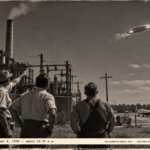
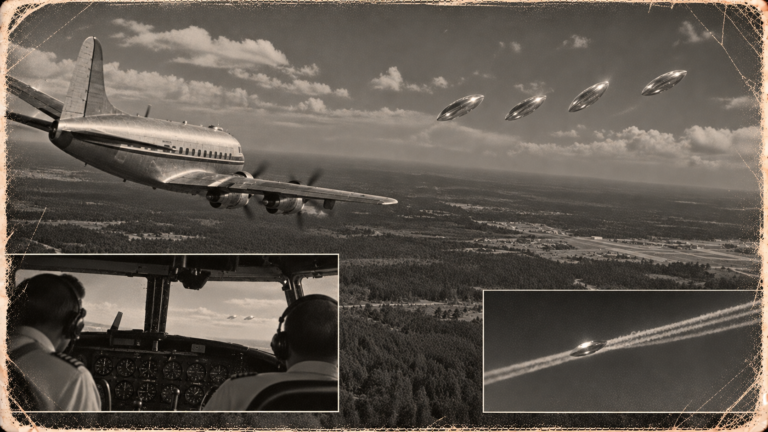
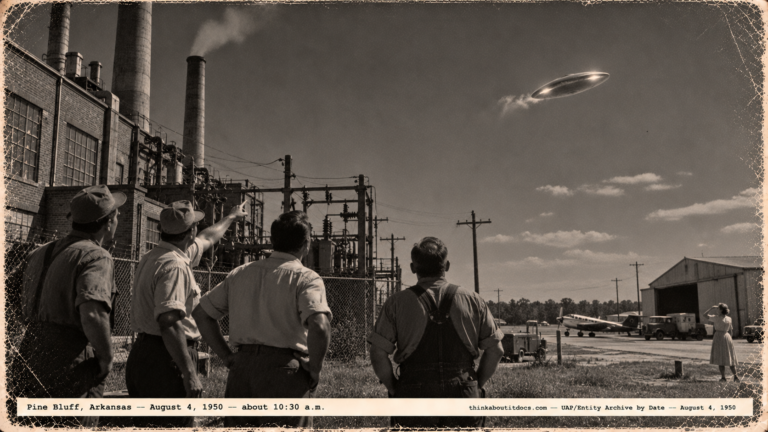
A Norfolk teenager photographs a dark oval object "spinning like a football," July 9, 1947 — at the very peak of the flying-saucer wave.
THINK ABOUTIT UFO | UAP SIGHTING REPORT
1947: Flying Disc Photographed By Norfolk Youth
On the afternoon of July 9, 1947 — with the entire country talking about “flying saucers” and the Roswell press release barely a day old — a 13-year-old boy stood on his front porch in Norfolk, Virginia, raised an old camera set to a hundredth of a second, and fired off three frames at a dark oval object he said was “rocking and spinning like a football.” Bill Turrentine wasn’t surprised to see it; he had gone outside specifically hoping to. What makes the case unusual is not the sighting but the artifact: a real, contemporaneous photograph, examined by a commercial photo lab that pronounced it the best disc image taken to that point — and a young witness who couldn’t understand why the whole city hadn’t looked up and seen the same thing.
Date: July 9, 1947
Sighting Time: Afternoon (shortly after noon, Tuesday)
Day/Night: Day
Location: Norfolk, Virginia (residential street, 410 West Fourteenth Street)
Urban or Rural: Urban
No. of Entity(‘s): na
Entity Type: na
Entity Description: na
Hynek Classification: DD (Daylight Disc)
Duration: na
No. of Object(s): 3 (one large object, followed seconds later by two smaller objects)
Size of Object(s): Large object described as bigger than an automobile
Description of the Object(s): A rounded, oval object, darker than expected for a “saucer,” gray to almost black in color and likened to a “burned crisp,” rock, or stone. The edges glittered and the object appeared to trail dust. It rocked, spun, and wobbled in flight while moving rapidly. Two smaller objects followed a few seconds behind. None of the three made any sound.
Shape of Object(s): Oval (witness rejected the “saucer” description, comparing it to a football)
Color of Object(s): Gray, almost black; “burned crisp” appearance; glittering edges
Distance to Object(s): Estimated altitude about 5,000 feet, just below the cloud base
Height & Speed: Approximately 5,000 feet altitude; estimated speed about 600 mph; traveling from the southwest toward the northeast
Number of Witnesses: One primary witness (Bill Turrentine, 13); his 18-year-old sister, Josephine, was called to look but did not corroborate the sighting
Special Features/Characteristics: Photographed by the witness (three exposures at 1/100 second; one usable negative); object trailed dust; glittering edges; football-like rocking/spinning motion; silent flight; front-porch rail and trees in frame provided scale reference
Case Status: Insufficient Data
Source: Norfolk Ledger-Dispatch (Norfolk, Virginia), July 9, 1947, article by George Hebert; secondary host rense.com
Summary/Description: Thirteen-year-old Bill Turrentine of Norfolk, Virginia photographed a large oval object he said was bigger than an automobile, gray to nearly black, with glittering edges and a dust trail, rocking and spinning “like a football” as it moved rapidly from the southwest to the northeast at an estimated 5,000 feet and roughly 600 mph. Two smaller objects followed seconds behind. He took three exposures with an old camera; one negative was usable and was enlarged by a local photo firm, whose technicians judged it a competent photograph limited only by the film stock.
Related Cases: 1949 “These Flying Discs Are At It Again,” Virginia | 1952 Nash-Fortenberry Sighting, Norfolk | 1957 Fort Belvoir, Virginia photo | Kenneth Arnold sighting, June 24, 1947 | Roswell “flying disc” press release, July 8, 1947 (wave context)
DETAILED REPORT
The account is a same-day newspaper report filed by George Hebert of the Norfolk Ledger-Dispatch on July 9, 1947 — a genuinely contemporaneous record, which immediately distinguishes this case from the retrospective testimony common to the early archive. The witness was Bill Turrentine, a 13-year-old who lived at 410 West Fourteenth Street and had just returned from summer school at Maury. By his own account, the nationwide wave of “flying saucer” reports had prompted him to go outside with his camera specifically to look for one. Shortly after noon he saw a large object approaching from the southwest, which he photographed from his front porch.
Turrentine’s description is notable for resisting the “saucer” template that dominated the press that week. He insisted the object was rounded and oval rather than disc-like, comparing its motion to a spinning, wobbling football. He described it as larger than an automobile, gray to almost black — like a “burned crisp,” rock, or stone — with edges that glittered and an apparent trail of dust. He estimated its altitude at roughly 5,000 feet, just beneath the cloud deck, and its speed at about 600 mph as it moved northeast. Critically, he reported that the large object was followed seconds later by two smaller ones, and that none of the three produced any sound. This three-object detail is present in the source’s full report but is mis-recorded as a single object in the live template’s object count.
The photographic element is the case’s distinguishing feature and its central limitation. Turrentine took three exposures at 1/100 second with an old camera, then developed the film himself after fetching developer from Olney Road; only one negative came out usable. He brought a self-made contact print to the newspaper, and the published image was an enlargement produced by a local firm, Photo Craftsmen. The firm’s technicians reportedly judged the boy’s work competent for the equipment, attributing the lack of fine detail to the film stock rather than to any error, and noting that the porch rail and trees in the frame offered a useful scale comparison. No further technical analysis of the negative is on record. Corroboration was sought and not obtained: Turrentine called his sister Josephine to look, but she apparently did not see or believe in the object. The result is a contemporaneously documented, named-witness case anchored by a real but low-resolution photograph that never received competent forensic examination — strong on provenance, weak on evidentiary yield.
RESEARCHER’S NOTES
The Burned Crisp — Norfolk 1947 and the Photograph at the Peak of the Saucer Wave
- Classification Assessment: DD (Daylight Disc) is correctly applied and should stand. The sighting is a daytime observation of a structured, non-luminous object, which is the defining profile of the category, and the “disc” label here is conventional rather than literal — the witness explicitly described an oval, football-like form. The presence of two trailing objects does not change the classification, as all three were observed as daylight structured objects with no occupants, no landing, and no close approach. No Close Encounter category applies. The object count, however, must be corrected from 1 to 3 to match the source.
- Source Chain Assessment: This is the case’s principal strength. The originating source is a same-day, by-lined newspaper report in the Norfolk Ledger-Dispatch — a contemporaneous, named primary source authored by an identifiable journalist, George Hebert, and naming the witness in full with his address. Under our source hierarchy this is a credentialed-journalist primary record, well above the typical anonymous or late-collected entry. The secondary host (rense.com) is merely a reproduction point and carries no evidentiary weight of its own; the citation rests entirely on the 1947 newspaper, which is the appropriate anchor.
- Pattern Context and Cultural Priming: The date places this case at the absolute peak of the 1947 wave — July 9, one day after the Roswell Army Air Field “flying disc” press release and roughly two weeks after Kenneth Arnold’s June 24 sighting. The witness’s own statement that he went outside with a camera because of all the “saucer” talk is an unusually candid record of expectation and priming, and it must be weighed honestly: a motivated 13-year-old actively hunting for a saucer during the most intense media saturation of the phenomenon’s history is a textbook setup for misperception of a conventional object. At the same time, the specific anti-template details — the dark “burned crisp” coloring, the dust trail, the football motion, the two trailing objects — are not the stock saucer imagery of the period, which cuts against simple suggestion. Norfolk would produce far better-documented Virginia cases in the following years, notably the 1952 Nash-Fortenberry sighting.
- Physical Evidence and Evidentiary Weight: A photograph exists, which is rare for 1947, but its evidentiary value is sharply limited. It was a single usable frame from three exposures, taken on an old camera with film the lab itself said lacked detail, developed by the boy, and never subjected to competent forensic analysis — the commercial firm’s praise concerned print quality and scale reference, not authentication of the object. The image is consistent with a distant unidentified object but equally consistent with a bird, balloon, aircraft, or film/processing artifact, and cannot discriminate among them. Combined with the failure to corroborate (the sister did not confirm) and the youth of the sole witness, the photo cannot lift the case above Insufficient Data despite the excellent source provenance.
The Norfolk youth case is a rarity for its era — a contemporaneous, named-witness sighting with an actual photograph, filed the same day by a working newspaper reporter. That provenance is genuinely strong and earns the case a secure place in the record. But strong provenance is not the same as strong evidence: the photograph was low-resolution, self-developed, never properly analyzed, and uncorroborated, and the lone witness was a 13-year-old who had gone outside expressly hoping to photograph a saucer at the height of the 1947 media wave. The honest position is Insufficient Data — a well-documented sighting whose central artifact simply cannot carry the weight of a firm determination. It stands as one of the better-attested civilian photo cases of the wave and an instructive study in how provenance and evidentiary value can diverge.