July 14, 1952 — Chesapeake Bay, Virginia
THINK ABOUTIT UFO|UAP SIGHTINGS REPORT
The 1952 Nash-Fortenberry Sighting: Two Pan Am Pilots, Eight Discs, 12,000 MPH
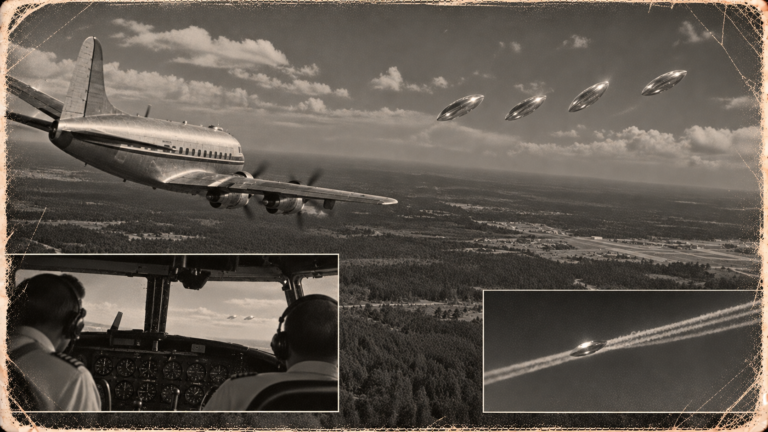
On the evening of July 14, 1952, two Pan American World Airways pilots flying a DC-4 over Chesapeake Bay watched eight glowing, coin-shaped objects execute maneuvers that a Dalton Mark 7 computer would later confirm as a 150-degree course reversal completed in roughly 12 seconds — a turn that, at the distances involved, implied a speed approaching 12,000 miles per hour. Captain William Nash and Second Officer William Fortenberry were experienced Navy-trained aviators flying at a precise, known altitude, which let them do something most UFO witnesses never can: use the aircraft’s own position as a fixed reference point to calculate real numbers rather than rough impressions. A decade later, Harvard astrophysicist Donald Menzel would attempt to explain the sighting as a reflection off atmospheric haze layers — and Nash’s own, still-vivid rebuttal, delivered by letter, remains one of the sharpest exchanges in the history of UFO skepticism.
Date: July 14, 1952 (BBU 1444)
Sighting Time: 8:12 p.m. Eastern Standard Time
Day/Night: Night (the sun had set an hour before; the coastline was still visible, and the night was clear and almost entirely dark)
Location: 20-25 miles north of Norfolk, Virginia, over Chesapeake Bay [CCL Item #24]
Urban or Rural: Airborne, over water near an urban coastal area
No. of Entity(‘s): Not Applicable
Entity Type: Not Applicable
Entity Description: Not Applicable
Hynek Classification: NL (Nocturnal Light — point or extended luminous sources observed at night)
Duration: Approximately 12-15 seconds for the main maneuver sequence; roughly 5 minutes for the full observation including the objects’ climb and disappearance
No. of Object(s): 8 (an initial group of 6, joined later by 2 more)
Description of the Object(s): Bright, circular, coin-shaped objects with well-defined, non-phosphorescent edges; red-orange in color, uniform over the upper surface of each; flew in a stepped echelon formation, flipped on edge mid-maneuver, and reversed course near-instantaneously
Shape/Size/Color of Object(s): Circular/disc-shaped, estimated at approximately 100 ft in diameter and 15 ft thick; red-orange, roughly 20 times more brilliant than surrounding ground and city lights
Distance to Object(s): Estimated slightly more than a mile below the aircraft (roughly 2,000 ft altitude, with the DC-4 at 8,000 ft); closed to within about half a mile of the aircraft during the pass
Height & Speed: Held approximately 2,000 ft altitude for most of the observed time; calculated at roughly 12,000 mph during the 150-degree course reversal (90 miles covered in an estimated 12-15 seconds)
Number of Witnesses: 2 primary (Captain William B. Nash, First Officer; Second Officer William H. Fortenberry), plus at least 7 additional independent witnesses in the same area within 30 minutes per Air Force investigators, including a Lt. Commander and his wife, two women in Stockley Gardens, and a naval officer aboard the cruiser USS Roanoke
Special Features/Characteristics: Objects held a narrow, stepped echelon formation; flipped from flat to edge-on and back during the maneuver, exposing unlighted edges approximately 15 ft thick; executed an apparent 150-degree course reversal in seconds, described by the pilots as “a ball ricocheting off a wall”; two additional objects joined the group mid-maneuver, appearing to accelerate to catch up; all objects blinked out simultaneously, then reappeared before finally climbing away and vanishing in an irregular, staggered pattern; investigating USAF officers noted the pilots’ account coincided precisely with independent reports collected separately the same evening
Case Status: Officially Unresolved / Unknown per Project Blue Book, which ruled out the possibility that 5 F-86 jets flying out of Langley AFB were responsible before closing the case as unexplained; later (1962) given an alternative “temperature inversion reflection” explanation by Harvard astrophysicist Donald H. Menzel, an explanation Nash directly and specifically disputed as inconsistent with the observed geometry of the sighting
Source: Tom Tulien, Sign Historical Group; Nash & Fortenberry, “We Flew Above Flying Saucers,” True Magazine, October 1952; Ruppelt, Report on Unidentified Flying Objects (1956); Menzel, The World of Flying Saucers (1963); USAF Project Blue Book files, NARA; personal files of William B. Nash
Summary/Description: On the evening of July 14, 1952, a Pan American World Airways DC-4 en route from New York to Miami, cruising at 8,000 ft over Chesapeake Bay approaching Norfolk, Virginia, was crewed by Captain F. V. Koepke, First Officer William B. Nash, and Second Officer William H. Fortenberry. Nash and Fortenberry saw six bright, red-orange, circular objects streaking toward the aircraft in a stepped echelon formation at tremendous speed, roughly 2,000 ft below the plane. As the objects neared, they flipped on edge, reversed their formation order, then flipped back flat and departed sharply westward — a 150-degree course change the pilots calculated, using a Dalton Mark 7 flight computer and the aircraft’s own known altitude as reference, at roughly 12,000 mph. Two more identical objects then joined the group from behind the aircraft before all eight blinked out, reappeared, and climbed away into the night sky, vanishing in a staggered pattern. The pilots radioed a report to the military immediately after landing; USAF investigators met them the next morning for nearly two hours of separate, detailed questioning, and informed them that seven other independent witnesses had reported similar sightings in the same area within 30 minutes of their own observation. Blue Book ruled out nearby jet traffic and filed the case as an Unknown. A decade later, Donald Menzel proposed the sighting was an optical effect caused by a searchlight refracting through layered atmospheric haze — an explanation Nash rejected in detailed correspondence, pointing out that the theorized light source’s position was inconsistent with the observed echelon formation’s geometry.
Related Cases: Directly connected to the July 16, 1952 Hampton Roads, Virginia sighting by NASA-Langley aerodynamicist Paul R. Hill, who began watching the sky specifically because of press coverage of the Nash-Fortenberry case two nights earlier, and went on to a lifelong study of UFO propulsion physics; occurred in the same general period and region as the buildup to the Washington National Airport flap the following weekend
Detailed Report
On the evening of July 14, 1952, a Pan American World Airways DC-4 was on a routine flight, ferrying from New York to Miami with ten passengers and a crew of three, including Captain F. V. Koepke, First Officer William B. Nash, and Second Officer William H. Fortenberry.
The sun had set an hour before, though the coastline was still visible, and the night was clear and almost entirely dark. With the aircraft set on automatic pilot, while cruising at 8,000 feet over the Chesapeake Bay approaching Norfolk, Virginia, they were due to overfly the VHF radio range station in six minutes and make a position report. Since this was Fortenberry’s first run on this course, Nash, in the left pilot’s seat, was orienting Fortenberry by pointing out landmarks and the distant lights of the cities along the route.
Nash had just pointed out the city of Newport News and Cumberland, ahead and to the right of the plane, when unexpectedly a red-orange brilliance appeared near the ground, beyond and slightly east of Newport News. The brilliance seemed to have appeared all of a sudden, and both pilots witnessed the startling appearance at practically the same moment.
Nash later described their initial observations: “Almost immediately we perceived that it consisted of six bright objects streaking toward us at tremendous speed, and obviously well below us. They had the fiery aspect of hot coals, but of much greater glow, perhaps twenty times more brilliant than any of the scattered ground lights over which they passed or the city lights to the right. Their shape was clearly outlined and evidently circular; the edges were well defined, not phosphorescent or fuzzy in the least and the red-orange color was uniform over the upper surface of each craft.”
“Within the few seconds that it took the six objects to come half the distance from where we had first seen them, we could observe that they were holding a narrow echelon formation, a stepped-up line tilted slightly to our right with the leader at the lowest point, and each following craft slightly higher. At about the halfway point, the leader appeared to attempt a sudden slowing. We received this impression because the second and third wavered slightly and seemed almost to overrun the leader, so that for a brief moment during the remainder of their approach the positions of these three varied. It looked very much as if an element of ‘human’ or ‘intelligence’ error had been introduced.”
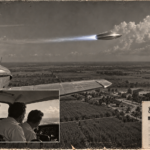
The procession shot forward like a stream of tracer bullets, out over the Chesapeake Bay to within a half-mile of the plane. Realizing the line was going to pass under the nose of the plane and to the right of the copilot, Nash quickly unfastened his seat belt to move to the window on that side. Both pilots would later recollect: “All together, they flipped on edge, the sides to the left going up and the glowing surface facing right. Though the bottom surfaces did not become clearly visible, we had the impression that they were unlighted. The exposed edges, also unlighted, appeared to be about 15 feet thick, and the top surface, at least, seemed flat. In shape and proportion, they were much like coins. While all were in the edgewise position, the last five slid over and past the leader so that the echelon was now tail-foremost.”
This shift had taken only a brief second, completed by the time Nash reached the window. Both pilots then observed the discs flip back from on-edge to flat and dart off to the west, holding the new formation. The objects had seemed to dim slightly just before the abrupt angular turn, then brightened considerably after making it. “The only descriptive comparison we can offer is a ball ricocheting off a wall,” Nash proposed.
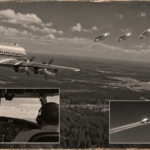
An instant later, two more identical objects darted out past the right wing, from behind and under the airplane at the same altitude as the others, and quickly fell in behind the receding procession, glowing noticeably brighter, as though applying power to catch up. Then the lights of all the objects blinked out, reappeared a moment later, maintained low altitude across the darkness of the bay until about 10 miles beyond Newport News, then began climbing in a graceful arc well above the plane’s altitude before blinking out randomly and vanishing.
Describing the disappearance years later, Nash wrote: “As they climbed, they oscillated up and down behind one another in an irregular fashion, as though they were extremely sensitive to control… they disappeared by blinking out in a mixed-up fashion, in no particular order.” Their bewildered initial reaction is best captured in Nash’s own words: “We stared after them, dumbfounded and probably open-mouthed… There were flying saucers, and we had seen them. What we had witnessed was so stunning and incredible that we could readily believe that if either of us had seen it alone, he would have hesitated to report it. But here we were, face to face. We couldn’t both be mistaken about such a striking spectacle.”
The time was 8:12 p.m. Eastern Standard Time. Fortenberry checked the main cabin; no passengers had seen anything. The pilots radioed Norfolk with their scheduled position report, then added a second message for the military: “Two pilots of this flight observed eight unidentified objects vicinity Langley Field; estimate speed in excess of 1,000 mph; altitude estimated 2,000 feet.” Captain Koepke then took over the controls while Nash and Fortenberry reconstructed the sighting.
Using a Dalton Mark 7 computer, they determined the objects’ angle of approach and departure — a difference of about 30 degrees, meaning the objects had made a roughly 150-degree change of course almost instantaneously. Using their known position relative to the Norfolk VHF range, they calculated Newport News was 25 miles away, adding the estimated 10 and 30 miles traveled in each direction for a total distance of about 90 miles — conservatively rounded down to 50 miles for their official estimate. To determine the sighting’s duration, they reenacted the sequence seven times using the cockpit’s panel stopwatches, never exceeding 12 seconds; they conservatively adopted 15 seconds for their final calculation. That yielded a speed of 200 miles per minute — 12,000 miles per hour.
They estimated the objects at slightly more than a mile below the plane, roughly 2,000 feet above ground, and — comparing their apparent size to a DC-3’s wingspan at that distance — judged them at approximately 100 feet in diameter and 15 feet thick. This case is unusual in that the aircraft’s own known altitude of 8,000 feet gave the pilots a fixed reference point most UFO witnesses never have, since most sightings occur against an empty sky with no standard of comparison.
Nash later explained his confidence in the altitude estimate in a letter to Dr. Donald Menzel: “We both had flown many thousands of hours at either 7000 or 8000 feet… a sort-of ‘instinct-judgment’ about the height of objects gradually developed… Our judgment, after seeing these things travel nearly a hundred miles, and observing them both from a distance and almost directly beneath us, was that they were holding 2000 feet for most of the observed time.” Both pilots had Navy backgrounds — Nash had flown patrol bombers hunting German submarines off Africa and South America, and Fortenberry served two years in the Navy’s air experimental wing — giving both men intensive training in aircraft identification.
They landed at Miami shortly after midnight and found their radioed message had been forwarded with an addition: “Advise crew five jets were in area at the time.” The pilots were certain the objects were not jets. At 7 a.m., USAF investigators called; USAF Wing Intelligence Officer Major John H. Sharpe and four officers from the 7th District Office of Special Investigations met them at the airport, questioning each pilot separately for one hour forty-five minutes, then together for a half hour. Questions had been prepared in advance to evaluate their independent recall; map overlays and a complete, matching weather report were compared. Following the interview, investigators told the pilots that seven additional witnesses had already reported similar sightings within 30 minutes, in the same area — including a Lieutenant Commander and his wife who described a formation of red discs making immediate directional changes without any turning radius.
NICAP later retained copies of some confirming reports published in Norfolk newspapers. One witness stated she and a friend, sitting in Stockley Gardens, saw seven or eight objects “circling overhead and then going north,” the first three white and the rest yellow and red. A naval officer aboard the cruiser USS Roanoke reported eight red lights near Point Comfort proceeding in a straight line before disappearing, sighted about 15 minutes before the pilots’ own observation.
Press coverage of the sighting the following day led NASA-Langley aerodynamicist Paul R. Hill to watch the sky himself on the evening of July 16. He observed two amber objects approach from the south, curve overhead, then begin revolving around a common center before switching to the vertical plane — joined by two more before all four headed south. “Up to that point I had been just a fascinated spectator. Now they had convinced me,” Hill later wrote. “It was within my line of business to know that no Earthcraft could remotely approach those maneuvers.” Hill went on to a lifelong study of UFO reports and propulsion physics, publishing his findings posthumously in Unconventional Flying Objects: A Scientific Analysis (1995).
At the time, Project Blue Book’s nine-person staff was overwhelmed, receiving roughly twenty reports a day by mid-July, with about 40 percent going unexplained. Blue Book determined the five Langley jets could not account for the sighting and filed the case as an Unknown — receiving what the report itself describes as a “less than adequate” investigation, given that the following weekend brought the far more publicized Washington National Airport radar events.
In 1962, Harvard College Observatory director Donald H. Menzel reexamined the case for his book The World of Flying Saucers. Working from the limited official report, Menzel proposed the sighting was a reflection in the cockpit windows, given the apparent violation of inertia in the objects’ near-instantaneous reversal. Nash disputed this sharply in a letter: “The objects were between us and the West. They would have had to be damned persistent, consistent and impossible reflections to have manifested in three cockpit windows in exactly the same way… pilots do not excite easily or they would not be airline pilots.” Ruling out cockpit lighting or a cigarette as sources (there were no hostesses aboard and the cockpit door was closed), Menzel ultimately concluded Nash’s observations were “completely consistent with the theory that the discs were immaterial images made of light” — proposing that a searchlight shining through stacked layers of atmospheric haze from a temperature inversion could produce a series of apparently ricocheting discs.
Since official weather reports showed no inversion that night, Menzel theorized an undetectable localized one, driven by a summer heat wave and drought. He never identified the specific light source, though he suggested a coastal light shining northeast toward the plane. This raises an internal inconsistency: since the discs’ echelon had its leading object at the lowest point, the light source implied by the formation’s geometry would have to be behind the aircraft, not in front of it as Menzel’s theory required — nor does the reflection theory explain the two objects that joined from beneath the plane, or the edge-flip-and-reversal maneuver at what investigating officer Major Sharpe called “a speed fantastic to contemplate” (90 miles in 12 seconds works out to 27,000 mph).
Bill Fortenberry was lost in a Boeing B-377 Stratocruiser crash in the Pacific in early 1957, with all aboard. Nash went on to fly the Berlin corridors for 15 years before retiring from Pan American. In a 2002 interview for the Sign Oral History Project, Nash offered his final assessment: “Looking at the thing shook us up. We stared at each other, and all of a sudden there was this realization that our world is not alone in the universe… I know to this day, that it was nothing from this planet.”
RESEARCHER’S NOTES
The Nash-Fortenberry Case — Quantified Data From Two Trained Observers
- The known-altitude reference point is this case’s single greatest evidentiary advantage. Because the DC-4’s own altitude was precisely known, Nash and Fortenberry could calculate real distance, size, and speed figures rather than offering rough impressions against an empty sky — a genuinely rare condition in UFO reporting.
- Both witnesses had directly relevant professional training. Navy-trained aircrew with extensive aircraft-identification instruction and thousands of hours flying at the exact altitudes in question are about as qualified a pair of observers as this archive’s 1952 cases produce.
- Independent corroboration from at least seven other witnesses within the same 30-minute window substantially strengthens the case. Multiple unconnected observers, including a naval officer and civilians in a public park, describing broadly consistent phenomena in the same region the same night is a meaningful pattern, even without identical detail.
- Menzel’s temperature-inversion explanation has a specific, identifiable geometric problem. The formation’s own described structure — leading object lowest, trailing objects progressively higher — implies a light source behind the aircraft, which conflicts with where Menzel needed the source to be for his reflection theory to work.
- The case directly triggered a second, independent sighting two days later. Paul Hill’s July 16 observation exists specifically because he read about this case and decided to watch the sky himself — an unusually direct causal link between one UFO report and another, and one that launched a career-spanning scientific study of the subject.
- The case’s investigation was acknowledged, even at the time, to be less thorough than it deserved. Its timing — one week before the Washington National Airport flap consumed the Air Force’s UFO-investigation resources — meant a genuinely strong case received comparatively limited official follow-up.
The Nash-Fortenberry sighting remains, by the standards of this archive, one of the best-documented and most carefully reconstructed UFO cases of the entire 1952 wave — two trained, credentialed observers with a fixed altitude reference, a rapid and detailed post-flight reconstruction using onboard instruments, independent same-night corroboration from multiple unconnected witnesses, and a later proposed explanation that its principal witness was able to specifically and technically dispute rather than simply deny. It remains, officially, an Unknown.
“There were flying saucers, and we had seen them… We couldn’t both be mistaken about such a striking spectacle.”
— Captain William B. Nash
PHOTOGRAPHS

Reported actions of Chesapeake Bay discs. (credit: NICAP / Richard Hall, 1964)