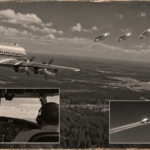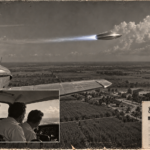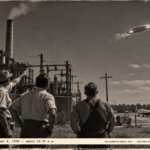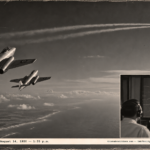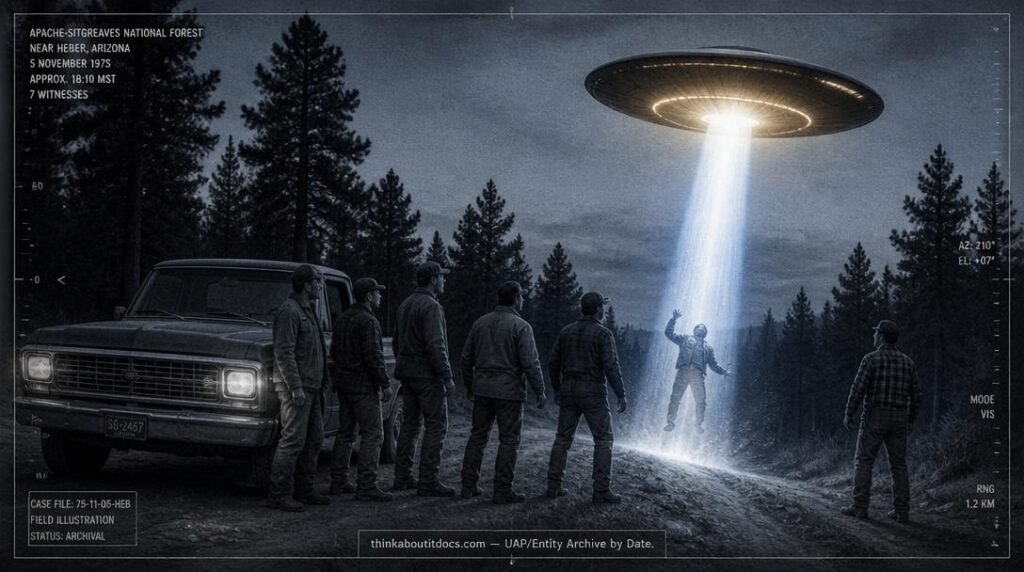
Archival rendering of the November 5, 1975 encounter near Heber, Arizona, in which Travis Walton was reportedly struck by a beam and disappeared for five days.
THINK ABOUTIT ABDUCTION REPORT
1975: Think AboutIt’s Abduction Summary – Travis Walton
On the evening of November 5, 1975, a seven-man forest service brush-clearing crew in the Apache-Sitgreaves National Forest near Heber, Arizona, reported encountering a luminous disc hovering near their truck on a remote dirt road. Crew member Travis Walton approached the object on foot and was reportedly struck by a brilliant blue-white beam that hurled him backward through the air. The remaining six crew members fled in the truck; when they returned, both Walton and the object were gone. Walton was missing for five days, reappearing near Heber on November 10 with fragmentary memories of entities and an unfamiliar environment aboard a craft. Five of the six crew members passed polygraph examinations administered by the Arizona Department of Public Safety within days of the event. A total of thirteen polygraph examinations would eventually be conducted in connection with the case — eleven passed, one inconclusive, one failed. The Travis Walton abduction is the first major UFO case involving the multi-day disappearance of a witness corroborated by multiple independent observers and remains one of the most extensively tested and debated cases in the field.
Date: November 5, 1975 (initial encounter); November 10, 1975 (Walton’s return)
Sighting Time: Approximately 6:10 p.m. MST
Day/Night: Dusk/Night (near sunset in early November at ~5,500 feet elevation in the White Mountains)
Location: Remote dirt road in the Apache-Sitgreaves National Forest, near Turkey Springs, approximately 15 miles south of Heber, Arizona (Navajo County)
Urban or Rural: Rural (remote National Forest, no structures or habitation nearby)
No. of Entity(‘s): Multiple (per Walton’s account — small humanoids and larger human-appearing beings)
Entity Type: Two types reported by Walton: (1) Small humanoids with large, luminous brown eyes, bald, with small features, approximately 5 feet tall, wearing loose tan-brown robes; (2) Human-appearing beings — a man and a woman, attractive, wearing blue coveralls, who did not speak but led Walton to a room where he lost consciousness
Entity Description: The small humanoids had disproportionately large heads, enormous dark eyes, small noses, mouths, and ears, and marshmallow-pale skin. Walton described them as fetus-like in appearance. The human-appearing beings were taller, wearing blue coveralls with a helmet-like transparent covering, and did not respond when Walton spoke to them
Hynek Classification: CE-IV (Close Encounter IV) — abduction with missing time, physical interaction (beam strike), and five-day disappearance
Duration: Initial encounter: several minutes. Walton’s absence: 5 days, 6 hours (approximately 6:10 p.m. November 5 to shortly after midnight November 10)
No. of Object(s): 1 (initial encounter); possibly additional craft observed by Walton during his account of the abduction experience
Description of the Object(s): Initial encounter: a luminous, reflective, flattened disc hovering close to treetop level, described as smooth, glowing yellowish-orange to golden. Rogers and Walton estimated approximately 20 feet in diameter. It emitted a blue-white beam or flash when Walton was beneath it. Upon the crew’s return, the object was gone; Rogers reported seeing a luminous object lift from the forest and streak toward the horizon as they fled. Return: Walton described regaining consciousness on a road near Heber beneath a silvery disc approximately 40 feet in diameter, which departed vertically with a breeze but no sound
Shape of Object(s): Flattened disc / saucer
Size of Object(s): Approximately 20 feet in diameter (initial encounter estimate); approximately 40 feet in diameter (Walton’s return observation)
Color of Object(s): Yellowish-orange to golden glow (initial); silvery/mirrored (Walton’s return)
Distance to Object(s): Approximately 75–100 feet from the truck (initial); approximately 90 feet from Walton (initial approach); 12 yards (return)
Height & Speed: Hovering near treetop level during initial encounter; departed at high speed toward the horizon per Rogers’s observation
Number of Witnesses: 7 for the initial encounter: Travis Walton, Mike Rogers (foreman/driver), Allen Dalis, Dwayne Smith, Kenneth Peterson, John Goulette, Steve Pierce. Walton alone for the abduction experience and return
Special Features/Characteristics: Walton was reportedly struck by a brilliant blue-white beam described variously as a ray, flash, or prolonged strobe, which hurled him backward through the air approximately 10 feet. The remaining crew fled in panic. Walton was missing for five days in sub-zero overnight temperatures without cold-weather survival gear. He reappeared near Heber, calling his sister from a gas station shortly after midnight on November 10, confused, dehydrated, and distraught, with approximately five days of missing time. Sheriff Marlin Gillespie described the crew as sincerely distressed. Law enforcement initially investigated the possibility that Walton had been murdered. Extensive ground and air searches (including helicopters and dogs) during the five-day absence found no trace of Walton. The case was investigated by APRO (Jim Lorenzen), with funding assistance from the National Enquirer. Walton published two books: “The Walton Experience” (1978) and “Fire in the Sky” (1996). A feature film, “Fire in the Sky,” was released in 1993
Case Status: Unexplained (contested)
Source: Travis Walton, “The Walton Experience” (Berkley, 1978) and “Fire in the Sky” (Marlowe & Co., 1996); APRO investigation (Jim Lorenzen); Cy Gilson, Arizona Department of Public Safety (polygraph examinations 1975 and 1993); Philip J. Klass, “UFOs: The Public Deceived” and “UFO Abductions: A Dangerous Game”; Bill Barry, investigative account of the case; court and academic literature on polygraph validity (see Researcher’s Notes)
Summary/Description: On November 5, 1975, a seven-man brush-clearing crew encountered a luminous disc hovering in the Apache-Sitgreaves National Forest near Heber, Arizona. Travis Walton approached the object and was struck by a blue-white beam. The remaining crew fled; upon returning, Walton and the object were gone. Walton reappeared five days later near Heber with fragmentary memories of small humanoid and human-appearing entities aboard a craft. Five of six crew members passed polygraph tests administered by the Arizona DPS. A total of thirteen polygraph examinations were conducted over subsequent years — eleven passed, one inconclusive, one failed (Walton’s first test, administered under problematic conditions). The case remains one of the most extensively documented and debated abduction cases in UFO history.
Related Cases: Brian Scott Abduction Case 1971–1975 | 1997 Phoenix Lights
Detailed Report
On the late afternoon of November 5, 1975, a crew of seven men employed under a U.S. Forest Service brush-clearing contract were driving home from work on a remote dirt road in the Apache-Sitgreaves National Forest, approximately 15 miles south of Heber, Arizona, at an elevation of roughly 5,500 feet in the White Mountains. The crew foreman and driver was Mike Rogers; the other crew members were Travis Walton (Rogers’s close friend), Allen Dalis, Dwayne Smith, Kenneth Peterson, John Goulette, and Steve Pierce.
At approximately 6:10 p.m., as dusk settled over the forest, the crew observed a glowing object through the trees ahead. Rogers stopped the truck. The object was a luminous, flattened disc hovering near treetop level in a clearing approximately 75–100 feet from the vehicle, glowing a yellowish-orange to golden color and roughly 20 feet in diameter.
Walton exited the truck and walked briskly across the clearing toward the object, later estimating he came within 90 feet of it. As he reached a position roughly beneath the disc, the object began to wobble or rock. A brilliant blue-white beam struck Walton — described variously by crew members as a ray, a flash, and a prolonged strobe — and hurled him backward through the air approximately 10 feet, where he fell on his back. Allen Dalis shouted at Rogers to drive. Rogers accelerated away from the scene. Looking back as the truck fled, Rogers reported seeing a luminous object lift out of the forest and streak toward the horizon.
Cy Gilson, the polygraph examiner who later tested the crew, recorded detailed pretest interviews with each man. Dalis described the object as yellowish-white, giving off a steady glow rather than a bright light, and recalled seeing Walton stop beneath it with his hands in his pockets before the object began to wobble; when the flash came, Dalis put his head down and, looking up again, saw Walton silhouetted with his arms raised before yelling for Rogers to leave. Rogers, viewing the object through the truck windows from the far side, similarly described a yellowish-tan glow, could make out shadows the object cast on the ground, and recalled a prolonged flash of light followed by seeing Walton thrown backward and falling onto his back.
After driving a short distance, the crew debated what to do, then returned to the site. Both the object and Walton were gone. They searched briefly by flashlight, calling Walton’s name, then drove to the main road and contacted law enforcement. Deputy Ellison and Sheriff Marlin Gillespie responded and returned to the site with the crew for a further search, which was called off with plans for a larger effort at daylight. Gillespie would later describe the crew members as genuinely and visibly distressed.
Over the next five days, ground and air searches — including helicopters and tracking dogs — failed to locate Walton. Overnight temperatures dropped below zero. Law enforcement considered the possibility that Walton had been murdered, and the crew members came under suspicion. The six remaining crew members had indicated willingness to take lie detection tests. On the second day of the search, Cy Gilson of the Arizona Department of Public Safety administered polygraph examinations to all six. Five passed; Allen Dalis’s results were ruled inconclusive. The successful results drew national media attention.
Shortly after midnight on November 10, five days and six hours after the initial encounter, Walton’s brother-in-law Grant Neff received a phone call from a confused and distressed Travis Walton, calling from a gas station near Heber. Walton was found slumped in a phone booth, dehydrated and disoriented, with several days’ growth of beard. He had fragmentary memories of waking in a hospital-like room aboard what he took to be a spacecraft, encountering small humanoid beings with disproportionately large heads, enormous dark luminous eyes, and fetus-like features, wearing loose tan-brown robes. He described being led through corridors to a room where he encountered human-appearing beings — a man and a woman in blue coveralls — who did not speak but placed a device over his face, after which he lost consciousness. His next memory, as Walton later recounted in his book Fire in the Sky, was of coming to on the pavement of a road near Heber, the cold air waking him, in time to glimpse a mirrored disc hovering silently a few feet above the road before it shot upward and vanished, stirring the nearby trees with the breeze of its departure.
The case was taken up by APRO (the Aerial Phenomena Research Organization), led by Jim Lorenzen, which arranged for psychological examinations and a polygraph test for Walton through the National Enquirer, which was providing financial support for the investigation and seeking exclusive coverage. Walton’s first polygraph, administered by examiner John McCarthy under conditions that both sides would later describe as problematic, was failed. This result was initially suppressed by the Enquirer, which ran a large feature touting the case. When the failed test became public, it became one of the most debated elements of the case.
Walton was subsequently tested by additional examiners and passed. In February 1993, polygraph examiner Cy Gilson — the same examiner who had tested the crew in 1975 — administered a test to Walton using state-of-the-art computerized equipment. This test was notably sponsored by skeptic Jerry Black, who had hoped to disprove the case. Walton passed. In the same 1993 session, Gilson retested crew members Allen Dalis (whose 1975 test had been inconclusive) and Steve Pierce, plus Walton’s brother Duane and mother Mary Walton Kellett. All passed. The full polygraph ledger for the case stands at thirteen tests administered to nine individuals: eleven passed, one inconclusive, one failed.
Researcher’s Notes
The Walton Abduction — Apache-Sitgreaves 1975 and the Weight of the Record
- The Multi-Witness Foundation: What separates the Travis Walton case from the great majority of abduction reports is that the precipitating event — the encounter with the luminous disc, the beam strike, and Walton’s disappearance — was witnessed by six other people. These were not family members sitting in a living room or fellow travelers in a contactee tradition; they were co-workers on a Forest Service contract, several of whom (notably Allen Dalis) had no personal relationship with Walton and in Dalis’s case had active tensions with him. They reported the event to law enforcement immediately. Sheriff Gillespie found them sincerely distressed. Five of six passed polygraph tests within days, administered by a state law enforcement examiner (Cy Gilson) with no stake in the outcome. Skeptics have generally been forced to argue either that all seven men were colluding in a hoax — against their individual interests, under police suspicion of murder, and under polygraph examination — or that the six crew members genuinely misperceived a natural or man-made phenomenon and Walton’s disappearance was coincidental.
- The Polygraph Record — Strengths and Complications: The thirteen-test polygraph record is simultaneously the case’s strongest evidence and its most contested element. The 1975 DPS tests of the crew are among the least assailable polygraph results in UFO case history — administered by a state examiner, under law enforcement auspices, within days of the event, to reluctant subjects under suspicion of involvement in a possible homicide. Walton’s own polygraph history is more complex: his first test, administered by John McCarthy, was failed, using a “Relevant/Irrelevant” methodology that polygraph researchers (notably David Raskin and Charles Honts) have separately characterized as scientifically outdated and prone to a high rate of false-positive results, particularly for an agitated, recently traumatized subject. Walton’s subsequent passes, including the 1993 Gilson test sponsored by an independent skeptic, used a modern computer-scored Control Question Test methodology and restored much of the evidentiary ground lost by the earlier failure. The archive notes the full record — eleven passes, one inconclusive, one failure — and the significant methodological gap between the failed test and the passed ones, and lets the reader weigh the pattern.
- The APRO and National Enquirer Entanglement: The case’s investigative chain is complicated by the involvement of the National Enquirer, which provided financial support to APRO’s investigation in exchange for exclusive coverage rights. This arrangement created incentive structures that complicate the evidentiary record — the initial suppression of Walton’s failed McCarthy polygraph, which only became public after outside scrutiny by skeptic Philip Klass, is the clearest example. The Enquirer’s financial incentive favored validating the case; APRO’s institutional incentive favored a landmark abduction investigation. Neither incentive structure is consistent with disinterested fact-finding, though it does not by itself establish that the underlying account is false. Subsequent investigations, including the 1993 Gilson retests, were conducted outside the Enquirer relationship and under adversarial sponsorship, which strengthens their evidentiary weight relative to the earlier tests.
- The Klass Critique and Its Rebuttals: Philip Klass, one of ufology’s most prominent skeptics, published extensive criticism of the case across two books, arguing among other things that Rogers and Walton staged the encounter to escape a failing forest-clearing contract. Forest Service officials who supervised that contract directly disputed the financial-motive theory, stating on the record that a hoax would not have benefited Rogers. Walton and his supporters also demonstrated, using original source transcripts, that several of Klass’s most damaging quotations of crew members had been selectively trimmed in ways that altered their apparent meaning — a pattern documented in Walton’s own later rebuttal material and independently noted by investigator Bill Barry. This does not resolve the underlying case either way, but it means Klass’s published critique should not be taken at face value without checking his sourcing.
- The 1993 Retest and Its Significance: The 1993 Gilson retests of Walton, Rogers, and Dalis were conducted at the initiative of a skeptical investigator, Jerry Black, who had originally believed the case to be a hoax and reopened his own independent inquiry before the tests were arranged. All three passed using modern computer-scored methodology, which polygraph researchers have described as significantly more resistant to conscious countermeasures than the analog techniques used in 1975. Black’s own assessment shifted substantially over the course of his investigation, a detail worth noting given his initial skepticism and lack of incentive to validate the case.
- The Walton Case in the Archive: The Travis Walton abduction is classified Unexplained (contested). Unexplained, because no conventional explanation has been established that accounts for all elements — the multi-witness sighting, the beam strike, the five-day disappearance in sub-zero conditions, the physical condition upon return, and the polygraph record. Contested, because the McCarthy polygraph failure, the Enquirer entanglement, the evolving public presentation of Walton’s abduction narrative, and the inherent unverifiability of the aboard-craft memories leave room for legitimate dispute. The case is not a closed file in either direction. It is the first major abduction case with a multi-witness foundation and an extensive polygraph record, and it set the template — for better and worse — for how abduction cases would be investigated, publicized, and debated for the next half century. The archive holds it at the weight the evidence supports, and no more.
Travis Walton walked across a clearing in the White Mountains on a November evening in 1975, and whatever happened next has never been adequately explained. Six men watched him fall. Five days later he came back. The record holds what the record holds — thirteen polygraph tests, seven witnesses, two books, one movie, and a question that remains open.
“I am still of the same opinion that they were valid examinations.”
— Cy Gilson, polygraph examiner, reaffirming his 1975 findings in 1993
Extended Analysis: The Polygraph Controversy
Because so much of the public debate over this case has centered on its polygraph record, it’s worth walking through that record’s methodology in more detail. Modern polygraph practice recognizes a meaningful distinction between the older “Relevant/Irrelevant” (RI) technique and the more rigorous “Control Question Test” (CQT) format developed later. Published reviews of the scientific literature — including field-study meta-analyses summarized in peer-reviewed psychology journals and cited in U.S. federal court opinions evaluating polygraph admissibility — have consistently found the RI format to carry a very high false-positive rate, while properly administered CQT examinations have shown accuracy rates researchers generally place in the 85–90% range under both laboratory and field conditions.
This distinction matters directly for the Walton case. The 1975 Gilson tests of the six crew members used a CQT-style approach, administered by a state law-enforcement examiner under no incentive to validate a UFO story. Walton’s own first test, administered by private examiner John McCarthy, used the older RI methodology — a format polygraph researcher David Raskin, reviewing the transcripts at the time, considered outdated by contemporary standards. Independent polygraph scholar Charles Honts has separately noted that RI-format failures carry little diagnostic weight and should not be treated as meaningful evidence of deception on their own. Compounding the methodology concern, contemporaneous accounts describe Walton as visibly agitated and distressed during the McCarthy session — a state that tends to increase false-positive risk on already less reliable RI-format tests.
Skeptic Philip Klass made the failed McCarthy test the centerpiece of his published case against Walton, and the result did significantly damage the case’s public reputation for years afterward, including among some ufologists who otherwise found the multi-witness sighting itself credible. But Klass’s broader case relied heavily on selectively edited quotations from crew members and Forest Service officials — quotations that, when checked against fuller transcripts later obtained by Walton’s team, generally read quite differently in context. Investigator Bill Barry, whose own book Klass drew from, was sharply critical of how his material had been used. None of this proves the underlying abduction account true; it simply means Klass’s specific evidentiary claims deserve the same scrutiny he applied to Walton’s.
The 1993 retests, conducted using modern computer-scored CQT methodology under the sponsorship of an initially skeptical investigator, produced passing results for Walton, Rogers, and Dalis, with Gilson reporting very high statistical confidence for Rogers and Dalis specifically. Polygraph researchers consulted on the case at the time were skeptical that simple repeated retelling of a story over eighteen years would meaningfully help a deceptive subject pass a modern CQT exam, given the computer-scoring method’s resistance to conscious countermeasures. Jerry Black, the skeptic who sponsored the 1993 tests, ultimately concluded that Walton had little practical incentive to submit to further testing if he had been lying, since the film adaptation was already complete and Walton’s compensation already secured.
Taken together, the polygraph record shows a genuinely mixed picture rather than a simple validation or debunking: strong, methodologically sound results supporting the crew’s sighting account and, eventually, Walton’s own testimony, alongside one badly flawed early test that nonetheless shaped much of the case’s public reception for two decades. The 1993 film “Fire in the Sky” dramatized the on-craft abduction sequence with substantial creative embellishment; Walton has stated the film’s human drama is broadly accurate while the alien-encounter sequence was fictionalized well beyond his own described memories, which he has characterized as brief, non-violent, and involving beings with visible pupils rather than the featureless “grey” entities of later abduction folklore.