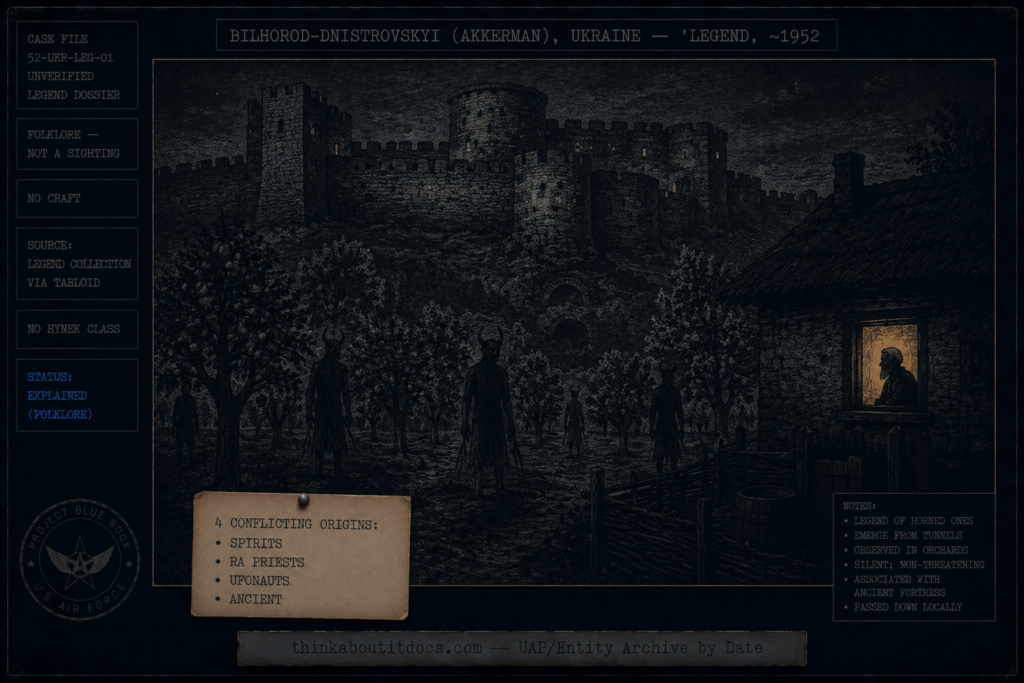
The "horned humanoids" of Belgorod-Dnestrovsky's Akkerman fortress — a body of Ukrainian local legend rather than a dated 1952 sighting, with four conflicting origin stories and no craft. Logged as folklore. (thinkaboutitdocs.com — UAP/Entity Archive by Date)
THINK ABOUTIT UFO|UAP|ENTITY SIGHTINGS REPORT
1952: “Horned” Humanoid Legends of Belgorod-Dnestrovsky (Akkerman Fortress), Ukraine
FOLKLORE / LEGEND — not a documented sighting.
No craft, no investigated event, no fixed date. Catalogued honestly as local folklore.
It reads like a close encounter — an old man with insomnia looks out his window one summer night in 1952 and sees tall, horned figures moving in a neighbor’s garden; by morning every apple is gone, and soon the town is whispering about horned things that come up out of the ground to steal food. But trace it to its source and the “sighting” dissolves into something older and looser: a collection of local legends about the ancient Akkerman fortress, gathered by ethnographers and retold in a Russian tabloid, in which horned beings are said to dwell in the fortress’s underground tunnels. The fortress and its tunnels are real medieval history; the horned dwellers are folklore — devils, forest spirits, Egyptian priests in horned caps, or “Ufonauts,” depending on which version you read. The archive keeps the entry, but files it as what it is: a piece of regional legend attached to a real ruin, not a dated UFO or entity event.
Date: Given as June or July 1952 (this is the date of one anecdote within a body of folklore, not a verified event date)
Sighting Time: Night (as told)
Day/Night: Night
Location: Belgorod-Dnestrovsky (Bilhorod-Dnistrovskyi), Odessa region, Ukraine — near the Akkerman fortress
Urban or Rural: Rural (a garden plot near the fortress)
No. of Entity(‘s): Several (as described in the legend)
Entity Type: Folkloric “horned” humanoids — tall figures appearing to have horns
Entity Description: Tall human-like figures that appeared to be horned; said in local legend to live underground beneath the fortress, to avoid daylight, and to come to the surface at night to take food
Hynek Classification: None — no craft or object is involved; this is a folkloric entity legend, not a UFO-associated encounter (the prior CE-III is incorrect, as CE-III requires beings associated with a craft)
Duration: Not applicable
No. of Object(s): None — no object reported
Description of the Object(s): Not applicable
Shape of Object(s): Not applicable
Size of Object(s): Not applicable
Color of Object(s): Not applicable
Distance to Object(s): Not applicable
Height & Speed: Not applicable
Number of Witnesses: 1 in the central anecdote (an elderly pensioner); the wider material is collective town legend, not enumerated witnesses
Special Features/Characteristics: Tied to the real Akkerman fortress and its documented underground tunnels; legend holds the horned beings live below and surface at night; competing local explanations include forest spirits/devils of Slavic folklore, a sanctuary to the Egyptian god Ra whose priests wore horned caps, and “Ufonauts” from a supposed Black Sea UFO crash — the explanations are mutually exclusive and self-cancelling
Case Status: Explained (folklore / local legend, not a sighting event)
Source: Yuriy Misyuk, a student of local lore, quoted in Komsomolskaya Pravda (Russian tabloid); the underlying material is a collection of Belgorod-Dnestrovsky legends compiled by ethnographers Vladislav Chelpanov and Sarvar Sklyar
Summary/Description: A body of local legend, retold in a Russian newspaper, holds that horned humanoid beings live in the underground tunnels of the ancient Akkerman fortress at Belgorod-Dnestrovsky, Ukraine, surfacing at night to take food. Its best-known anecdote, dated June or July 1952, describes an elderly insomniac seeing several tall, horned figures in a neighbor’s garden, with the apples gone by morning. There is no craft, no investigation, and no fixed event — only folklore attached to a real medieval fortress. It is recorded as a legend rather than a UFO or entity sighting.
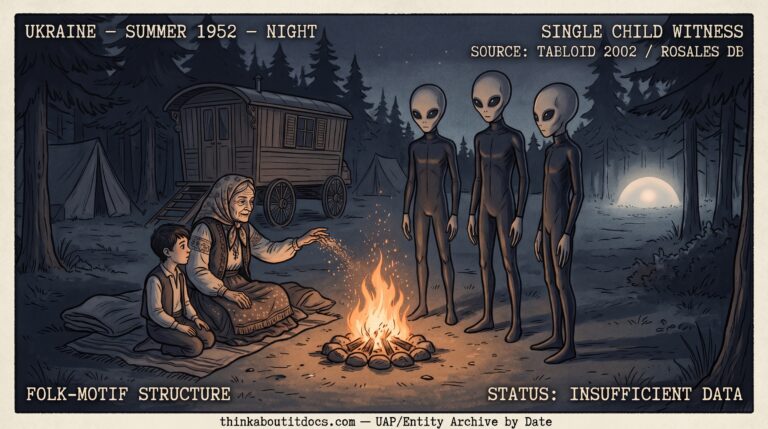
Related Cases: 1952: 3 Human-Like Aliens in Ukraine | Subterranean Bases (underground-dweller legends) | the broader corpus of Slavic “underground folk” and forest-spirit folklore
DETAILED REPORT
The story, as the archive received it, is built around a single vivid anecdote. One summer night in 1952 — June or July, the retelling says — an elderly pensioner in Belgorod-Dnestrovsky, unable to sleep, looked out the window of his one-room house and saw several tall figures in his neighbor’s garden plot. They appeared, to his alarm, to be horned. He switched off his light and hid; in the morning, the neighbor’s apple trees had been stripped. From there, the account says, talk spread through the town and nearby villages of horned beings that came at night to steal food.
Followed to its root, though, this is not an isolated 1952 sighting but one thread in a much older tapestry of local legend. The material reaches the archive through a student of local lore, Yuriy Misyuk, quoted in the Russian tabloid Komsomolskaya Pravda, and behind that lies a published collection of Belgorod-Dnestrovsky legends compiled by two ethnographers, Vladislav Chelpanov and Sarvar Sklyar. Their subject is the Akkerman fortress — Bilhorod-Dnistrovskyi — a genuine architectural monument of the 13th and 14th centuries, and the legend holds that a labyrinth of tunnels beneath it is home to horned beings who emerge after dark.
What is real here is the setting. The fortress exists, and its underground spaces are historically documented; the Ottoman traveler Evliya Çelebi noted them after visiting in 1657. Old ruins with real tunnels are precisely the kind of place that accretes legend, and Belgorod-Dnestrovsky’s has accreted a great deal. What is not real, in any evidential sense, is the horned dwellers, and the giveaway is that the legend cannot decide what they are. The same body of lore offers, in turn, that they are forest spirits or devils of Slavic folklore; that they are the ghosts of priests from a supposed underground sanctuary to the Egyptian god Ra, who wore horned caps; that they are “Ufonauts” who survived a UFO crash into the nearby Black Sea and hid beneath the fortress; and, in another breath, that they have nothing to do with any UFO because they have been reported since ancient times. These explanations are mutually exclusive. A real event has one nature; a legend has as many as its tellers need.
The prior page filed this as a CE-III — a close encounter with beings associated with a craft. That is doubly wrong. There is no craft anywhere in the account; there is a garden, some missing apples, and a frightened old man’s glimpse of shapes in the dark. And even setting the classification aside, the material is not a witness report in the sense the archive’s other entries are. It is folklore: collective, undated in any firm way, endlessly variable, and explicitly presented by its own sources as legend. The single “1952” anecdote has been lifted out and given a date and a Hynek class it cannot support.
None of this requires inventing a debunking. Horns in a night-time glimpse can be any number of mundane things — an animal, a person in a hat or carrying tools, shadow and suggestion in a sleepless man’s window — and stripped fruit trees need no explanation more exotic than ordinary thieves or wildlife. But the archive does not even need to adjudicate the apples. The honest classification is prior to that: this entry is a regional legend attached to a real fortress, not a documented UFO or entity event, and it should be read and filed as folklore.
RESEARCHER’S NOTES
The Horned Folk of Akkerman — Ukraine and a Legend Mistaken for a Sighting
- Classification, why none applies: CE-III was the prior label and it fails on the most basic requirement: there is no craft. CE-III denotes animate beings associated with a UFO, and nothing in this account involves an object of any kind — it is figures in a garden and missing fruit. Under the archive’s own standard, entity reports lacking a craft are not close encounters of the third kind, and legends carry no Hynek classification at all. The field is correctly set to None, with the reason that this is folklore rather than a witnessed craft-associated event.
- Source-chain assessment: The chain runs from a published collection of local legends (ethnographers Chelpanov and Sklyar) to a tabloid retelling (Komsomolskaya Pravda) to a local-lore student (Misyuk) to the catalog entry. At no point is there an investigated incident, a named primary witness who was interviewed, or contemporaneous documentation of a 1952 event. This is the same Russian-tabloid folklore-to-UFO pipeline that the archive treats with heightened caution on Soviet and post-Soviet material generally; even without a specific problematic compiler’s byline, the genre is legend-laundering, and the “June or July 1952” date is an artifact of cataloguing, not a record.
- The self-cancelling explanations as the tell: The clearest signal that this is folklore rather than a sighting is that the lore supplies four incompatible origins for the same beings — Slavic forest spirits, horned-capped priests of an Egyptian Ra cult, crashed-UFO survivors, and timeless ancient creatures unconnected to any UFO. A genuine encounter generates one disputed interpretation; a living legend generates a menu. The Egyptian-Ra-sanctuary and Black-Sea-crash elements in particular are the kind of romantic accretion that gathers around any dramatic ruin, and they should be read as storytelling, not data.
- What is real, and the geographic fix: The one solid thing in the entry is the Akkerman fortress itself, a real 13th–14th-century monument at Bilhorod-Dnistrovskyi in Ukraine’s Odessa region, with genuinely documented underground passages recorded since the 17th century. That reality is the seed crystal for the legend, not evidence for it. A secondary correction: some retellings confuse this Ukrainian Bilhorod-Dnistrovskyi with the Russian city of Belgorod in Belgorod Oblast, and the prior page’s breadcrumb even filed it under “Russia Sightings.” The fortress and the legend are Ukrainian, Odessa region, and the entry is located accordingly.
The horned humanoids of Belgorod-Dnestrovsky are a good story and a real piece of regional folklore, rooted in a genuine medieval fortress whose tunnels have invited legend for centuries. What they are not is a 1952 UFO or entity sighting. The archive keeps the entry for its place in the record and its location interest, strips the CE-III it never warranted, names the legend-collection at its source, and files it honestly as folklore — Explained not in the sense of a solved sighting, but in the sense that we can say plainly what this material is: a legend about a fortress, not a documented encounter.