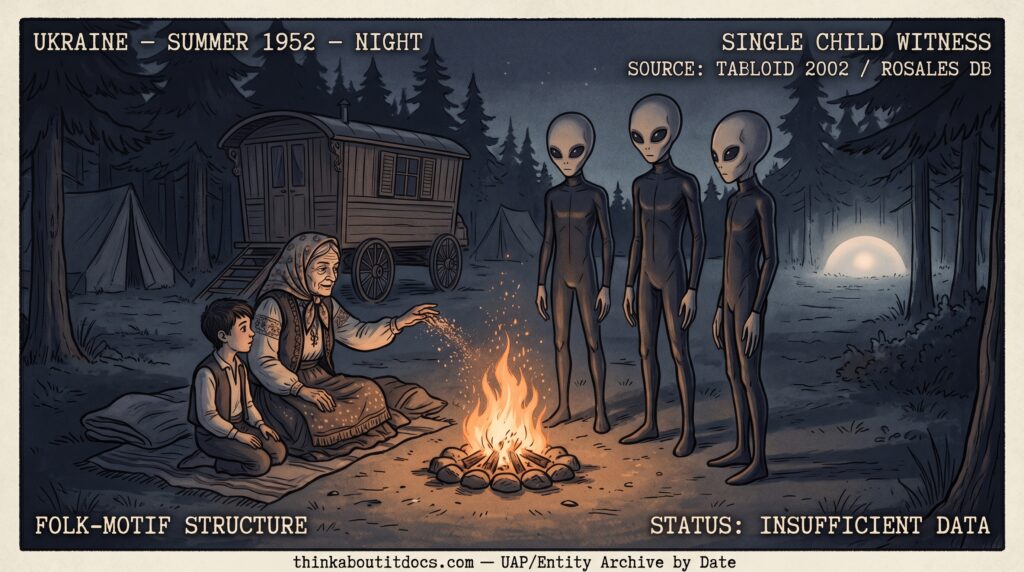
The 1952 Ukrainian campfire encounter — three featureless-headed beings and a Romani woman warding them off with charmed dust, recalled decades later in a tabloid. A folklore-tinged, single-source account; logged Insufficient Data. (thinkaboutitdocs.com — UAP/Entity Archive by Date)
THINK ABOUTIT UFO|UAP|ENTITY SIGHTINGS REPORT
1952: Three Human-Like Entities at a Campfire, Ukraine
SINGLE CHILDHOOD RECOLLECTION, TABLOID-SOURCED DECADES LATER
read with the heightened caution the archive applies to the Soviet/post-Soviet tabloid-folklore pipeline.
It is an atmospheric story: a boy alone at a Roma campfire one summer night in 1952, a sudden wind that scatters the horses, a dome of light in the forest glade, and three tall, featureless-headed beings who emerge and sit down across the fire — until an old Romani woman throws a handful of “dust” into the flames, making them crackle and spark, and the entities flinch back. After fifteen minutes of silent staring through the fire, the beings return to the dome and a glowing globe shoots away. The trouble is that this reaches the record only through a Ukrainian paranormal tabloid in 2002, recounting an event a half-century earlier as remembered by a man who was a small child when it supposedly happened. Its shape is as much folk tale as sighting — the wise old woman warding off night-spirits with a charm is an ancient motif, not an observational detail. The archive keeps the entry, flags its weak and late source chain, and files it as Insufficient Data.
Date: Summer 1952 (no precise date; reported decades later)
Sighting Time: Night
Day/Night: Night
Location: Ukraine (exact location not recorded), rural — a Roma encampment near a forest glade
Urban or Rural: Rural
No. of Entity(‘s): 3
Entity Type: Tall human-like humanoids with large, featureless heads (possibly helmeted)
Entity Description: Human-like in form but with large, featureless heads — perhaps helmets with a transparent front section, the witness was unsure; wearing tight-fitting outfits; one over 2 meters tall, the others shorter, the smallest about 1.70 m; communicated among themselves in “hissing” sounds
Hynek Classification: CE-III (animate beings associated with a craft) — provisional; the account is a single childhood recollection published in a tabloid decades later
Duration: About 15 minutes (the shared time at the fire)
No. of Object(s): 1
Description of the Object(s): A bright, compact light that rose above the ground in the forest glade like a dome, from which the entities emerged; on their departure a strong wind rose from it and a lighted globe-shaped object shot up from the meadow and vanished
Shape of Object(s): Dome of light / globe
Size of Object(s): Not recorded
Color of Object(s): Bright / luminous (not otherwise specified)
Distance to Object(s): Nearby (in the adjacent forest glade)
Height & Speed: The globe “zoomed up” and vanished; not quantified
Number of Witnesses: Nominally 2 (the boy, Ivan Sergeevich K., and an elderly Romani woman), but only Ivan’s recollection survives; the woman is a figure within his account, not an independent source
Special Features/Characteristics: Sudden wind scattering the horses; dome of light; featureless-headed beings communicating in hissing sounds; the elderly woman throwing “dust” into the fire to make it crackle and spark, which appeared to frighten the entities; a prolonged silent mutual watch across the fire; departure via the dome and a globe shooting away — elements that blend reported sighting with folk-tale motif
Case Status: Insufficient Data
Source: Albert Rosales, Humanoid Contact Database, citing the tabloid “Interesting Newspaper” (Интересная газета), Kyiv, D-Block #4, 2002
Summary/Description: By a single account published in a Ukrainian paranormal tabloid in 2002, a man recalled that as a boy in the summer of 1952 he was at a Roma encampment in Ukraine when a sudden wind scattered the horses, leaving him alone at the fire with an elderly Romani woman. A dome of light appeared in a nearby glade, and three tall, featureless-headed humanoids emerged and sat at the fire, hissing among themselves. The woman threw “dust” into the flames, making them spark and seeming to alarm the beings; after about fifteen minutes the entities returned to the dome and a glowing globe shot away. The account is a decades-late childhood recollection from a tabloid source, and is logged as Insufficient Data.
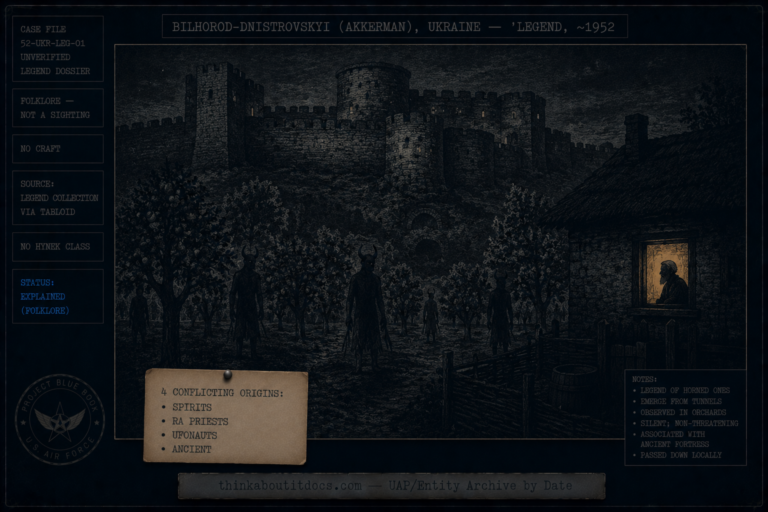
Related Cases: 1952: “Horned” Humanoid Sightings in Belgorod-Dnestrovsky, Ukraine (folklore) | 1990: Donetsk, Ukraine Abduction | the broader corpus of Soviet/post-Soviet tabloid humanoid reports
DETAILED REPORT
The account, as carried in Albert Rosales’s Humanoid Contact Database from its tabloid source, is this. A man identified as Ivan Sergeevich K. recalled that, as a young boy in the summer of 1952, he was spending the night at a Roma encampment somewhere in Ukraine. A strong wind arose suddenly and frightened the horses, which scattered; their owners ran off after them, leaving Ivan alone at the bonfire with an elderly Romani woman. There was then a bright flash from a nearby forest glade, where a compact light rose above the ground in the shape of a dome. Out of it walked three human-like beings with large, featureless heads — possibly helmets with a transparent front, the boy could not tell — dressed in tight-fitting outfits. One stood over two meters tall; the other two were shorter, the smallest about one meter seventy. They approached the fire, sat, and spoke among themselves in hissing sounds.
The old woman, the account continues, took a clump of “dust” from her knapsack and threw it into the fire, which began to crackle loudly. When one of the beings tried to approach, she threw in more, making the fire spark violently, and this seemed to frighten them. For about fifteen minutes the entities and the two witnesses sat across from one another, staring through the flames. Finally the beings walked back to the dome; the strong wind rose again, plainly from the dome this time, and a lighted globe shot up from the meadow and vanished.
Before weighing the story, the source must be named plainly, because it governs everything. This report did not come from a contemporaneous 1952 investigation. It appeared in 2002 in “Interesting Newspaper” (Интересная газета), a Ukrainian outlet of the post-Soviet paranormal-tabloid genre, and entered the catalog literature when Albert Rosales included it in his Humanoid Contact Database. Rosales is a thorough and valuable compiler, but his database is explicitly an aggregation of raw reports from all manner of sources, gathered without case-by-case verification; inclusion documents that a story was told, not that it occurred. The chain here is therefore a fifty-year-old memory, published in a sensational outlet, with no independent confirmation — the precise profile the archive treats with heightened caution for material from the former Soviet sphere, where a folklore-to-tabloid-to-catalog pipeline has produced many colorful but unverifiable “cases.”
The internal structure of the account deepens that caution, because it reads substantially as folklore. The pivotal element is not the beings but the old Romani woman who repels them with a handful of charmed “dust” thrown on the fire. That is a folk-tale motif of great antiquity — the wise elder who wards off night-spirits or demons with a ritual substance and the protective power of fire — and it sits oddly inside a literal extraterrestrial reading. Filtered through a child’s memory and half a century, with the storyteller’s grandmother-figure besting the visitors by old country magic, the narrative has the architecture of a tale told and retold around exactly such fires, later attached to the visual vocabulary of the flying-saucer age (the dome of light, the tight outfits, the globe shooting away). The prior page’s closing section took the opposite view, treating the dust-versus-entities moment as a genuine “clash between ancient folklore practices and extraterrestrial visitors”; that is the page asserting the literal reality of an unverifiable scene, and it has been removed.
None of this proves the experience never happened, and a frightened child at a night fire may well have perceived something. But between a single witness who was a small boy at the time, a recollection surfacing in a tabloid five decades later, no second testimony beyond the woman who appears within the story, and a strongly folkloric shape, there is nothing here that can be confirmed and nothing that rises to a documented event. The honest verdict is Insufficient Data, with the weakness of the source chain stated rather than dressed over.
RESEARCHER’S NOTES
The Campfire Visitors — Ukraine 1952 and the Tabloid-Folklore Pipeline
- Classification, held but provisional: CE-III is defensible as a label, since the account pairs animate beings with a craft-like dome of light, and it is retained as the report-type. But it rests on the thinnest possible footing — one witness, a child at the time, recalling the event decades later through a tabloid — so it marks a category rather than a vouched-for encounter, and it sits beside an Insufficient Data status. The nominal “two witnesses” should be read carefully: only Ivan’s recollection reaches us, and the elderly woman is a character within his account, not a separately recorded source.
- Source-chain assessment: The decisive fact is the provenance. The root is “Interesting Newspaper,” a post-Soviet paranormal tabloid, in 2002; the path into ufology is the Rosales Humanoid Contact Database. Rosales’s compilation is genuinely useful as an index, but it deliberately collects reports without vetting each one, so a citation to it confirms only that the story exists in the literature. For an event dated 1952 and first surfacing in print in 2002, with no contemporaneous record, the evidentiary value of the specific details is very low. This is the Soviet/CIS tabloid-folklore pattern the archive flags on principle, regardless of which compiler carried it.
- The folkloric architecture as the key signal: The most clarifying observation is that the story’s hinge is a folk motif. A wise old Romani woman who drives off threatening night-beings by casting a charmed substance into the fire belongs to traditional tale, not to typical occupant reports, in which witnesses rarely have a ready ritual defense that works. Combined with the dome of light, the hissing featureless figures, and the globe that “zooms” away, the account reads as a traditional night-visitor tale overlaid with mid-century saucer imagery and preserved in a child’s memory. Recognizing that structure is more useful than analyzing the beings’ anatomy, which the prior page attempted.
- A note on terms, and why Insufficient Data: The source uses “Gypsy”; the accurate term is Roma or Romani, used here, with the original wording noted only for source fidelity. On the evidence: a single decades-late childhood recollection, a tabloid origin, no corroboration, and a folkloric shape on one side; no positive proof of deliberate fabrication on the other. That balance is Insufficient Data — not a documented anomaly to call Unexplained, and not a demonstrated hoax or mundane event to call Explained. The proportionate response is to keep the entry, name its weak and late source honestly, strip the credulous interpretation, and flag the folklore.
The Ukrainian campfire encounter is a vivid and even charming story, and it has a legitimate place in the record as a catalogued report. But its strength is atmospheric, not evidential. Told straight, it is a single childhood memory, printed in a paranormal tabloid half a century after the fact and carried into the literature by an aggregating database, built around an old folk motif of warding off night-spirits with fire and charmed dust. Stripped of the page’s literal-minded “folklore meets aliens” gloss, flagged for its weak Soviet-era tabloid chain, and held to a provisional CE-III, it stands as Insufficient Data — kept, named honestly, and left exactly as uncertain as it is.