Corby contactee 1952, bedroom visitor experience, happy planet aliens, FSR Case Histories, golden-skinned humanoids, unassociated humanoid report
THINK ABOUTIT UFO|UAP|ENTITY SIGHTINGS REPORT
1952: Humanoid Encounter in Corby, England
CONTACTEE / BEDROOM-VISITOR PATTERN
— single witness, no craft observed. Read as a benign “Space Brother” experience and a nocturnal bedroom-visitor episode, not a craft encounter.
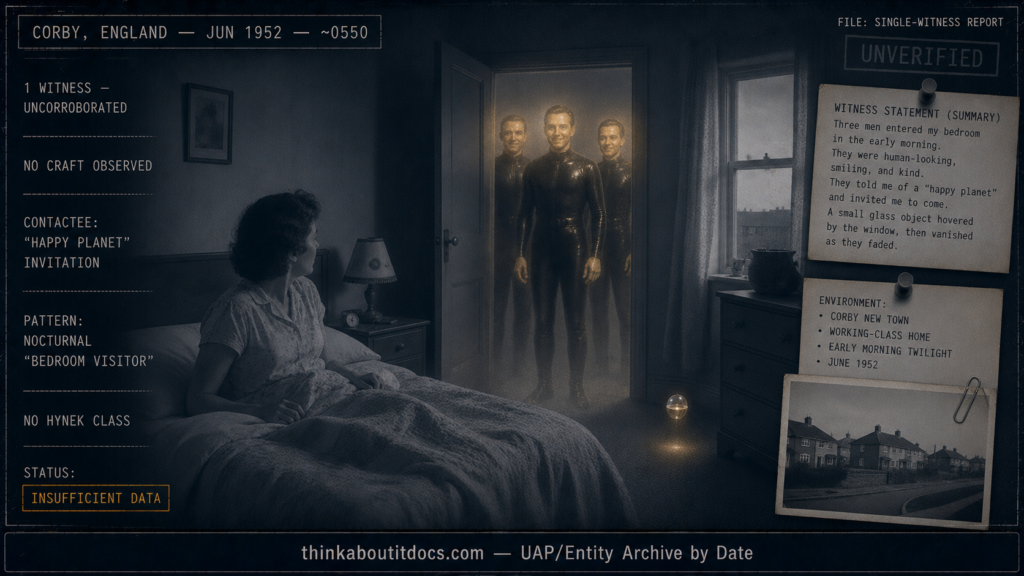
It is a small, gentle story with the texture of a half-waking dream. Early one June morning in 1952, a woman lying in bed in Corby, England, saw a tiny glass-like object drift in through the window, settle to the carpet, and slowly fade away. Her front door then opened and three smiling men walked in — human-looking, with golden skin and shiny black tight-fitting outfits — who told her in friendly tones that they came from a very “happy” planet and invited her to go with them. She declined, and the three men abruptly vanished. There is no craft anywhere in the account, no second witness, and the whole episode has the dissolving, threshold quality of the nocturnal “bedroom visitor” experience as much as of a real encounter. It is also a textbook benign contactee vignette. The archive keeps the entry, sizes it honestly, and files it as Insufficient Data.
Date: June 1952 (no specific day)
Sighting Time: About 0550 (early morning, around first light)
Day/Night: Early morning / twilight (the witness was in bed)
Location: Corby, Northamptonshire, England (then a designated “New Town”)
Urban or Rural: Urban/residential (a home in the New Town)
No. of Entity(‘s): 3
Entity Type: Human-looking “Space Brother”-type beings (benign contactee mode)
Entity Description: Three smiling men, human in appearance, with golden-colored skin, wearing shiny black tight-fitting outfits; friendly in manner
Hynek Classification: None — no craft or object the beings were associated with was observed; this is an unassociated humanoid/contactee report, not a close encounter of the third kind (the prior CE-III is incorrect, as CE-III requires beings associated with a craft)
Duration: Brief (a short exchange before the figures vanished)
No. of Object(s): 1 (a tiny glass-like object that floated in and then disappeared; not a craft, and the beings were not seen to arrive in or depart in any vehicle)
Description of the Object(s): A small, glass-like object that came in through the window, floated down to the carpet, and gradually disappeared
Shape of Object(s): Small and glass-like (not further described)
Size of Object(s): Tiny
Color of Object(s): Clear / glass-like
Distance to Object(s): Within the bedroom (close)
Height & Speed: Floated slowly; not quantified
Number of Witnesses: 1
Special Features/Characteristics: Witness in bed at early morning; a tiny glass-like object that floated in and vanished; three benign, smiling, golden-skinned humanoids entering through the door; a friendly message about a “happy” planet; an invitation to leave with them, declined; the figures vanishing instantly — features consistent with a benign contactee experience and with the nocturnal “bedroom visitor” / hypnagogic pattern
Case Status: Insufficient Data
Source: Flying Saucer Review (FSR) Case Histories, Supplement 16 — a brief catalogued account; no named witness or investigator given
Summary/Description: By a single brief account in FSR Case Histories, a woman in Corby, England, lying in bed early one June morning in 1952, saw a tiny glass-like object float in through the window and vanish on the carpet; her door then opened and three smiling, golden-skinned men in shiny black outfits entered, said they came from a very “happy” planet, and invited her to go with them. She declined, and the men suddenly disappeared. No craft was observed. The account fits both the benign contactee and the nocturnal bedroom-visitor patterns, rests on one witness, and is logged as Insufficient Data.
Related Cases: 1952: Two Humanoid Figures Seen in a Mexico City Room (another bedroom-visitor account) | 1952: Giant Humanoids near Nîmes, France (contactee pattern) | the early-1950s benign “Space Brother” contactee accounts
DETAILED REPORT
The account, carried briefly in Flying Saucer Review’s Case Histories supplement, is short and may be given plainly. Early one morning in June 1952 — the time noted as around 5:50 — a woman was lying in bed at her home in Corby, then a newly designated “New Town” in Northamptonshire, England. She saw a tiny, glass-like object come in through the window; it floated down to the carpet and gradually disappeared. Her front door then opened, and three smiling men walked in. They looked human but had golden-colored skin and wore shiny black, tight-fitting outfits. They spoke to her in a friendly way, telling her that they came from a very “happy” planet, and invited her to come with them. She declined the invitation, and the three men suddenly disappeared.
The most useful thing the archive can do with so slight an account is to place it correctly, and it sits at the meeting point of two well-documented patterns. The first is the contactee experience. Unlike the frightening abduction reports, contactee accounts characteristically feature benign, attractive, human-like beings who communicate a pleasant message and often extend an invitation; the “happy planet” and the friendly offer to come away are pure contactee idiom, the gentle Space-Brother mode that flourished in exactly this period. The second is the nocturnal “bedroom visitor” experience: a person in bed, at the threshold of sleep or waking — here in the early-morning hypnopompic window — perceiving a small luminous object and then figures who appear, interact, and simply vanish. The hallmark of such experiences is precisely what this account describes: things that materialize and dematerialize rather than enter and leave, a glass object that “gradually disappeared” and men who “suddenly disappeared.”
The classification has to be corrected on a point the archive applies consistently. The prior page filed this CE-III, a close encounter of the third kind, but CE-III requires animate beings associated with a craft, and there is no craft here at all. The witness saw no disc, no landed object, nothing in the sky; the only “object” was a tiny glass-like thing that floated in and vanished, and the three men arrived through a door and left by vanishing. An entity report with no associated craft is, by the archive’s standard, an unassociated humanoid report rather than a close encounter of the third kind, and it carries no Hynek class. The prior page also entered the three men into the object fields, listing “three objects,” which confused entities for objects; that has been corrected.
None of this calls the witness dishonest. People sincerely report bedroom-visitor and contactee experiences, which can be vivid and emotionally real, and the gentle, non-threatening character of this one is typical of the form. But as evidence it is a single uncorroborated account, with no craft, no second witness, and a brief catalogue entry for a source; its content fits ordinary threshold-of-sleep experience and the period’s contactee imagery at least as readily as any external event. There is nothing here to confirm and nothing that rises to a documented anomaly. The proportionate verdict is Insufficient Data, with the contactee and bedroom-visitor patterns noted.
RESEARCHER’S NOTES
The Corby Visitors — England 1952 and an Encounter Without a Craft
- Classification correction (CE-III to none): The decisive fix is that there is no craft. CE-III specifically denotes beings associated with a UFO, and this account contains no craft of any kind — a tiny glass-like object that floats in and vanishes is not a vehicle, and the three figures arrive through a door and depart by vanishing. Under the archive’s standard, that is an unassociated humanoid (here, contactee) report carrying no Hynek classification. The correction matches those already applied to other craftless entity entries, and consistency requires it. The prior page’s listing of the three men as “objects” has also been corrected.
- The double pattern as the core reading: The account’s content is doubly templated. Its beings and message are contactee-standard: benign, human-like, golden-skinned figures bearing word of a “happy planet” and an invitation to leave — the friendly Space-Brother mode of the 1950s. Its structure is bedroom-visitor-standard: a sleeper at early morning, a small luminous object, figures who appear and vanish rather than come and go. Either framework, and especially the two together, explains the report’s shape without recourse to a literal visitation. Recognizing that is more useful than treating the golden skin and black suits as physical description.
- Source-chain assessment: Flying Saucer Review’s Case Histories supplements are a genuine catalogue series, so the entry is a real recorded account rather than an invention. But the entry is brief and gives no named witness, no investigator, and no follow-up; it documents that the story was collected, not that it was investigated or corroborated. For a single-witness, no-craft, vanishing-visitor account, that places the evidentiary value low.
- Why Insufficient Data: With one witness, no craft, no corroboration, a brief catalogue source, and content that fits both the contactee template and the nocturnal bedroom-visitor experience, there is nothing to confirm and nothing to disprove. That is Insufficient Data — not a documented anomaly to call Unexplained, and not a demonstrated hoax or solved misperception to call Explained. The proportionate response is a short entry that places the account in its patterns and leaves it there.
The Corby encounter is a minor, gentle entry, and the archive’s service is to size it honestly: one witness, no craft, three smiling visitors from a “happy planet” who appear and vanish in a bedroom at first light. Stripped of the CE-III it never warranted, with its three “objects” corrected back into the men they were, and read against the contactee and bedroom-visitor patterns it so clearly follows, it stands as Insufficient Data — kept for the record, and left as slight as it is.