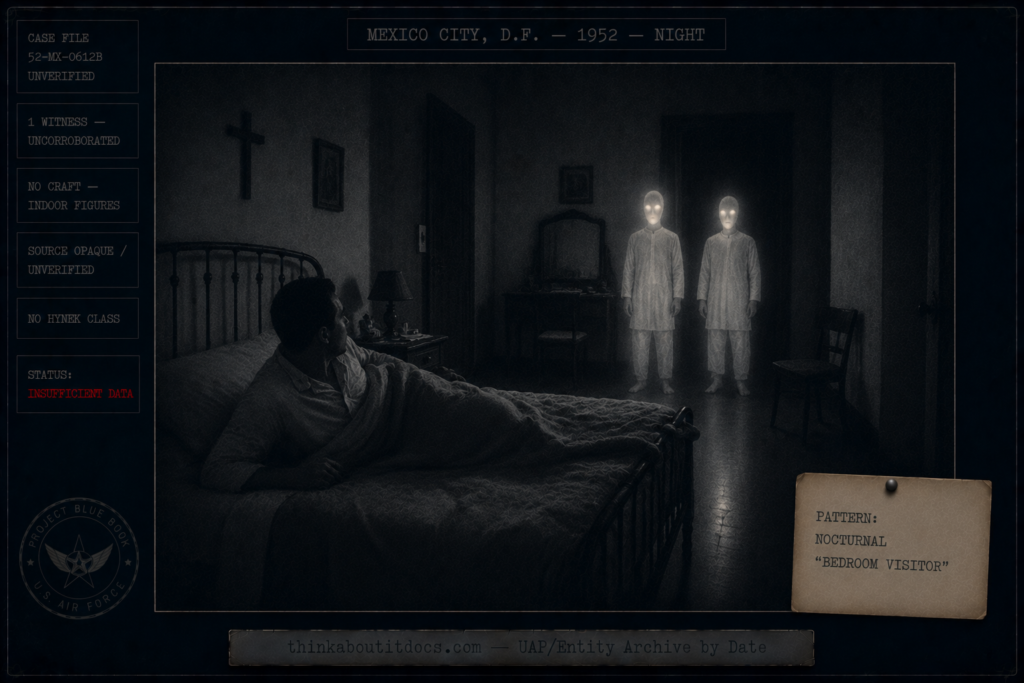
The 1952 Mexico City account of Juan Maturano — two short figures with glowing faces in his room one night, no craft, one witness, an opaque source. Logged Insufficient Data. (thinkaboutitdocs.com — UAP/Entity Archive by Date)
THINK ABOUTIT UFO|UAP|ENTITY SIGHTINGS REPORT
1952: Two Humanoid Figures Seen in a Mexico City Room (Juan Maturano)
It is among the thinnest entries in the archive, and honesty about that is the report. A man named Juan Maturano said that one night in 1952 he woke or looked up to find two short figures in his room, dressed in white tunics, their faces glowing. That is the whole account — no craft, no date beyond the year, no second witness, and a source that surfaces nowhere else. The bedroom setting, the small luminous figures, and the single sleeper are the recurring furniture of the nocturnal “bedroom visitor” experience as much as of any external encounter. The archive keeps the entry for the record, but files it for what it is: a single unverifiable account, too slight to support more than a careful “Insufficient Data.”
Date: 1952 (no month or day recorded)
Sighting Time: Night (not further specified)
Day/Night: Night
Location: Mexico City, D.F., Mexico (indoors, the witness’s room)
Urban or Rural: Urban
No. of Entity(‘s): 2
Entity Type: Small humanoid figures
Entity Description: Two short figures wearing white tunics, with glowing faces
Hynek Classification: None — no craft or object is involved; this is an unassociated humanoid report, not a close encounter of the third kind (the prior CE-III is incorrect, as CE-III requires beings associated with a craft)
Duration: Not recorded
No. of Object(s): None — no object reported
Description of the Object(s): Not applicable
Shape of Object(s): Not applicable
Size of Object(s): Not applicable (the entities were described as short)
Color of Object(s): Not applicable (entities wore white; their faces glowed)
Distance to Object(s): Close (the figures were in the witness’s room)
Height & Speed: Not applicable
Number of Witnesses: 1 (Juan Maturano)
Special Features/Characteristics: Indoor, night-time, single-witness encounter with no craft; glowing faces and white tunics; account consistent with the nocturnal “bedroom visitor” experience as well as with an external event; source does not appear in other catalogs
Case Status: Insufficient Data
Source: Juan Maturano, “Tulipán de Diamantes” (a single, uncorroborated source that does not appear elsewhere in the UFO literature)
Summary/Description: Juan Maturano reported that one night in 1952, in Mexico City, he encountered two short figures in his room, dressed in white tunics and with glowing faces. No craft was involved, no further detail was given, and there was no second witness. The account is single-source and unverifiable, and is logged as Insufficient Data.
Related Cases: the broader corpus of single-witness nocturnal “bedroom visitor” reports | 1952: Abduction in Tucson, Arizona | 1531: Virgin Mary Seen Near Tepeyac, Mexico (a Mexican luminous-figure apparition for contrast)
DETAILED REPORT
The account is two sentences long, and inflating it would betray the record. Juan Maturano reported that, one night in 1952 in Mexico City, he found two short figures in his room. They wore white tunics, and their faces glowed. Nothing else is given — no time of night, no duration, no description of how they arrived or left, no craft, and no other witness. The source is attributed to “Tulipán de Diamantes,” a title that does not appear elsewhere in the UFO literature and cannot be evaluated as an investigative reference.
What can responsibly be said is mostly about category. This is not a UFO report in any structural sense: there is no object, nothing aerial, nothing the witness connected to a craft. It is an indoor encounter with figures, which places it among entity or apparition accounts rather than sightings. And its specific shape — a single person, at night, in a bedroom, briefly perceiving small luminous humanoid figures — matches a very common and well-documented human experience: the hypnagogic or hypnopompic “bedroom visitor,” the same phenomenology that underlies “old hag” and sleep-paralysis encounters across cultures, in which vivid figures are perceived at the threshold of sleep. The white tunics and glowing faces also echo religious apparition imagery, which in mid-century Catholic Mexico would be a readily available frame.
None of that proves the experience was internal rather than external; a two-sentence account cannot be diagnosed. But it sets the honest boundary. There is one witness, an opaque source, no corroboration, no craft, and no investigation. The archive notes the prosaic possibilities not to dismiss Maturano but to mark that they are at least as available as any exotic reading, and that nothing in the record can decide between them.
RESEARCHER’S NOTES
The Maturano Figures — Mexico City 1952 and the Limits of a Two-Sentence Account
Classification correction (CE-III to none): The prior page filed this CE-III, but CE-III specifically denotes animate beings associated with a UFO, and there is no craft anywhere in this account — only two figures in a room. Under the archive’s own standard, an entity report with no associated object is an unassociated humanoid report, not a close encounter of the third kind, and carries no Hynek class. The field is corrected to none accordingly.
- Field and location corrections: Two smaller fixes. The prior page placed the entity description (“short figures, wearing a white tunic, with glowing faces”) in the object fields, though no object exists; those details belong to the entities and have been moved, with the object fields marked not applicable. And the location was tagged “Rural” — for Mexico City, the largest metropolis in the Americas, which is plainly wrong and is corrected to Urban.
- Source-chain assessment: The case rests entirely on one attribution, “Tulipán de Diamantes,” credited to Juan Maturano, which does not appear in the standard UFO catalogs and cannot be verified as an investigative source; the title reads more like a literary or self-published work than a case file. There is no contemporaneous documentation, no second witness, and no investigation. This is a single uncorroborated account from an opaque source — the weakest tier of evidence the archive handles.
- Evidentiary weight and why Insufficient Data: With no craft, no corroboration, no checkable source, and a two-sentence narrative that fits ordinary nocturnal experiences as well as any anomalous one, there is nothing to confirm and nothing to disprove. That is Insufficient Data in its purest form — not a documented anomaly to call Unexplained, and not a demonstrated mundane event or hoax to call Explained. The proportionate response is a short entry that says plainly how little is here.
The Maturano figures are a genuinely minor entry, and the archive’s service is to size them honestly rather than dress them up: one witness, one opaque source, two glowing figures in a Mexico City room one unspecified night in 1952, and no craft at all. Stripped of the CE-III it never warranted, relocated to the city it actually occurred in, and noted for its resemblance to the common bedroom-visitor experience, it stands as Insufficient Data — kept for the record, and left exactly as slight as it is.