The 1952 Nîmes encounter — giant humanoids, a human translator, a straw-hat craft, a penal-colony origin story, and an atomic-warning message. A contactee-pattern account; logged Insufficient Data. (thinkaboutitdocs.com — UAP/Entity Archive by Date)
THINK ABOUTIT UFO|UAP|ENTITY SIGHTINGS REPORT
1952: Giant Humanoids near Nîmes, France
CONTACTEE-PATTERN ACCOUNT — single witness, recounted in a later case compilation.
Read as the 1950s “Space Brother” template, with a questionable date.
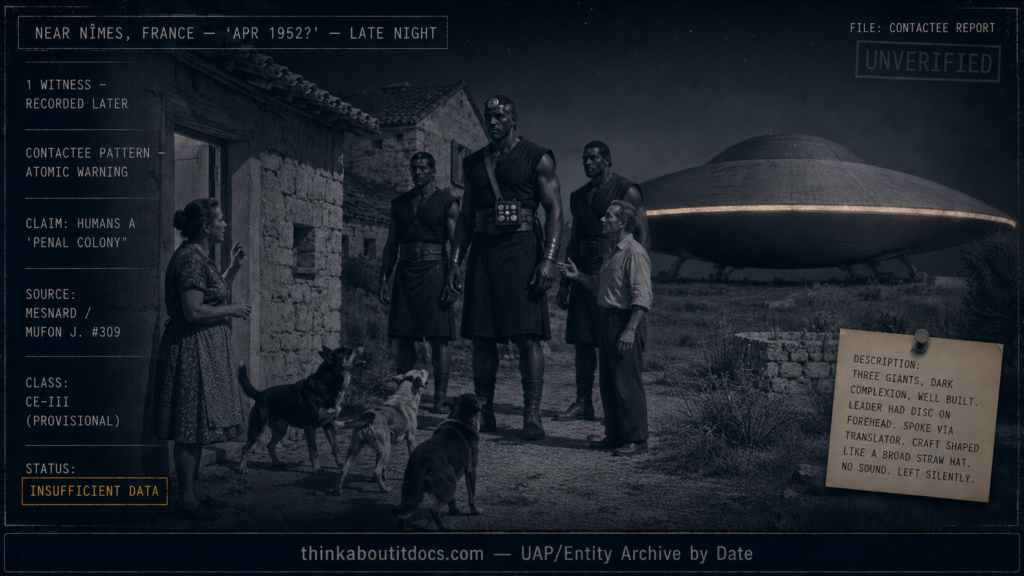
It has the shape of a fireside tale and the furniture of a 1950s contactee story. A woman staying in an isolated stone outbuilding near Nîmes is woken at night by her dogs, goes out, and finds three towering, well-built humanoids and one ordinary-looking man who speaks perfect French and acts as their translator. The giants explain that they seeded the first human colony on Earth — as a penal colony — show her a huge craft shaped like a straw hat hovering silently nearby, demonstrate the ability to levitate and dematerialize objects, and announce that they have come to take plant and mineral samples to gauge the effects of atomic explosions. Afterward, she reports lasting psychic experiences. Every one of those beats is a hallmark of the contactee genre that flowered in the 1950s, and naming that is the most useful thing the archive can do with the account. It rests on one witness, reaches the record through a later French case-file compilation, and cannot be corroborated; it is logged as Insufficient Data with the contactee character flagged.
Date: Given as April 10, 1952 — but see Researcher’s Notes; the date is questionable
Sighting Time: Late night
Day/Night: Night
Location: Rural property near Nîmes, Gard, southern France
Urban or Rural: Rural (isolated stone buildings)
No. of Entity(‘s): 4 (three giant humanoids and one ordinary-appearing human intermediary)
Entity Type: Giant human-like “Space Brother”-type beings, with a human-appearing translator
Entity Description: Three giant, well-built, dark-complexioned human-like figures (the witness likened their appearance to “Hindus,” per the source); one appeared older and acted as leader, with a half-marble shape on his forehead and a strap around his neck holding a box with buttons. A fourth figure was a normal-sized, ordinary-looking man who spoke perfect French and translated
Hynek Classification: CE-III (animate beings associated with a craft) — provisional; the account includes a craft, but it is a single-witness contactee narrative recounted later (see Researcher’s Notes)
Duration: Not recorded (an extended encounter including conversation and demonstrations)
No. of Object(s): 1
Description of the Object(s): A huge craft shaped like a straw hat, hidden nearby, which hovered silently just above the ground
Shape of Object(s): Straw-hat shaped (broad, domed)
Size of Object(s): Huge (as described)
Color of Object(s): Not specified
Distance to Object(s): Close — the witness was shown the craft nearby
Height & Speed: Hovered silently just above the ground
Number of Witnesses: 1 (the “normal” human is a figure within the account, not an independent witness)
Special Features/Characteristics: Dogs agitated before the encounter; a human intermediary/translator; a leader figure with a forehead ornament and a button-box device; a claimed origin story (humans seeded as a penal colony); a straw-hat craft hovering silently; demonstrations of levitation and dematerialization; a stated mission to collect samples to assess atomic-explosion effects; reported psychic experiences afterward — a cluster of classic contactee motifs
Case Status: Insufficient Data
Source: Joël Mesnard, “French Abduction File,” MUFON UFO Journal No. 309 (a later compilation of French contact/abduction cases)
Summary/Description: By a single account recorded in Joël Mesnard’s compilation of French contact cases, a woman at an isolated rural property near Nîmes was woken one night in 1952 by her dogs and encountered three giant, well-built humanoids and an ordinary-looking man who translated for them. The beings claimed to have seeded humanity as a penal colony, showed her a huge straw-hat-shaped craft hovering silently nearby, demonstrated levitation and dematerialization, and said they had come to take vegetation and mineral samples to evaluate the consequences of atomic explosions; she reported psychic experiences afterward. The account follows the 1950s contactee pattern, rests on one witness, and is logged as Insufficient Data.
Related Cases: 1952: Three “Mummy-Like” Beings at Lomo de Ballena, Peru (another 1952 contactee account with an atomic-warning message) | 1952: Contact in the Angatuba Mountains, Brazil | the early-1950s “Space Brother” contactee accounts of George Adamski and Truman Bethurum
DETAILED REPORT
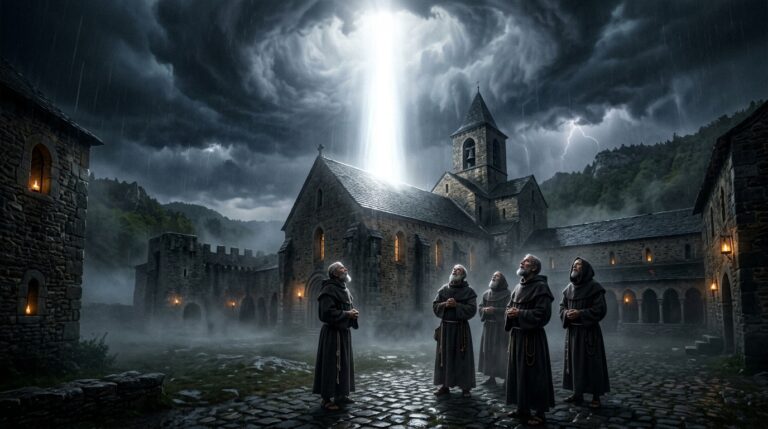
The account is preserved in the work of Joël Mesnard, a serious and well-regarded French ufologist, in a MUFON UFO Journal piece compiling French contact and abduction files. By that account, a woman was staying in an isolated stone building, set apart from the main house on a rural property near Nîmes in southern France. One night in 1952 she was awakened by her dogs growling, and went out to investigate with the dogs following. Near a second, smaller stone building she came upon four figures: three giant, human-like beings, well-built and dark-complexioned — she compared their look to “Hindus” — and one ordinary-sized, ordinary-looking man.
The normal-looking man spoke perfect French and acted as a translator between the witness and the giants. One of the giants appeared older and seemed to be the leader; he had a half-marble shape on his forehead and wore a strap around his neck holding a box fitted with buttons. The human intermediary said that the beings had taken him years earlier, in an encounter of his own. The older giant told the witness that his people had originally established the first human colony on Earth — and that it had been a penal colony. He then showed her their craft, concealed nearby: a huge object shaped like a straw hat, hovering silently just above the ground. The witness was given demonstrations of the beings’ ability to levitate and dematerialize objects. Before they left, the giants told her they had come to collect vegetation and mineral samples in order to evaluate the consequences of atomic explosions. She later reported numerous psychic experiences following the encounter.
The most useful service the archive can perform is to identify the genre, because once seen it is unmistakable: this is a classic contactee narrative. The contactee accounts that flourished in the 1950s share a recognizable architecture, and this case reproduces nearly all of it. The beings are benevolent and human-like rather than frightening or alien-bodied; there is a designated spokesman or leader; communication is smooth, here via a human translator; the encounter is built around a delivered message; that message centers on humanity’s atomic weapons; and the experience is wrapped in a grand cosmic backstory — in this instance, the striking claim that humans were seeded on Earth as a penal colony. The lasting “psychic experiences” afterward are likewise a standard contactee coda, marking the witness as a chosen ongoing recipient. The straw-hat craft, the levitation demonstrations, and the cosmic genealogy are the set dressing of the form.
This matters for dating. The account is placed at April 1952, but the mature contactee template it follows was only just emerging that year — George Adamski’s famous California desert contact, the genre’s founding event, came in November 1952, seven months later, and the full elaboration of “Space Brothers” warning humanity about the atom came over the following years. A narrative this complete in its contactee structure sits awkwardly on an early-1952 date. It does not carry the hard anachronism of a Grey-abduction tale dated before 1961, because contactee motifs did exist in embryo by 1952; but a fully-formed example, recorded later in a compilation and accompanied by ongoing psychic claims, is more plausibly a later-recalled or later-recorded account assigned to 1952 than a contemporaneous report of that spring. The date should be treated as uncertain.
None of this requires calling the witness dishonest. Sincere contactee experiences are a real psychological phenomenon, and the form has always attracted people reporting genuine, vivid, life-altering encounters. But as evidence, the account is a single uncorroborated testimony, recorded after the fact, whose every feature conforms to a cultural template and whose central content — a penal-colony origin of humanity, demonstrations of dematerialization, a sample-taking mission about the atom — cannot be checked against anything. There is nothing here to confirm and nothing that rises to a documented event. The honest verdict is Insufficient Data, with the contactee character placed at the center.
RESEARCHER’S NOTES
The Nîmes Giants — France 1952 and the Space-Brother Template in French Dress
- Classification, defensible but provisional: Unlike several craftless entity entries in the archive, this account does include a craft — the straw-hat object — with which the beings are associated, so CE-III is structurally correct as the report-type and is retained. The provisional marking reflects two things: the account is single-witness and recorded later, and it is really a contactee narrative, a category that formally overlaps CE-III but is built around a message rather than an observed object. There is also a mild internal tension in the source, which elsewhere files this among “abduction” cases (the human intermediary says he was taken years before, and the witness is given an onboard-style tour and demonstrations); the witness herself was not abducted, so CE-III remains the better fit, with the contactee nature flagged as dominant.
- The contactee template as the core finding: The single clarifying observation is that nearly every element is a genre convention: benevolent human-like beings, a leader-spokesman, frictionless communication, a message centered on atomic weapons, a cosmic origin story for humanity, and lasting psychic effects on the witness. When an account reproduces a template this completely, the template is the most economical explanation for its shape, whatever its origin in the witness’s experience. The prior page presented the narrative straight, without noting that it is a textbook example of the form; that framing is the main correction.
- Source-chain and dating assessment: The provenance is respectable — Joël Mesnard was a careful French investigator, and the case is preserved in a recognized journal compilation, not a tabloid. But a compilation records that a story was collected, not that the events occurred, and Mesnard’s piece is a later gathering of French files rather than a 1952 investigation. Combined with the fully-developed contactee structure, which postdates or only barely coincides with the genre’s 1952 emergence, this points to a later-recorded account placed at 1952. The date is flagged as questionable on those grounds, a softer flag than the hard post-1961 anachronisms seen in the Grey-abduction cases but a real one.
- A note on description, and why Insufficient Data: The source’s comparison of the beings to “Hindus” is the witness’s own period phrasing and is attributed rather than adopted; the beings are described here as tall, well-built, and dark-complexioned. On the evidence: a single witness, a later compilation source, a complete contactee template, a questionable date, and uncheckable cosmic content on one side; no positive proof of deliberate fabrication on the other. That balance is Insufficient Data — not a documented anomaly to call Unexplained, and not a demonstrated hoax to call Explained. The contactee flag is the most important thing the entry carries.
The Nîmes encounter is a vivid and even charming specimen of the European contactee story — penal-colony origins, a straw-hat ship, giant well-built guides, and a warning about the atom delivered through a human translator under a southern-French night sky. Told straight, it is not evidence of seeded prison-world ancestry or dematerializing visitors; it is a single witness’s contactee narrative, recorded later and placed at 1952, following the Space-Brother script point for point. Flagged as a contactee account, held to a provisional CE-III, and dated with appropriate doubt, it stands as Insufficient Data.