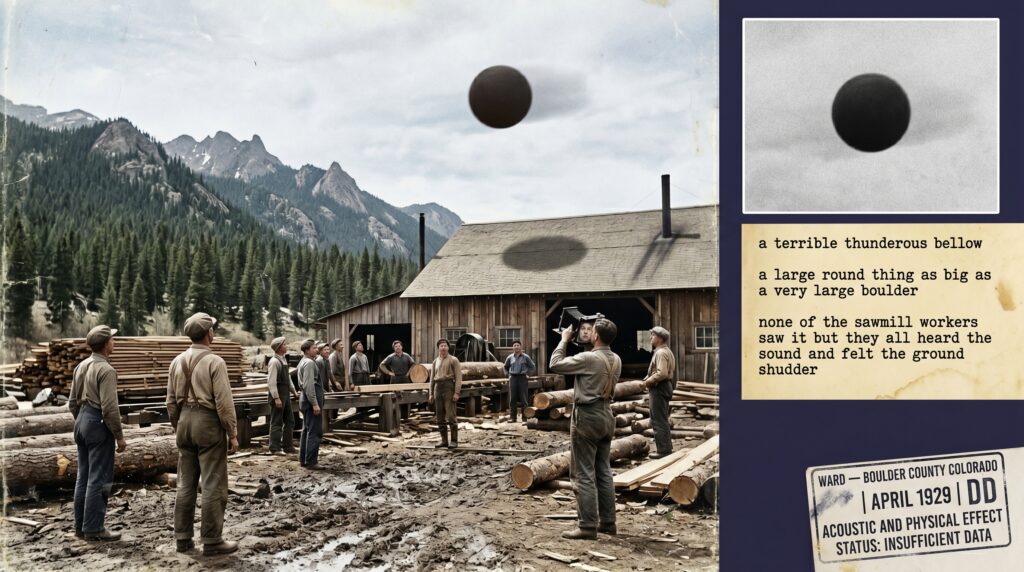
Ward, Boulder County, Colorado, April 1929 — Edward Pline photographed the sawmill as a large round object as big as a very large boulder moved overhead with a terrible thunderous bellow that shook the ground. None of the sawmill workers saw it but all felt and heard the event. Photo survives. Source: El Disco, letter from Hetty Pline. Case status: Insufficient Data.
THINK ABOUTIT UFO | UAP | SIGHTING REPORT
1929: Possible UFO In Old Photo
In April 1929, Edward Pline was at the sawmill in Ward, Colorado — a small mountain mining and lumber community at over 9,000 feet in the Front Range — taking a photograph of the mill for some reason or another when a terrible thunderous bellow came over the site and a large round thing as big as a very large boulder moved through the air above them. None of the sawmill workers saw it. But every one of them heard the sound and felt the ground shudder. Edward Pline’s camera was pointing at the sky and the object was in the frame. His daughter Hetty eventually found the photograph among her father’s things, noticed the object in it, tried the County Historical Society, found nothing, wrote to El Disco, and asked for help. Edward Pline passed on a few years after the incident. The sawmill workers are long gone. The photograph survives. The ground shudder was real. The archive holds both.
Date: April 1929 — exact date not recorded
Sighting Time: Daytime — exact time not recorded
Day/Night: Day
Location: Ward, Boulder County, Colorado, USA — sawmill, Ward, Colorado; elevation approximately 9,450 feet, Front Range Rocky Mountains
Urban or Rural: Rural — mountain mining and lumber community
No. of Entity(‘s): None observed
Entity Type: None
Entity Description: None
Hynek Classification: DD (Daylight Disc) — large round object photographed in full daylight; described by the primary witness as a large round thing as big as a very large boulder moving through the air; accompanied by a terrible thunderous bellow and ground vibration corroborated by multiple independent witnesses
Duration: Insufficient Data — passed over the sawmill; exact duration not recorded; long enough for the sound to be heard and the ground to shudder and for the object to appear in a photographic frame
No. of Object(s): 1
Description of the Object(s): A large round object described as moving through the air above the sawmill — as big as a very large boulder in the witness’s estimation. Visible in the photograph taken by Edward Pline at the moment of the event. Accompanied by a terrible thunderous bellow — a sound significant enough to cause all sawmill workers to register it independently. Produced ground vibration felt by all workers simultaneously. The object itself was not seen by the sawmill workers — only the photographer’s image captured it — but the sound and ground shudder were physically experienced by all present.
Shape of Object(s): Round — described as a large round thing; disc or spherical profile
Size of Object(s): As big as a very large boulder — substantial; the witness comparison implies an object of significant apparent size
Color of Object(s): Insufficient Data — not recorded in available source; visible in the photograph against the sky
Distance to Object(s): Directly above the sawmill — passed over at low enough altitude to produce ground vibration and a thunderous sound; exact distance not recorded
Height & Speed: Low altitude — passed above the sawmill; moving through the air — not hovering; speed not recorded
Number of Witnesses: Multiple — Edward Pline (photographer, primary visual witness via photograph); all sawmill workers present — exact number not recorded; all heard the sound and felt the ground shudder; none visually observed the object
Special Features/Characteristics: Multi-sensory corroboration by non-seeing witnesses — the sawmill workers did not see the object but independently experienced the acoustic effect (terrible thunderous bellow) and the physical effect (ground shudder) simultaneously; this multi-sensory independent corroboration by multiple workers is the most analytically significant element of the case, establishing that a real physical event occurred regardless of the photographic evidence alone; the photographer captured the object incidentally — Edward Pline was there to photograph the sawmill, not the sky; Ward, Colorado at 9,450 feet elevation is high mountain terrain in the Front Range where conventional aircraft operations in 1929 were extremely rare; the photograph was preserved within the Pline family across decades before Hetty Pline submitted it to El Disco; historical society research produced no corresponding records
Case Status: Insufficient Data — named photographer and submitter; photograph exists and is reproduced in the post; multi-sensory corroboration by multiple sawmill workers established; no formal photographic analysis documented in available sources; no historical society corroboration found
Source: El Disco — letter from Hetty Pline, daughter of photographer Edward Pline
Summary/Description: In April 1929, Edward Pline was photographing the sawmill at Ward, Colorado when a large round object as big as a very large boulder moved above the site accompanied by a terrible thunderous bellow and ground vibration felt by all sawmill workers present. None of the workers visually observed the object but all independently experienced the sound and physical ground effect. The object appears in Pline’s photograph. His daughter Hetty Pline later researched the incident without result and submitted the photograph and account to El Disco. Case status: Insufficient Data.
Related Cases: 1927: Cave Junction, Oregon Photo | 1910: France — Copa Catalunya Disc Photograph | Colorado Sightings Archive | Early UAP Photographic Cases Archive
Detailed Report
The Thunderous Bellow at the Sawmill — Ward, Colorado, April 1929
The account comes through a letter written by Hetty Pline to the UFO publication El Disco. She writes in her own words:
This photo was taken by my father, Edward Pline, at the sawmill in Ward where we lived at the time. He thinks it was 1929 and somehow the month of April was mentioned in the original post. He was about six years old then.
A clarification on the internal arithmetic: if Hetty’s father Edward was about six years old at the time of the photograph, then it was Hetty’s grandfather — also named in her account as the photographer — or the account contains a generational reference ambiguity. The archive preserves the account as submitted. Edward Pline is identified as the photographer regardless of the generation.
His father was there to photograph the sawmill for some reason or another, and, allegedly, as he was taking the photo, he described a terrible thunderous bellow, and a large round thing as big as a very large boulder that moved through the air above them. You can see it in the picture.
None of the sawmill workers saw the thing in the photo, but they all heard the sound and felt the ground shudder.
Later in my life I tried researching the incident at the County Historical Society, but I did not find any references to it. My father passed on a few years after the incident, and I have not found any surviving sawmill workers from that time. Perhaps you have more information about this incident.
— Best wishes, Hetty Pline
The photograph itself shows the sawmill at Ward with a disc-shaped or large round object visible in the sky above it. The image is a silver gelatin photographic print consistent with late 1920s amateur photography technology. No formal analysis of the negative or print is documented in available sources.
Ward, Colorado in 1929 was a small high-altitude mining and lumber community in Boulder County at approximately 9,450 feet elevation. Commercial aviation over the Front Range at that altitude in April 1929 was essentially nonexistent. Whatever produced a terrible thunderous bellow and ground shudder significant enough for an entire sawmill crew to register simultaneously while working was not routine air traffic.
RESEARCHER’S NOTES
The Thunderous Bellow Over Ward — Colorado 1929 and the Multi-Sensory Corroborated Photographic Case
- Multi-Sensory Corroboration as the Evidentiary Core: The most analytically significant element of the Ward 1929 case is not the photograph — it is the sawmill workers. None of them saw the object. But every one of them heard the terrible thunderous bellow and felt the ground shudder simultaneously, independently, without any communication with the photographer. This is multi-sensory physical corroboration of a real event by multiple independent witnesses who had no visual stimulus to anchor their experience. They did not see something and describe it — they experienced a sound and a physical vibration that had no conventional source in their immediate environment. The photograph documents what caused it. The workers document that it was real. Together they form an evidentiary structure significantly stronger than either would be alone.
- Ground Shudder at 9,450 Feet — Physical Effect Analysis: A ground shudder felt by workers at a high-altitude sawmill in April 1929 from an aerial object passing overhead is a physical effect that implies either extreme low altitude flight producing pressure waves, or a propulsion or energy mechanism producing ground-coupled vibration at distance. In 1929 no known aircraft at any altitude routinely produced ground vibration detectable at sawmill level. The combination of the thunderous acoustic effect and the simultaneous ground shudder argues for an object producing both airborne pressure waves and ground-coupled energy — a physical profile inconsistent with any 1929 aviation technology operating over the Rocky Mountains.
- The Incidental Photograph and the Absent Photographer Motive: Edward Pline was at the sawmill to photograph the mill — not the sky. The object appears in his photograph because it was directly above the mill at the moment he was shooting. This is the same incidental photography structure as the 1910 Copa Catalunya and 1926–1927 Cave Junction cases — no prior claim, no self-promotion, no staged composition. The photograph exists because someone had a camera pointed in the right direction at the right moment for entirely unrelated reasons. In photographic evidence assessment, the absence of an intentional witness claim is a positive factor rather than a negative one.
- Generational Transmission and the Historical Society Gap: Hetty Pline’s unsuccessful search of the Boulder County Historical Society records is itself an analytically interesting data point. A sawmill event significant enough to cause a crew-wide acoustic and physical response in a small mountain community in April 1929 left no newspaper trail, no official record, and no surviving oral history accessible through institutional channels. This absence is consistent with either a very localized event affecting a small isolated workforce with no press access, or an event that was discussed and then socially suppressed in the same way that pre-modern UAP witnesses consistently suppressed accounts for fear of ridicule. The archive notes the historical record gap without asserting its cause.
 Edward Pline pointed his camera at the Ward sawmill in April 1929 and something was above it making a sound that shook the ground and none of the men working there looked up in time to see it but all of them felt it.
The photograph caught it.
Hetty Pline kept the photograph.
She searched the county records and found nothing and wrote to a magazine and asked for help.
The archive is the help it found.
The object is in the picture and the ground shook and that is the record.