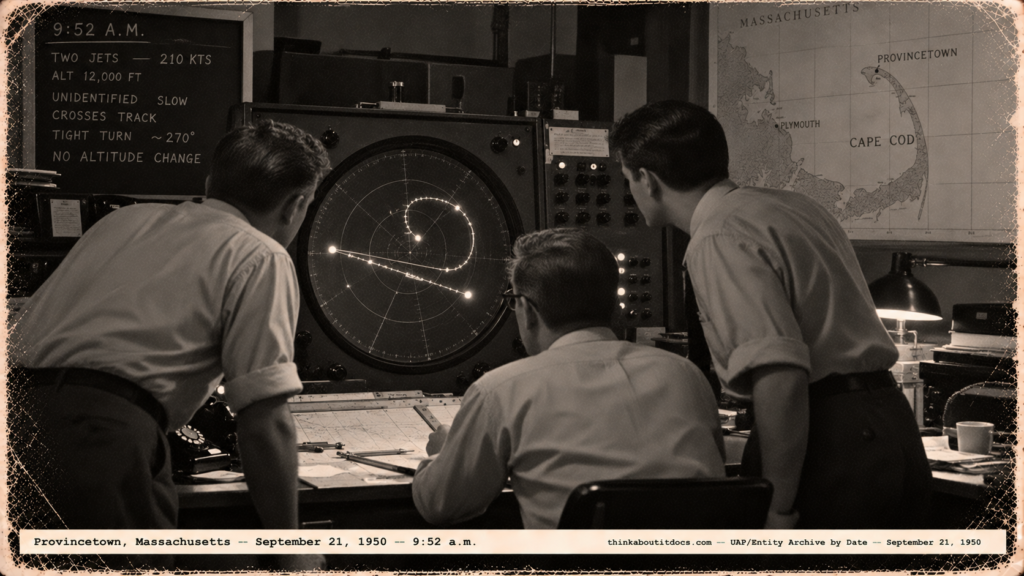
On September 21, 1950, an MIT radar team tracked an unidentified echo that crossed two jets and made a sharp 270-degree turn.
THINK ABOUTIT UFO|UAP SIGHTINGS REPORT
1950: Provincetown, Massachusetts — The MIT Radar Loop
At 9:52 on the morning of September 21, 1950, a small team from MIT’s Weather Radar Research Group was tracking two jet fighters at 30,000 feet with an SCR-615-B Signal Corps radar, as a favor to an Air National Guard weather officer who wanted wind data. About three minutes after first contact, they noticed another signal on a closing course. They warned the pilots by radio. The echoes nearly merged, with the stranger crossing about three miles ahead of the jets, and then it swung through a sharp turn of nearly 270 degrees and came back at them. The pilots, flying in haze, never saw it.
The team put its speed at about 22 miles a minute, roughly 1,320 mph, and the turn at 11 or 12 g, and said the echo was steady and solid, not weather. The Air Force card carries this Provincetown, Massachusetts radar case as Unidentified (BBU #809). It is also a case about paperwork: the 1950 OSI report and the 1952 MIT letter that rediscovered the record disagree on several details, and this page lays out both.
Date: September 21, 1950 (Thursday)
Sighting Time: 9:52 a.m. EST (OSI report); catalogs say 9:53-9:55
Day/Night: Day (haze below and light haze above the jets)
Location: Tracked on the MIT campus, Cambridge, Massachusetts (Building 24), with the jets on a run from Provincetown north toward the Isles of Shoals; the Blue Book location is Provincetown
Urban or Rural: Radar station in an urban setting; the object over the water and Cape Cod area
No. of Entity’s: 0 — Not Applicable
Entity Type: Not Applicable
Entity Description: Not Applicable
Hynek Classification: Radar only (no visual; the jet pilots could not see the object)
Duration: The jets’ third radar run lasted about 9 minutes (537.6 seconds); the object was tracked for about a minute to a minute and a quarter, about half of it in the turn
No. of Object(s): One
Description of the Object(s): A steady, solid radar echo of moderate strength that closed on the jets, passed them, made a sharp turn of nearly 270 degrees and approached again; not a hydrometeor
Shape/Size/Color of Object(s): Not seen; the radar echo suggested irregular surfaces and comparatively large size
Distance to Object(s): Crossed about three miles ahead of the jets (MIT, 1952); the first contact was at about 15 miles and 285 degrees azimuth
Height & Speed: Between 25,000 and 35,000 feet, not resolvable relative to the jets at 30,000 feet; about 22 miles per minute (about 1,320 mph); acceleration in the turn 11 or 12 g (MIT, 1952)
Number of Witnesses: 3 radar observers (a research associate who is also an Air National Guard major, an analyst and an electronics technician) plus 2 jet pilots who were in radio contact but saw nothing
Special Features/Characteristics: Both the R-scope and PPI scope showed the echo; the echoes merged as it passed the jets; a weather officer at Otis AFB telephoned that afternoon asking MIT to keep the matter confidential; no motion-picture camera was running on the scope
Case Status: Unidentified (Project 10073 Record Card; BBU #809)
Source: Spot Intelligence Report ID-OSI 24-0-175, 1st District OSI (October 5, 1950) with the Detachment B interview of October 2-3, 1950; MIT Weather Radar Research Group letter, October 6, 1952; Signal Corps Engineering Laboratories and Signal Corps Intelligence Agency transmittals, 1952; Project 10073 Record Card; Jan Aldrich; Hynek, The UFO Report, pp. 139-141
Summary/Description: An MIT radar team tracking two jets saw an unidentified echo cross their track, loop through about 270 degrees and return.
Related Cases: None established
Detailed Report
The setup. According to the later MIT letter, the group had arranged informally with the Air Weather Service unit at Otis Field on Cape Cod to track a pair of jets at 35,000 feet to estimate their wind drift, a request the writer said he never fully understood and did not usually approve of. The OSI version has the two F-86s flying between Provincetown and the Isles of Shoals at 30,000 feet, 250 mph indicated, 420 mph corrected, tracked by three men operating an SCR-615-B in Building 24 on the MIT campus, and gives the length of the third run as 537.6 seconds. The 1952 letter says they believed the jets were F-84s.
The track. The first radar contact came at 15 miles and 285 degrees azimuth, with the jets flying straight and level toward the northwest, 333 degrees. About three minutes later the team noticed another signal on a closing course and told the pilots by radio to watch for aircraft coming from their left. At about four minutes the two signals nearly merged, with the object crossing about three miles ahead; the pilots, flying with a haze layer below and light haze above, saw no aircraft. The other signal then made a very sharp turn of nearly 270 degrees and again approached on an intercepting course, closing, as far as radar could tell, at about five minutes. The object was passing directly over or under the jets, as the echoes merged on both scopes.
The speed. The 1952 letter says the best estimate was 22 miles a minute, with about half of the minute they tracked it spent in the sharp turn, and the acceleration in the turn comes out at 11 or 12 g as well as they could figure. The OSI report gives about 1,320 miles an hour on both the R-scope and the PPI scope, an altitude between 25,000 and 30,000 or 30,000 and 35,000 feet that could not be fixed relative to the jets, and the research associate’s description of the maneuvers as a perfect interceptor pass. His uncertain factors included about a minute between the two points of the turn, a turn radius that might be somewhat larger or smaller, and azimuths good to about ten degrees.
The research associate’s letter. OSI quotes a September 27, 1950 letter from the research associate to the Otis staff weather officer. He called the event exceedingly puzzling and the turn utterly fantastic, doubted the human frame could absorb it, and said that if the object was radio-controlled it had no business flying such courses near planes on legitimate work. He said a few rough calculations about control surfaces and angles only deepened the puzzle and that the object must have been entirely unconventional in many basic respects. What bothered him most, he wrote, was the very good radar echo, which implied irregular surfaces and a size large enough that the pilots should have had a good chance of seeing it. He also regretted not having used the motion-picture cameras that can run in conjunction with the radar.
The investigation. The 1st District OSI interviewed him on October 2 at Detachment B in Boston; he had worked for MIT as a research associate since 1946, was a staff weather officer with the Massachusetts Air National Guard’s 67th Fighter Wing and had used radar since 1943. The Brockton analyst and the Dorchester electronics technician confirmed his statements and said they too had watched the object on the scopes. The OSI officer noted that many people at MIT knew about the sighting; the District Commander, citing an AFCSI letter of February 8, 1950, ordered no further investigation, and the Air Force card carries the case as Unidentified.
The 1952 rediscovery. In October 1952 the MIT group wrote that it had finally found its records on the incident, which had been reported to no one else, and that it was the first formal report to the Signal Corps; the weather officer at Otis had called the afternoon of September 21 asking that the matter be kept confidential, and two men from the Boston OSI visited the next day. The Signal Corps Engineering Laboratories forwarded it to the Chief Signal Officer, and the Signal Corps Intelligence Agency passed it to Air Force intelligence in November 1952, noting that the Air Force treats such reports with a high classification.
RESEARCHER’S NOTES
Radar Evidence, Without a Picture
- The 1950 and 1952 versions: The OSI report (1950) gives about 1,320 mph, F-86s and no distance; the MIT letter (1952) gives 22 miles a minute (the same speed), F-84s and a three-mile crossing. Catalogs say 1,500 mph, 15 g and a mile to a mile and a half; the documents do not.
- No visual: The pilots could not see the object, and the file does not rule out that it was above or below them; the radar echoes merged on both scopes.
- Not weather: The research associate’s statement that it gave a steady, solid echo of moderate strength is the file’s only argument against a radar artifact.
- Missing camera: The scope was not being filmed; the research associate said he regretted it, and discussed running a similar mission to see if it would reappear.
- Confidentiality: The Otis weather officer asked MIT to keep it confidential the same day.
- Names: The research associate is named in catalogs as Maj. Myron H. Ligda, but the scans redact the name; the associate’s colleague is named in catalogs as Joseph V. Connelly.
The Provincetown tracking is among the best-instrumented 1950 cases because it came from a professional radar research group that was not looking for anything unusual. Two documents written two years apart agree on the core event and disagree on some figures, and the Air Force card kept it as Unidentified.
“Our best estimate of the speed of the “Saucer” was 22 miles per minute.”
— MIT Weather Radar Research Group letter, October 6, 1952