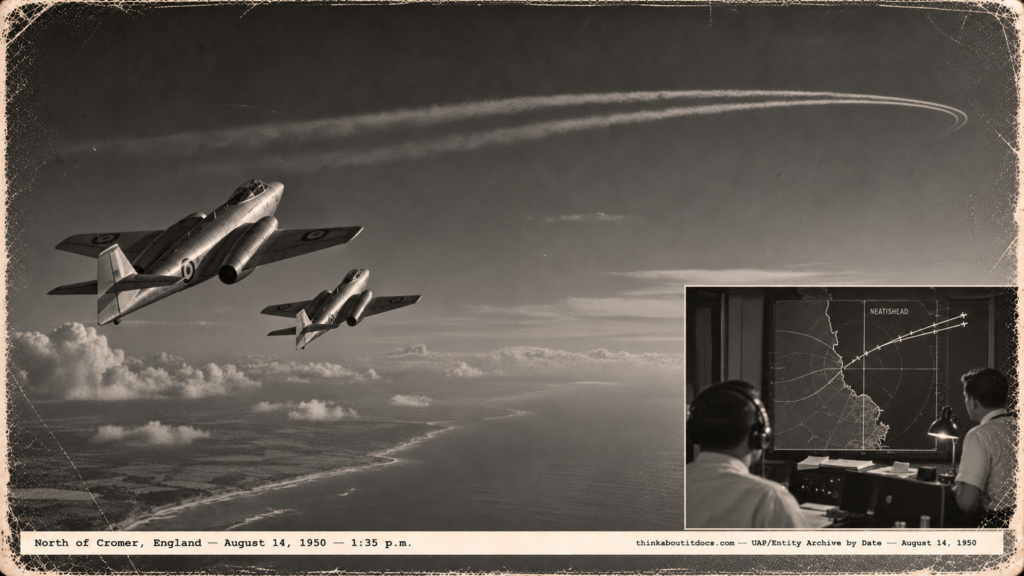
On August 14, 1950, two RAF Meteors chased two parallel contrails north of Cromer without ever seeing the aircraft.
THINK ABOUTIT UFO|UAP SIGHTINGS REPORT
1950: North of Cromer, England — Two Meteors, Two Contrails, No Aircraft
On the afternoon of August 14, 1950, RAF radar at Neatishead plotted an unidentified aircraft 90 miles out over the North Sea, and two Meteor jet fighters of 257 Squadron were scrambled. Climbing north of Cromer, the pilots saw two distinct vapor trails on a parallel course at great distance and higher altitude, which suggested widely spaced engines on a single aircraft. The Meteors never got close enough to see what was making them; at about 38,000 feet the trails vanished.
The documents in the file describe an unidentified aircraft, not a flying saucer. The USAF Third Air Division summarized it for Washington as a penetration of British airspace by an aircraft not known to belong to a friendly country, the RAF could not identify it despite checking a long list of units, and the Air Ministry’s intelligence directorate wrote that if no home-based aircraft could be shown to have been flying, a high-altitude reconnaissance flight had to be considered. The Blue Book listing evaluates this Cromer, England case as Other (Contrails).
Date: August 14, 1950 (Monday)
Sighting Time: Radar plot 13:22Z; Meteors airborne 13:27Z; contrails sighted 13:35Z (14:00Z in the USAF and RAF summaries)
Day/Night: Day
Location: North Sea off Cromer, Norfolk, England; the Meteors flew from RAF Horsham St. Faith and sighted the trails about 10 miles north of Cromer (52°56’N, 01°19’E)
Urban or Rural: Over water
No. of Entity’s: 0 — Not Applicable
Entity Type: Not Applicable
Entity Description: Not Applicable
Hynek Classification: RV (radar-visual)
Duration: Contrails watched from 13:35Z to about 13:42Z; radar plot from 13:22Z to about 13:45Z, reappearing at 13:49Z
No. of Object(s): One unidentified aircraft, seen as two parallel vapor trails
Description of the Object(s): Two distinct vapor trails on a parallel course, suggesting widely spaced engines on a single aircraft; the aircraft itself was never seen
Shape/Size/Color of Object(s): Not seen; only trails; no description possible because the Meteors were too far away
Distance to Object(s): About 5 miles on the GCI radar when the Meteors got slightly ahead of the trails; a pilot estimated the trails at about 30 miles at one point
Height & Speed: Radar height 15,000 feet initially, then 40,000 feet on the Type 13; speed about 325 knots (about 375 mph) with no variation, computed at Neatishead; an earlier figure was 280 knots
Number of Witnesses: 2 Meteor pilots (the section leader and his wingman), the Neatishead radar and GCI controller, and two USAF pilots who saw two further contrails
Special Features/Characteristics: Radar plot at 055 degrees true, 90 miles from Neatishead; trails turned to starboard, confirmed by the GCI controller; a joint plot with the Meteors faded and reappeared off Grimsby
Case Status: Unidentified aircraft per RAF and USAF files; Blue Book listing: Other (Contrails)
Source: Third Air Division, USAF summary to the Director of Intelligence, 1950; RAF Fighter Command letters, August 22 and September 7, 1950; Air Ministry D.D.I.(Tech) letter, September 5, 1950; Eastern Sector signal A.3 of August 14, 1950; Jan Aldrich
Summary/Description: Two RAF Meteors chased two parallel contrails off Cromer without seeing the aircraft, which no unit admitted to flying.
Related Cases: None established
Detailed Report
The radar plot. The Eastern Sector signal in the file lists the chronology. At 1322 hours a plot appeared 055 degrees true from Neatishead at 90 miles range, height given as 15,000 feet. Red Section of 257 Squadron was ordered to scramble at 1324 and was airborne at 1327. At 1328 the raid was picked up on a Type 13 height-finder, which gave 40,000 feet, and the amended height was passed to the jets, which had levelled off at 15,000 feet.
The contrails. At 1335, with the section 10 miles north of Cromer and still climbing, the pilots sighted trails on the starboard beam, high above and on a parallel course. To obtain height, they got slightly ahead of the trails, in sight, at a radar range of 5 miles. At about 1342 the trails turned to starboard, which the GCI controller confirmed, and the section turned too. From about 1341 the aircraft and the Meteors were plotted jointly, seven miles north of Hunstanton, on a westerly and then northerly course. At about 1345 the section was at 38,000 feet with the trails still above and behind. The section continued to climb to about 39,500 feet and no aircraft was seen. A constant watch was kept but no track was seen to go seaward that could be connected with the original plots.
The RAF letter. Fighter Command’s August 22 letter to the Air Ministry says the Meteors were too far away at all times to give any description of the aircraft or to judge height, but the separate trails suggested widely spaced engines. It lists the authorities contacted, including Bomber Command, No. 11 and 12 Groups, the 3rd Air Division USAF, the Central Fighter Establishment and several RAF stations and test establishments, all of which denied having aircraft there. It says it was first thought the aircraft might be USAF F-84s from Manston, but the American pilots said they saw the two Meteors at 36,500 feet and, at the same time and above, two further contrails.
The Air Ministry reply. On September 5 the Air Ministry’s Deputy Director of Intelligence (Technical) asked for the track’s length and direction, its speed and wind, the outgoing track and whether Dutch and Allied units had been checked, and added that the report was most interesting: if it could be positively established that no home-based aircraft was flying at that time, area and height, then the possible use of a reconnaissance aircraft in a photographic role had to be considered. On September 7 Fighter Command replied that the plot appeared 90 miles out two minutes before the scramble, speed 325 knots with no variation (an earlier figure of 280 knots was computed at Watnall), wind at 40,000 feet from 310 degrees at 35 to 40 knots, and that no check with Dutch or Allied units had been made at that headquarters.
The USAF summary. The Third Air Division’s Office of the Deputy Chief of Staff, Intelligence sent a summary to the Director of Intelligence, USAF, headed “Unidentified Aircraft Over U.K.” It says an aircraft was plotted at 40,000 feet off Cromer at 1400Z on August 14, that the pilots sighted two distinct vapor trails on a heading of 280 degrees which disappeared by the time the Meteors reached 38,800 feet, that the appearance suggested widely spaced engines, that investigation had not identified the aircraft and that no further action was being taken.
RESEARCHER’S NOTES
A UFO Case the Documents Call an Aircraft
- Not a saucer report: Every document in the file calls it an unidentified aircraft; it entered UFO catalogs later, through summaries of the RAF material.
- Times: Summaries give 14:00Z, the Eastern Sector chronology 13:22Z; the two are consistent only if 14:00 is the summary’s round figure.
- Speed: 325 knots was computed at Neatishead; 280 knots was an earlier Watnall figure; 15,000 feet and 40,000 feet are the radar heights from two sets.
- Heading: The USAF summary gives 280 degrees for the trails; the RAF letter’s figure is partly illegible in the scan.
- Two sets of trails: The USAF pilots reported two further contrails above the Meteors, which is the file’s own reason the identity question stayed open.
- Designation: The Air Ministry letter reads “Type 27” in the scan, which I could not confirm as a specific aircraft; I describe it only as a reconnaissance aircraft.
The Cromer case is a puzzle of tracks and trails more than of any visible object. Two Meteors saw contrails but never the aircraft, nobody admitted to flying it, and the files end with a request for further checks that the RAF said belonged at ministry level.
“too far away at all times to give any description”
— RAF Fighter Command letter to the Air Ministry, August 22, 1950