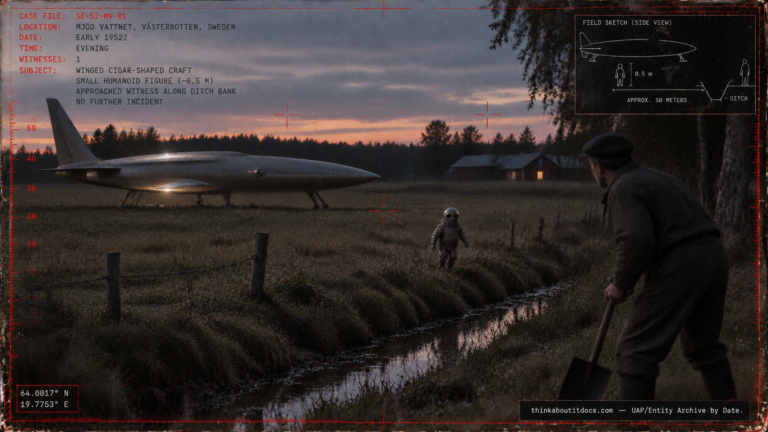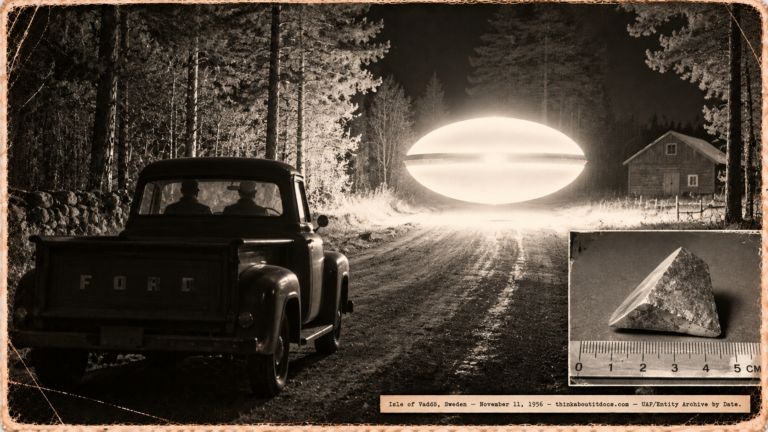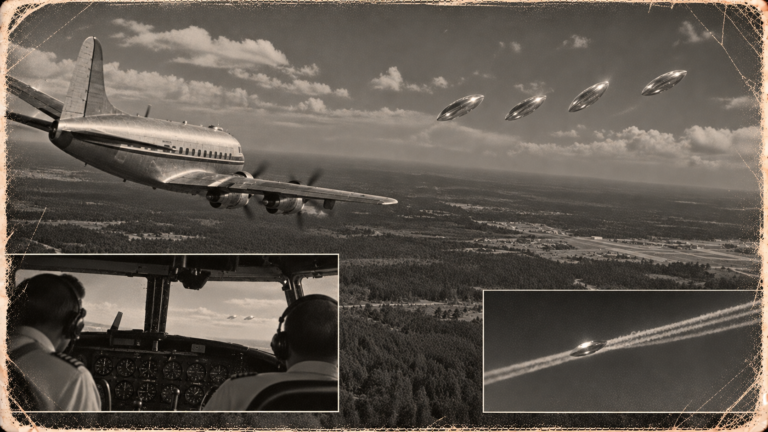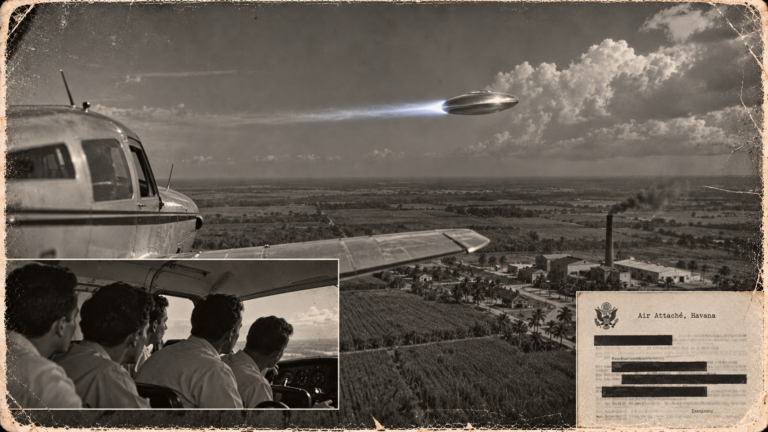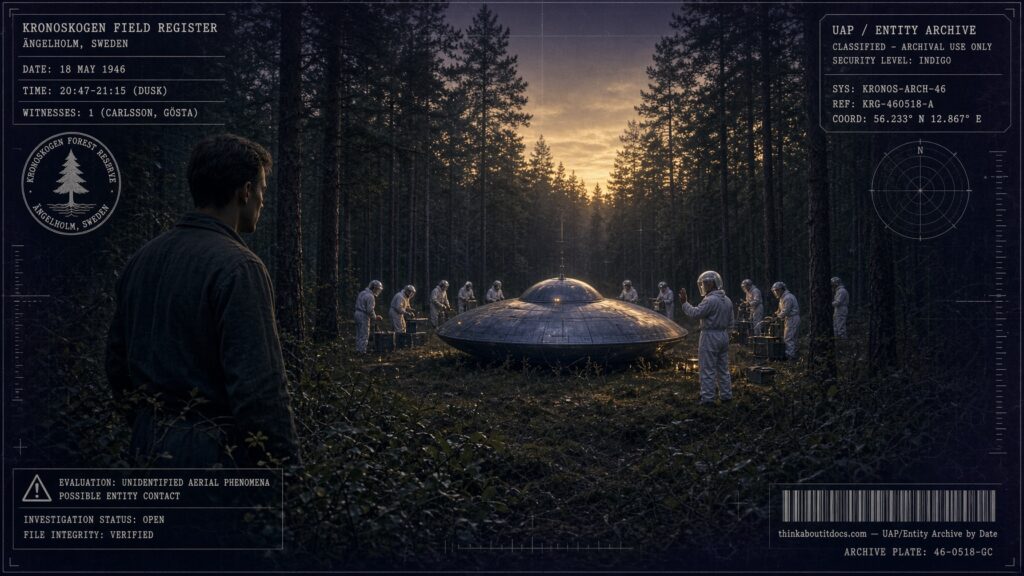
May 18, 1946 — Kronoskogen forest, near Ängelholm, Sweden. Gösta Carlsson's encounter with a landed disc and its eleven-member crew became Sweden's most famous UFO story — and remains disputed by the country's own leading investigators.
THINK ABOUTIT UFO | UAP SIGHTING REPORT
1946: The Ängelholm Encounter — Gösta Carlsson
A 28-year-old railway worker walked home through a Swedish forest one evening in May 1946 and, by his own account, found a flying saucer being repaired by its crew. He quit the railway, built a pharmaceutical empire, financed a professional hockey team, and eventually built a concrete monument on the spot to commemorate the moment that changed his life. It’s the most famous UFO story in Swedish history — and the organization that has investigated it longest and hardest says there’s no convincing evidence it happened as told.
Date: May 18, 1946
Sighting Time: Evening, approximately 18:00-22:00
Day/Night: Evening/dusk
Location: A clearing in the Kronoskogen forest, near the town of Ängelholm, Skåne, southern Sweden
Urban or Rural: Rural — forested area, then near a location that had seen “large-scale test flights” in the period, per some historical accounts
No. of Entity(s): 11
Entity Type: Humanoid, described in various tellings as “Nordic”-type in general appearance
Entity Description: Roughly 6 feet tall, wearing white coveralls and transparent (or, in some tellings, opaque) helmets, uniform in appearance among themselves. They appeared to be performing repair or maintenance work on the craft when first observed.
Hynek Classification: CE-III — Close Encounter of the Third Kind. A landed craft with directly observed occupants engaged in apparent activity, at close range, meeting the standard definition for this classification tier.
Duration: Approximately 30 minutes to several hours depending on the account version; earlier sourcing (Flying Saucer Review, 1972) gives roughly 30 minutes, while some later retellings describe a considerably longer encounter
No. of Object(s): 1
Description of the Object(s): A domed disc, changing color, with a cupola and a mast estimated at roughly 5 meters, resting on the ground with what appeared to be retractable landing gear. It emitted a whining sound while stationary and departed with a bright red light, moving away at speed.
Shape of Object(s): Disc with central dome/cupola and mast
Size of Object(s): Approximately 80 feet (about 24 meters) across, per the account’s most detailed telling
Color of Object(s): Described as changing color while on the ground; bright red during departure
Distance to Object(s): Approximately 40 feet at closest observed distance; Carlsson reported being kept at a distance by one of the occupants using some form of gesture or device
Height & Speed: Stationary on the ground throughout the observed encounter; departed at unspecified but implied high speed
Number of Witnesses: 1 — Gösta Carlsson, alone at the time
Special Features/Characteristics: Physical trace evidence was reported at the site — burned grass, ground imprints, and a fin or landing-gear mark forming a roughly 5-meter geometric pattern, sometimes described as an equilateral triangle; Carlsson later attributed the origin of natural bee-pollen health remedies to information he said he received from the encounter (in some later versions of his story, described as recurring dreams or ongoing contact rather than direct communication during the original event), which formed the basis of the pharmaceutical company Cernelle that made him wealthy; Carlsson did not go public with the story until decades later and personally financed and helped design a permanent concrete monument at the site, erected in 1972 and still standing; the case has been the subject of the most extensive single-case UFO investigation in Swedish ufological history, conducted primarily by researcher Clas Svahn of UFO-Sweden, who worked with Carlsson directly for years and co-authored a book on the case, Mötet i gläntan (“The Meeting in the Clearing”), in 1995.
Case Status: Disputed
Source: Flying Saucer Review, March-April 1972; Clas Svahn and Gösta Carlsson, Mötet i gläntan, UFO-Sweden, 1995; UFO-Sweden official case files (ufo.se); Ängelholm municipal historical records regarding the 1972 memorial
Related Cases: 1946: May UFO & Entity Sightings Archive
Detailed Report
On the evening of May 18, 1946, Gösta Carlsson, then a 28-year-old employee of the Swedish state railway, was walking home through the Kronoskogen forest near Ängelholm in southern Sweden. According to his account, he was drawn off the path by a light visible among the trees and, investigating, came upon a large disc-shaped craft resting in a forest clearing, apparently in the middle of repairs.
The craft, in his description, had a domed central section, a mast rising from its top, and a color that shifted while it sat on the ground, emitting a low whining sound. Around it moved eleven humanoid figures, roughly six feet tall, dressed in matching white coveralls with transparent helmets, engaged in what appeared to be maintenance work. When Carlsson approached to a distance of roughly 40 feet, one of the figures gestured for him to keep his distance, and he did. He reported watching the scene for approximately 30 minutes before the craft’s occupants concluded their work, boarded, and the object departed, emitting a bright red light as it rose and sped away.
At the site, later investigation documented physical traces: patches of burned grass, ground imprints consistent with landing gear, and a mark — variously described as a fin impression or a geometric pattern — forming a roughly 5-meter equilateral arrangement. These physical traces became the basis for the permanent memorial Carlsson would later commission.
Carlsson did not publicize the encounter immediately. Over the following years, he left his railway position and went on to found Cernelle, a company producing health remedies from bee pollen, becoming known nationally as “Pollenkungen” — the Pollen King — as the business made him wealthy. He later became a prominent investor in Swedish ice hockey, financing Rögle BK into the country’s top professional league. In various tellings across the following decades, Carlsson connected his business success directly to information he said he received in connection with the 1946 encounter, in some versions describing ongoing contact or recurring dreams involving the same beings well beyond the original event.
In 1972, Carlsson personally financed and helped design a monument at the reported landing site — a concrete scale model of the craft as he described it, surrounded by rings representing the reported landing traces. The memorial, in the Kronoskogen forest, remains standing today, drawing tourists and UFO enthusiasts, and is generally cited as one of only a small handful of dedicated UFO memorials anywhere in the world.
RESEARCHER’S NOTES
Fame Is Not Evidence — And UFO-Sweden Says So Itself
- On why this case’s investigation history is unusually thorough: Unlike most cases in this archive, the Ängelholm encounter has been the subject of a formal, sustained, decades-long investigation by Sweden’s principal UFO research organization, UFO-Sweden, led specifically by researcher Clas Svahn, who worked directly with Carlsson over an extended period and co-authored a full-length book on the case in 1995. That level of dedicated, organizational scrutiny is rare in this archive’s record. It matters that the conclusion of that scrutiny, stated in UFO-Sweden’s own published case assessment, is direct: no convincing evidence exists that the event occurred as Carlsson described it.
- On the gap between fame and evidentiary weight: This case’s cultural prominence — a permanent monument, national media coverage across decades, a nickname (“Pollen King”) that entered popular vocabulary — is a function of Carlsson’s business success and his own decision to memorialize the story publicly, not a function of independent verification. A monument documents that Carlsson believed his own account strongly enough to spend money building it; it does not corroborate the account itself. This distinction matters specifically because the case’s fame can create an impression of unusual credibility that the underlying investigation does not support.
- On the account’s own internal drift: Multiple retellings of this story across the decades show variation in key details — the duration of the encounter, the nature of the “information” Carlsson said he received (direct communication during the event versus later recurring dreams), and even some physical details of the craft and site. This kind of drift across a fifty-plus-year public retelling career is common in long-running personal narratives generally, but it does complicate treating any single version, including the earliest published one, as a fixed, reliable baseline.
- On why this case is retained despite the negative investigation finding: This archive’s standard is to document claims and their investigation status honestly, not to exclude culturally significant cases simply because they were not corroborated. The Ängelholm encounter is, regardless of its truth value, the most consequential UFO narrative in Swedish history by any measure of public impact — a physical monument, a national nickname, decades of tourism, and a formal book-length investigation. That significance is itself worth documenting, clearly labeled as Disputed rather than Unexplained or Verified.
A young railway worker walked into a Swedish forest one evening and came out with a story that built him a fortune, a hockey team, and a monument that still stands in the trees near Ängelholm. Whether he also came out having actually met eleven beings repairing a flying saucer is a question the country’s own leading UFO investigators spent decades trying to answer — and, by their own account, could not.
IMAGE PROMPT
Dossier-style illustration, indigo-charcoal palette with one diegetic warm accent color (soft twilight gold), period-accurate mid-1940s photographic register, tactical HUD stamp overlay. Location: a forest clearing in Kronoskogen, near Ängelholm, Sweden. Date: May 18, 1946. Time: evening, dusk. Number of Witnesses: 1, Gösta Carlsson. Scene: a young man in simple 1940s work clothes standing at the tree line, watching a domed disc with a central mast resting on the forest floor, eleven figures in matching white coveralls and transparent helmets moving around it performing repair work, one figure turned toward the witness with a hand raised in a warning gesture. Soft golden dusk light filters through the trees, the disc’s surface catching and shifting color in the fading light. Include a small credit stamp reading “thinkaboutitdocs.com — UAP/Entity Archive by Date” in the lower corner, styled as part of the tactical HUD overlay.
SEO IMAGE METADATA
Image Title: The Ängelholm Encounter — Kronoskogen, Sweden, 1946
Alt Text: Gösta Carlsson watches eleven white-suited figures perform repairs on a domed disc in the Kronoskogen forest, Sweden, May 18, 1946
Caption: May 18, 1946 — Kronoskogen forest, near Ängelholm, Sweden. Gösta Carlsson’s encounter with a landed disc and its eleven-member crew became Sweden’s most famous UFO story — and remains disputed by the country’s own leading investigators.
Description: Archival-style illustration of the May 18, 1946 Ängelholm encounter, Sweden’s best-known UFO contact claim, in which Gösta Carlsson reported witnessing a landed disc and eleven white-suited occupants in the Kronoskogen forest; Case Status: Disputed, per UFO-Sweden’s own extensive investigation. thinkaboutitdocs.com.