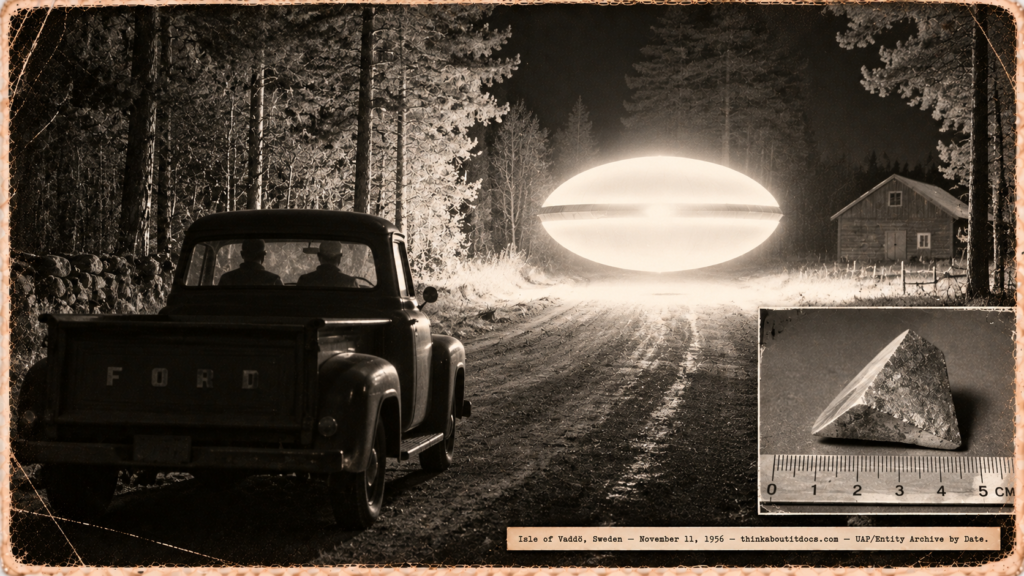
Isle of Vaddö, Sweden, November 11, 1956: the sphere hovered 100 metres ahead for 10 minutes, then departed. The witnesses found a tungsten carbide artifact of unknown original shape at the landing site.
THINK ABOUTIT UFO|UAP SIGHTINGS REPORT
1956: Isle of Vaddö, Sweden — The Artifact in the Road
On the night of November 11, 1956, Stig Ekberg and Harry Sjöberg were driving a Ford V8 pickup on the island of Vaddö, about 90 kilometres north-northwest of Stockholm, when a bright flattened sphere approached from the east at about a kilometre’s distance and 100 metres altitude. Then it turned toward them. The engine sputtered and died. The headlights went out. The object glided down, rocking back and forth, and settled in the middle of the road about 100 metres ahead of the truck, hovering one metre above the ground. It illuminated the surrounding landscape so intensely that a barn half a kilometre away was visible as clearly as in sunlight. The air smelled of ozone and smoldering insulation.
After about ten minutes the light intensified, the object lifted, turned, and accelerated away in the direction it had come from. Ekberg restarted the engine — it started normally. The headlights came back on. They went to where the object had been. The grass at the landing site was flattened. And on the ground, hot to the touch, was a small three-sided piece of metal about the size of a matchbox. It was heavier than it looked. They took it with them. When analysts at SAAB and later laboratories in Sweden, Denmark and Germany finished with it, the verdict was tungsten carbide and cobalt — a known manufactured hard metal, outstanding quality, consistent with early 1950s production. Its original shape had no identified conventional use.
Date: November 11, 1956
Sighting Time: About 10:00 p.m.
Day/Night: Night
Location: Isle of Vaddö, Uppland, Sweden (approximately 90 km north-northwest of Stockholm)
Urban or Rural: Rural island road
No. of Entity(‘s): Not Applicable
Entity Type: Not Applicable
Entity Description: Not Applicable
Hynek Classification: CE-II (Close Encounter II) — object observed in close proximity with physical effects: electromagnetic effects on vehicle (engine death and headlight failure on approach; normal function resumed after departure), physical trace at landing site (flattened grass), and recovered artifact
Duration: Approximately 10 minutes
No. of Object(s): 1
Description of the Object(s): Bright flattened sphere, 8 metres wide and 3 metres high. Approached from the east at approximately 1 kilometre range, 100 metres altitude. Turned toward the witnesses and descended, rocking back and forth, until hovering 1 metre above the road surface. Emitted extremely intense white light — so bright a barn 500 metres away was visible as in daylight. The air carried a smell of ozone and smoldering insulation. After about 10 minutes, the light intensified, the object lifted, moved left, executed a sudden turn and accelerated away in the direction of its original approach.
Shape/Size/Color of Object(s): Flattened sphere; 8 m wide × 3 m high; bright/white; intense illumination
Distance to Object(s): Initial approach ~1 km; settled 100 m ahead of vehicle at 1 m altitude
Height & Speed: Approached at 100 m altitude from approximately 1 km range. Hovered at 1 m above road surface. Departure: lifted, moved left, sudden turn, rapid acceleration away.
Number of Witnesses: 2 — Stig Ekberg (driver) and Harry Sjöberg; both were construction workers building a house on the island
Special Features/Characteristics: Electromagnetic effects: Ford V8 engine stopped and headlights failed on the object’s approach; both resumed normal function after departure. Extreme illumination. Ozone and smoldering insulation smell. Physical trace: flattened grass at landing site. Physical artifact recovered: three-sided piece of metal, matchbox-sized, heavy, hot to touch. Artifact subsequently analyzed by SAAB (Sven Schalin), and laboratories in Sweden, Denmark and Germany: composition confirmed as tungsten carbide and cobalt (a hard metal alloy), quality outstanding but consistent with early 1950s manufacturing; original shape not identified as serving any conventional purpose.
Case Status: Unexplained. Artifact analyzed and confirmed as manufactured tungsten carbide/cobalt; original shape unidentified. Case cited by Jacques Vallée and Peter Sturrock in the Sturrock Panel report.
Source: Jacques Vallée, in Peter Sturrock (ed.), The UFO Enigma: A New Review of the Physical Evidence (1999); Illobrand Von Ludwiger, case summary (1998); SAAB analysis by Sven Schalin; laboratory analyses in Sweden, Denmark and Germany
Summary/Description: Stig Ekberg and Harry Sjöberg watched a flattened sphere settle in the road 100 m ahead of their truck. Engine and headlights failed on approach, restored on departure. Grass flattened at site. Artifact recovered: three-sided tungsten carbide/cobalt piece, matchbox-sized, of unknown original purpose. CE-II with recovered physical material.
Related Cases: 1956: November UFO|UAP & Entity Sightings Archive; 1956: McLeod, Alberta RCAF Photograph (Sturrock Panel)
Detailed Report
Stig Ekberg and Harry Sjöberg were construction workers who had come to the island of Vaddö, in Uppland county north of Stockholm, to build a house. On the evening of November 11, 1956, at about 10 p.m., Ekberg was driving his Ford V8 pickup along an island road when a bright object became visible to the east. It was flying at an estimated 100 metres altitude, roughly 1 kilometre away, and had the shape of a flattened sphere — 8 metres wide and 3 metres high by the witnesses’ estimates.
The object made a sharp turn toward the truck. At that point the engine sputtered and died and the headlights went out. The object began descending, slowly gliding down, rocking back and forth as it came. It settled in the middle of the road about 100 metres ahead of the stationary truck, hovering 1 metre above the ground. The illumination was extraordinary — the surrounding landscape was lit so intensely that a barn half a kilometre away was visible as if in full sunlight. The witnesses also noticed that the air smelled of ozone and of smoldering insulation, a combination suggesting strong electromagnetic fields in the vicinity.
After approximately 10 minutes, the light of the object intensified. It lifted from its position, moved left and upward, executed a sudden turn and accelerated away in the direction from which it had come. Ekberg tried the ignition — the engine started normally. The headlights came back on. The electromagnetic effects had ended with the object’s departure.
The two men walked to the landing site. The grass was flattened in the area where the object had hovered. On the ground, in the flattened area, they found a small object that was hot to the touch — a three-sided piece of metal approximately the size of a matchbox, heavier than its size suggested.
After several unsuccessful attempts to have the artifact formally studied, it was eventually brought to SAAB — the Swedish aerospace and automotive manufacturer — where analyst Sven Schalin conducted a thorough examination. Further analyses were subsequently performed at laboratories in Sweden, Denmark and Germany. The consistent finding across all analyses: the artifact was composed of tungsten carbide and cobalt, a combination used in manufactured hard metal products such as cutting tools and industrial components. The material’s overall quality was outstanding but not unusual for early 1950s production. The artifact’s original three-sided shape, however, could not be matched to any known manufactured product serving a conventional purpose.
The case was compiled and summarized by German researcher Illobrand Von Ludwiger in 1998 and subsequently cited by Jacques Vallée in Peter Sturrock’s edited volume The UFO Enigma: A New Review of the Physical Evidence — the same Sturrock Panel report that carried the McLeod, Alberta RCAF photograph analysis. Photographs of two pieces of the artifact were provided by Von Ludwiger.
RESEARCHER’S NOTES
Why the Artifact Matters — and What It Doesn’t Prove
- The Sturrock Panel context: Peter Sturrock’s 1999 panel brought together credentialed physicists, astronomers and engineers to examine physical evidence cases. Vallée’s inclusion of the Vaddö case — with the Von Ludwiger analysis and the multi-laboratory artifact results — in that peer-reviewed context gives it a level of scientific vetting rare in the UFO physical-evidence record. The panel did not conclude the artifact was extraterrestrial; it concluded the artifact was anomalous in its original shape and merited continued study.
- What tungsten carbide/cobalt tells us: Tungsten carbide bonded with cobalt is a standard hard metal used in drill bits, cutting inserts and wear-resistant industrial components. Its presence in the artifact means it is a manufactured object — not a meteorite fragment, not slag, not a geological specimen. Something made it. The question the analyses could not answer is what it was part of and why its shape has no conventional match.
- The E-M effects: Engine failure and headlight failure on a vehicle approaching a close-range UFO, with both restoring to normal function immediately after the object departs, is one of the most consistent patterns in the CE-II physical-effects record. The Vaddö case follows this pattern precisely. The ozone smell and smoldering insulation odour are also consistent with intense electromagnetic field exposure — ozone is produced by electrical discharge, and smoldering insulation suggests induced currents in electrical wiring.
- Chain of custody: The artifact passed from the witnesses through unsuccessful preliminary contacts to SAAB for analysis and then to multiple European laboratories. Von Ludwiger documented it in 1998, approximately 42 years after the event. The long gap between the event and the formal documentation is a limitation — the artifact’s provenance depends entirely on the witnesses’ account of how and where they found it. What is not in question is the artifact’s composition, which multiple independent laboratories confirmed.
- The tag error on the live page: The existing standalone was tagged “1955” — this is a 1956 case (November 11, 1956). Corrected in this rebuild.
The Vaddö case rests on two witnesses, a documented landing site, a recovered artifact with confirmed composition and anomalous shape, multi-laboratory analysis, and citation in a peer-reviewed scientific panel. It does not prove an extraterrestrial origin for either the object or the artifact. What it provides — a physical object recovered from a landing site, analyzed by competent institutions, with a composition that is manufactured but a shape that serves no known purpose — is exactly the kind of physical residue the Sturrock Panel was convened to examine.
“The overall quality of the material was outstanding, but not unusual for the early 1950s. The original shape of the specimen was unusual and it has not been identified as an object serving a conventional use.”
Illobrand Von Ludwiger, case summary (1998), cited in Jacques Vallée, in Peter Sturrock (ed.), The UFO Enigma: A New Review of the Physical Evidence (1999)